大成功

Jan. 4th, 2026 02:56 pm

Time for a brief update on my kyūdō practice.

You may recall that after 2½ years of painful struggle and utter failure in this martial art of Japanese archery, I attended a seminar in South Carolina in hopes that our sensei would be able to correct my constant misfiring, which I wrote about at length here.

That was four months ago. So how has it gone?

Holding the tally board following Austin Kyūdō's 108 Arrows Shoot 2026.

Holding the tally board following Austin Kyūdō's 108 Arrows Shoot 2026.

Pretty well. Putting sensei’s feedback into practice has helped immensely. While I’m still far from perfect, I’d say I’m able to shoot nearly as reliably as anyone around me, which is an amazing degree of improvement.

Which brings me around to yesterday’s practice session: our annual ceremony of shooting 108 arrows to begin a new year.

Ironically, the meaning behind the ceremony is Buddhist in nature, as a way to recommit to overcoming the 108 Defilements. In her email to the group, our club leader phrased it as “letting go of tension, frustration, mistakes, grudges, and anything else we carry from the past year.” I think those words perfectly encapsulate my attitude toward my shooting in 2025.

So this was a very intentional opportunity to make a break with the struggles of the past, and begin a new year with a clean slate.

In previous years, my terrible form and lack of confidence made this ceremony uncomfortable for me, and I contributed very little to the group effort. But with newfound confidence in my shooting, this year I was eager to push myself and publicly demonstrate my progress. Plus this would be exactly the kind of shooting-focused practice I need.

One way I prepared was working out with my bow while the group was on hiatus over the holidays. I specifically wanted to develop the strength to hold a full draw for longer, and the endurance to do so repeatedly. To that effect, I did daily workouts, building up to three sets of three draws with my 12 kg bow, holding each one for 24 seconds before release.

On the day of the ceremony a dozen of us showed up, so math suggested each person should aim for about 9 or 10 shots. Whatever! I was the first archer to the firing line, shot the club’s first arrow of the year, and spent the most time at the line.

And at the end of the session, I tallied 36 shots, well more than anyone else, and tying (intentionally not surpassing) the current record for most shots during the annual ceremony.

Not all of them were perfect, of course. About a third of the way in, three of my shots ricocheted off the target, but I realized what I was doing wrong and corrected my form from that point forward. And even if I count those as misfires, that’s still a 92% success rate, which I haven’t enjoyed since early 2023.

So yeah, my shooting has definitely improved, and I’m pretty happy with where I’m at, with an eye toward improving even further in 2026. Or, as the Japanese would say, “Daiseikō!”

Aside from general improvement, one of my next steps is joining the local archery range and getting proficient at distance shooting. The range is open all day, every day, and is a very convenient 10 minute drive from home.

I also have the option of formal testing and advancing in rank, but – having begun in a different school of kyūdō that doesn’t have tests or ranks – those things aren’t of any interest to me. Nor am I particularly interested in flying out to South Carolina (or further) every few months for seminars.

For now, I’m perfectly happy taking my time and refining my form, free of the significant downsides that come with formal testing and ranking systems.

Though I will say that after 2½ years of stress, insecurity, and failure, being the top dog at the dojo – even if it was just for this one day – felt really, really good. If this were a TV drama or sports anime, this would have been the climactic episode of my redemption arc! And it was a deeply satisfying way to begin a new year.

Since ancient times, mankind has been preoccupied by a quest for “freedom”. Even in today’s somewhat enlightened society, safeguarding our “freedom” is an almost daily topic of conversation.

But I wonder how many of us have ever made the effort to formulate in words exactly what that term means to us. And if you don’t know what freedom means, how can you possibly successfully attain it?

Freedom!

Freedom!

For me, freedom has three main components: choice, independence, and ethics.

First is the freedom to choose between alternatives. Where a man has no choice to make, there is no freedom.

And to be truly free, that choice must be largely independent of external influence or coercion. A man who is coerced or misinformed is not able to freely choose.

And finally, “freedom” has no meaning unless a person can make decisions based upon the values and beliefs that he holds as the product of his upbringing, education, life experiences, emotional makeup, and philosophy.

As a bonus aside, I’ll assert here that a person’s values are most often a uniquely individual balance between benefit to oneself and benefit to others, where the latter category might be further subdivided into one’s “in-group/family” and “outsiders/others”, however broadly or narrowly one chooses to make that distinction.

So that’s my operative definition of personal freedom; now let’s consider whether we do a good job attaining it…

We humans like to think of ourselves as complex, multifaceted, and diverse, as the pinnacle of evolution, and imbued unique capacities of intellect, free will, discretion, morality, and freedom of choice.

How ironic then that, across all cultures and times, the overwhelming majority of human behavior can be reduced to two very simple principles:

  • Get more of the sensations that we perceive as pleasurable, and
  • Get rid of the sensations that we perceive as unpleasant.

This two-line algorithm is not only sufficient to describe almost all human behavior, but that of nearly all animal life, down the simplest amoebae and paramecia. If it’s pleasant, move toward it; if it’s unpleasant, run away from it. It’s poignantly emblematic that the Declaration of Independence, one of mankind’s most cherished documents, proclaims “the pursuit of happiness” as a vital and basic “unalienable right” of all men.

What does it say about our vaunted sense of freedom and individuality if 99% of all human thought, feelings, and behavior can be boiled down to a ludicrously simple two-line program, the exact same one used by the most tiny, primitive unicellular organisms? Where is freedom to be found in slavishly obeying that biological imperative?

Here is where the Buddhist in the audience has something to contribute.

Without judging anyone’s individual spiritual practices, I would assert that Buddhism is not fundamentally about stress relief, quiescing our thinking, blissing out, self-improvement, earning merit for future lives, extraordinary experiences, psychic abilities, or deconstructing the self. Those things may or may not happen along the way, but I think that the core goal of the Buddhist path is breaking free of our instinctual programming by first understanding that we habitually live under a false illusion of freedom, then gradually learning how to find genuine freedom by ensuring that our thoughts, speech, and actions are driven by conscious, values-driven choices, rather than never-questioned blind reactivity and maladaptive habit patterns.

Realizing that pleasure and discomfort are the central drivers of our biological programming, the principal line of inquiry for Buddhists has been cultivating a more skillful and beneficial relationship to these influences. A key tenet is the principle of dependent arising, which describes the chain of cause and effect that explains how our relationship to desire creates our experience of dissatisfaction. My distillation of it goes:

  • Because we are alive, we have senses.
  • Because we have senses, we experience contact with sensory objects.
  • Because we experience contact with sensory objects, we experience sensations. These sensations are immediately perceived as pleasant, unpleasant, or neutral at a pre-verbal, instinctual level. Let’s call that the sensations’ “feeling tone”.
  • Because our perceptions produce these low-level feeling tones, we instinctually relate to the pleasant ones with desire, the unpleasant ones with aversion, and are mostly disinterested in the neutral ones.
  • When our desires and aversions arise, we react with craving and need, becoming entangled and increasingly attached to having things be a certain way in order for us to be happy.
  • Because of our attachment to things being a particular way, in a world where we control very little and where change is inevitable, we suffer when our needs and desires are not met, and even when our desires are fulfilled, we become anxious knowing that it’s only temporarily.

This is the sequence of events that leads to our experience of dissatisfaction, stress, anxiety, suffering, and unhappiness.

Of course, if dependent arising were an immutable progression, it wouldn’t be of any practical value in our quest for freedom. But there’s one key step where — with sufficient mindfulness, wise intentions, and skill built up through patient practice – we can pry open a tiny window in this sequence of events and grasp our one opportunity to consciously choose a different response.

And that window of opportunity presents itself in how we relate to our sensations. It’s telling that, looking back on what I’ve written above, aside from “pleasure”, the other word that appears in both my two-statement definition of human behavior and the Buddhist principle of dependent arising is “sensations”.

A Buddhist would say that the only place where we have the opportunity to influence our unrealistic expectations is found in how we relate to our sensations. If we can see our perceptions clearly and in real-time, as well as the pleasant/unpleasant/neutral feeling tones that they evoke, we can wake up from our unexamined habit of letting those feeling tones blossom into the reactive craving and aversion that drives most of our subsequent thoughts, emotions, and behaviors. In each moment, if we can bring mindfulness to our sensations and our reactions to them, we can consciously choose to respond in a way that is less compulsive, less harmful to ourselves and others, and better informed by our values.

When it doesn’t harm ourselves or others, pleasure is a vital part of living a fulfilling life. However, our dysfunctional habit of blindly following pleasure and running away from discomfort needs to be balanced by wise intentions like purpose, mission, and ethical values that are more complex but also more advanced in Maslow’s hierarchy of needs. In this sense, the traditional Buddhist monastic way of life may go a bit too far in its inclination toward banishing or vilifying pleasure, rather than seeking a middle way that allows one to wisely examine, engage, practice with, and potentially master one’s relationship to pleasure and aversion.

Note that this isn’t the same as saying that “life is just suffering” or that one has to avoid pleasure and resign oneself to pain. What I’m saying is that we can learn how to relate to our desires and aversions more skillfully, rather than being mindlessly led around by them. And that is the only path to true freedom and living a fulfilling life of integrity, wisdom, and joy, and a life that is in alignment with our innermost and highest values.

Rhonda, one of my meditation teachers back in Pittsburgh, used to liken it to commuting on a familiar route. Taking the main highway might require the least mental effort, but it might not be the best, fastest, safest, or most pleasant route. The only way to know is to cultivate the ability to choose something different: something other than what comes to mind automatically.

Then she would describe her commute home on Ohio River Boulevard. She could stay on the highway, but the Pennsylvania Department of Transportation had thoughtfully placed a big traffic sign indicating (the town of) “Freedom with an arrow indicating the off-ramp (that’s it, above). True freedom is exactly that kind of off-ramp, giving us an opportunity to get off the limited access highway of compulsive reactivity and mindless habit.

If you want to be truly free – not satisfied with the mere illusion of freedom and the suffering that it entails — you need to be able to see beyond desire and aversion, beyond reactivity and habit. Freedom means being fully awake in every single moment, willing and able to make real, meaningful choices that are informed by one’s ethical values.

The key to success is developing the skill to be awake enough in each moment to avail ourselves of that little window in the chain of dependent arising, where our perceptions of pleasure and discomfort, if unexamined, can blossom into untempered desire and aversion. If you will excuse me hyper-extending an apocryphal truth: in terms of manifesting wisdom and living an ethical life, the price of freedom is eternal mindfulness.

Or so it seems to me.

Here I was, all set to post my first of these new “Memorabilia” blogpos, when this happened:

These too shall pass...

See that big black gaping hole in the toecap of my pine green Chuck Taylor sneakers? Yep, they bit it. Now let’s talk about why I care about a dirty old pair of Chucks…

Out of all the pairs of Chucks I’ve had, this was my only real custom order. Back in 2011, I used Converse’s custom sneaker configurator to build this pair up from scratch, with gunmetal grey stitching and eyelets, green highlight stripes, and a gingham patterned inner lining. But the topper was the silver embroidered “T2SP” on both outer heel panels.

The significance? It’s a reference to an old fable about a monarch who commissions a ring to make him happy in times of sadness. The ring is inscribed with the phrase This too shall pass… hence “T2SP”.

Although the story is Persian in origin, it echoes the central Buddhist doctrine of impermanence, anicca, one of Three Characteristics of Existence. Something well worth keeping in mind at all times!

While they were my favorite pair of sneakers for most of the past fourteen years, impermanence finally caught up with my Chucks this past week. Into the bin you go!

I’ve always been a little – sometimes a lot – older than the friends I hang around with. So I figure some folks might be wondering how it’s going following my recent stroke… What it’s like to live with the realization that a portion of my brain is, literally, dead.

The most pertinent fact is that my stroke is over. Actually, it was probably over by the time the EMTs showed up, but then there was the whole diagnosis and treatment protocol and investigation and followup plan. But now, six weeks later, that episode is as much a piece of history as my first driving test.

Physically, I’d like to say that I have no lingering aftereffects. Sensation returned to my left hand over the first 48 hours, and that numbness had been the only significant aftereffect.

The psychological impact was more lasting, manifesting in several flavors that’ll fill the balance of this blogpo.

Betrayal

Easily the most prominent emotion has been the feeling that I was betrayed by my body. For sixty years, I knew in my bones that my body could thrive and succeed no matter what outrageous demands I placed on it. Eating like a 14 year old? No problem. Bike 150 miles in a single day? Piece of cake! Going out drinking and nightclubbing until 4am and getting up at 6am to facilitate meetings with Fortune 500 clients? Easy-peasy! Work 80 to 120 hours per week for nine months straight on a death march project? BTDT.

But completely out of the blue one morning, the body I’ve relied upon all my life suddenly betrayed me, with no warning, while doing nothing more strenuous than walking down a staircase, something I do dozens of times every day.

I can’t tell you how much of a shock that was. I’ve been through the classic responses: anger, grief, bargaining. The only one I missed was denial, because it just wasn’t possible to ignore.

Mistrust

Trust, once broken, is difficult to restore.

Even after the hospital sent me home, I didn’t feel that I could just go back to a normal life. Even though that episode was over, I didn’t trust that I wasn’t still in imminent danger. I still felt that I had to stay vigilant, on guard against anything that might come up, even though I know that I’m not in full or direct control of my body’s health. Once bitten, twice shy.

Hyper-awareness

Because of that, I’ve been hyper-aware of every little niggle that arises… and in a 61 year old body, there are plenty of them.

I have developed some neuropathy in my feet, and any time a body part “falls asleep” sets off stroke alarms in my head. And that pain in my armpit: could that be a lymphoma? The stitch in my side kinda feels like a kidney stone, or maybe diverticulitis. The pain in the opposite side is probably pancreatic cancer, or maybe just liver failure. And my chest pains might be a symptom of atrial fibrillation, which is a huge risk factor for stroke.

I’m not normally prone to hypochondria, but nor am I used to waking up one morning and having a stroke. Even after consulting my physician, I can’t say for certain whether all these maladies are complete fiction, or real but minor discomforts, or something far worse.

Fear

What does the future hold? How much longer will I live? The truth is that I have almost no information and very limited influence.

That’s hard. It’s a cause for anxiety, uncertainty, and unease. In a word: fear. Raw existential dread. Not something I’ve ever had to face directly, so it’s one of those unpleasant “learning experiences”.

During the day, there’s enough stuff going on to distract me from all this, but the fears are more insistent at night. Keeping one’s imagination in check is a full-time job!

Living a normal life in this midst of all this is not easy! But then, what’s the alternative?

Fortunately, every morning I get up and notice that I don’t appear to be fatally ill. And after six weeks of evidence to the contrary, my worst fears have weakened to the point where life has started to feel normal again.

Coping

What helps? Good question.

Has my longstanding meditation practice helped? Somewhat. Meditation taught me how to distinguish between skillful thoughts and unskillful thoughts as they arise; that I don’t need to give full credence to everything a fearful mind envisions; and how to short-circuit the mental proliferation that can fuel unnecessary fear about the future. It also allows me to see that my moods and emotions are intensely charged interpretations of one possible future – not reality itself – and that they are essentially both transitory and empty of real substance.

That doesn’t mean that I’m able to dispel all my fears, especially in the dark, lonely silence of a late night, with nothing to think about other than my body, its ephemeral nature, and its treacherous sensations.

The thing that seems to help most is the simple passage of time. As I mentioned above, day after day, the worst case scenario doesn’t seem to happen. And that data has slowly piled up into an irrefutable conclusion that I seem to be mostly okay, at least in this moment.

Not that I feel like I can trust that just yet. But it does seem more and more plausible as each day goes by.

Conclusion

I am subject to aging. I am subject to sickness. I am subject to death.

These irrefutable truths are hard to face, and they’re a rude awakening that every one of us will have to come to terms with, at a time and in a manner we do not control. And this society does a shitty job preparing people for this immense challenge.

I’ve had a conceptual understanding of these truths since my sister died following a stroke fifty years ago. In my life, they’ve been reminders of the preciousness of life. Now they’re more omens about the precariousness of life. My life. My very finite life.

I’ve been burnt out on dhamma books for a number of years, feeling – justifiably – that after a certain point, reading about dhamma has diminishing returns, and what’s truly important is putting what you’ve learned into practice. But circumstances ensured that these five titles made my reading list. Here’s some capsule reviews of my dhamma reading from earlier this year.

Richard Shankman’s “The Experience of Samadhi”

The Experience of Samadhi: An In-depth Exploration of Buddhist Meditation

The jhanas — esoteric states of heightened concentration – have perplexed me since my 2007 reading of the Buddha’s Middle Length Discourses. Although they are emphasized in a huge number of Buddhist suttas, there’s lots of disagreement about what they are, how to achieve them in meditation practice, and how important they are. Shankman’s book was recommended to me by Mariposa Sangha teacher Carolyn Kelley. The first half summarizes what the original Pali texts say about jhana, contrasting that with the radically different reformulations that derive from the Visuddhimagga, a commentary written 900 years later.

The latter half of the book contains statements — also frequently at odds with one another – from well-respected modern teachers, both lay and monastic, including Jack Kornfield, Bhante G, and Ajahn Brahm.

My takeaway is that it’s futile to strive to find a “real answer” to those questions about the jhanas, because the disagreements have persisted for centuries. The best thing to do is to concentrate (pun intended) on your own practice, ignoring all the furor over what the jhanas are, whether they actually exist, how important they are, and how to achieve them. From Shankman’s introduction:

“Dharma practice is not a matter of finding the one ‘true and correct’ interpretation of the doctrine and practice that is out there waiting for us to discover, if only we could find it, but instead, it’s the ability to examine ourselves honestly, recognizing our strengths and limitations so that we may apply our efforts in the most fruitful directions.”

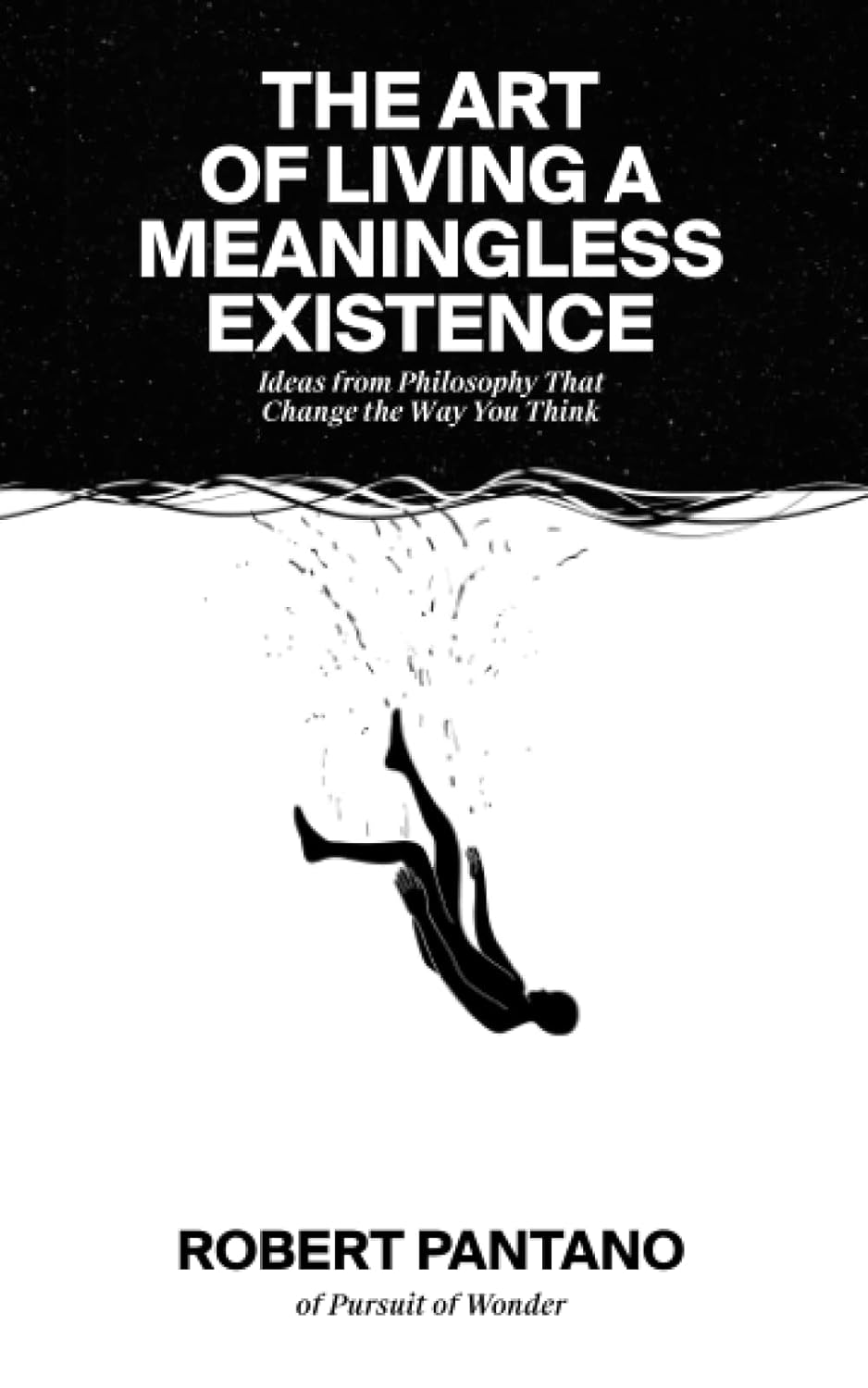
Robert Pantano’s “The Art of Living a Meaningless Existence”

The Art of Living a Meaningless Existence: Ideas from Philosophy That Change the Way You Think

I’m a sucker for these kinds of brutally honest titles: this one by the creator of the philosophical “Pursuit of Wonder” YouTube video series. This book is basically an encapsulation of the author’s version of the quest I undertook 25 years ago: to revisit the philosophical and ethical alternatives to religion, as well as my own personal beliefs. Then – given those beliefs – how to find the best way I can to live in accordance with my values.

Pantano pulls from all the major Western superstars, including Schopenhauer, Nietzsche, Jung, Emerson, Bukowski, as well as my biggest influences: Sartre, Camus, and Alan Watts. He doesn’t spend much time evaluating Buddhism, but — like many kids these days – gets positively juicy about Seneca and Stoicism.

Ironically, when alphabetized by author, this book sits on my shelf directly adjacent to the “Philosophy For Dummies” book that I kicked off my inquiry with back in 2002 (blogpo)! I found it enjoyable going back over some of the intellectual paths I trod over two decades ago and hearing what someone in a similar situation made of it. From his summary of Ernest Becker’s work:

“What’s worse than living a life knowing that one will die is living a life knowing that one will die without having lived as many moments as one can properly relishing in the fact that they have not yet died.”

CIMC’s “Teachings to Live By”

Teachings to Live By: Reflections from Cambridge Insight Meditation Center

I received this privately self-published book as a benefit for being a longtime member and supporter of the Cambridge Insight Meditation Center. It is a compilation of reflections that were sent out by email during the Covid-19 pandemic lockdown, authored by several CIMC teachers, including Larry Rosenberg, Narayan Liebenson, the late Ron Denhardt, Madeline Klyne, and longtime dhamma friends Zeenat Potia and Matthew Hepburn.

This book reminded me of so many things about CIMC that I hold precious, even a decade after last setting foot in that building. One of those treasures is the center’s unwavering dedication to ensuring that practice isn’t an esoteric, intellectual exercise, but visibly transforms our mundane, everyday lives.

I think that’s summed up best in the following citation from one of Narayan’s sections, entitled “Begin Again”. I’ve already read this in one of my dhamma talks, and will no doubt continue to share it with other practitioners.

Remember that meditation is not sitting. Sitting is a form and meditation is the love of awareness (whatever posture the body may be in). And sitting is an invaluable form in which to cultivate the love of awareness and the capacity to bring our practice to the entirety of our lives, not just to the cushion.

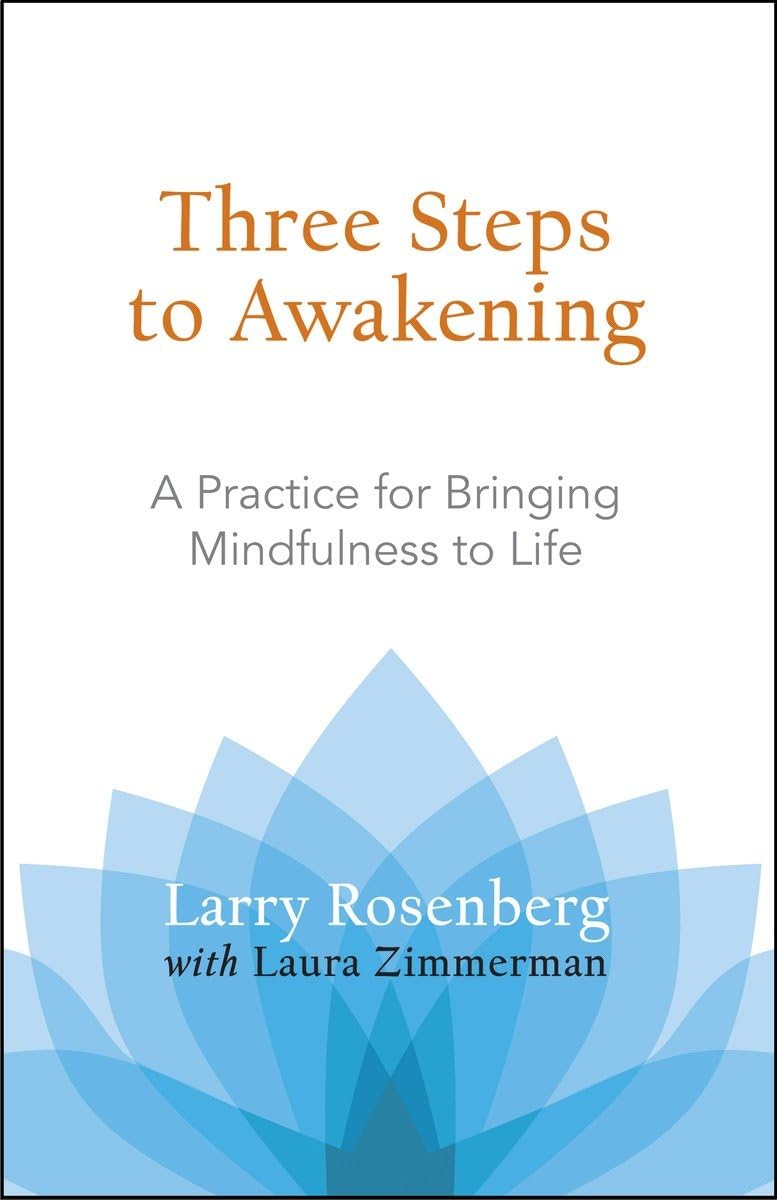
Larry Rosenberg’s “Three Steps to Awakening”

Three Steps to Awakening: A Practice for Bringing Mindfulness to Life

Cambridge Insight’s eminently practical view of meditation practice derives largely from CIMC’s founder, Larry Rosenberg. I studied with Larry for twelve years, and nowhere is his understanding of the dhamma more compellingly articulated than in this book, plainly subtitled “A Practice for Bringing Mindfulness to Life”. I heartily recommend it to anyone interested in meditation’s value in learning how to live.

Larry has distilled a lifetime of dhamma practice into three steps that anyone can perform. In my own words, those are: finding calm by maintaining awareness of the sensations throughout the body that arise with breathing (shamatha); using awareness of the breath to identify less with habitual discursive thought (vipassana); and transitioning awareness from the breath to the silence that underlies all the happenings in our daily lives (choiceless awareness).

That sounds pretty esoteric, but Larry is always practical, down-to-earth, and immediate.

Don’t put your faith in a “future you” who will evolve over a number of retreats and sittings. Of course you will reap byproducts down the road. But you do not have to wait, because meditation is a never-ending process of learning how to skillfully relate to everything daily life presents. Confirmation and verification occur right here and now!

Actually, this seeming passive activity sets in motion a dynamic energy that does move you in a wonderful direction. But don’t divide your attention with a preoccupation to improve. In our approach, you’re not attaining specific stages of wakefulness, or life goals, but rather taking care of each moment, whether on the cushion or at home or in school. This is why you are encouraged to not separate practice and daily life.

The Buddha is considered a fully awakened human being. He is offering you help to join him. Each moment of awareness is a small moment of Buddha mind. As the wakefulness matures by applying it to every occurrence in life, off and on the cushion, you will see the by-products of the learning that comes from this enhanced awareness. You are learning how to live skillfully in every moment, whether on retreat or at home with your family, at work with colleagues, or with strangers on the bus.

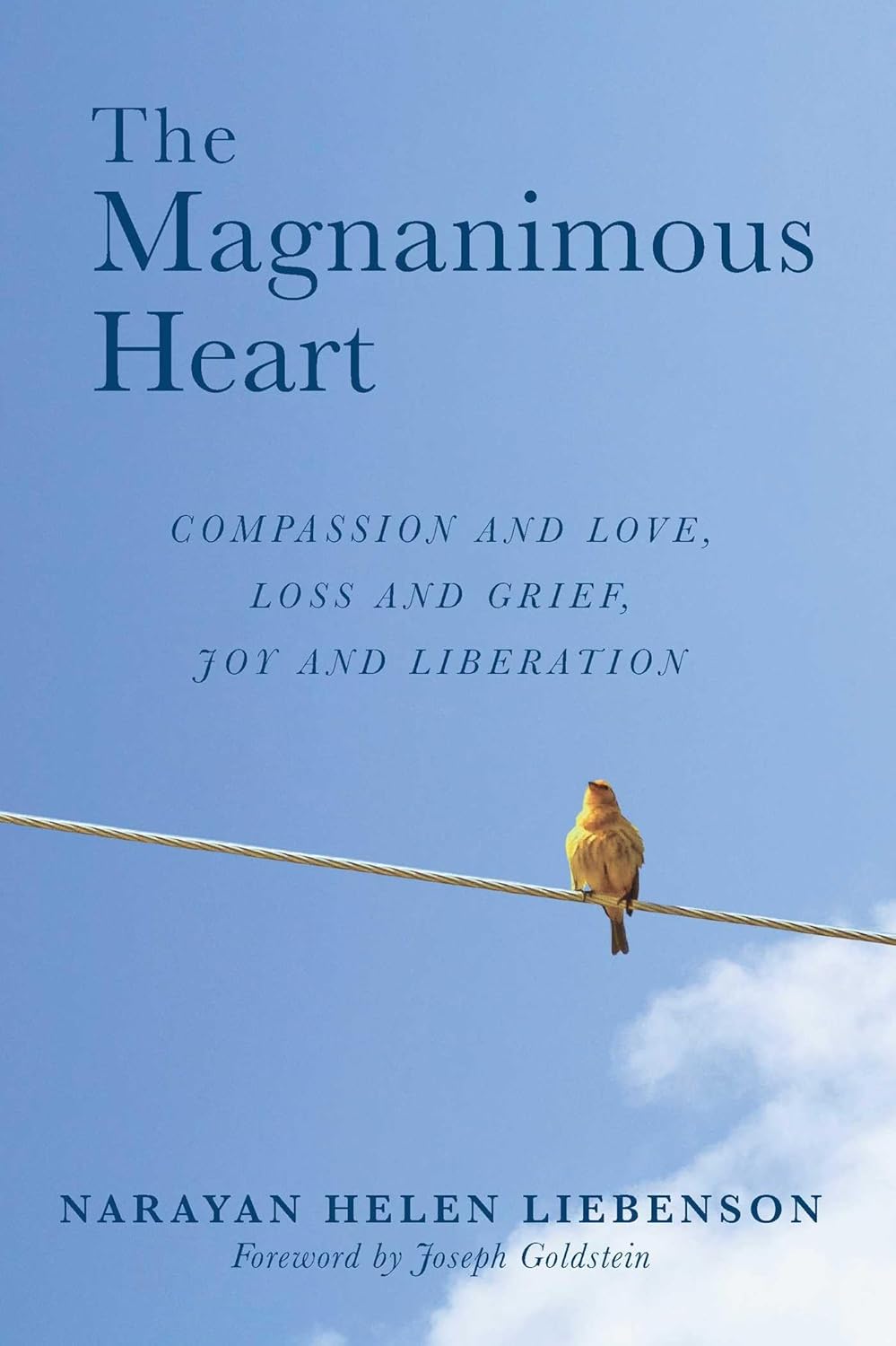
Narayan Liebenson’s “The Magnanimous Heart”

The Magnanimous Heart: Compassion and Love, Loss and Grief, Joy and Liberation

Narayan is a co-founder of Cambridge Insight and Larry’s longtime partner in teaching at CIMC. I also received her new (well, 2018) book as a thank-you gift for my support of the center. Amusingly, it was the first work selected by the new book club at Mariposa Sangha, my new meditation center in Austin.

The book is her very personal response following a period of tremendous loss, grief, and trauma in her life, and she confronts these topics head-on, without denial, distraction, or avoidance. It’s an unvarnished sharing of how an experienced meditator met some of life’s most painful challenges, which may be of value to others going through similar difficulties.

Fortunately, my life has been largely free of trauma, so for me the book was more like an evocative, frank, heart-opening account from a dear friend.

Is there any moment other than now that is more worth being awake in? We would have to answer no to the question, given that now is the only moment in which life can be lived. There is nothing to be gained by looking forward to future events that seem better than this boring moment right now. This boring moment right now is our life, and everything else is just thought. When we make contact with the sparkling nature of right now, the specific content we encounter in this moment matters less. Ultimately, being present for whatever is going on is more important than whatever is going on.

Major milestones don’t come as frequently after 18 years of meditation practice, but this month provided a big one in my burgeoning role as a teacher: my first time having the honor of offering the Three Refuges and the Five Precepts.

Taking the Refuges & Precepts is the most fundamental Buddhist ceremony, and is frequently offered at meditation retreats.

Bikkhu Bodhi: Going for Refuge & Taking the Precepts

The Three Refuges are a public statement of confidence in the historical Buddha as a regular human who came to a profound and useful understanding of how the human mind works; the Dhamma, or teachings he gave based on that understanding; and the Sangha, the community of like-minded practitioners. It’s helpful for meditators to relate to these vows as more descriptive of how one feels and where they are currently at in their practice, rather than something proscriptive that someone else is imposing upon them.

How important these vows are in the context of your practice, the specific technicals details of what they mean, and the consequences of breaking them are entirely up to the individual. You can view these as a solemn public statement that you are “A Buddhist”, or you can simply consider them an unnecessary holdover from uncomfortably devotional Asian Buddhist practices, or anything in-between. The Refuges & Precepts are only as solemn as you want them to be.

The Five Precepts are voluntary ethical practices that prompt the practitioner to increase our awareness of the skillfulness of our thoughts, speech, and actions, and to reflect on their impact upon our inner wellbeing.

The Precepts in particular can be uncomfortable for meditators brought up in the Abrahamic religions, where they can come across sounding like the Ten Commandments. However, the similarity is very shallow. A practitioner can adopt all, some, or none of the Precepts. In modern formulations, each Precept not only includes refraining from a particular unskillful action, but also cultivating a corresponding beneficial one.

In addition, taking the Precepts is completely voluntary, and there’s no requirement or pressure involved. They aren’t an edict imposed by some arbitrary external authority, but something one chooses for oneself because of the value and benefit one expects to receive by working with them. And there’s no one handing out punishments for failing to keep the Precepts.

Finally, the Precepts are vague, and (I believe) intentionally so. They’re meant to urge practitioners to look inside themselves and explore the subtleties of what their heart tells them is ethical and skillful. You would think that the precept to refrain from killing living creatures would be pretty straightforward, but our modern society raises complex questions in the ethical grey area that we must all face. Does that mean you can’t kill troublesome insects? Even accidentally? Does it rule out compassionate euthanasia or assisted suicide or abortion? Does it mean we cannot eat meat? And isn’t killing plants still killing a living being? And it’s the same with all the other Precepts; they encourage us to explore our own internal values and how well our real-world actions conform with them.

So that’s what the Refuges & Precepts are. Let’s get back to me…

I first took the Refuges & Precepts in April 2006 at Cambridge Insight, two years into my practice. I’d devoted enough time and study to be confident that I’d found a good home base for exploring how to live my life in accord with my inner values. When I took the Refuges & Precepts, it was deeply meaningful for me.

Over the years I gained knowledge and experience as a practitioner, then began slowly moving into teaching. The Refuges & Precepts were always in the back of my mind, and I hoped that someday I would be able to offer the ceremony to others. But I didn’t feel confident enough to volunteer until recently, now that I’ve got five years of regular teaching under my belt.

But it was the timing that forced my hand. I’ve always felt that the Refuges & Precepts should be offered in May, on the holiday of Vesak, which Buddhists observe as the day of the Buddha’s birth, his enlightenment, and his passing. When my Monday meditation group started lining up our May teaching schedule, they granted my request to take two consecutive weeks — May 9 and 16 – to offer the ceremony.

As the date approached, I sent out an introductory email to the group. After all, this would be very different from our usual sitting and dhamma talks, so I gave people fair warning and set expectations, and sent along the translation we’d be using. It’s worth noting that following the Covid-19 pandemic, the Monday group is still meeting in an online videoconference.

I think people heeded my warning, because only six people attended the first session, about half our usual size. My goal for the evening was to go over what the Refuges & Precepts are – the information I covered above – leaving plenty of time to answer questions. The explanation seemed sufficient, as there were only a couple questions.

The second session had seven people, as we lost one of the previous week’s attendees but gained two new ones. After a quick recap for the new people, I took a couple more questions, then segued into the actual ceremony.

In short, we read the Homage to the Buddha, the Refuges, and the Precepts. For each, I encouraged people to recite them with me in English, then I chanted the Pali version (and anyone who wanted to join in was welcome to), and rang the meditation bell. Because doing this online would have otherwise been a mess, I asked everyone to keep their microphones muted. It seemed to work out fine.

I wanted to follow CIMC’s custom of following the ceremony with a shared social celebration, and I’m really glad I did, because it helped me convey my joy and how special an event it was. For some people it was their first time ever taking the Refuges & Precepts; it was the first time the Monday group had offered them; it was, of course, also my first time offering them; it was the day of Vesak, the most important Buddhist holiday, observing the Buddha’s birth, enlightenment, and passing; and the Monday group’s fifth anniversary is close at hand. And talk about auspicious: there was even a lunar eclipse! It was a wonderful opportunity to share with each other the joy of our practice together, and seeing it bearing fruit.

I probably don’t need to repeat how pleased and honored I feel at being able to offer this ceremony for the first time to a dedicated group of friends and practitioners of varying levels of experience. For me, it was a resounding success, and a huge milestone in my meditation practice and my growth as a teacher.

Now I just have to turn around and teach Dependent Origination two days later to the other group I sometimes lead!

“No matter how much I meditate, I’ll never become Enlightened, whatever that is.” So said an experienced practitioner during one of my meditation groups’ Q&A periods.

I had a strong and immediate reaction, because her understanding of Enlightenment is based on a frustratingly common misconception, and her despairing attitude is completely unnecessary.

The Seven Factors of Enlightenment

To be fair, most Buddhist texts do an awful job explaining Enlightenment (aka Nirvana, Nibbana, arahantship). It’s usually described as a one-time, life-changing accomplishment that completely and permanently obliterates our greed, hatred, delusion, and all the doubts and dissatisfactions of normal life.

That’s a great goal to aspire to, especially if it motivates you to meditate. But there are three big drawbacks.

The first problem is that greed, hatred, delusion, and doubt are an unavoidable part of life, and no human being can fully eradicate them. Chasing such an unattainable goal engenders a whole spectrum of painful, destructive mental states that conflict with the growth of wisdom: insufficiency, striving, comparing oneself to others, frustration, self-doubt, and ultimately failure.

The second problem is that the idea of Enlightenment as a permanent state contradicts the Buddhist belief that everything is impermanent. As described, Enlightenment is a specific mental state, and all things—especially all mind-states—are temporary, ephemeral, and guaranteed to change. Enlightenment as a one-time, irrevocable transformation just doesn’t jibe.

And finally, in my experience Enlightenment simply doesn’t exist. I have never met any meditator—lay or monastic, teacher or student, male or female—who claimed to be Enlightened, or who claimed to have met someone who was.

So much for the formal, upper-case noun “Enlightenment” as described in the suttas and as envisioned in popular culture. But let’s draw a distinction between formal “Enlightenment” and the lower-case adjective “enlightened”.

The former implies a mythical, permanent, once in a lifetime achievement. But if we use “enlightened” to describe a particular action, or a momentary mind-state which may come and go over time, we come much closer to something useful: an action or state of mind that any human being could achieve, if only for a brief time.

What is an enlightened action? It arises from a mind-state of intimacy and connection with all living beings that struggle with suffering. Enlightened acts exhibit love, compassion, delight, and stability, and are free from self-referentialism.

While most of us don’t think that way most of the time, we can and do experience those ah-ha! satori moments of insight when we can see a different, more enlightened way of being. And our practice is to recognize those moments, allow them to guide our actions in the world, examine the results of those actions, and cultivate more such enlightened moments.

This is something everyone can experience and aspire to, without incurring all the striving, comparisons, and failure of chasing some grandiose vision of permanent “Enlightenment”. And when we view enlightened mind-states as temporary, they do not conflict with the law of impermanence. And most importantly, this ”momentary enlightenment” is eminently achievable.

And if you somehow still believe in that permanent state of “Enlightenment”, in practice that's still nothing more than consecutive moments of enlightened behavior.

So let me summarize my view of Enlightenment:

  • Enlightenment is not what you’ve been told. Enlightenment is simply stringing together enlightened mind-states and actions more and more frequently.
  • At first, this may not be quickly or easily achieved. But early results produce confidence and progress that gradually accelerates.
  • Enlightenment is definitely not a permanent, one-and-done accomplishment. It’s something that requires diligence, effort, and commitment over time.
  • It’s unrealistic to expect Enlightenment to erase all the complexities, doubts, and selfishness of normal life, but it will greatly reduce them.
  • Letting enlightened moments motivate our behavior still results in the same radically transformed way of thinking about, relating to, and responding to normal life, enabling us to minimize our own suffering, and that of all living beings.

So don’t tell me you’ll never be Enlightened. The real-world possibility of Enlightenment is as close as the very next action you take.

New meditators often struggle with the idea of sitting still. One of the inevitable first questions asked at a beginners’ sitting is whether one must remain 100% perfectly still, or whether it’s okay to shift, scratch, and so forth.

While some traditions like zen are fairly strict in this regard, vipassana is less rigid: one should make a reasonable effort to remain still, bringing such impulses to conscious awareness, then making a considered decision about whether the movement is necessary or not.

But whether it is strictly enforced or not, the underlying rationale is the same in both schools of thought.

In our daily lives, the overwhelming majority of our actions are ruled by habit: if your nose itches, you scratch it; your knee hurts, you change your position. This is a great evolutionary advantage, because it frees your conscious mind from spending time thinking about trivial matters, so that you can pay attention to more important things.

But nature applies this ability too broadly, and acting unthinkingly out of habit also causes harm and gets us into unexpected trouble. Habit isn’t guided by wisdom or compassion or empathy, and it negates our freedom to react to the events of our lives in a well-considered way.

In meditation, one of the benefits of sitting still is gradually developing the ability to insert a little wedge of time between itch and scratch, between ache and move, or in general between any stimulus and our habitual response. By simply watching the itch rather than scratching it, we become a little less reactionary; we regain the freedom to choose how we respond and the opportunity to choose actions which are more wise, compassionate, and beneficial.

At first, this requires spending a lot of time in your head, and lots of effort trying to observe, interrupt, and override your previously unexamined habits. But you begin to see real-world benefits, and with practice you gradually become less reactionary by default… and also a kinder, wiser, and more compassionate person.

At some point you realize that being vigilant about your habitual behaviors is less effort now than when you first started. It no longer feels like you’re overriding your natural habits; it feels like you’re simply responding naturally. You’ve developed the skill, seen the real-world benefits, and broken the yoke of your old habits, at the low cost of some hours spent sitting around not scratching yourself!

This is one of the benefits of meditation, and why most schools of Buddhism emphasize being physically still while meditating.


Sitting still can also relate to an even more fundamental Buddhist idea: how much of our behavior is driven by desire and aversion.

During sitting meditation, the impulse to move is generally a manifestation of aversion. We perceive a sensation in the body such as an itch or an ache, and we want that sensation to stop.

But Buddhists see desire and aversion as the ultimate causes of human suffering. We want the world—and our experience of it—to be something other than how it is, which makes us dissatisfied and unhappy. Ultimately, the Buddhist philosophy addresses how to acknowledge, accept, and embrace this disconnect between what we want and what the world can provide.

Part of that is learning how to accept conditions we don’t want, but are powerless to change. This is where sitting still comes in: by not scratching that itchy nose—no matter how badly we want to—we are practicing and building up the patience, forbearance, and equanimity that will be needed when we face much greater challenges, such as our own aging, sickness, and unavoidable death.

It was in the midst of this aspect of sitting still that I began considering one particular insight that I’d like to share.

If one takes this orientation toward accepting the world as it is to an extreme, Buddhist philosophy might imply a kind of universal acceptance of life’s conditions, even to the extent of complete passivity: “This is how things are, and any attempt to change things is an act of aversion that ultimately leads to suffering.”

While that’s not really the Buddhist mindset, I found it an interesting object for consideration. And when I applied it to sitting practice, I came upon the idea that all volitional movement of the body must be a manifestation of dissatisfaction. Because if there is no desire or aversion, there is no need to change one’s circumstances, no motivation to move. What reason would there be for a being—freed of all desire and aversion—to move in any way?

Obviously, that’s a theoretical question, since no one is truly free of aversion; we all have itches, get hungry, go to the toilet, and fear aging, sickness, and death. But the idea that dissatisfaction underlies all movement has been a fruitful idea to turn over in my head, and has provided a new way to consider my bodily movements and the motivations behind them.

Playing with that concept has made sitting still during meditation a more active and engaging activity. It has also made it much easier to be physically still during sits!

As it spread across Asia and the rest of the globe, Buddhism changed and adapted to the local cultures it encountered; however, Buddhism’s core goal—freedom from suffering—and its core method—contemplative meditation—have perforce remained constant… until recently.

Thus it’s understandable that the 20th Century Westerners who went to Asia would come back with a unique version of Buddhist practice that ought to work better for those of us brought up in the West than the original article. The hybrid Buddhism that we inherited from them had been distilled down to the essentials that would most appeal to educated middle class White people like themselves.

That meant discarding inconvenient concepts and practices such as reincarnation, myths & deities, miracles & supernatural powers, ritual & chanting, merit-making, the more esoteric states of concentration practice, karma, renunciation, non-duality, and non-self. That’s how American Buddhism became divorced from Asian, and enabled a diminished “secular meditation” with all the uncomfortable bits filed off.

Triple productivity after 4 days of meditation!!!

That decision made some sense, as several parts of devotional Buddhism are at odds with our Christian heritage or directly contradict universally-accepted scientific laws. But the stylized meditation techniques that have gained such popularity in the American mainstream have also lost sight of the actual purpose and point of meditation practice.

The most facile example of the trendy “Mindfulness Movement” is Jon Kabat-Zinn’s Mindfulness-Based Stress Reduction program. Obviously, learning tools to cope with stress is a Good Thing, but I can’t help but be saddened by how much got lost when the goal of meditation was reduced from the “eradication of the root cause of human suffering” to “just help me get through my day”.

It’s as if everyone in Asia had been inoculated with a one-time permanent cure for diabetes, but we Americans have shortsightedly continued carrying blood testing kits and syringes filled with insulin, only treating the symptoms of the chronic disease as they arise day after day.

Another painful example is how big business and professional sports have co-opted meditation as a cheap tactic for “guaranteed career success” and “enhancing peak performance”, promoted by well-heeled management consultants and wealthy athletes like Kobe Bryant, LeBron James, and Derek Jeter.

I’ve participated in several sittings and talks run by prominent performance-oriented meditation gurus, and always felt deeply uncomfortable. Because at their core, these programs and prescriptions are diametrically opposed to what Buddhist meditation is all about. Whether it’s vanquishing your business or athletic rivals, these techniques are designed to promote selfish desires and goals which reinforce the ego.

In contrast, Buddhism guides the meditator toward the understanding that no worldly attainments can ever provide deep or lasting satisfaction; toward relinquishment of personal desires; and toward freedom from our unexamined enslavement to the insecure demands of the ego.

All too frequently, I hear proclamations from people publicly known as meditation experts that completely set my nerves on edge. In their own literal words, meditation can: lower stress levels, help you drop all distractions that may interfere with winning, enhance peak performance, aid in the reduction of how chronic pain affects the mind, help you cope with the aftermath of a disappointing performance, strengthen your drive, boost your belief in yourself and your ability, build your athletic identity, improve sleep patterns, speed recovery time, enhance endurance, aid in proper fueling, and help control oxygen.

I’m sorry George, but the Buddha had a far more important and fulfilling goal than “speeding recovery time”, “building his athletic identity”, and “controlling oxygen”.

Through tireless self-aggrandizement and promotion, many of these business and sports meditation gurus have grown rich and famous as a result of dispensing their advice. I’m going to leave that contradiction aside however, as it’s too obviously hypocritical to waste time discussing.

Attending these completely secularized meditative self-gratification programs is kind of like taking classes at a prestigious cooking school, but disregarding everything except how to microwave a frozen burrito. It’s such a waste! Buddhism has a larger mission and so much more to offer than empty self-affirmations and greed-reinforcing self-talk.

I’ve also observed that when teachers introduce meditation practices to naïve Westerners, most of the reported short-term benefit is due to peer pressure or the placebo effect. For the practitioners I’ve known, their initial months of meditation were uncomfortable and challenging before things settled down and the practice started producing its slow, gentle results. But Americans have been sold a persistent fable that meditation will produce immediate and noticeable relief; so that’s what people report, after just a few minutes alone with their unruly internal dialogue.

For all these reasons, the majority of Americans think of—and relate to—meditation as if it were just another self-improvement project: a way to be a far more powerful, unshakeable, invincible you.

While there are undeniable positive side effects of long-term meditation practice, it’s not about building up, improving, or perfecting the self; it’s about letting go of the self, and liberation from the tyranny of the ego.

And the ultimate goal of Buddhist meditation—which the Western mindfulness movement has completely forgotten—is the freedom and well-being that results from the eradication of suffering in our lives: something many self-proclaimed “meditation experts” have a vested interest in perpetuating and profiting from.

In their recent marketing communications, the Cambridge Insight Meditation Center has published brief interviews with some of their regular practitioners as a kind of “get to know you” feature.

Although I haven’t made an appearance at CIMC in years, I thought it’d be fun to answer some of those questions myself, especially since today marks the 15th anniversary of my first visit to CIMC (or any meditation center).

CIMC meditation hall

CIMC meditation hall

CIMC: Tell us about yourself.

I discovered Buddhism around age 40, while seeking a way to live in closer accord with my inner values after a divorce, moving, and changing jobs. The teachings resonated with me, and I found CIMC’s non-sectarian method pleasantly approachable.

I was a CIMC regular and volunteer for eleven years, during which time my practice matured rapidly. In 2015 I moved to Pittsburgh, where I now support and occasionally teach two vipassana sitting groups.

CIMC: How did you learn about CIMC? When did you come to CIMC for the first time? And what program did you attend?

I first checked out a Tuesday night Beginners’ Drop-In sitting in April 2004, and followed up with a two-day Beginners’ Workshop with Maddy Klyne the following month. After that, I started going to all the Wednesday evening sitting & dhamma talks—enthusiastically absorbing everything I could—then joined some standing practice groups; formed a kalyana mitta “spiritual friends” group; and undertook retreats at CIMC, IMS, and the Bhavana Society to begin putting all those teachings into practice.

CIMC: How has CIMC or a teacher transformed or benefitted your life?

More than any single teacher, I benefited from the unbelievable diversity and expertise of the guest teachers CIMC brought in to lead weekly Wednesday night sittings and dhamma talks. In addition to our own esteemed guiding teachers, CIMC provided a rare and precious opportunity to learn from many of the most respected teachers in the world.

I knew almost nothing about Buddhism when I arrived at CIMC. The teachings I received there—combined with my own meditation practice and independent study—have transformed how I relate to every element of my life, thereby addressing my original desire to live in harmony with my values, and gave me the confidence and depth of knowledge to begin advising and teaching others.

CIMC: Are you a member? If yes, why?

Although I left Boston in 2015, I am still a member at CIMC. The urban center has immense capability to bring the Buddhist mindset to a mainstream audience who would never engage with this path of wisdom otherwise. Having received so much benefit from CIMC, maintaining my membership is how I continue to support the center, the teachers, and the mission of offering the dhamma to others.

CIMC: What’s your favorite way of supporting or engaging with the CIMC community?

I always used to stay for tea after the Wednesday evening dhamma talks, having detailed discussions about practice in the dining room with other attendees right up to (and sometimes well beyond) the center’s official 10pm closing time. The conversations were always thought-provoking, and helped me feel like an integral part of the center and supported by a community of engaged, like-minded practitioners.

For more than a decade, CIMC was one of the most important elements of my life, and I continue to benefit from the time I spent there, even though I’m no longer a familiar face at the center.

Beyond that, there isn’t a lot for me to say in observance of today’s 15th anniversary of practice; I covered most of it in my 10th anniversary blogpost.

In the five years since I wrote that post, there have been two major developments in my practice.

The most obvious has been establishing my practice here in Pittsburgh, where I have been fortunate to find two local sitting groups, and was able to sit a retreat with venerable Bhante G. at the Bhavana Society in nearby West Virginia. These have provided regular prompting for my sitting practice, as well as the continued support of like-minded practitioners.

In addition, on several occasions I have led sittings and dhamma talks for these two groups, which has been a major change from how I practiced in Boston. After a decade and a half, I now find my practice transitioning from absorbing and practicing the dhamma to sharing it with others and offering instruction. This has been a major shift, and—as I mentioned above—one I would not have undertaken without the confidence and depth of knowledge I gained during my time at CIMC.

On my recent trip to North Carolina, I was able to sit with two large, thriving groups: the Triangle Insight Meditation Community in Durham and the Insight Meditation Community of Charlotte. Unexpectedly, the leaders of both sittings claim CIMC’s founders as their primary teachers.

That experience prompted me to drop a note to CIMC’s guiding teachers, wherein I shared the following. Speaking about the teachers I met during my trip:

They provided very visible examples of how important CIMC’s teachers have been in spreading vipassana practice throughout the US. It’s a noble legacy that will persist for decades and impact thousands of lives.

This experience was an unexpected reminder of how indebted I am and how much I miss CIMC. Now, as my practice transitions from absorbing the dhamma to sharing it with others, I realize how blessed I was to have spent so many years at CIMC and learned so much from such eminent teachers.

Over the solstice, I attended an 8-day silent meditation retreat with Bhante Gunaratana at his Bhavana Society retreat center in West Virginia.

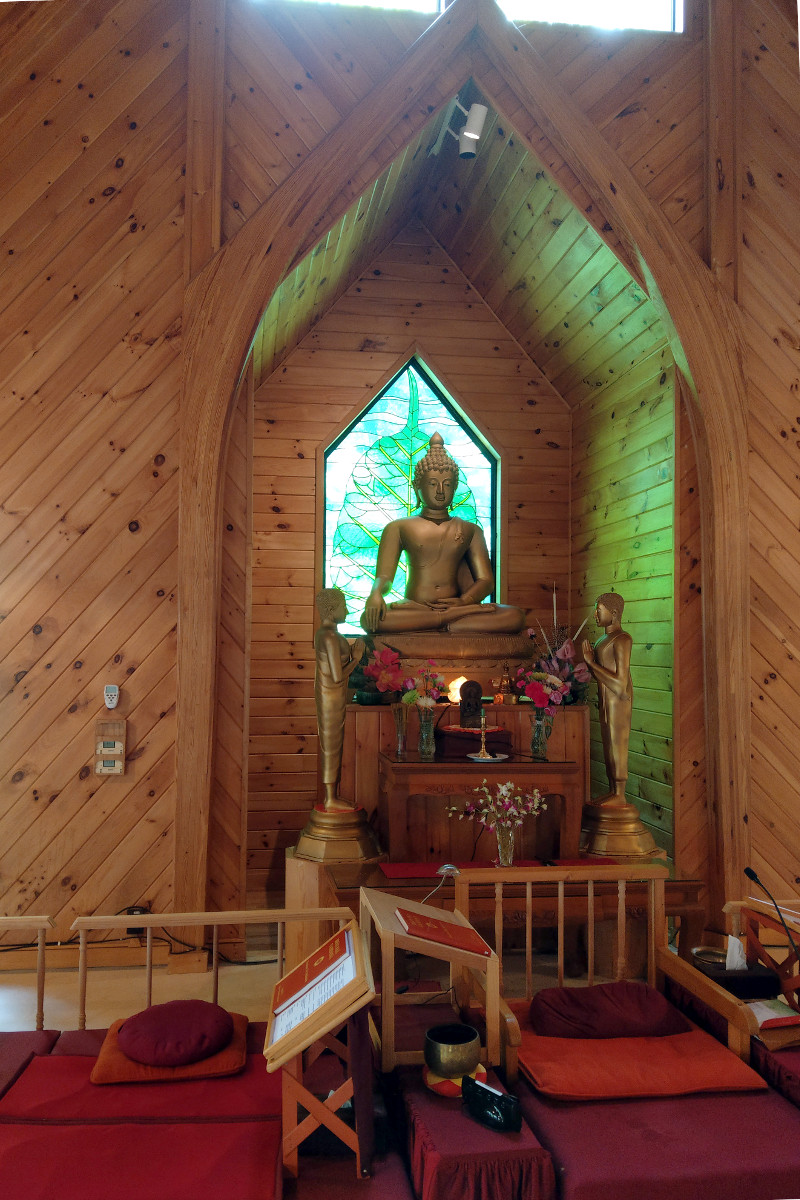
Bhavana Buddha

Buddha in Bhavana's main hall

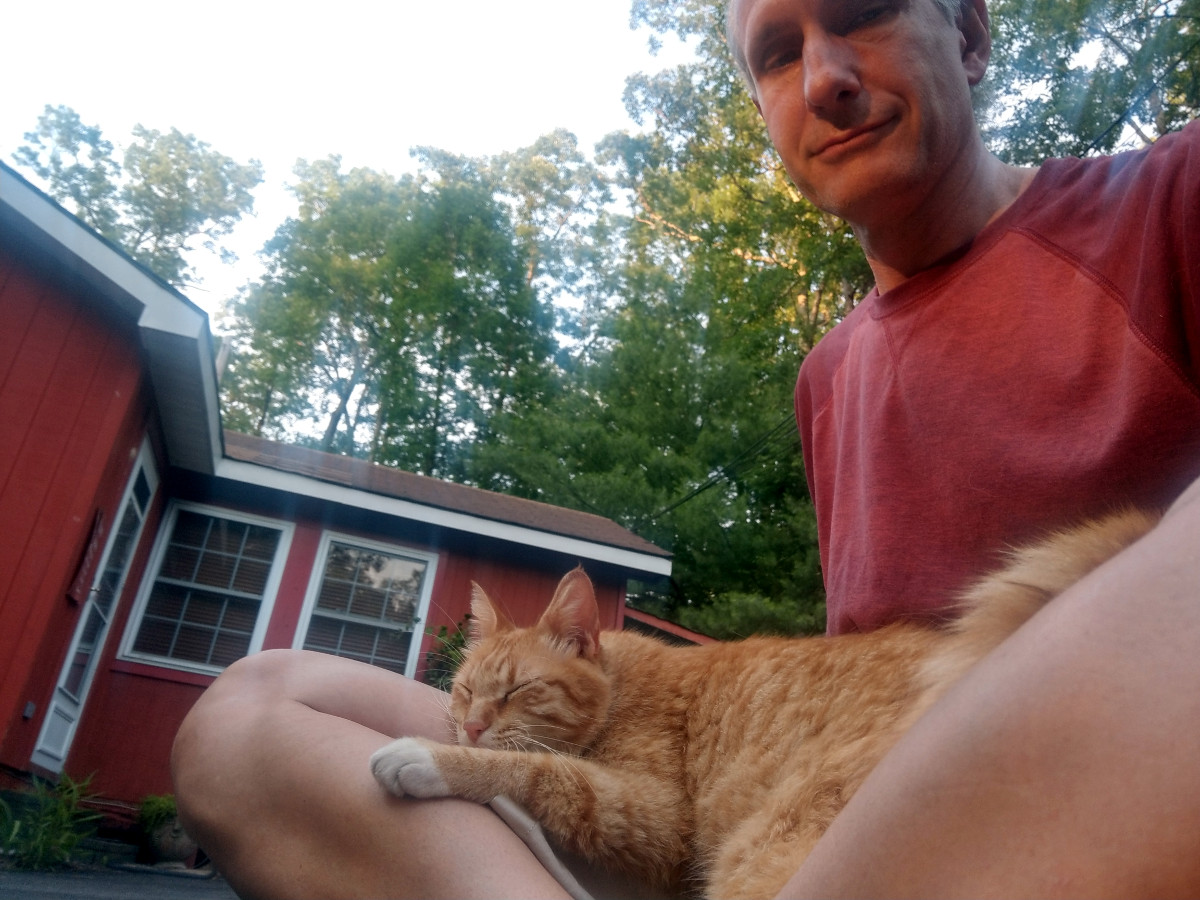
Bhavana Buddy

Bhavana Buddies

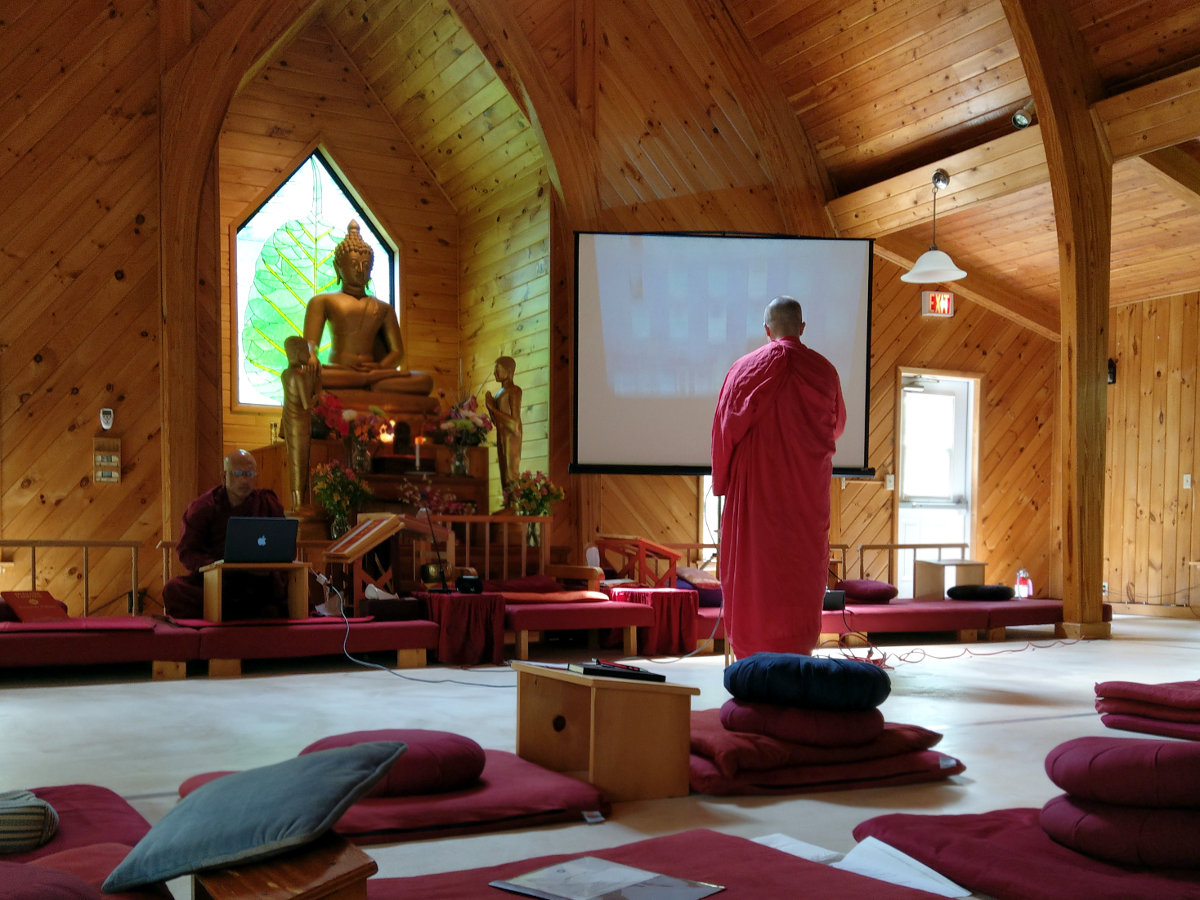
Dhamma Talk?

Is this a dhamma talk?

My Kuti

My Kuti

What Eighth Precept?

What Eighth Precept?

Bhante G. is a well-known Sri Lankan Buddhist monk, the author of the widely-read manual “Mindfulness in Plain English”. To be honest, I didn’t know he was located so close. When I learned that Bhavana is a three and a half hour drive from Pittsburgh, I was immediately motivated to go do a retreat, especially since I wouldn’t be inconveniencing Inna, who has been out of town for months on business. And at 90 years old, Bhante G.’s advancing age gave me an added sense of urgency.

Last spring, when I looked at the Bhavana Society’s schedule, one event immediately stood out: a jhana retreat planned for the end of June.

What’s “jhana”? Jhana is an intensive concentration meditation practice which predated the Buddha, which presumably leads to four increasingly subtle and esoteric mental states.

The jhanas comprise Right Concentration: the eighth component of the Buddha’s Noble Eightfold Path leading toward the ultimate goal of practice: the cessation of suffering. Once you have developed a high degree of equanimity through the jhanic concentration practice, you can use it (and the impermanence of those states) as a tool in Vipassana practice: the development of insight/wisdom through the internalization of the Three Characteristics of Existence (impermanence, unsatisfactoriness, and non-self).

That sequence—practice concentration, then use it to develop wisdom—is one of two ways that people approach Buddhist practice. The other approach, called “dry” or “pure” Vipassana practice, does it the other way around: meditators work directly to realize the Three Characteristics, and let their concentration skills develop as needed. Meditating on the Three Characteristics through Vipassana meditation comprises the seventh element of the Noble Eightfold Path: Right Mindfulness.

Virtually all modern western Insight Meditation centers go the latter route, teaching Vipassana meditation exclusively. They rarely talk about the jhanas, and often discourage jhana practice, believing that the preoccupation with mental attainments is an unnecessary diversion from the development of wisdom… if those presumed attainments even exist at all! Having “grown up” in that Insight tradition, I dismissed jhana practice for years as little more than legacy Asian mysticism.

But ten years ago I decided to read some of the original Buddhist suttas, specifically the Majjhima Nikaya: the Middle-Length Discourses (my 2007 blogpost). There I discovered that there’s a passage describing how a skilled meditator enters the jhanas as a preliminary part of practice. Moreover, that standardized passage is repeated in a lot of suttas: about 30 percent of them, IIRC. Appearing so frequently, it was clearly something the Buddha considered extremely important. From then on, I knew I couldn’t simply dismiss jhana practice; I needed to give it a fair and openminded trial.

I bought books and did online research, but couldn’t get past my confusion. On one hand, the “jhana factors” that arise are familiar to me: applied thought, sustained thought, single-pointedness, happiness, bliss, and equanimity. But on the other hand, the four jhanic states are subtle and difficult to judge, and I certainly hadn’t experienced any of the mental imagery (nimitta) or magical powers that supposedly precede them. Were they merely metaphorical? As an avowed empiricist, I had difficulty reconciling the presumed importance of these concentration practices with the mystical bullshit that accompanied them.

As a followup to his best seller, Bhante G. also wrote a book about the jhanas called “Beyond Mindfulness in Plain English: An Introductory Guide to Deeper States of Meditation”, which I also read. So when I learned his center was nearby and that he’d be leading a jhana retreat, I figured the time was right to go and try to resolve my longstanding confusion. That’s why—due to an unfortunate scheduling coincidence—I decided to stay home at our Tuscan villa on the day the Giro d’Italia bike race came by: so that I could guarantee my spot in Bhante G.’s jhana retreat as soon as they opened online registration.

To conserve Bhante G.’s strength, activities like dhamma talks, Q&A, and teacher interviews were shared, with three different monks taking responsibility for two days each. As a result, my understanding of the jhanas changed and evolved over the course of the week.

The first two days we were in the care of Bhante Jayasara, a young American novice. He addressed the groundwork for jhana practice: specifically, suppressing the negative mental states called the Five Hindrances: a straightforward and familiar practice.

During his Q&A, he shared his personal experience of a nimitta: a sign of deep concentration that’s often perceived as a bright light. I found his sharing informative and inspiring, especially his confirmation that the nimitta is not a visual perception, but a purely mental one.

Interestingly, he could only share this with us because he’s not yet a fully-ordained monk, since the Vinaya—the Buddhist monastic rules—forbids monks from contradicting the canon or discussing their own personal experiences and attainments. So if you’re looking for practical advice based on personal experience, don’t bother asking a monastic!

During his Q&A, I asked which of the Five Hindrances compulsive planning fell under and how to practice with it. Of course, the answer was somewhat nuanced. Planning is often useful, but could also be an expression of anxiety and discomfort with uncertainty. In the moment when the compulsion comes up, one should consider three things: what is the appeal of planning, how it might be problematic, and how to reframe one’s habits of mind to avoid following that pattern out of compulsion. As Bhante Jay summarized: “The gratification, the danger, and the escape.”

After that, the middle two days were handled by Bhante Seelananda, a middle-aged monk who was born in Sri Lanka and became a monk at age eleven. As a lifelong academic scholar, he has exceptional knowledge of the Pali canon (the Buddhist scriptures).

His talks covered Buddhist academic theory relating to the jhanas in unrestrained detail, reciting a litany of passages in Pali and lists of theoretical esoteric mental states. Less of a dhamma talk and more of a collegiate lecture, it was the first dhamma talk I’ve ever attended that included a slide deck presented with an overhead projector and laser pointer!

With a straight face, he reported the magical powers the canon associates with the jhanas: the abilities to fly, read minds, recall past lives, and clairaudience.

At no time did he share any personal reflections or practical advice, limiting himself to reporting the content of the Pali canon as if it were literal truth. I’m not sure whether that was because the monastic rules prohibited him from contradicting the Buddhist writings, or whether his childhood upbringing within the monastic community rendered him an indoctrinated faith believer incapable of critical thought.

In either case, he had zero practical advice to share that would have benefited his audience of lay practitioners. As you might imagine, his circular reasoning and arguments from false authority didn’t sit well with an objective materialist like me.

After coming into the retreat with an open mind and specifically looking for practical help, I was getting discouraged and felt that I was wasting my time. I was ready to conclude that the jhanas are simply not a useful concept. Sure, concentration practice is important in habituating oneself to meta-thinking; the Five Hindrances are things we can all relate to; even the “jhana factors” I listed earlier make sense in the context of quiescing the discursive mind. But the four jhana states themselves sound like abstract, magical mumbo-jumbo.

And even if they are real, someone has got to find a better way to teach them. One doesn’t learn how to whistle by being told “Just blow long enough, and it’ll happen”; and one doesn’t learn how to swim by being told “Keep splashing around on your own and one day you’ll magically become a master swimmer”. You need someone to directly show you the techniques of how to whistle, how to swim… and how to meditate, achieve, and recognize these abstract, theoretical mental states.

For me, no matter how much of the official doctrine Bhante Seela cited, the jhanas simply don’t pass the Kalama test. In the Pali canon’s Kalama Sutta, the Buddha tells the Kalama tribe to accept as true only those teachings that one has personally verified are skillful, blameless, praiseworthy, and conducive to happiness; and to expressly reject teachings that derive from blind faith, dogmatism, and belief spawned from specious reasoning. And the jhanas demand a whole lot of the latter.

After Bhante Seela’s academic theorizing, the final two days’ talks were given by Bhante G., and I was eager to hear how he would follow up. Thankfully, as a non-academic, Bhante G. is more personable and more encouraging than Bhante Seela, which was reassuring in itself.

In the meditations he led, he ended each sitting by reciting verse 372 of the Dhammapada, one of the earliest Buddhist texts:

There is no concentration without wisdom,
Nor wisdom without concentration.
One who has both wisdom and concentration
Is close to peace and emancipation.

This is the central theme of his teaching. Here “concentration” is a reference to jhana practice, and “wisdom” is shorthand for Insight or Vipassana practice. While the two are often considered completely separate practices, Bhante G. says they are parallel roads, different but complementary ways of reaching the same destination. After all, Vipassana constitutes Right Mindfulness, the seventh element of the Buddha’s Noble Eightfold Path, while Right Concentration (the jhanas) comprises the eighth. That helped me put concentration practice into a better perspective.

But where I most benefited from Bhante G.’s wisdom was in the group interview I attended, where I was able to ask “How can you tell you’ve reached a jhana state if you don’t experience something as unmistakable as those bright-light nimittas?” His answer was packed with insightful nuggets.

First, one should look at those factors that co-arise with jhana: applied thought, sustained thought, single-pointedness, happiness, bliss, and equanimity. Those are a lot more concrete than the four abstract jhana levels. He said that entering the first jhana isn’t that hard to do for an experienced practitioner, but it’s a subtle and difficult thing to see. He said I might have achieved it many times, but who can say? You just have to judge for yourself. The important thing is to just practice. Concern yourself with your own mind, not the esoteric theories about signs and levels.

His advice was personal, immediate, practical, and encouraging… way more useful than any of the infographics Bhante Seela had presented. I’m so glad that I got into this retreat and had the opportunity to have an exchange with him, while he is still well enough to teach. It was touching when, on the last day of the retreat, I ran into him on his daily walk and we exchanged smiles.

So where did I wind up as far as jhana practice? While I didn’t get confirmation that jhanas exist or not, I did get a degree of practical clarity. Taking Bhante G.’s words to heart, I’m not going to pay a lot of attention to the jhanas. I’ll continue to practice meditation of various flavors (Vipassana/Insight, concentration, and samatha/calmness), with the main focus on evolving my relationship to desire, aversion, impermanence, ethics, and renunciation.

With that, let’s dump all this philosophy. “How was it?” I hear you asking. Well, lemme tellya…

Long retreats hurt. Despite their obvious benefit, I dread them. Even though I use a meditation bench, long periods of sitting hurt both my knees and back, and my knee pain turned severe this time. On top of that, my yogi job was washing dishes, and their sinks are definitely not at a height for normal-sized humans.

There’s also an odd kind of discomfort associated with heightened mindfulness. I would spend all day building up my mindfulness, only to find it difficult to relax and fall asleep at night, because I was so busy noticing and observing everything. Once you’re in that mental state, you can’t simply shut it off, which in my experience leads to a particular kind of retreat fatigue. I find that far more uncomfortable than the more-frequently reported discomfort returning to mainstream society following a long retreat.

Rather than being put up in a dormatory, for the first time ever I got my very own kuti, a tiny one-person cabin off on its own, used as a living space by monastics. It was little more than an uninsulated wooden shed, with a twin mattress and just enough space to squeeze around it on three sides. No electricity, but two windows. I guess it fit the modern idea of a “tiny house”. Thankfully, there weren’t too many insects inside, though I was still glad to have brought bug repellent. I was assigned the cabin named “Panna”, which is Pali for “wisdom”.

The weather. The first three days were hot and sunny, which I enjoyed, despite the lack of aircon. Although the heat was supposed to hold all week, the weather turned very rainy and cold from Wednesday through Sunday. Several times so much rain fell that the short, grassy downhill path to my kuti spontaneously turned into a rushing brook!

Flora and fauna everywhere. Poison ivy. Fireflies. A deer outside my kuti one morning. Termites or something loudly trying to bore into the kuti all day and night long until the rains came and drove them off. Ridiculously loud and annoying tree frogs that trilled back and forth to one another from 8pm to 11pm, sounding for all the world like dueling car alarms. Great for practicing equanimity, but not so great for actually sleeping.

And Buddy. We were told that we’d see Buddy, their tabby cat, who might come and sit in your lap. Monday evening, during a ten-minute break between sittings, I ran into him outside the main building, introduced myself, and made friends. I sat cross-legged in the driveway, and he climbed into my lap and promptly fell asleep. I saw him a couple more times, but he too disappeared once the rain started. I mused that although I hadn’t experienced the Buddhist concept of “no-self”, I did understand “no-Buddy” (nobody).

Other oddities, for your amusement…

Bhavana’s retreat FAQ suggests bringing earplugs, and those were key! I’ve already mentioned the nightly amphibian car alarm chorus and the termites or whatever was chewing its way into my shack. On top of that, the kuti came with a battery-powered clock whose second hand ticked louder than its built-in alarm; I yanked its batteries on the second day. Then the pounding rain on the kuti’s roof topped it all off. Without my earplugs I wouldn’t have gotten any sleep at all.

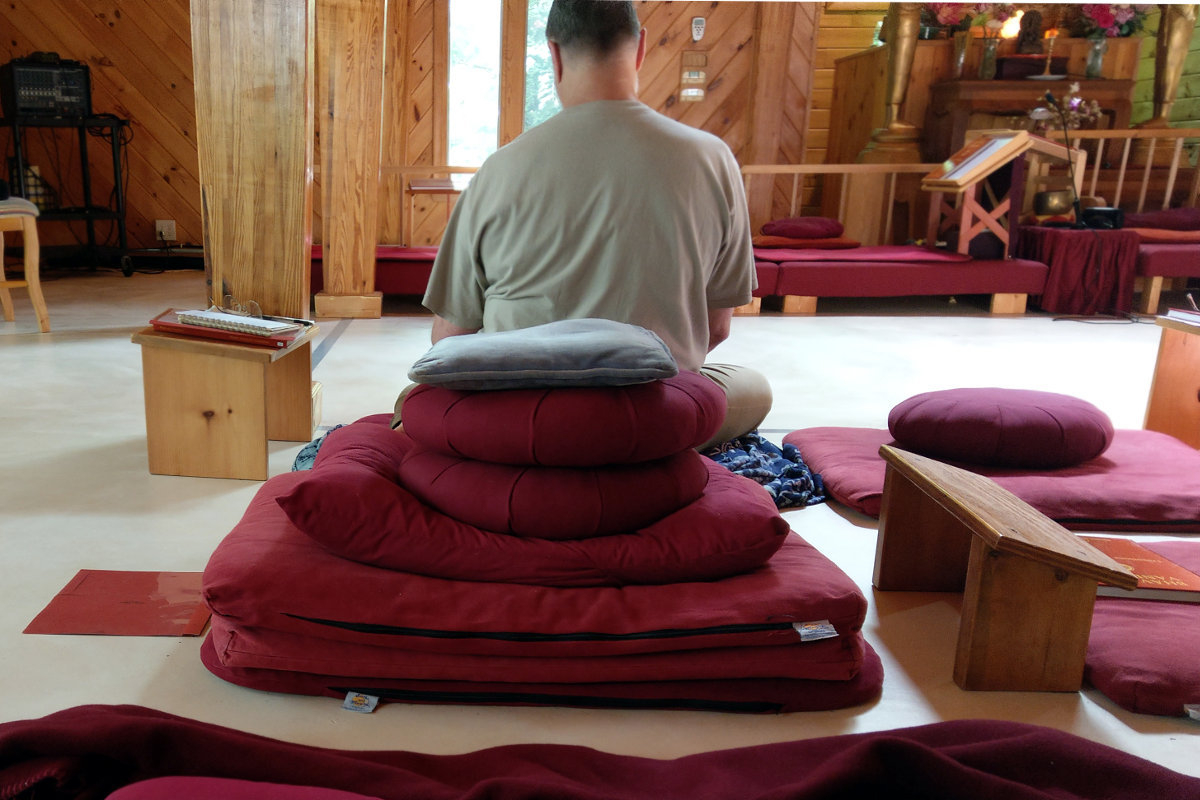
There’s always one… Normally people claim a spot in the meditation hall and have one zabuton (mat) and one zafu (a tall cushion) or meditation bench. One guy sitting a couple rows in front of me built and sat atop a ziggurat composed of no less than three zabutons, a square cushion, two zafus, and another square cushion, with a bench nearby, just in case. He was perched more than two feet off the floor! Which I think is a violation of the vow we took on the first day to uphold the Eight Precepts, specifically the vow to refrain from using high or luxurious beds and seats. Ridiculous!

The food. Normal people always crow about how great retreat food is; I’m too finicky for that, but I found everything surprisingly palatable. Plus there were a couple treats, such as Nutella, Gatorade, and one day we got orange juice. They also provided Sriracha sauce, which I found helped many dishes, except loading up on it wasn’t always the best idea, since I usually didn’t fetch anything to drink with my meal! Still, when the retreat ended, I made a quick stop at Dairy Queen for a Dilly Bar, then grabbed a cola and potato chips to enjoy on the drive home.

My yogi job washing dishes provided some entertainment. I’m used to turning dishwashing gloves inside-out to dry, which is difficult to do unless you know this secret: blow into them like a balloon to reverse the fingers. But somehow I managed to explode two gloves by blowing too hard into them! They blew up with impressively loud bangs during an otherwise silent retreat!

At one point (for some unknown reason) the cook pulled me aside to tell me he thought I looked like Frank Zappa. “Maybe it’s the ponytail?” That’s a new one on me. In the past I’ve drawn comparisons to David Beckham, Steven Seagal, Fabio Lanzoni, and (in a swipe from the ex-wife) Star Trek’s emotionless Mr. Spock.

Even with all this zaniness, it was a good and productive retreat, although three weeks later my knees are still recovering. I was able to meet and practice with Bhante Gunaratana, a cherished teacher whose career is nearing its conclusion; and I gained some clarity about how to practice with and relate to the jhanas (or not). It gave me what my practice needed, and was quite a memorable experience.

Upon coming home, I felt a huge sense of relief. Not because of the retreat, but because I had concluded four months of frequent travel: two weeks gallivanting around Asia in March, a week in Italy in May, and another week on retreat in West Virginia in June. It’s nice to visit new places, but home will always be home, and I was eager to hole up for a while in a familiar place. I wouldn’t mind if there were a few less-eventful weeks in store for me now!

Thailand

May. 2nd, 2018 08:58 am

My second and final weekend in Southeast Asia, Inna and I flew up to Phuket, Thailand for sightseeing and tigers!

While this blogpost only covers our weekend in Thailand, you can read about the rest of my two weeks in Malaysia here, and our other weekend side-trip to Singapore here.

Saturday, 24 March 2018

Saturday morning Inna and I were up early and caught another Grab car to KLIA. While there, we both picked up some chocolate, then got brunch at a place called Secret Recipe. I got a tasty “cheesy fire chicken wrap”.

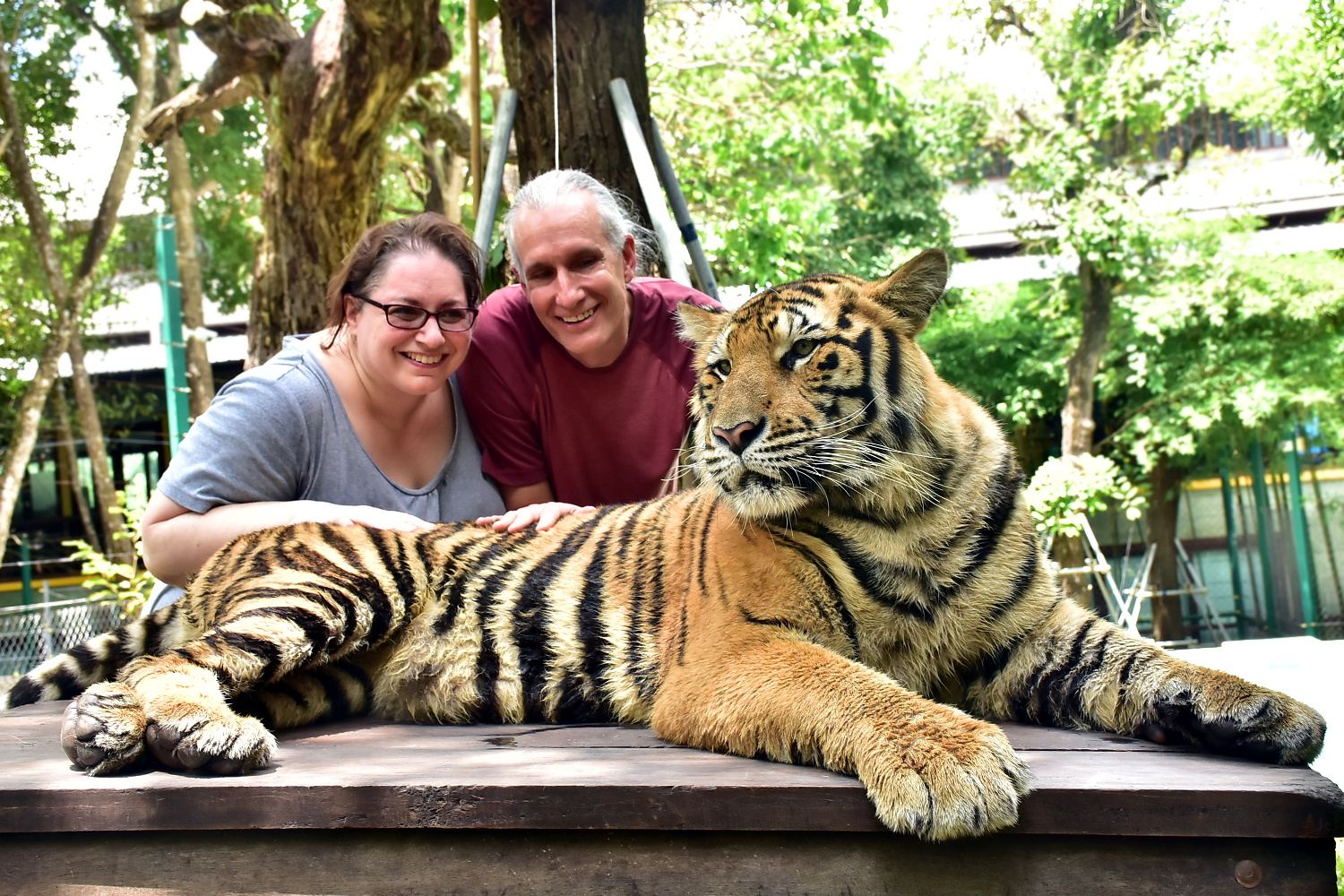
Family Portrait

Family Portrait

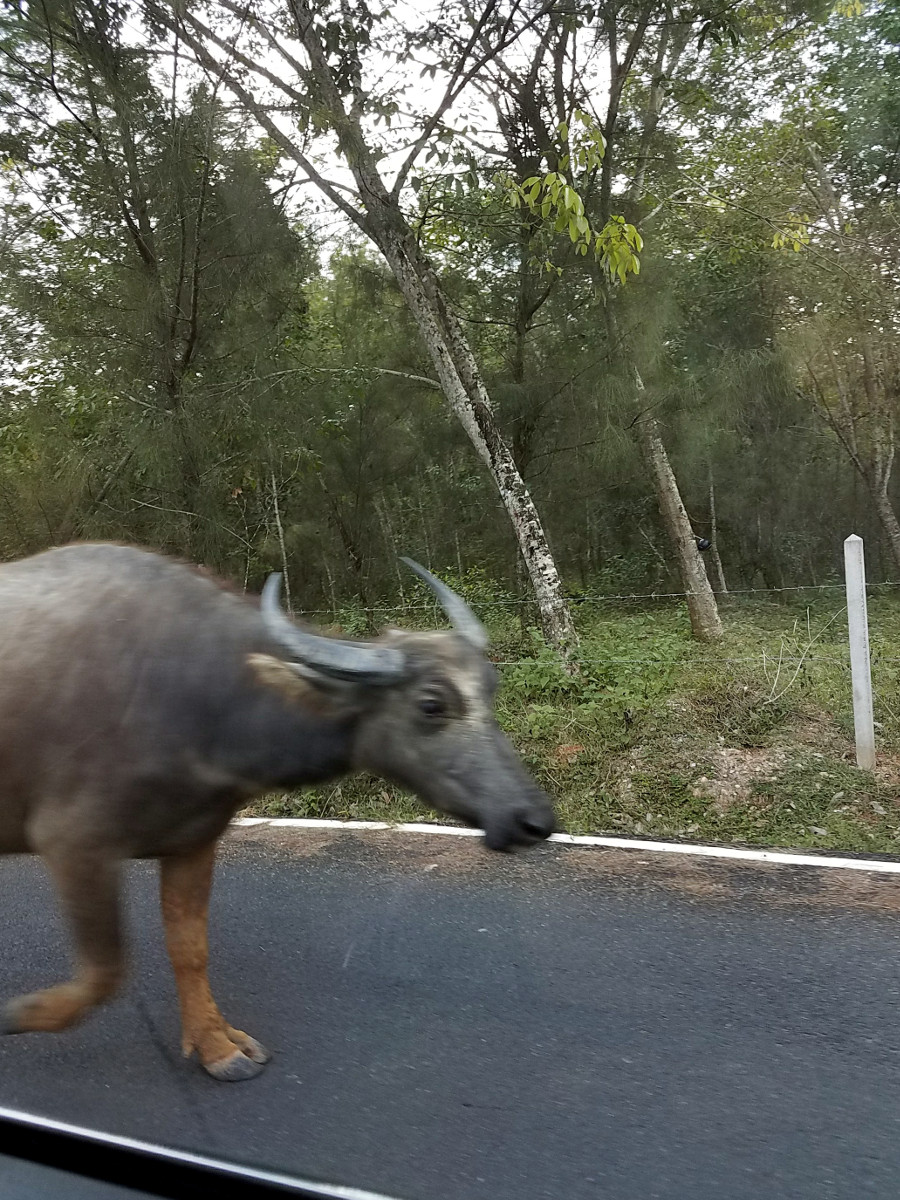
Share the Road

Share the Road

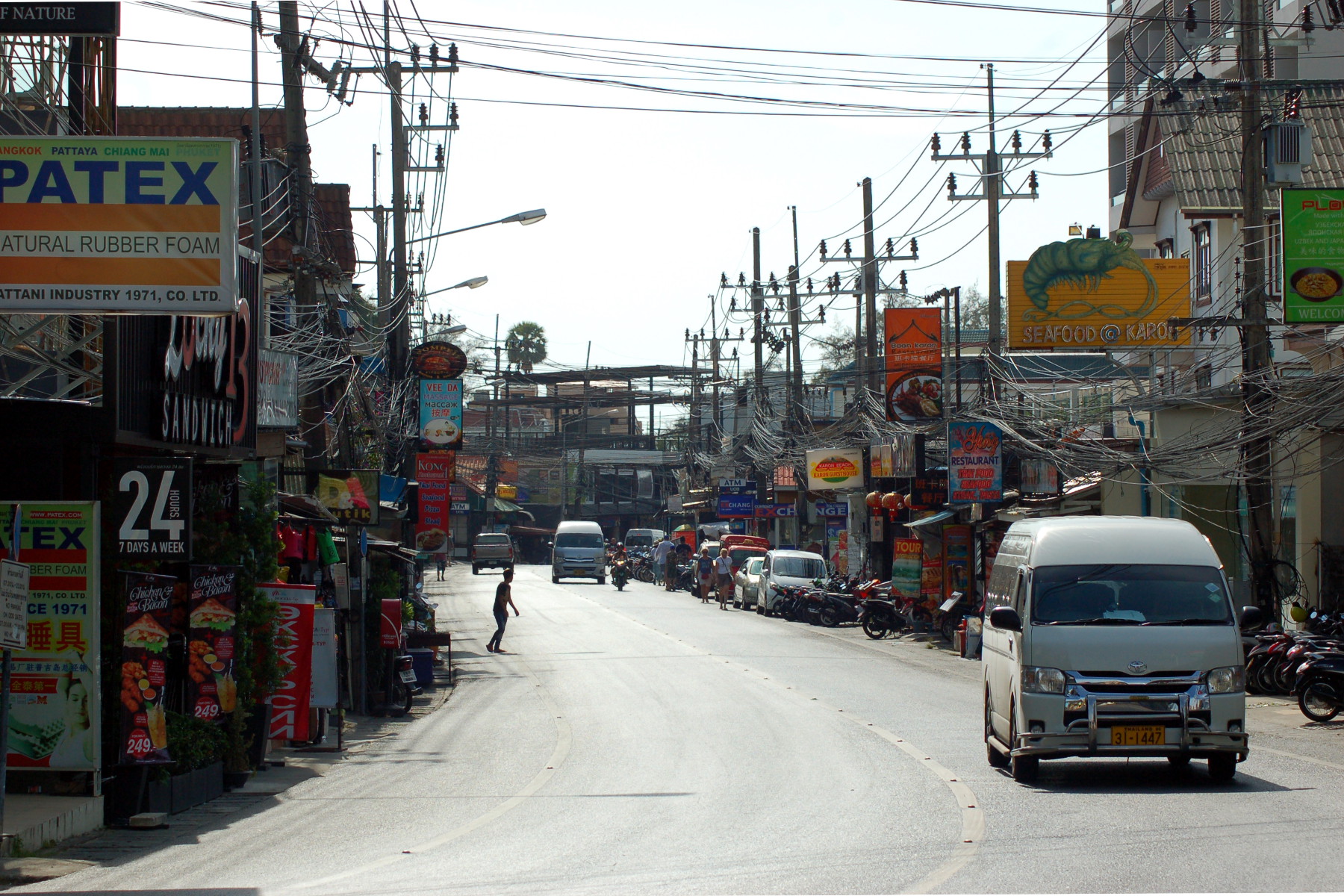
Thailand

Main Street, Thailand

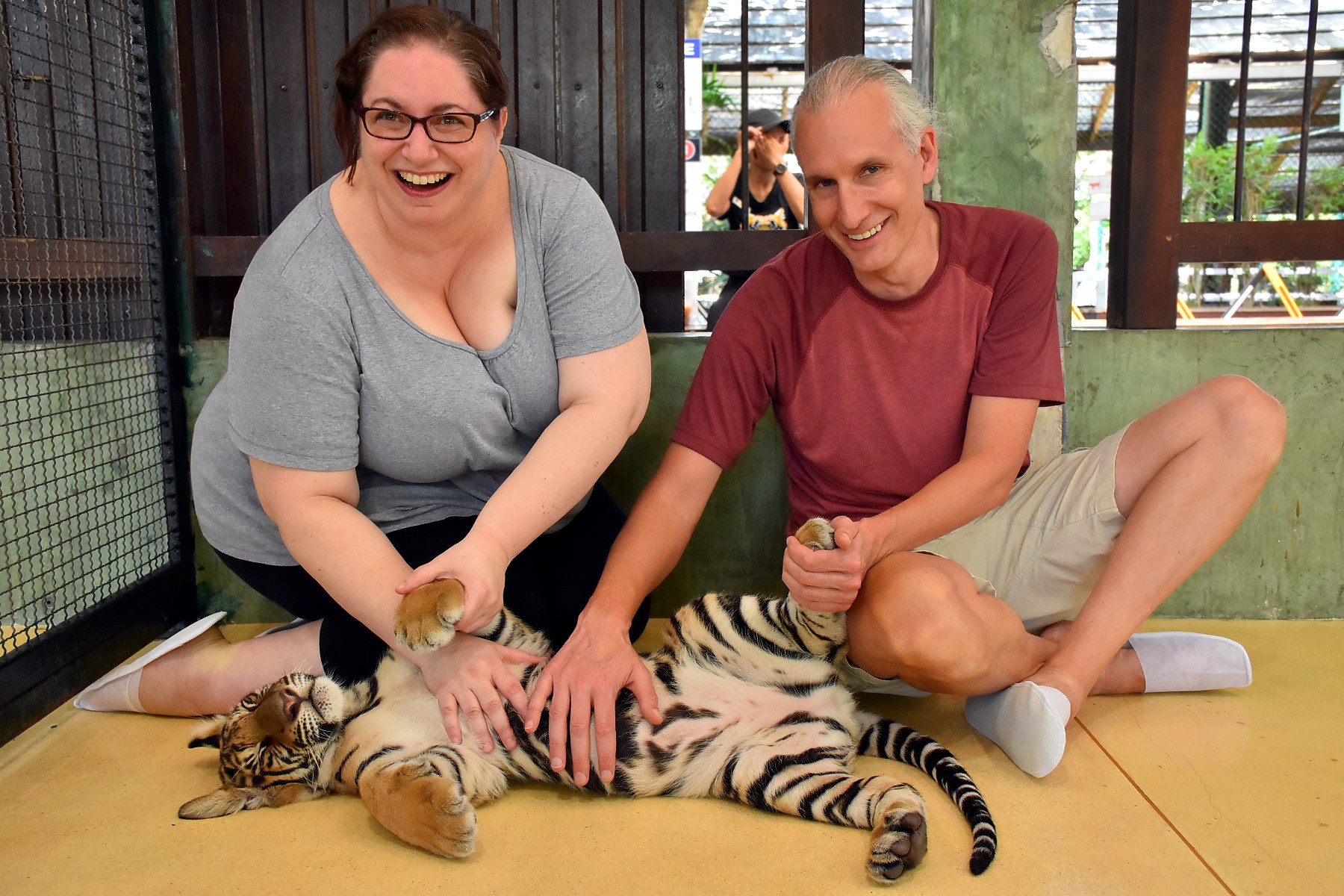
Git the Belly!

Git the Belly!

Give Skull

Give Skull

Motivating the Predator

Motivating the Predator

Good Rubs

Good Rubs

Eye of the Tiger

Eye of the Tiger

Want Some Tongue?

Want Some Tongue?

I Can Has Belly?

I Can Has Belly?

Tiger Ham

Tiger Ham

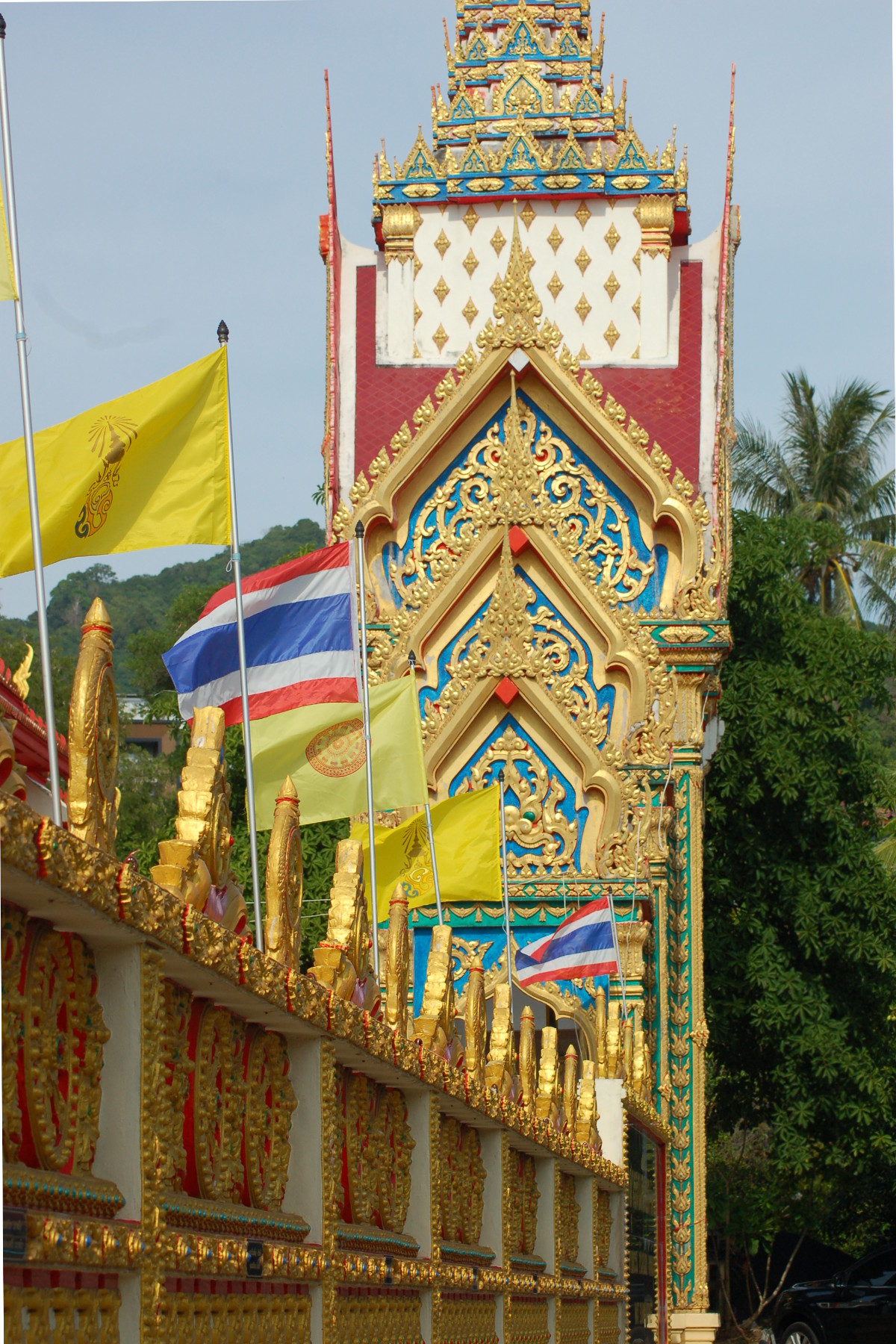
Buddhist Flags

Buddhist Flags

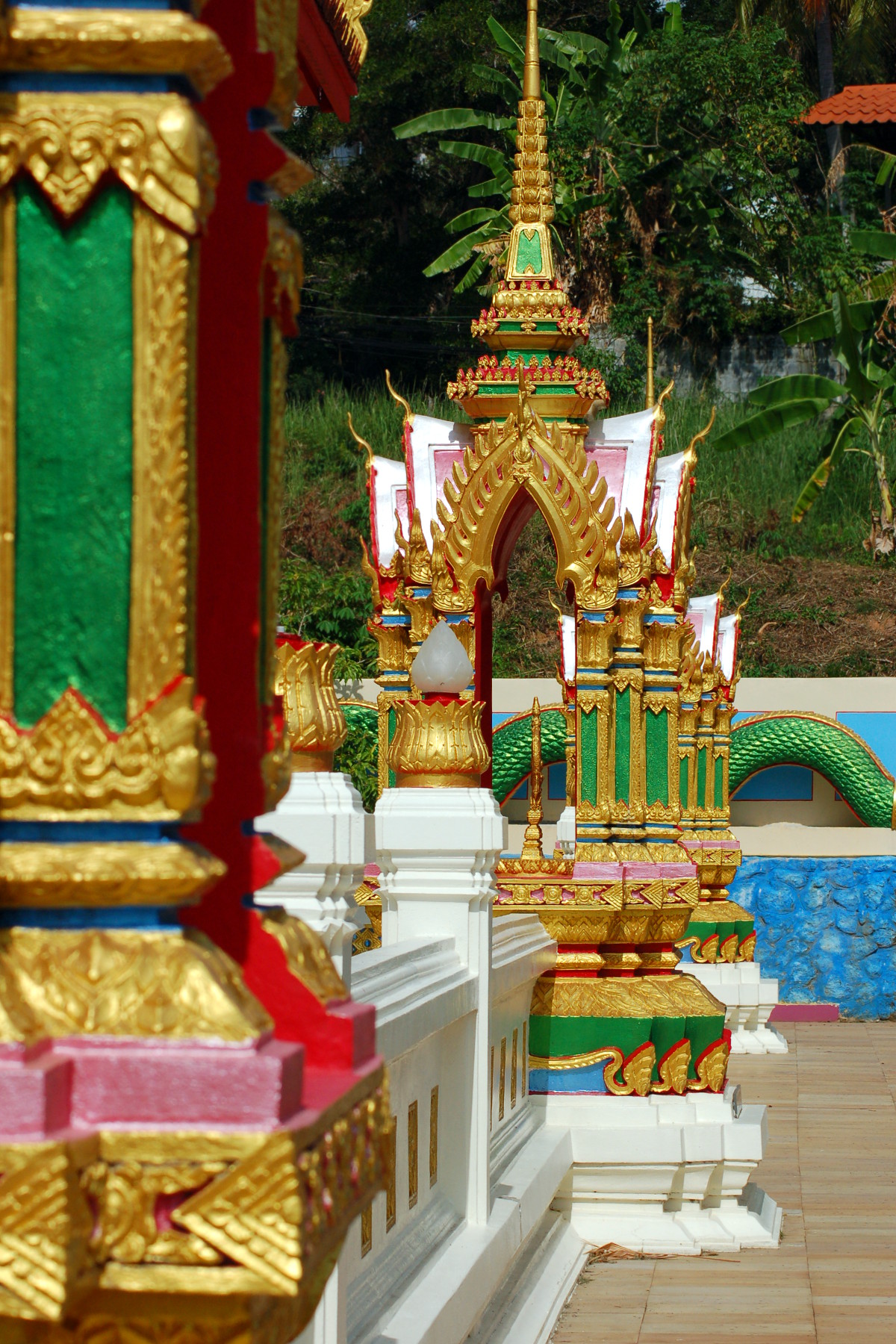
Temple Shrines

Temple Shrines

Phuket Sunset

Phuket Sunset

A Piece of Thailand

A Piece of Thailand

Full Thailand Photoset

Our flight on Malindo Air was quiet, with a landing that passed just feet over the Mai Khao beach before touching down. In fact, the landing strip is so close to the shore that the airport’s colored landing lights extend far out into the ocean, which we could later see shining on the horizon from our resort. We de-planed, got some Thai baht, and hit immigration to obtain more passport “cheese”.

Thailand! For me, who has derived a lot of benefit from the Thai Forest tradition of Buddhism, visiting Thailand was the fulfillment of a lifetime dream. Even though a meditation retreat wasn’t on our agenda, just setting foot in Thailand was a very big deal for me.

As a tourist haven, Phuket isn’t exactly a remote forest monastery. Instead, the island features a ton of super popular beaches, and is also the site of some of the worst devastation from the 2004 Indian Ocean tsunami that killed a quarter million people. On top of that, Phuket set my new high-water mark for westward travel.

What surprised both Inna and I was the immediate and pervasive presence of Russian signage alongside Thai and English and Chinese. There were Russian signs everywhere—down to the take-out pizza menu in our hotel room!—and lots of Russian being spoken by airport visitors. Inna was most surprised that the people speaking unaccented Russian were very obviously ethnically and genetically Asian; logical, since the USSR spanned the entire width of Asia, but a surprise nonetheless!

It was a long but fascinating 75-minute cab ride from the airport to the resort. Avoiding the main highway, the driver took us along narrow back-country roads; at one point, we had to stop while a water buffalo blocked our way! Then we reached more built-up areas that match every stereotype of dumpy poverty-ridden Third World commercial blight, interspersed with stomach-turning party towns full of foreign tourists and the predatory natives who cater to them. Along the way, I tried to recall the Thai I’d learned in an adult ed course ten years ago, while Inna tried to avoid getting carsick from the twisting, bouncing ride.

I was frustrated by two odd technological limitations. First, although the Google Maps app allows you to download offline maps that you can use when not connected to the internet, maps of Thailand are not available. Fortunately, I’d been warned of this and downloaded dedicated maps. Secondly, the difficult Thai script would be the ideal use case for the Google Translate app’s ability to translate script shot using a phone’s camera, but again, that is not allowed. So the Thai government actually outscored Singapore as a visitor-unfriendly police state!

We arrived at Karon Beach and checked into our hotel—the Movenpick—which provided us with nice little lei-style flower wristlets. Our room came with a huge king-sized bed comprised of two twin mattresses side-by-side, as well as a balcony with views of both the ocean and the main pool area. Reminiscent of the strange electrically-frosted glass at the hotel back in Singapore, there were big wooden panels between the bedroom and the bathroom that you could slide aside to reveal a pass-through style opening. Strange!

Arriving around dinnertime, we walked the length of the resort’s large landscaped compound to their Brazilian restaurant. Along the way, we checked out the hotel lobby, the main and satellite pools, the spa, and the grounds overall. We also stumbled into their rec room, featuring a pool table with purple felt, and a pink foosball table! But overall, we were very pleased with the resort.

At the restaurant, I got a nice sirloin, some mediocre corn on the cob, and a new first: a Nutella milkshake! Meanwhile, Inna… Well, let’s see if I can do this justice. What does a Jewish woman born in the Ukraine, with an Israeli childhood, living in America, working on a project in Malaysia, on vacation in Thailand, who doesn’t eat beef, order for dinner? Brazilian charrusco barbecue, of course!

After dinner, since we were close to the beach, we crossed the busy main drag and checked it out. It was quiet and dark, in contrast to the loud commercial chaos along Beach Road. Some people had lit a paper lantern-balloon, and let it soar into the night sky.

Heading back to the hotel, we made our way to the room and turned in for the evening.

Sunday, 25 March 2018

Waking up early again, I let Inna sleep and got some sunrise photos from our balcony overlooking the Movenpick compound, the beach, and the Andaman Sea. Once Inna roused, we checked out Pacifica—the hotel’s breakfast buffet—which was excellent. Then we waited for a cab to take us to our morning destination.

Before my trip, Inna and I had kicked around ideas for where we might go. Langkawi? Panang? Bangkok? Angkor Wat? I considered staying in Kuala Lumpur to catch the final stage of the Tour de Langkawi bicycle race. We didn’t solidify on Phuket until Inna noticed one of her local coworker’s profile icons on Whatsapp: a young lady hugging a tiger. When Inna learned that there was a place in Phuket called Tiger Kingdom that let you pet tigers of all ages that had been raised in captivity… Well, our destination was set. So off we went!

Tiger Kingdom was absolutely amazing! You get 10-15 minutes in the enclosure with 3-5 animals, their watchful handlers, and an optional photographer. The place seemed well-run; the tigers looked healthy, the place didn’t smell, and the staff were attentive.

We spent time with tigers of three of the four age groups: smallest, small, and big cats (passing on “medium”). The smallest guys, about six months old, were utterly kittenish and adorable. Our first little guy was completely passed out, and what struck me was the immense size of his paws! Then, when another group left the enclosure, their more active tiger cub bounded over. At first, I was startled, but the keepers were okay with it, and the new kit decided to spend his time gnawing on our sleepy boy’s head. We also got to play with one girl who was teething and wanted to bite everything in sight (we were given a convenient log to proffer).

The biggest and smallest cats were most popular, so we were the only people visiting the “small” cat enclosure, and the handlers let us stay in there a good long time. Don’t let the “small” fool you, though; these were big, solid predators! We didn’t bring our photographer into this enclosure, which was too bad, because in the heat and humidity, my phone’s camera decided to act up badly.

We finished by visiting the Big Cats, and despite being huge, they were all pretty chill. In the midday heat, one was enjoying a big block of ice placed against her back, and then casually smacked Inna right in the face with the flick of a surprisingly solid tail.

Inna had been excited even before our hour-long visit, but she was downright giddy the whole time, which I found heartwarming. It’s not often she’s so unreservedly demonstrative, and I’m glad I could be there in person to share this experience with her. I was equally delighted, too, although hopefully a little less overtly. It was a stupefyingly cool experience.

To be honest, there’s no way to communicate how awesome it was to sit there, grab a great big tiger’s paw, and rub his belly. In the photos, both Inna and I are having the time of our lives, so I’ll let the photos do most of the talking. As Inna crowed, it was probably the best money we’ve ever spent.

On the return trip, our cab dropped us off on Beach Road, so we visited the beach again. The sea was blue, but not quite the turquoise of the Caribbean, because the Andaman drops off quickly once you’re away from the shoreline. We watched as a parasailer donned a life preserver and got strapped into her safety harness and took off from the beach. Just as the chute was about to be dragged into the air by the motorboat it was tethered to, her local handler, dressed only in a tee shirt and shorts, leapt up into the parachute’s lines, hanging precariously above the tourist’s head, doing the required steering.

The hot sun was too much for Inna, so we crossed back across to the resort, picking up ice creams on our way back to our room. After downloading and checking out all the tiger photos, she and I opted to go separate ways.

I grabbed my camera and hurried off toward town, interested in visiting the local Buddhist vihara: Wat Karon. It was quiet, and I didn’t see anyone other than some guys doing construction, so I just wandered around the grounds, taking lots of pictures. I left a couple dollars, some Thai baht, and some Malaysian ringgits in their donation box before taking my leave. I strolled through town before returning to the hotel room.

Meanwhile, Inna had gone to the resort’s spa for a massage (her credit card receipt says she purchased “1 ORIENTAL FOOT”), so I grabbed a towel and headed across to the beach, intent on absorbing some Thai sun on the last tanning opportunity of my Asian trip. I took a nice, relaxing swim in the Andaman, then dried off in the late-afternoon sun.

After returning to our room, I captured some excellent sunset photos from our balcony before meeting back up with Inna. On the way down to dinner, we hit the gift shop, where I picked up a nice little copper-colored Buddha painting to bring home: to be treasured as an authentic Buddhist item that I had picked up myself on a trip to Thailand!

My dinner, in the transformed Pacifica breakfast space, was a tasty Thai cashew chicken dish. Then back to our room to hang and enjoy our dwindling time in Phuket.

Monday, 26 March 2018

We had a languorous Monday morning, realizing that in less than 24 hours I’d be headed back to Pittsburgh. Inna looked and sounded happier and more relaxed than she’d been after her initial arrival in Malaysia.

We packed up and had another nice breakfast where I opted to try a taste of kimchee. Then we settled with the hotel and hopped our long van ride back to Phuket Airport. This time, the hotel’s driver took the busy, ugly commercial main highway all the way, but it was still interesting.

At immigration, we waited in a huge line full of Russians before getting our exit visa stamps. We endured some confusion due to a gate change, plus having to board a bus that drove us across the tarmac to our plane. The flight back to Kuala Lumpur was a little turbulent, but we landed, sidestepped past customs, and I got my third Malaysian entry stamp in ten days, followed by the usual cab ride home.

Leaving KLIA at 5pm, I would have less than 12 hours in Kuala Lumpur before I was back at the airport for my flight home. That evening was a blur of preparation: dinner at the hotel restaurant (Tex-Mex pizza), unpacking from Thailand and repacking everything to go home, taking a shower, ordering a 4am cab, and heading to bed.

Looking back on Thailand, what remains with me are the incredible contrasts. The most advanced Buddhist country in the world! But wow it’s a commercial dump! But the resort is really awesome! I can’t help but feel the dissonance of a reflective Buddhist culture coexisting with hedonistic beach towns of commercialized hell, massage parlors, pleasure girls, and a disturbing number of recreational shooting ranges.

All the same, between the beach and the tigers and it being Thailand and sharing all of it with Inna… it was an incredible and very memorable trip.

As you might imagine, there are a ton of amazing photos, so you should check out my full Phuket photoset. And you can get Inna’s perspective in her Phuket overview and Tiger Kingdom blogposts.

As mentioned above, you can continue reading about the rest of my trip in my Malaysia blogpost, as well as the side trip we made the previous weekend in my Singapore blogpost.

Malaysia

Apr. 30th, 2018 12:08 pm

Visiting Southeast Asia has always been on my bucket list. Fanatsizing about going maybe someday was easy; but I’ve never had the courage and initiative to start making it happen. So when Inna agreed to a (minimum) six-month work assignment in Kuala Lumpur (Malaysia), I had to make the most of the opportunity and visit her there. And so the trip was planned.

In the end, I wound up going for two weeks in the middle of March, spending four days in Malaysia, three days in Singapore, three more days in Thailand, and the equivalent of four full days flying there and back.

This post covers those travel days and my time in Malaysia. It’s the wrapper story that surrounds followup posts about the weekends we spent in Singapore (here) and Thailand here, which warranted their own separate writeups. Doing that splits my trip report into three digestible, reader-friendly sections, and lets me organize and post more photos from each of those adventures.

But first things first: Malaysia!

Wednesday, 14 March 2018

Kicked off the trip with two Facebook status updates. Since I’d be spending all of 3-14 (aka Pi Day) flying, I made a universally underappreciated comment about spending “pi in the sky”. But I also dredged up a pertinent quotation from Led Zeppelin’s classic “Ramble On”:

Now’s the time, the time is now to sing my song.
I’m goin’ round the world—I got to find my girl.
On my way…

With Inna at Suria & Petronas Towers

With Inna at Suria Mall & Petronas Towers

Petronas Tower from Somerset Roof Pool

Selfie at Somerset Roof Pool with Petronas Tower

Petronas Tower from Somerset Ampang

Petronas Tower from Somerset Ampang

Somerset Ampang from Petronas Towers

Somerset Ampang Roof Pool from Petronas Tower

Petronas Towers

Petronas Towers from KLCC

Petronas Towers

Petronas Towers from KLCC

Petronas Tower 1 Top

Petronas Tower 1 Top from Tower 2

Kuala Lumpur Panorama

Big Kuala Lumpur Panorama

Full Malaysia Photoset

The drive to Pittsburgh’s airport was uneventful other than dealing with freezing temperatures and snow showers. My flight to Chicago’s O’Hare was delayed half an hour due to a broken headset and the need for de-icing. On our final approach to O’Hare, we flew for miles next to another jet that landed seconds before us on a parallel runway. Conveniently, my flight from Chicago to Tokyo had also been delayed 40 minutes because the plane hadn’t arrived.

It’s funny how much can transpire on a 13-hour flight. I stayed awake in order to sync my sleep pattern up with Kuala Lumpur, which is exactly 12 hours off from Pittsburgh time. I kept an eye out for aurorae, which were active following a solar storm, but I saw none. Flying All-Nippon Airways (ANA), I tried the Japanese version of curried rice for the first time, and cold noodles in a light sauce. I had a brief scare when I lost my reading glasses on the floor in a fully-darkened cabin. But the highlight of the flight was getting a fabulous nighttime shot of the lights of snow- and ice-bound Nome, Alaska from 34,000 feet.

Jumping the Date Line requires a new timestamp, so:

Thursday, 15 March 2018

After doing the Date Line time warp, I arrived in Tokyo late Thursday night. It was my second time in Asia, and the first since a work assignment in Seoul in 2008. Back then, my connections were also in Tokyo, although this transfer was at Haneda, rather than Narita. I arrived to lots of Facebook Likes and a welcome exchange of messages with Inna.

It was an easy process—but a long walk—to my next gate, where I charged my devices and did a little exploring. My most noteworthy observation: to alert oblivious pedestrians that something’s behind them, instead of mechanistic beeping, the little terminal golf-carts at Haneda play the tune of Disney’s “Heigh-Ho” song from Snow White.

My third flight of the “day” took off just after midnight, which means another date stamp:

Friday, 16 March 2018

Another eight uncomfortable hours in flight.

Having gone sleepless for more than 40 hours, I was unhappy and barely functional. One highlight was flying over the Philippine island of Palawan, although I was on the wrong side of the plane to see it.

At the end of my three-day flying ordeal, we finally approached Kuala Lumpur International Airport (KLIA). But as we were about to touch down, the pilot gunned the engines, climbed, and performed a complete go-around for another try at landing. I couldn’t make out the explanation they offered, but I think they mentioned the control tower. Kind of disconcerting.

After de-planing, the first stop was customs and immigration, where I garnered my first “cheese”: our shorthand term for the reward at the end of the long lines. One of my goals for this trip was to accrue some new passport stamps to join the lonely one from Mexico back in 2010 before my current passport expires. Happily, I received a Malaysian entry stamp, then found my luggage, bought me some Malaysian ringgits and a prepaid taxi voucher, and hopped a cab.

Obviously, Malaysia is a foreign place to me, and it’s also a Muslim country, so I was primed for things to be different. This was most apparent when I noted that every announcement over the airport PA ended with the phrase: “… and have a Happy Jenni”. I was surprised that I’d apparently landed in the middle of some kind of major holiday, whatever “Jenni” was. But eventually Inna and I figured out that it was just an odd pronunciation of what they were really saying: “Have a happy journey”!

That was followed by an hour-long taxi ride from the suburban airport to the heart of KL’s business district and Inna’s hotel: the Somerset Ampang. After leaving a snowy Pittsburgh, I reveled in the humid, tropical heat and the sight of lush hills full of palm trees. Having landed at 7am Friday morning, Inna had just begun her normal workday, so after getting into her empty suite I unpacked, tested out the roof pool on the 22nd floor, then enjoyed a long-anticipated shower. From the pool, I could see one of KL’s two Petronas Towers, knowing my baby was working right over there, on the 75th floor.

Having worked a half day, Inna came home around 4pm. It was the first time I’d seen her in two months, and it was a nice reunion, although by then I was staggering due to sleep deprivation. She kindly guided me through dinner (teriyaki chicken) at the hotel restaurant (Souled Out). After 50 hours without sleep, I finally collapsed into bed, while Inna stayed up and conscientiously booked our last-minute flights and hotel in Singapore. I’m grateful for her help, because I was in no condition to execute, and without her diligence, my trip would have been a lot less eventful and memorable.

The next morning, less than 24 hours after I landed, I was back at KLIA where Inna and I hopped another flight to Singapore. We explored the town on Sunday and returned to KL Monday night. We had an amazing time, but the events of that side trip will all be related in a separate blog post devoted to that weekend in Singapore.


Tuesday, 20 March 2018

Having returned to Kuala Lumpur Monday night from our long weekend in Singapore, Tuesday morning Inna returned to work at her office in the Petronas Towers. While she engaged in a regular work week, I had the rest of the weekdays to myself.

After spending two days flying to Asia, followed by the weekend’s side trip, I was still exhausted. My Tuesday plan was to relax all morning, catch up on my email and web reading, and hit a grocery to get some foodstuffs.

In what would become my daily ritual, I went up to the roof pool around 10am for a leisurely swim and some early sunbeams, then came back down to shower. Although on Tuesday I tried out Inna’s window-side jumbo-size tub, which I mostly fit into. In the afternoon, I scampered across a major intersection to the nearest grocery-esque store and stocked up on fluids and snack foods, including a knockoff-brand Pringles potato chip in “green curry” flavor… not recommended!

After work, Inna took me to Pavilion, one of KL’s many malls, to have dinner at Wild Honey, her favorite breakfast place (yup, pancakes and sausages for dinner), then ice cream at Baskin Robbins, and an interesting dollar store called Daiso Japan. While I enjoyed the shopping, that part of KL is all huge malls populated with international luxury brands, and I’d hoped for something with more local flavor.

We were back home and in bed before the equinox hit at 15 minutes past midnight.

Wednesday, 21 March 2018

Wednesday was accidentally another rest day. After seeing Inna off, I had my swim and did more catching up online. While I was enjoying 90-degree Equatorial warmth, Pittsburgh had received ten inches of snow, with temperatures in the 20s and 30s: far below climate normals for late March. So sad!

I planned to hop a 2pm shuttle, do some more shopping, and then visit Inna at work, but she let me know that she was going to be working in a locked room, isolated and without communication, until at least 5:30pm, so at the last minute I decided to punt. In the end, I just hung around the hotel, relaxing.

Although I’d originally hoped to catch the Tour de Langkawi—a professional bike race—the following weekend, Inna counter-proposed flying to Thailand and playing with tigers, something she’d discovered from a coworker. It was ridiculous how stoked she was about playing with big cats, and I definitely wanted to share that experience with her. So later that evening Inna booked our tickets for Phuket. We were both very excited.

Thursday, 22 March 2018

The next morning, in addition to my obligatory morning swim and sun, I did a load of laundry. It was my first time using a combined washer-dryer unit, and it was fine, other than the inconvenient 5-hour cycle time.

Hoping to execute my aborted plan from the day before, I grabbed my dSLR and walked through the KLCC Park that stood between our hotel and the Petronas Towers. I took my time, finding ample places to compose photos of the iconic buildings.

Of course, there’s a mall (called Suriya) at the foot of the towers, so I made my way to my shopping target: a Japanese bookstore called Kinokuniya. I browsed the cycling and extensive manga collections, but in the end I gravitated toward the section on Buddhism. I found many familiar books on vipassana by authors that included my teacher Larry Rosenberg, Gil Fronsdal, Ajahn Brahm, Goenka-ji, Jack Kornfield, Tara Brach, Sylvia Boorstein, Sharon Salzberg, Ajahn Sumedo, and others. In the end, I picked up three titles: “Bear Awareness: Questions and Answers on Taming Your Wild Mind” by favorite teacher Ajahn Brahm; “Vipassana Meditation as Taught by S. N. Goenka” by his student William Hart, and “Buddhist Ethics” by Hammalawa Saddhatissa.

After finding nothing else of interest in the mall, I met up with Inna, who got me free visitor access to the tower and took me up to her working space on the 75th floor (of 88). There I met several of her coworkers and clients, took a few panoramic photos of the KL skyline, and hung around until Inna was ready to leave.

From there, we had dinner at Ben’s, a restaurant in the Suriya mall, where I had yet another pasta carbonara. Despite Southeast Asia’s reputation as a culinary destination, I didn’t find anything special to recommend it. But the couch was comfy, and we had a nice view of the evening light show in the fountain between the towers and the park.

Inna’s coworkers pinged about going out for drinks, but, already eating, we demurred. However, on our way out of the mall, she spied a couple friends on the escalator. After we lost them on their descent, one of them (Freddy) tracked us down. He graciously took a couple photos of Inna and I in front of the fountain lights, and the three of us hung out for one round of drinks before he ambled off toward Jalan Petaling, one of KL’s Chinatowns, while Inna and I caught a quick cab home.

Friday, 23 March 2018

With more air travel scheduled for Saturday, I declared Friday another rest day. After my swim, I had lunch at the hotel restaurant, got a few hotel errands done, and tried to nap.

Inna went out with her coworkers after work, so I just hung out. When she finally came home, she stayed up late booking her flights for a May trip home, which will be followed by a family reunion in Florence, and then back to KL.

The next day we would hop a plane to continue our adventure with a long weekend in Phuket, again returning Monday evening. You can read about that side trip in my Thailand blogpost.


Tuesday, 27 March 2018

I had a mere 12 hours between returning to KL Monday night from our long weekend in Phuket, Thailand, and my departure flight back home the next morning.

I roused myself at 4am Tuesday to say goodbye to Inna, then slipped out into a rainy morning. After a long, characteristically pensive cab ride to KLIA, I quickly got through customs, acquired my third Malaysian exit visa stamp, hopped the Pittsburgh-like train between the landside and airside terminal buildings, and waited for my flight to Tokyo.

On board, I couldn’t sleep, and instead composed an email to Inna with thoughts about our visit. Seven hours later, landing this time at Narita airport, I was pleasantly surprised to see the runway lined with sakura: cherry trees in blossom, a favorite symbol of Japan. While waiting for my next flight, the Japanese televisions showed news reports about the progress of the cherry blossoms, rightfully a matter of national import.

Two hours later, while boarding my flight to O’Hare, my seatmates asked me if I would move to another row so they could co-parent their screaming progeny. Citing a 36-hour journey, I outright refused, unless they could provide me a window seat with a bulkhead I could lean against to sleep. Even for Buddhists, compassion for others is no more important than self-compassion. They eventually found someone who would switch; that person took only the aisle seat in my row, which left the middle seat unoccupied! What a blessing on a 12-hour flight!

I’d need every possible chance for sleep, because their breeding experiment wailed like an ambulance, accompanied by coughing fits from a handful of passengers who sounded 87 percent dead from tuberculosis. Unable to sleep, my fortitude was down to zero when we finally reached O’Hare.

In Chicago, I had to go through immigration and customs, re-check my bag, take a train between terminals, and pass through another security checkpoint. Fortunately, I had a three-hour layover, and managed it easily. I found myself dangerously wobbly and close to passing out, even after downing a small pizza. After more than 24 hours without sleep, I was back in the sleep deprivation zone, and desperately needed to get myself home and in bed.

Happily, the flight from Chicago to Pittsburgh was short and quiet, and my checked luggage was spat out onto the conveyor just as I approached the carousel. I dragged my bags out to the car, loaded myself up, and drove home to an enthusiastic reception from a very lonely—but something short of tiger-sized—cat.

Malaysia wasn’t quite what I expected. Before I left, my biggest concern was that Malaysia, as a strongly Muslim nation, complete with calls to prayer broadcast over loudspeakers, would feel extremely alien. But what I found was a surprisingly diverse, cosmopolitan society.

English might not be the primary language amongst Malays, but it’s present. They use the English alphabet, so (unlike Thailand) you can eventually learn Malay words by reading them. But if you rely on English, be aware that their spelling is idiosyncratic if not downright creative. You might figure out how to get to the universiti or a katedral or the sentral rail station. Or you can catch a bas or a teksi to the konvensyen center or the muzium of tekstil. Or relax at the rekreasi park or the golf kelab, which is in another seksyen of town. And make sure you ask for extra sos for your food.

Having found itself awash with oil money, Malaysia shows the inefficiencies of rapid growth, with a melange of modern high-rises displacing dilapidated and uninspired neighborhoods that had themselves only recently overtaken outright jungle. It’s an ethnically and economically segregated society, and what I saw of it—mostly downtown malls—lacked any connection to its history or locality.

To be fair though, I did a poor job exploring KL, lacking the time or motivation to venture beyond the bland, characterless malls and the immediate temptation of our hotel roof pool.

Epilogue

Having been through the details in this and subsequent blogposts, let’s take a step back and review the big picture.

I’m particularly challenged by international travel, or more properly not knowing the local language. That wasn’t a major factor, as there was plenty of English in use.

Despite that trepidation, I’m delighted to have added nine new pieces of “cheese” to my passport: three pairs of Malaysia entry and exit visas, another pair from Thailand, and an entry stamp (only) for Singapore. Plus two connections on the ground in Tokyo, as well. Great success!

Beyond that, I set new records for the farthest I’ve traveled south and west. I somehow survived ten flights totaling 22,000 miles and 50 hours in the air, plus uncounted hours of the usual airport runarounds. And despite all that travel, I happily didn’t contract any illnesses.

On the other hand, because I couldn’t sleep, each transcontinental flight amounted to staying awake for two consecutive all-nighters. Doing that twice in two weeks would be a major trial, even for someone half my age! Although I was nearly delirious due to sleep deprivation, not sleeping did make it easier to deal with jet lag, despite the 12-hour difference meaning daytime was suddenly night and nighttime suddenly was day.

Contrary to the warnings I was given, I found it much easier traveling east, because I got home in the evening and could immediately collapse in bed, whereas on my outbound trip, I had arrived at 7am and had a whole day ahead of me before I could (or should) go to sleep.

With only four days in KL, and three each in Singapore and Phuket, I was a little disappointed that I didn’t have the chance to do any biking, or visit more than one Buddhist vihara, and little local food or shopping. I’ve been spoiled by my trips to Scotland and St. Thomas, where I had weeks—if not months—to explore and get to know my destination, which I vastly prefer. With Inna based in KL, I should have devoted more than two weeks, but I’d been a little apprehensive, and didn’t want to distract her from work, either.

Of course, that was all balanced by the wonders we did experience, such as Singapore’s Gardens By The Bay, Phuket’s Tiger Kingdom, and swimming in the Andaman Sea. I have some amazing photos and memories that I’ll always treasure.

And I enjoyed swimming in the hotel roof pools each morning. Though I felt a little awkward doing so, the epitome of the idle rich white man. After all, I had nothing better to do than travel from snowy Pittsburgh to Southeast Asia to lie around all day and absorb the equatorial sun while everyone else was working their mundane day jobs. Coming from middle-class roots, I’m just not comfortable with the idea of such conspicuous self-indulgence.

Beyond the passport stamps, the tropical sun, and the exotic sights, the main reason behind my trip was spending time with Inna, seeing how she was making out, and doing what I could to relieve some of the familiar stress that comes with working abroad.

Fortunately, over the weeks and months, Inna has gotten comfortable with her clients and confident in her role and what’s expected of her. So many elements of her project remind me of my half-year deployment in St. Thomas, which was strenuous, amazing, and absolutely off-the-charts ridiculous. The day she left Pittsburgh, I wrote that “I’m incredibly proud of her career progress”, and three months later, that sense of pride has only increased. She’s been kicking ass, and it’s awesome to see.

I’m surprised that despite the equatorial heat, Inna has taken to Kuala Lumpur, to the extent that she might be open to extending her stay. I will, of course, be very interested in how that question resolves itself in coming months.

Continuing the topic of stress, this trip was a test for Inna and I, and our ability to work together under challenging conditions. We made it harder for ourselves by not discussing our plans for our two weekends until the absolute last minute. I’m particularly thankful for her willingness to handle the arrangements for Singapore and Phuket while I was comatose in bed trying to catch up on sleep.

As with any partnership, we each had our moments of difficulty and irritability to work through, but in the end we made a great team, helped one another out, achieved most of what we wanted to do, and built an immense pile of memories together that we can share and cherish.

I don’t like her living on the opposite side of the planet, but it did afford me the opportunity and the impetus for a once in a lifetime trip: one I’d dreamed about for years. I’m glad to have taken that rare opportunity, and to have shared such a memorable experience with the woman I love.

Having read this through, if you’re interested, here are links to more images and text about my trip.

When the philosophy behind Vipassan⁠meditation started to resonate for me, I went through a phase of hoovering up as much as of the dhamma as I could get my paws on. Not content with my meditation center’s weekly dhamma talk, I subscribed to podcasts from teachers like Gil Fronsdal and Ajahn Brahm and drank deeply from the resulting firehose of teachings. Once new meditators find the dhamma, it’s not uncommon for them to go through an intense period of curiosity and enthusiasm like that.

I recently gave a talk about the importance of learning about the dhamma. Although I provided a verbal list of resources to help meditators self-educate, I have assembled this blogpost for easier and more permanent reference.

Although there are many flavors of Buddhism, this list focuses on Vipassan⁠or Insight Meditation, which has become popular in the US, as evinced by the success of the meditation centers and teachers listed below. So my most fundamental pointer is to seek out anything that claims to belong to the Vipassan⁠/ Insight Meditation heritage, as there are a ton of resources beyond the few items I can list here.

Audio & Video Resources

Why list audio resources first? Because the dhamma has traditionally been shared via “dhamma talks”, but also because it’s a much more personal experience, allowing the listener to really connect with and get a feel for the teacher and the teachings. I truly believe that the experience of listening to the dhamma is the best way to learn about it (and preferably in-person, when possible).

DharmaSeed
This website contains an ever-growing collection of tens of thousands of high-quality audio recordings of dhamma talks by hundreds of amazing teachers, collected over a period of more than 30 years. It is an absolutely incomparable resource that I cannot recommend highly enough.

Audio Dharma
Gil Fronsdal is perhaps my favorite teacher, and this site offers recordings of dhamma talks given by Gil and other teachers at his Insight Meditation Center in California. While most dhamma talks are about 45 minutes long, this site also has shorter talks they call “darmettes”.

Buddhist Society of Western Australia
Ajahn Brahm, the Spiritual Director of BSWA, is a monk in the Thai Forest tradition of Ajahn Chah. A Londoner by birth, his sense of humor has made him a widely-sought-out speaker. The BWSA Teachings web page links to a rich collection of both audio and video dhamma talks. Ajahn Brahm is also the author of several very readable dhamma books.

Amaravati Monastery
Located in south-eastern England, Amaravati is another monastery in the Thai Forest tradition. The Teachings section of their web site contains lots of dhamma talks by respected teachers as well as a handful of videos.

Recommended Reading Lists

Before I dive into my own suggestions, here are some excellent reading lists compiled by major Insight Meditation centers.

Insight Meditation Society, Barre MA
The very successful first American Insight Meditation center has a definitive list of the best books around, sorted both by author and topic.

Cambridge Insight Meditation Society, Cambridge MA
Boston’s CIMC provides a slightly more succinct list, with lots of overlap with the IMS list.

Insight Meditation Center, Redwood City CA
IMC’s list naturally focuses on Gil Fronsdal’s books, but also includes many others, organized by topic.

Bhavana Society, High View WV
The list at Sri Lankan monk Bhante G.’s center naturally focuses on his works, which span the entire spectrum from beginner to expert.

My Book Recommendations

Although there are lots of commercially available books on Insight Meditation, you don’t have to spend a ton of money on them. Borrow books from your library or your fellow practitioners. And you can also usually find free books at your local meditation centers, because the dhamma has traditionally always been offered free-of-charge.

Also, before you spend money on a book, check to be sure its tone and texture is right for you. Meditation books tend to fall into two camps: really dense, esoteric, academic books for the advanced practitioner; and down-to-earth books that are more approachable and suitable for the rest of us. Although there are exceptions to every generalization, often the former are written by monastics or Asians for whom Buddhist philosophy and the Pali language were part of their upbringing. In contrast, most of us will be more comfortable with the westernized material written by Americans who studied in Asia.

Having said that, here are some of my specific recommendations:

Although I don’t have specific books in mind, I also highly recommend books and talks by any of the following teachers:

  • Jack Kornfield
  • Sharon Salzberg
  • Joseph Goldstein
  • Tara Brach
  • Sylvia Boorstein
  • Cristina Feldman

Pali Canon Suttas

Finally, I would be remiss if I didn’t mention the Access to Insight web site. Although it’s not something a beginner would curl up with in front of the fire on a cold winter night, it is nonetheless an excellent repository of the original suttas that comprise the Theravadan Buddhist canon. If someone mentions a sutta that sounds interesting, or if you just want to explore the source material, this is your best online resource. The most fundamental discourses for Vipassan⁠practitioners are:

And another very similar site is SuttaCentral.

May your exploration of the dhamma be fruitful and rewarding!

Inna wanted to go to the 2017 Meetin national celebration in Seattle in September, and it made sense to piggyback that with a detour up to Victoria BC to visit my brother, since—after my mother’s death—he’s unlikely to be coming east any longer.

The logistics were enough of a nightmare that we actually needed a travel agent’s services. Inna and her mother flew direct to SFO to visit family for a few days. Then Inna flew OAK (not SFO) to SEA while I simultaneously got from PIT to SEA via IAD. After the Meetin gathering, we’d take the ferry to Victoria BC, then eventually get home flying Air Canada together from YYJ to YYZ to PIT. Meanwhile, Inna’s mother returned on a direct flight from SFO. Yeah. Glad to have an agent handle all that.

Seattle Skyline & Rainier

Seattle Skyline & Rainier

Danger Man

Danger Man

Self-Portrait in Steel

Self-Portrait in Steel

Inna's on the Ball

Inna's on the Ball

The Sky's the Limit

The Sky's the Limit

Family @ Observatory Hill

Family @ Observatory Hill

Sunken Garden

Sunken Garden

Japanese Garden

Japanese Garden

Full Seattle photoset

Full Victoria photoset

Tuesday, the day before I left, was memorable for two reasons.

First, having just gotten over a three-week long summer cold, I woke up with another sore throat, heralding another ugly illness spanning the duration of the trip.

Second, that evening I had a ticket to go see Walk With Me, a movie centered around Buddhist icon Thich Nhat Hanh’s meditative community at Plum Village. Between this and other previous films, I’ve become convinced that the medium of film really isn’t a good vehicle for introducing Buddhist philosophy to the masses. But that’s really not a topic for this blogpost…

After I returned home, my sore throat left me with a sleepless night before an early Wednesday morning walk to the bus stop, then a two-bus expedition out to the Pittsburgh airport. Having lived without owning a car for more than twenty years, I hadn’t even thought about driving!

My first flight—from Pittsburgh to DC—was delayed 30 minutes by a maintenance issue, causing me to skip my planned combined breakfast and lunch as I loped through Dulles seeking my connecting flight.

After five hours with absolutely zero legroom in a United cattle car, I touched down at SeaTac hungry, tired, and sick. I ignored the seventeen text messages from our catsitting friend and hoofed it to the Uber lot to meet up with Inna, who had flown in separately from Oakland CA.

Although I’ve made half a dozen trips to the PNW, I’d never been to Seattle, so everything here was new to me.

After a lengthy drive into downtown Seattle, we tried to check into our hotel—the Inn at the WAC—only to discover that our room wasn’t ready. We had only planned to drop our bags before heading out for dinner anyways, so we simply got a recommendation from the desk clerk and headed straight to the nearby Tap House Grill. I had a French dip sandwich and ice cream, while Inna ordered shrimp and tiramisu ice cream, which wound up being her favorite meal of the trip.

We returned to the hotel to find a tray with hot tea, cocoa, a chocolate bar, and a handwritten note—to Mr. and Mrs. Nirenburg—waiting in our room, since the staff had overheard Inna mentioning my illness. Inna tracked down Sheela and Monika, our Pittsburgh friends who were also attending the Meetin gathering, and the four of us chatted briefly in our room. After a long day of travel for me, we opted to skip arrival-day festivities in favor of rest and a quiet evening in bed.

Thursday morning we were up early to join a small group of Meetin people exploring Pike Place Market. Along the way, I snagged a cinnamon bun for breakfast. We observed the market’s outdated manual daily stall-assignment ceremony, then took a brief guided tour with still more Meetin peeps. With tired legs, Inna and I wandered off for some overpriced ice cream. Then I spied a stall selling roasted corn on the cob, but balked at the ludicrous $5 price tag. We both eyed the beautiful ristra hot pepper arrangements—each for different reasons—but realized they would be impossible to transport back to Pittsburgh.

We joined another big Meetin group for lunch at the Pike Brewing Company, but left before ordering when Inna realized she wasn’t sure if she had forgotten her medications in San Francisco. That led to an afternoon of phone tag with doctors and chasing around drugstores before we returned to the hotel, where she found them hidden in the bottom of her bag.

But along the way, Inna picked up some dahlias for our room, and I ducked into Metsker Maps, where a postcard with a bicycle and the phrase “Conquer the Hill” called out to me in anticipation of my upcoming Dirty Dozen ride.

Tired after so much walking, we were content to rest in the hotel until the evening event: a meet-and-greet at the top of Smith Tower. On the way, we experienced elevator malfunctions in both our hotel and our destination. Smith Tower is a lot like Boston’s Custom House Tower. Both are about 35 stories and 490 feet tall, with an open-air skywalk observation deck at the top. We took a few pictures of the view, then went in to chat with other Meetin folks. Those included Mary McDaid (Portland OR), event organizers Anita Christensen (Portland) and Helene Pincus (Las Vegas), and I had to interrogate Deanna Cochener, whose cellphone case loudly announced that she was a Portland Timbers supporter.

Afterward we wandered around with Monika, stopping to admire the Seattle Public Library. The steep hills in downtown Seattle were vaguely reminiscent of Pittsburgh, and we shared an uncomfortable laugh when one woman apologized to us as her dog’s feces literally rolled and bounced down the steep sidewalk into our path. In Westlake Park plaza we found a giant-sized Connect Four game, and I promptly destroyed Inna twice running, despite never having played before. The girls stopped in a mall for Pike Place Chowder, while I brought a theoretically fast Mod Pizza back to the room.

Friday was really the main Meetin day. After Uber failed us—and charged us anyways—we got ourselves invited to share a Lyft summoned by New Yorkers Ricky Evans & Zhenya Brisker. That dropped us at the morning’s activity: a duck tour. While waiting, Inna & I chatted with Laurelee Langan, who was there representing Boston. Despite my having been through at least two dozen duck tours, the tour itself was fine, featuring Amazon’s HQ, the Fremont Troll, houseboats and floatplanes on Lake Union, and lots more. Near the Belltown Apartments, the tour guide indicated we were passing through a quiet zone, which I happily observed, having lived for ten years on the Boston duck tour route myself.

Afterward, rather than spending $33 each to get into the Museum of Pop Culture, we opted to visit a local food court with Sheela and Portlanders Bijana & Ankesh Kadakia. Still illin’, nothing appealed to me but fries.

After lunch, the “Meeps” gathered up again to go through the Chihuly Garden and Glass museum. The exhibit was short but breathtaking. In the middle of the tour, I remembered to show people that the abstract background image on my cellphone has for many years been a close-up of a green-and-yellow work of Chihuly glass that I took back at the 2000 Dargon Summit at Pittsburgh’s Phipps Conservatory, which you can see here.

After that, Inna and I returned briefly to the food court before walking down to the Olympic Sculpture Park and rejoining the larger group. We wandered around, enjoying another warm, sunny afternoon. While resting at one point, a kid ran up to Inna asking in an incredulous voice, “Hey lady, is that your belly?!?” She was taken aback but about to respond affirmatively when the kid’s caretaker came up to explain that the kid wasn’t actually referring to her stomach, but the rumbling sound of a nearby passing train!

I walked down to the harborside, having a nice conversation with Bijana, before the group split again, with most people headed predictably toward a bar. Meanwhile, Cha Cha Chen (DC) and I collected Inna and ambled off to meet Anita and the main group of Meeps for a ride up the Space Needle.

The Space Needle was a lot like Boston’s Customs House Tower and the Smith Tower from the day before: a reception room and elevators surrounded by a narrow exterior observation deck. The main difference is that the Needle was crowded to absolute capacity. But it did provide the requisite view of the city, the bay, and the mountains in the distance.

Inna & I were among the first to punt and make our way to the Belltown Pub, the first stop in the group’s planned bar crawl. I had a chicken sandwich and a cookie while we chatted with Helene and Ricky. Eventually we’d skip the bar crawl and drag Helene, Ricky, Zhenya, Sheela, and Monika back to the hotel’s common room for an evening of games: specifically Cheating Moth and Coup.

Saturday that same group got together for breakfast, having been lured away from the Meetin brunch by the promise of Quaffles—waffles made out of croissant dough and cinnamon—at Anchorhead Coffee. On the way there, we posed beneath a huge flower pot and watering can sculpture, and got unexpectedly sprayed with water. The Quaffles made up for it, as probably the best food we had during the entire trip.

Having no interest in the Meetin group activities planned for that day, Inna and I shooed the others away and walked aimlessly around the city, winding up at a Russian bakery called Piroshky Piroshky that Inna had sought out. She sampled their pelmeni (little dumplings), piroshki (potato and cabbage dumplings), and Napoleon cake, but pronounced them all mediocre. Then back to Pioneer Square, where I dragged Inna into Magic Mouse Toys and picked up perennial favorite Fluxx, while waiting for our underground tour.

In brief, Seattle used to have problematic above-ground sewage pipes. Then, after Seattle’s big fire, they decided to put them underground… Not by digging trenches, but by running them down the middle of the street, then filling them over and putting an elevated street over the top. Meanwhile, as buildings were being rebuilt, owners were required to build their primary entrances on the second floor, rather than the first. Wooden planks allowed people to get from the elevated street to the elevated second-floor entrances, spanning the open pits that was the old sidewalks, since they were still at the former street level. The old sidewalks were never filled in, just eventually roofed over, leaving downtown Seattle a maze of underground sidewalks connecting the basements (former first floors) of the surrounding buildings. Much of this work was financed by the mistress of several houses of ill repute. It was an interesting tour.

After that, we wandered around town some more, checking out Seattle’s K&L Gates building, the “Pittsburgh” Lunch, and so forth. Then hopped an Uber to take us to the suburban Seattle Meowtropolitan cat cafe, where we enjoyed some time with a few blasé felines. After an Uber back, I picked up a very yummy dinner from Mae Phim Thai. I spent the evening resting in the hotel room while Inna rejoined the Meetin crew for karaoke.

It felt odd to me, because the Meetin event was nominally a weekend thing, but we’d spent the entire day Saturday on our own. It felt like the social element of the trip had petered out, doubly so because our ferry to Victoria prohibited us from attending the farewell brunch on Sunday.

So the next morning we slept in a little, had a decent breakfast in the hotel, ran into Ricky and Zhenya in the lobby, and made our way to the ferry.

Looking back on Seattle, it seemed an okay town, but throughout its history it seems to have been very poorly slapped together, whether you’re thinking about their former sewage problems or the current explosive growth accompanying Microsoft and Amazon. We did have absolutely gorgeous, sunny weather up until the day we departed, but it’s probably a lot less fun in the rain. The accommodations were really great, except for the horrible elevators. My cold was mostly manageable, but I did wish I’d had the strength to bring my SLR camera along. And the Meetin group were generally enjoyable, although predictably more party- and drinking-oriented than Inna and I.

But overall, I really enjoyed my time in Seattle and could have stayed longer.

At the dock, our Victoria Clipper ferry bobbed and weaved in the wind-blown rain and heavy seas, and Inna didn’t have a particularly pleasant 90 minutes crossing over to Victoria. And as expected, we didn’t get passport stamps for our entry into Canada; cheap bastards.

However, by the time we docked, the seas had calmed and the sun was out, and we walked through downtown and past the Empress Hotel on the way to our lodgings at the Hotel Rialto. After nearly a year, it was really, really enjoyable to be outside the authority of the Trump Presidency. Tired from our journey, we had Indian at nearby Sizzling Tandoor before going back to the hotel and crashing.

Monday I let Inna sleep late, then we hoofed it through Chinatown to pick up our rental car, where we wound up with a RAV4 rather than a VW because the Hertz dealer somehow lost the keys when he got out of the vehicle after driving it up. We’d hoped to drive along the coastline of Vancouver Island up to my brother’s home, but had to settle for the inland highway because they were pressed for time.

We had Thai food for lunch and a nice visit with my brother, plus my sister-in-law, whom I haven’t seen in several years. We took separate cars and met up at the top of Observatory Hill for a brisk but breathtaking panoramic view of the island. Then they headed home while I took Inna up to Victoria’s famous Butchart Gardens.

The gardens were predictably amazing, and predictably crowded. What didn’t run according to plan was the weather, as the predicted day-long rain held off completely. Inna bought me some gelato in the Italian garden, and we took our time enjoying the scenery.

Tired from the walking we’d done all week, we gave up on dinner and just got some basics at 7-Eleven, including some products that you’d have to find in imported food shops at home.

Tuesday morning we wandered around downtown a bit. We looked into the John Fluevog shoe store, chatted with the proprietor of North48 Bicycles, perused the surprisingly well-stocked MEC sporting goods co-op (c.f. REI), and discovered Baggins Shoes, who will print any custom design you want onto a pair of Chuck Taylors or Vans. Then we had brunch with my brother at Willy’s, a diner in town. Sadly, my sister-in-law’s back trouble prevented her from tagging along.

After saying farewell to my brother, Inna and I moseyed down to Craigdarroch Castle—a Victorian mansion rather than a medieval castle, of course—which was cute but not particularly engaging, though Inna found some interest in the stained glass and examples of actual filled-out “dance cards”. By the time we dragged ourselves back to the hotel, we were both completely done with the walking and tourist thing and ready to go home. We had dinner at the hotel—a cube of mac and cheese, topped with tandoori chicken!—before showering, checking into our homeward flights, and turning in.

Wednesday we were up and out, with a quick drive up to Victoria’s leetle jetport. Our Air Canada flight to Toronto was long but uneventful. YYZ was a nightmare of maze-like corridors, eventually leading to a mid-corridor dungeon of a waiting area, with a tileless suspended ceiling and bare light fixtures dangling from their wires. Impatient to get home, we took an Uber from the airport rather than wait for the bus, and were very happy to arrive.

Inna enjoyed Victoria and would have liked to have spent more time there. Like Seattle, we were very fortunate to enjoy unseasonable and atypically good weather. It was especially nice to see my sister-in-law, since her health hasn’t permitted her to travel for some time.

Between the two cities, it was a pretty successful trip, though as always it was really nice to get back home again.

My meditation practice has been in maintenance mode since moving to Pittsburgh in 2015. But helping establish a new group and delivering my first dhamma talk has injected some energy.

The new group that’s starting up is organized by two women whose backgrounds include Thich Nhat Hanh, IMS, and Tara Brach. They sent out feelers looking for like-minded Vipassana practitioners, and got enough response to form a small practice group. Typically eight to ten people show up from a total pool of a couple dozen. I think we’d all like to see it grow into something more substantial, but that’ll take time and effort. And none of us are authorized dhamma teachers, so right now it feels very reminiscent of my old kalyana mitta (spiritual friends) group back in Boston.

CIMC meditation hall

CIMC meditation hall

A fair number of us—myself included—have long attended a Wednesday evening meditation group led by Rhonda Rosen. So far the two groups seem to be complementary, in that Rhonda focuses on Goenka’s guided meditations and Q&A about practice, while the new group seems more philosophical and a bit less secular.

At the first meeting, we talked about our individual goals for the group, and I think I summarized mine pretty effectively. What I am looking for is the opportunity to learn from other local meditators, the chance to invite distant dhamma teachers to visit Pittsburgh as guests and learn from them, the opportunity to share the learnings from my own practice with others, and to help build a venue where all of that can happen. And I emphasized that for me, the biggest thing I’ve missed since moving to Pittsburgh has been dhamma talks, where experienced teachers expound on the philosophical teachings of the Buddha.

Thereafter, we’ve met weekly for brief meditations—both sitting and walking—followed by some kind of dhamma talk and discussion.

As I said earlier, our biggest challenge is that none of us are teachers. So we’re sharing the responsibility of preparing material to present, whether it’s readings or recordings or original thoughts. Predictably, we began with the central tenets of Buddhism: the Four Noble Truths. I was asked to lead an evening discussing the Second Noble Truth: the Origin/Source/Cause of Suffering.

Treating this as my first proper dhamma talk, I spent some time gathering notes, and found that although the subject was far-ranging, everything fell together nicely with obvious segues. I put together an outline and ran through it a couple times in my head. Ample client facilitation experience as a consultant, plus the sessions I’ve led in my old kalyana mitta group, all gave me confidence and kept any nerves at bay.

Unfortunately, I set myself a very ambitious task: explaining how the sequence of events in the Buddhist psychology of Dependent Origination give rise to the pain of desires that ultimately cannot be fulfilled, along the way touching on kamma, ignorance, the Three Characteristics of Existence, the Four Divine Messengers, the Five Recollections, and the Eight Worldly Winds (Buddhism is *all* about lists), then closing by revealing the often-unexplained link of why silent meditation is the chosen tool to reach the goal of alleviating suffering. It was pretty much the Grand Unified Theory of Buddhism According to Ornoth.

Although ambitious, I think the idea was really worthy; but with so much ground to cover, the execution wound up being a bit strained.

After the talk, the verbal feedback I received was all very positive. The two founders were both effusive in praise, as was one of the new practitioners who admitted an intellectual inclination. But two longtime practitioners and the three new practitioners were all silent during the Q&A, which tells me that my own impressions about overreaching myself were probably correct.

Specifically, I tried to plow through way too much material for a single dhamma talk. I didn’t need to go into quite so much detail, nor be so technical. The delivery wound up being a lot more intellectual than I had hoped, and I think I lost some of the attendees as a result. Although that probably happens at every dhamma talk to one extent or another. Still, I should tighten up my material and make more effort to keep people engaged in future talks.

Giving such a long talk—40 minutes plus a few minutes of Q&A—was surprisingly tiring. But I’m really proud of the ideas I presented, especially explaining the mechanics of how and why Buddhists use silent meditation to address the suffering we all experience.

Preparing and delivering my first dhamma talk was novel and fun. But more importantly, I found it deeply rewarding to share some of my insights in hopes that they might help others along the path—whether experienced practitioners or relative newcomers. It was very satisfying, despite my inexperience in a teaching role.

Of course, the one thing that cures inexperience is practice. So it’ll be interesting to see whether I will enjoy and grow in proficiency in that teaching role, and to what degree my knowledge and experience can be of meaningful value to others. I look forward to that exploration.

It wouldn’t be the most entertaining use of your time, but if you’re truly curious, I’ve shared a written transcript of the talk. And if you’re truly masochistic, here's the 44-minute audio MP3, although be forewarned that the audio quality is low.

May featured two interesting events on strangely divergent ends of the spiritual spectrum.

Buddha statue
Dancers
Riverside ritual

The first was Vesak, which is the biggest holiday in the Buddhist calendar. Traditionally, the May full moon marks the date of the Buddha’s birth, the date of his enlightenment, and the date of the passing of his physical body.

For whatever reason, the American Buddhist groups I’ve associated with have never bothered to observe this occasion. However, the active Sri Lankan expatriate group here in Pittsburgh has organized an annual observance in accordance with their customs, and invited other local groups to contribute in their own ways.

So on the 15th of May I made my way down to the community park by the Pittsburgh Children’s Museum to join about a hundred others in my first observance of Vesak. Ironically, the downtown streets had been blocked off, so I had to hop off the bus and walk an extra half mile to get there. The reason: a big procession of Christians carrying idols and chanting the Lord’s Prayer. Very strange synchronicity.

One thing I have to say about Buddhists: their celebrations really suck. The observances included chanting, recitations from the dhamma, and a dhamma talk: all very stolid, head-y stuff. The most demonstrative display was by some beautifully elegant traditional dancers, who did an excellent job, though they too were pretty sedate.

When the talking was over, there was a procession down to the banks of the Allegheny for a peace ceremony that featured releasing rose petals and water into the river, to disperse throughout the world.

For me, the observance and opportunity for reflection were nice, but almost comically staid. Still, it was heartwarming to be able to participate in such an important community event, having had been offered no such observances by my American Buddhist communities.


A week later, at Inna’s prompting, I found myself driving into the remotest parts of the Berkshire hills of Western Massachusetts to attend a huge week-long pagan festival: the Rites of Spring.

I approached Rites with a twofold purpose. On one hand, nature—wood, wind, rock, and sun, and especially the solar holidays—are an important part of my spirituality. But I’ve always preferred to honor those in silence and solitude; so Rites was something of a test to see whether there is any room in my veneration of nature for community. And failing that, my fallback plan was to simply go my own way and treat it as my own five-day woodland meditation retreat.

In the end, I wound up balancing involvement with the community with solitary reflection and a good helping of meditation. I observed a few of the big community rituals, but felt more turned off by the people than spiritually moved. Inna and I did bring our drums to one of the fire circles, and that was fun. I summed up my feelings at one point: “Nature is majestic and mysterious and magical enough without all the dumb human inventions like magical energies and mythical beings and healing crystals and blah blah crap.”

My community experience was saved by a dear old friend who had coordinated the Sandwich Retreats back at the Cambridge Insight Meditation Center. Whispering Deer is an amazingly wise and lovable woman who shares the Buddhist teachings with a different audience at Rites, albeit translating it into their vernacular. Her series of workshops meditating on the four Brahmaviharas and mindfulness of the body gave me something familiar, trusted, and interesting to work with. It was really cool seeing Whispering Deer teaching the dhamma on her own, and I was delighted that Inna chose to join me in attending.

Quiet pond

Of course, I also found time for about seven hours of solitary meditation practice, usually on a granite rock or dock on the shore of the pond. I spent those hours enjoying the opportunity to observe and integrate with the sun, woods, and lake around me, and contemplating why the veneration of nature is something I find so difficult to share with others.

But another important aspect of the trip was the opportunity to connect more deeply with my partner. The trip took Inna and I out of our daily routine, and we had a couple long, quiet conversations that brought us closer together. And that was way more valuable to me than all the silly neo-pagan hoopla.

Think you’re gonna find Buddhism in Steeler Nation? I didn’t. When I moved to Pittsburgh, I didn’t expect to find many meditation centers; certainly not the diversity and convenience that I had enjoyed back in Boston.

I easily found Pittsburgh Shambhala, but Tibetan Buddhism is radically different than the Theravada Buddhism that speaks to me, and I’m uncomfortable with how they venerate their teacher, the late Chögyam Trungpa Rinpoche, to a fault.

Searching online, I discovered the Pittsburgh Buddhist Center, a small center run by three monks from Sri Lanka: one of the three primary Theravadan countries, together with Thailand and Burma. PBC even stream their Wednesday evening sittings, so I could get an idea what it was like before visiting. So that was the first place I checked out in person.

Their center is 40-minute drive out of town, which makes it inconvenient. The sangha is small, split about evenly between locals and Sri Lankan expats. Because of this, the practice retains a lot more of the Asian cultural context than the Americanized Vipassana centers I’m used to: there’s incense, offerings, extensive chanting in Pali, and their meditation sessions feature a lot of verbal instruction, which I don’t find helpful. Because of the Sri Lankan cultural influence, I haven’t felt especially integrated with that group.

On the other hand, they’re solid Theravadan, which is great to find in this town where refinement amounts to stuffing french fries inside your sandwich. And they’re the genuine article: fully-ordained monastics straight from Asia, rather than watered-down secular American teachers with no monastic experience. Even in Boston, being able to discuss practice and philosophy with a monk was a very rare and precious thing, and I never imagined that ongoing weekly contact would be available to me in Pittsburgh.

So PBC has pluses and minuses, but it seems like a place I’ll visit occasionally.

During my first visit to PBC, I was given a small pamphlet that listed the Buddhist groups in the area. That was a great resource, and one of the entries intrigued me. It was for something called “Vipassana Sitting Group”, which meets (at a Jewish temple, ironically) only a couple blocks from my apartment. Anachronistically, it listed no website and no Facebook page; just the personal email address for Rhonda, the organizer.

It turns out that Rhonda Rosen was of the same circle as people like Joseph Goldstein and Sharon Salzberg and Jack Kornfield and Larry Rosenberg: American hippies who practiced in Asia and returned to establish centers like CIMC and the Insight Meditation Society in Barre. Rhonda studied under the late Indian teacher S. N. Goenka, who is widely known for his rigid but effective teaching style. It turns out that she has run this small, unaffiliated meditation group under the radar for decades, generally following Goenka’s model.

Much like CIMC, her group is entirely made up of Americans with very diverse levels of practice experience, and she too has stripped off all the Asian cultural baggage in favor of a familiar secular, earnest, practical focus. She also maintains running verbal instructions during meditation, which runs sequentially through anapanasati, body scan, and metta.

Being so similar to my previous practice at CIMC and IMS—and conveniently located in my neighborhood!—I’ve attended Rhonda’s group more regularly, and have found it a lot easier to integrate with. My biggest frustration is that I can’t attend both her group and PBC because they meet during the same Wednesday evening time slot!

With attendance varying from 8-24 people each week, Rhonda’s group has a new and interesting dynamic for me to explore. It’s sort of halfway between the large-group formality of CIMC and the small-group informality of my little kalyana mitta spiritual friends group.

What do I mean By “formality”? At places like CIMC and IMS, most discussion is Q&A, where students pose questions that are addressed by the teacher, but students are usually discouraged from addressing one another’s questions directly. It’s a more centralized model where the teacher is the sole authoritative voice. In contrast, my KM group had no teacher, was completely egalitarian, and individual practitioners simply kicked ideas back and forth.

I’ve been carefully sussing out whether Rhonda wants her group to be more centralized or more open, and she has consistently encouraged me to offer my own ideas and experiences during group discussions. And with twelve years of study and practice under my belt, I often have useful ideas to contribute and experiences to relate.

With things to offer and encouragement to contribute, this group feels like a safe little laboratory for me to test the waters and find my own voice as a potential future teacher. That’s not a vocation that I intentionally pursued, but as people express appreciation for my comments, I become more aware of the value I can share, and more confident in my ability to articulate it in a way that others can receive. It’s a very new and interesting place to find myself, and so far I’m enjoying it.

This past weekend Rhonda’s group held a one-day retreat at the Zen Center of Pittsburgh, which sounds lofty but it’s really just an old farmhouse twenty miles out of town. I attempted to bike out to the retreat, but broke a spoke and had to abort my ride and drive out.

The retreat itself was nice, with about twenty people attending… And also three cats who live there, which I found delightful. One even came by to meow inquisitively a couple times during one of the sittings! It was nice to share a little more of an experience with Rhonda’s “regulars” beyond our short Wednesday sits.

For myself, I did have one minor insight, although it takes a bit of explaining to convey.

We’re all familiar with the geeks who desperately try to score points by knowing more about everything than everyone else, who turn even casual conversations into opportunities for one-upsmanship, to everyone else’s annoyance.

Behind their lack of social grace, all those people are trying to do is win others’ respect and admiration; they think that people will like them if they can show how much they know.

I’d use the word “mansplainers”, but that is a hatefully sexist term that does an injustice to most men and fails to address the women who exhibit the exact same behavior.

Those of us who realize that people don’t respond well to unwanted corrections have largely given up on offering them. A more fatherly approach that I usually take is to offer information only when it is useful or expressly desired.

Even though I’ve long-since abandoned the impulse toward parading my knowledge and one-upsmanship, I was surprised to realize that I still expect that being knowledgeable and competent will cause people to like me.

But that’s not necessarily true. In Rhonda’s sitting group, I’ve been trying to offer advice, suggestions, and insight to less experienced practitioners… no more than once per day, tho! My contributions have been really well-received, so my image in that group is generally one of knowledge and competence. But does that mean they like me? Not at all.

Maybe they like me, and maybe they don’t. Probably people’s impressions vary from one end of the spectrum to the other, based less upon how I present myself, and more determined by their own character and backgrounds. Demonstrating knowledge and experience isn’t a requirement for being liked, and actually doesn’t correlate well with social favor.

I’ll try to keep that realization in mind as I continue to build relationships with the people in the group and explore my own voice as an experienced practitioner.

Fourth of July is a time when Americans make a big deal about our freedoms. Freedom of religion, freedom of expression. Self-rule and freedom from oppression. Freedom of movement and career choice. Freedom to stockpile and use lethal weapons on one another. You’d think America would rank pretty high as a free and happy society.

But in reality, most Americans are neither free nor happy. And the reason is clear to see, codified for posterity right there in our Declaration of “Independence”:

We hold these truths to be self-evident, that all men are created equal, that they are endowed by their Creator with certain unalienable Rights, that among these are Life, Liberty and the pursuit of Happiness.

[Use of “unalienable” and lack of Oxford comma/semis are Jefferson’s. -o]

Paraphrased: We think Life is an inalienable Right. We think Liberty is an inalienable Right. And we think people are best occupied in an eternal, unending pursuit of more and better “Happiness”.

I would be reiterating a familiar refrain in pointing this out: forever chasing happiness will not lead you to the Garden of Eden; it’s better understood as a real-world manifestation of the eternal punishment of Tantalus. We’ve been taught from birth that no matter how much capital ‘H’ “Happiness” we obtain, we cannot ever be satisfied. We are compelled to eternally chase an elusive vision of future fulfillment that, by definition, cannot ever be achieved.

The mindless pursuit of more and better: do you call that freedom? I call that enslavement.

We are neither free nor happy because we are constantly cultivating unfulfilled wants, unrealized desires which society compels us are necessary before we can be happy. No matter how many “freedoms” we have, our nation’s economy and our individual lives are structured around our inability to ever achieve fulfillment. And no matter how many things we achieve or buy, our “Happiness” remains as distant as ever. This eternal hamster wheel of wanting something we don’t have is the very thing that makes us unhappy.

You think our country’s forefathers granted you enough freedoms to be truly free? You forgot about the single most important freedom of all: freedom from want.

The solution ought to be obvious to anyone who thinks rationally about it: if the pursuit of something cannot ever be achieved, then the pursuit must be abandoned.

To be truly happy, you must give up our founding fathers’ “pursuit of Happiness” and learn how to be not just okay, but happy with what you already have, and with the world as it is, complete with all its myriad problems and imperfections. The conclusion is Zen-like in its simplicity and profundity: to gain the thing you want, you have to let go of wanting that thing, and eventually abandon the very impulse of wanting itself.

Old people grok this more readily than the young. They’ve lived long enough to have acquired and achieved great things, seen how short-lived everything they worked for really was, and realized how little lasting happiness those things produced in the long run.

I can’t say I’ve freed myself from desire, but through my Buddhist meditation practice I’ve made surprising progress. By learning how to be at peace with life as it is, rather than chasing after life as it could possibly become, I’ve been happier, less worried about my status, more secure, less jealous, and more compassionate. By reducing my wants, I’ve adopted a much more a minimalist lifestyle, become more environmentally friendly as a result, and (perhaps ironically) become wealthier by wasting a much smaller percentage of my income on ephemera that ultimately prove unfulfilling.

Most important is that I’ve been “happier”. Lasting happiness cannot be achieved by pursuing it more and more intensely, but only by abandoning the chase and allowing oneself to actually *be* happy, in this and every moment, unconditionally and without disclaimer. Or the other way around: you will never *be* happy if you define happiness as something you don’t already have that you must eternally pursue.

America can only become the land of the free and the home of the brave if Americans become aware of and reject our “unalienable Right to the pursuit of Happiness”, which is just a tricky code phrase for the unending cycle of consumption and desire that keeps us enslaved to our petty wants.

Ten months ago, I went out to the Insight Meditation Society for their 9-day New Years retreat. It was my first time doing a retreat of that length, and I found it vastly more dramatic and emotionally challenging than any retreat I’d ever experienced.

When I came home, I hoped to share my experiences in two separate blog posts: one public, the other friends-locked. Although I completed the first draft of the public post, I never shared it, because I was unable to adequately express the more personal stuff in the private post. And external events interfered, as well.

Nearly a year has passed now, and so much has changed since then. I guess I probably won’t ever complete the private half of my account, but I thought it appropriate to clean up and share the bit I’d planned to post publicly, for those of my friends who are interested.

So here’s my report on last year’s New Years retreat, albeit belated and edited for privacy.

New Years Eve at IMS
Winter in Barre
Cold Sunrise at Gaston Pond
Snow on IMS hiking path

Back in December, three women and I shared a car ride out to the Insight Meditation Society in Barre for their 9-day New Years retreat with guiding teachers Yanai Postelnik, Catherine McGee, and Pascal Auclair.

This was only my second time at IMS, the prior visit being a 5-day retreat two years before. After reviewing my blog entry from that first visit, I made damned sure to bring more than a single pair of socks!

As you might imagine, the weather in the Worcester hills at the end of December provided a spectacle of its own. The first three days were fairly mild (35-42°), and the ground was bare, so I took the opportunity to familiarize myself with the miles of walking trails through the woods behind the center.

That was followed by five straight days where it didn’t get above 22°, and dipped below zero for several nights. Thankfully, our rooms were kept comfortably warm, although I noticed one space heater being used to thaw some frozen pipes in the basement of one of the dorms.

We had two snowfalls of about 3 and 6 inches, neither of which stopped me from regular trudges through the wooded paths out back, as you can see from the photos at right.

While walking outside on New Years Eve (before the snows), I realized that the long hedge in front of IMS was made up of large holly trees. Having grown up in Maine, I have a deep affinity for holly, which thrives in similarly cold and desolate places. So I gathered a handful of holly leaves and berries from the ground and placed them along the windowsill in my room (see photo).

The cold weather peaked on day eight of the retreat, when I took what could be conservatively called a brisk 3-mile trek around Gaston Pond. The sunrise above the snowed-over pond was lovely, but I nearly lost my fingers taking the accompanying photograph in air that was seven degrees below zero! Ironically, that was during perihelion, the time of year when the distance between the Earth and the Sun is actually the shortest!

Then the temperatures miraculously shot back up to nearly 50° on a misty morning on the last day of the retreat. The fog only thickened as the week’s snows rapidly sublimated and completely disappeared.

I definitely didn’t sleep well, and heard similar reports from several others. My theory is that the amount of time spent each day with eyes closed, observing the mind, builds up so much momentum that it’s difficult to shut it down to go to sleep at night. But that’s just one theory.

On New Years Eve, the teachers led us through a ceremony that included writing something we’d like to give up or leave behind on a piece of paper, then depositing them into a container to later be burned. I was sitting next to the container, and it was interesting to observe how most people emphatically threw their unwanted attributes into it, often ritually ripping the paper into bits beforehand. And then a very few folks (including myself) were much more reluctant to drop theirs in, as if they were letting go of a safety blanket.

The second Saturday—day eight of the retreat—was the day that all hell broke loose.

After returning from that long, frigid sunrise walk I mentioned above, I noticed that my throat was really sore. I had come down with a cold. I had taken lots of careful precautions, knowing that retreats are ideal breeding grounds for disease, but it had still caught up with me. Thankfully, there were only two days left before we headed home!

But that was nothing compared to what followed. At the start of the midday sitting, the teachers asked us to immediately go and check our rooms and secure our valuables, because someone had gone into several meditators’ rooms (there were no locks on any of the doors) and taken all their cash! Eventually we learned that eight to ten people in one particular dorm had been robbed, and some prescription painkillers had been taken, as well.

Having spent an entire week opening their hearts and allowing themselves to work with their emotional vulnerabilities, it would be difficult to describe the sense of violation that my fellow retreatants felt. However, with the wisdom of the teachers, the group found some ways to respond to the invasion that helped people heal.

First, the entire retreat—more than a hundred people—took up the “om mani padme hum” chant and walked in a procession from the main building’s meditation hall, through my dorm, then across a passage to the affected dorm, and back again. The chant was moving and powerful, and the combined strength and goodwill of so many people helped the meditators in that building feel that we had “taken back” the space.

Then arrangements were made for small groups of people to voluntarily take shifts doing walking meditation in that building all night long, so that the residents would know that someone was awake and present at all hours to protect them in case the thief returned. I would have volunteered, but I knew that getting a good night’s sleep was imperative for fighting my oncoming cold.

I wasn’t particularly concerned about my own safety. My room was near the main building, and no one in my dorm had been robbed. I was mostly concerned for the others. But as we went to bed that night, everyone was on edge and emotionally primed to respond to the potential return of the trespasser.

So it was in that state of mind that I woke up at 2am when the door to my room was opened. In the dim light from the “Exit” signs I could see the silhouette of someone slipping into my room from the corridor. By the time I was conscious enough to respond, they’d begun backing up, but that was when it hit me that this could well be the guy!

My heart racing and barely aware of what I was doing in my panic, I threw off my bedding, grabbed the door, and screamed “HEY!!!” The interloper was backing off hurriedly, then cowered on the opposite side of the corridor from me, saying “Imsorry Imsorry Imsorry, I got confuuused!”

That wasn’t the response I would expect from a thief, so I froze in mid-leap. That gave me enough time to scan what I could see of the person’s features in the darkness. Out of a hundred complete strangers at the retreat, I thought I recognized one of the women I had shared a ride with… “Claudia, is it?”

Apparently it was. She apologized again, and I think I just said “Okay” and closed the door on her. I would have flopped right back to sleep, except my heart was pounding and I was chock full of adrenalin. No matter how still I laid or how much I tried to calm my mind, there was no more sleep that night.

The next day—the last full day of the retreat—the teachers held a a small session for people who still felt they needed to work through some of their reaction to the burglary. I decided I would go and just ask how to deal with my body’s response, because no matter how much my mind had settled, my heart was still racing along in fight mode.

Claudia also appeared at that meeting, and we talked through the event. Apparently she had been one of the people doing walking meditation during the night, and in returning hadn’t realized that the passage from the second floor of one dorm led to the first floor of the other. She had walked into what would have been her room if she had been on the second floor, but because she was mistakenly on the first floor, she’d walked in on me instead.

People going into the wrong room by accident isn’t unheard-of there, since the doors all look the same, and there weren’t any locks on them (there are now). Of course, having that happen to me at 2am the night after a burglary was pretty much the worst timing imaginable. Since it was conceivable that something like that could still happen again, the following night I slept with my bed frame blocking my door from opening at all. I didn’t want to go through that a second time!

The final day brought the closing feedback session, where I spoke a brief piece about how the retreat had affected me emotionally much more than any previous retreat. And Claudia and I and the other two women in our car were the last ones out of the center after the retreat ended.

So, that’s a good bit about the body of the retreat. Now I’ll talk a bit about some of the ideas that came to me while spending all that time in silence.

Everything we experience, which feels so personal and unique to us, isn’t; it’s actually just one instance of sensations that virtually all humans experience at some point in their lives. Viewing them as universal phenomena makes it easier to hold one’s own pain lightly and feel a lot more compassion for others.

I thought up two interesting metaphors for how we relate to time. One can only see what’s happening clearly by being fully engaged and aware in the temporal present. Our past experiences can be like the film on a dirty window, making it more difficult to accurately view what’s going on in the present; our histories leave a residue that obscures or filters one’s view of the present. One need to try to see through or beyond the obscuration, or somehow clean the obstructions away. Similarly, focusing on the future can cast a shadow that darkens and obscures one’s view of the present; you can either spend all your time planning for and living in the shadow of an as-yet unrealized future, or step out of the shadow and experience the present moment in its full, vivid brilliance.

There’s an old instruction that goes something like this: never miss an opportunity to make someone else happy. I had some opportunities to play with this during the retreat, and the results were rewarding. I’d like to remember to do this more often.

When dealing with strong emotions (positive or negative), the best way to relate to it is with curiosity. Trying to suppress it isn’t healthy, and conversely one can easily lose perspective by self-indulgently wallowing in those emotions. The correct prescription is to explore one’s emotions with a sense of curiosity, because then one can understand, see the value of, and learn from those feelings.

In meditation, we cultivate a separation between the observer and the observed. In that way, the part of the persona that is observed can experience an emotion like anger, while another a part of the mind is at a slight distance from the experience, observing it, and learning from it. This separation of the observer from the observed isn’t just useful to help us see ourselves more clearly. Conversely, for those of us who have difficulty with our emotions, or are afraid of giving them free rein, it’s also a good way to free part of one’s persona to be fully absorbed in our emotions without the fear of losing control or being overwhelmed by them.

The common conceptual framework we inherited tell us that the heart is the place where we feel emotion. But saying that the heart is the seat of emotion is no more accurate than saying you hear sound through your kneecaps. If the heart was truly where emotions were located, people with man-made artificial hearts would never feel emotion, and doctors would perform cardiac surgery to cure depression, rather than prescribe drugs that impact brain chemistry! It’s time to stop referring to the heart as the seat of emotion, which is merely fossilized lore from a distant time of human ignorance.

There’s a huge amount more to say about that retreat, but I’m afraid the rest of the story will have to wait.

Frequent topics