It’s been five months since my stroke, and four months since my last blogpo about it. But Friday was another big milestone, and well worth another update.

It’s been a long road getting here. My stroke required a four-day hospital stay, and since my discharge, I’ve:

The Amplatzer Talisman Patent Foramen Ovale Occluder!!!

The Amplatzer Talisman Patent Foramen Ovale Occluder!!!

  • Visited my PCP twice and consulted with him online once
  • Visited my cardiologist twice
  • Visited my neurologist once
  • Visited my hematologist once
  • Had two lab blood draws and work-ups
  • Wore a heart monitoring device for a month
  • Consulted with a nutritionist three times
  • Had my cardiologist perform an in-hospital procedure called a “TEE test” where a camera was sent down my esophagus to observe the condition of my heart
  • Had an in-hospital radiologist perform an ultrasound to examine my legs for evidence of blood clots

At least that’s the ones I remember, and that doesn’t include another dozen-odd phone calls and emails, plus lots of wrangling with my insurance company over coverage and claims. Fun times!

All that work was intended to determine why my stroke occurred. But it didn’t.

In cases where there’s no smoking gun, cardiologists look at a specific feature of the heart called the foramen ovale. That’s a small hole between the heart’s two atria that allows blood to bypass going to the lungs before a unborn child begins breathing on its own. After birth, that opening usually closes and fuses shut.

But for one in four adults, that opening doesn’t fully close, which allows a small amount of unoxygenated blood returning to the heart through the veins to bypass the lungs and go straight back into the blood stream to the rest of the body. For most people, this isn’t a problem, but if a blood clot sneaks through that side door and travels to the brain, it can cause a stroke. So it’s one of the things that cardiologists look for when an otherwise healthy person has an unexplainable stroke.

Needless to say, that TEE test I had confirmed that hole in my heart, called a “patent foramen ovale”, or PFO. Ideally, if one could seal that opening between two chambers of the heart, it would prevent any possibility of that defect causing another stroke.

Amazingly, not only is PFO closure something modern medicine can actually do, but it’s considered low-risk and pretty routine. A thin catheter is inserted into the major femoral vein in the groin and up that vein directly into the heart itself. A collapsable metal device – it kind of reminds me of a mesh kitchen strainer – is sent through the catheter and deployed inside that hole, sealing it shut. Visually, it’s like a disc the size of a dime on one side of the opening, and another the size of a quarter on the other side, connected by a very short rod in the middle. See the goddamned photo (it’s not my favorite thing to look at, I’m afraid).

In order to ensure this all goes well, a second catheter – this one bearing a microscopic camera – is threaded up the femoral vein on the other side of the groin. And in my case I think a second camera was sent in through my arm, as well. Throw in an IV for fluids and anesthesia, and that’s a whole lotta jabs!

As I say, this is now considered pretty low-risk and routine. Patients are usually walking and sent home a couple hours later, and I was apparently the third PFO closure that my cardiologist had scheduled that day.

But from the patient’s (my) point of view, having a chunk of metal surgically implanted permanently inside my heart isn’t something I’d consider “routine”!

So leading up to Friday’s procedure, I had a fair share of anxiety about heart surgery and metal implants. It sounded like a whole lot of expense and effort just to reduce my chances of a stroke, especially when there was no clear evidence that this is what caused mine. I’ve been blessed to have never relied on the medical industry very much, so my nerves were pretty highly activated in the lead-up to my surgery.

Fortunately, I had my partner Inna to lean on, plus a number of friends who took an interest and expressed empathy and compassion, including but certainly not limited to Carolyn, Helen, Sally, Robie, Rhonda, Ben, and some of my PMC riding buddies. I might be going through some medical trauma, but I didn’t feel like I was doing it all alone, and that made a huge difference.

Happily, the procedure seems to have gone well, at least from the perspective of a couple days post-op. So now my concerns and preoccupations are focused primarily on the somewhat-involved process of recuperation.

Short-term, I’ve got some annoying restrictions, mostly so I don’t rip open those incisions into major veins. That means no driving, no flying, no lifting, and virtually no exercise. Those restrictions will ease over the coming weeks, but this will curtail and require a major reset for both my cycling and my kyūdō practice. For more on how this operation will impact my cycling, see the companion post on my cycling blog.

So for now I’ll be getting back some free time, which will be put to use catching up on some low-priority projects that I’ve deferred for ages: things like revising several bits of old computer code I rely on, cleaning up my personal online archives, and the like.

From a cardiac perspective, the most important short-term concern is to rabidly guard against any possible infections that might lead to endocarditis. Not only does that mean frequent washing with antibacterial soap, but more aggressive precautions. I’m literally not allowed to see a dentist for at least 6 months, and will need to take antibiotics before every dental appointment – even just cleanings! – for the rest of my life!

And of course there’ll be more medical followups. At minimum there’ll be another cardiac ultrasound to verify the work, plus followup meetings with my cardiologist and PCP.

But things seem under control at the moment, and hopefully I’ll be making a full recovery, after giving things a month or two (or six) to properly heal. And now I look forward to getting back to posting some less dramatic and more typical content!

I’ve always been a little – sometimes a lot – older than the friends I hang around with. So I figure some folks might be wondering how it’s going following my recent stroke… What it’s like to live with the realization that a portion of my brain is, literally, dead.

The most pertinent fact is that my stroke is over. Actually, it was probably over by the time the EMTs showed up, but then there was the whole diagnosis and treatment protocol and investigation and followup plan. But now, six weeks later, that episode is as much a piece of history as my first driving test.

Physically, I’d like to say that I have no lingering aftereffects. Sensation returned to my left hand over the first 48 hours, and that numbness had been the only significant aftereffect.

The psychological impact was more lasting, manifesting in several flavors that’ll fill the balance of this blogpo.

Betrayal

Easily the most prominent emotion has been the feeling that I was betrayed by my body. For sixty years, I knew in my bones that my body could thrive and succeed no matter what outrageous demands I placed on it. Eating like a 14 year old? No problem. Bike 150 miles in a single day? Piece of cake! Going out drinking and nightclubbing until 4am and getting up at 6am to facilitate meetings with Fortune 500 clients? Easy-peasy! Work 80 to 120 hours per week for nine months straight on a death march project? BTDT.

But completely out of the blue one morning, the body I’ve relied upon all my life suddenly betrayed me, with no warning, while doing nothing more strenuous than walking down a staircase, something I do dozens of times every day.

I can’t tell you how much of a shock that was. I’ve been through the classic responses: anger, grief, bargaining. The only one I missed was denial, because it just wasn’t possible to ignore.

Mistrust

Trust, once broken, is difficult to restore.

Even after the hospital sent me home, I didn’t feel that I could just go back to a normal life. Even though that episode was over, I didn’t trust that I wasn’t still in imminent danger. I still felt that I had to stay vigilant, on guard against anything that might come up, even though I know that I’m not in full or direct control of my body’s health. Once bitten, twice shy.

Hyper-awareness

Because of that, I’ve been hyper-aware of every little niggle that arises… and in a 61 year old body, there are plenty of them.

I have developed some neuropathy in my feet, and any time a body part “falls asleep” sets off stroke alarms in my head. And that pain in my armpit: could that be a lymphoma? The stitch in my side kinda feels like a kidney stone, or maybe diverticulitis. The pain in the opposite side is probably pancreatic cancer, or maybe just liver failure. And my chest pains might be a symptom of atrial fibrillation, which is a huge risk factor for stroke.

I’m not normally prone to hypochondria, but nor am I used to waking up one morning and having a stroke. Even after consulting my physician, I can’t say for certain whether all these maladies are complete fiction, or real but minor discomforts, or something far worse.

Fear

What does the future hold? How much longer will I live? The truth is that I have almost no information and very limited influence.

That’s hard. It’s a cause for anxiety, uncertainty, and unease. In a word: fear. Raw existential dread. Not something I’ve ever had to face directly, so it’s one of those unpleasant “learning experiences”.

During the day, there’s enough stuff going on to distract me from all this, but the fears are more insistent at night. Keeping one’s imagination in check is a full-time job!

Living a normal life in this midst of all this is not easy! But then, what’s the alternative?

Fortunately, every morning I get up and notice that I don’t appear to be fatally ill. And after six weeks of evidence to the contrary, my worst fears have weakened to the point where life has started to feel normal again.

Coping

What helps? Good question.

Has my longstanding meditation practice helped? Somewhat. Meditation taught me how to distinguish between skillful thoughts and unskillful thoughts as they arise; that I don’t need to give full credence to everything a fearful mind envisions; and how to short-circuit the mental proliferation that can fuel unnecessary fear about the future. It also allows me to see that my moods and emotions are intensely charged interpretations of one possible future – not reality itself – and that they are essentially both transitory and empty of real substance.

That doesn’t mean that I’m able to dispel all my fears, especially in the dark, lonely silence of a late night, with nothing to think about other than my body, its ephemeral nature, and its treacherous sensations.

The thing that seems to help most is the simple passage of time. As I mentioned above, day after day, the worst case scenario doesn’t seem to happen. And that data has slowly piled up into an irrefutable conclusion that I seem to be mostly okay, at least in this moment.

Not that I feel like I can trust that just yet. But it does seem more and more plausible as each day goes by.

Conclusion

I am subject to aging. I am subject to sickness. I am subject to death.

These irrefutable truths are hard to face, and they’re a rude awakening that every one of us will have to come to terms with, at a time and in a manner we do not control. And this society does a shitty job preparing people for this immense challenge.

I’ve had a conceptual understanding of these truths since my sister died following a stroke fifty years ago. In my life, they’ve been reminders of the preciousness of life. Now they’re more omens about the precariousness of life. My life. My very finite life.

I can’t say that I’m a big fan of losing a body part that has been with me since birth.

The first time I consciously noted the discomfort in my abdomen was in August, after I finished the Pan-Mass Challenge. I didn’t really pay much attention to it. It came and went, but eventually it became clear that it wasn’t just going to go away. By the end of September, it became prominent enough that I scheduled a visit to the doctor.

After describing my symptoms, the differential diagnosis was gall bladder, which was later confirmed by ultrasound. It made sense that my discomfort presented after the PMC; the gall bladder is involved in the digestion of fat, and PMC weekend typically marks the celebratory end of my training diet, when I finally allow myself to binge on high-fat foods like ice cream and cheese, after avoiding them throughout the spring and summer.

While I waited for a surgery date, the only way to manage my discomfort was to go right back onto a diet that was even lower in fat than my training diet. It was tolerable at first, but very limiting, and as the weeks dragged on, it got pretty damned boring.

Things proceeded pretty slowly. I talked to my GP in September, then a wait for an ultrasound, then a wait for a consult with a surgeon. He told me the surgery would probably happen in three weeks, at the beginning of November. Seven weeks later, November had passed with no surgery appointment and no word from the hospital.

I started a new job on Monday December 1st. That day, I came home and gathered up my paper mail from my mailbox, which included a notice informing me that my surgery was Thursday morning! You would think they would have called to make sure I was in town that day, or at least make some attempt to find a date that worked for me. Nope… Here’s your date, take it or suffer!

You’d think they would give more than 48 hours’ notice, right? Nope… So what if it’s your first week on a new job; if you want relief, you’ll clear your schedule on short notice. Ironically, their instructions included things to be done a week before surgery; I should have consulted a fortune teller, so that I’d have known to do those things five days before I was notified of my appointment!

The big challenge for me was finding someone who would take me home from the hospital. I’d already gathered four friends I hoped I could rely on, but one was out of town, two were unable, and another wasn’t responsive. I was pretty haired out until my friend Roopa agreed to help. Without her kindness, I would have had to cancel the surgery.

The actual surgery went pretty smoothly. While I expected hours of sitting around waiting, someone was usually talking to me, whether it was a prep nurse, an OR nurse, the anesthesiologist, his intern, the surgeon, or his intern. On seeing I was a cyclist (the unique tan markings are present year-round), the prep nurse gave me a memorable pitch for doing the American Diabetes Association’s North Shore Tour de Cure, which she oversees.

Once the appointed time came around, they wheeled me into the OR. By then I was already mildly sedated, but I remember the unique pattern of the lights. When the anesthesiologist put the mask over my face, I decided to count aloud for them, so that they’d know when I was out. I was told to just breathe deeply, and that pretty much was the end of that!

I have very little recollection of the recovery room, save for someone ringing Roopa to come pick me up. They wheeled me out and down to the car, where I lifted my arms in mock victory. Roopa got me home, where my halting gait caused one of the condo staff to ask if I’d been in another bike accident, but I replied, “No, just out of surgery…”

We made it upstairs and I flopped onto my bed. While Roopa very kindly ran down to the corner CVS for meds, I stripped off my jeans and shirt, hopped into PJs, and pretty much passed out. When she returned, we chatted for quite some time before she exercised her option to go home. I slept on and off a bit more.

The first 24 hours were challenging. Hydration and pectin drops were key because my throat had been irritated by intubation.

Being something of a Luddite about pain medication, I skipped the Percocet they prescribed, and didn’t even take any over-the-counter stuff. I’m a cyclist; I’m used to far more intense discomfort!

The worst pain was the dissipation of the CO2 gas they use to distend the abdomen; it irritates the diaphragm, but the signals sneak up that nerve and manifest as really sharp cramping pain inside the shoulder joints. That took a few days to dissipate.

After spending most of the day sedated or asleep, I opted to stay up late, then slept only briefly before waking up again at 4am. But that worked out okay, because I really wasn’t tired and had enough things to keep me entertained.

The surgery had been on Thursday, which worked well. Friday I spent most of the day sitting up at my desk, and was even able to remotely attend a couple work meetings. Each day I got a little bit stronger, tentatively introduced a little bit more food into my healing digestive system, and the pain slowly diminished. On Sunday I showered, shaved, and took the temporary dressings off my four incisions, leaving just some steri-strips. That made me feel a lot more human.

After three solid days of recovery, I headed back to work on Monday. I took the train in to the office and worked a regular day. Tuesday the trains were backed up, which forced me to walk the mile to work. None of this was fun—it challenged my stamina—but it did help me get back to normal functioning.

In the meantime, I experimented adding high-fat foods to my diet. Cookies. Cashews. Donuts. Pizza. A burrito. Fajitas. Lindt chocolates. And Häagen Dazs ice cream! My system took everything in stride, without any of the discomforting “downstream effects” that can accompany gall bladder removal.

Now, twelve days after the surgery, I’ve been cleared to do anything I want, including returning to kyudo and cycling. My sutures still require a little more time to heal, but life has pretty much returned to normal. I seem to be able to eat whatever I want, and I can finally make life plans without worrying about an operation with an unknown date and outcome.

About the only question I have left is how this might alter my on-bike nutrition needs during really long endurance rides. But I’m pretty confident, and eager to find out. But I’ll wait a while longer, letting things heal until springtime makes long rides possible again.

But overall I’m happy to say that I couldn’t have imagined a more successful outcome.

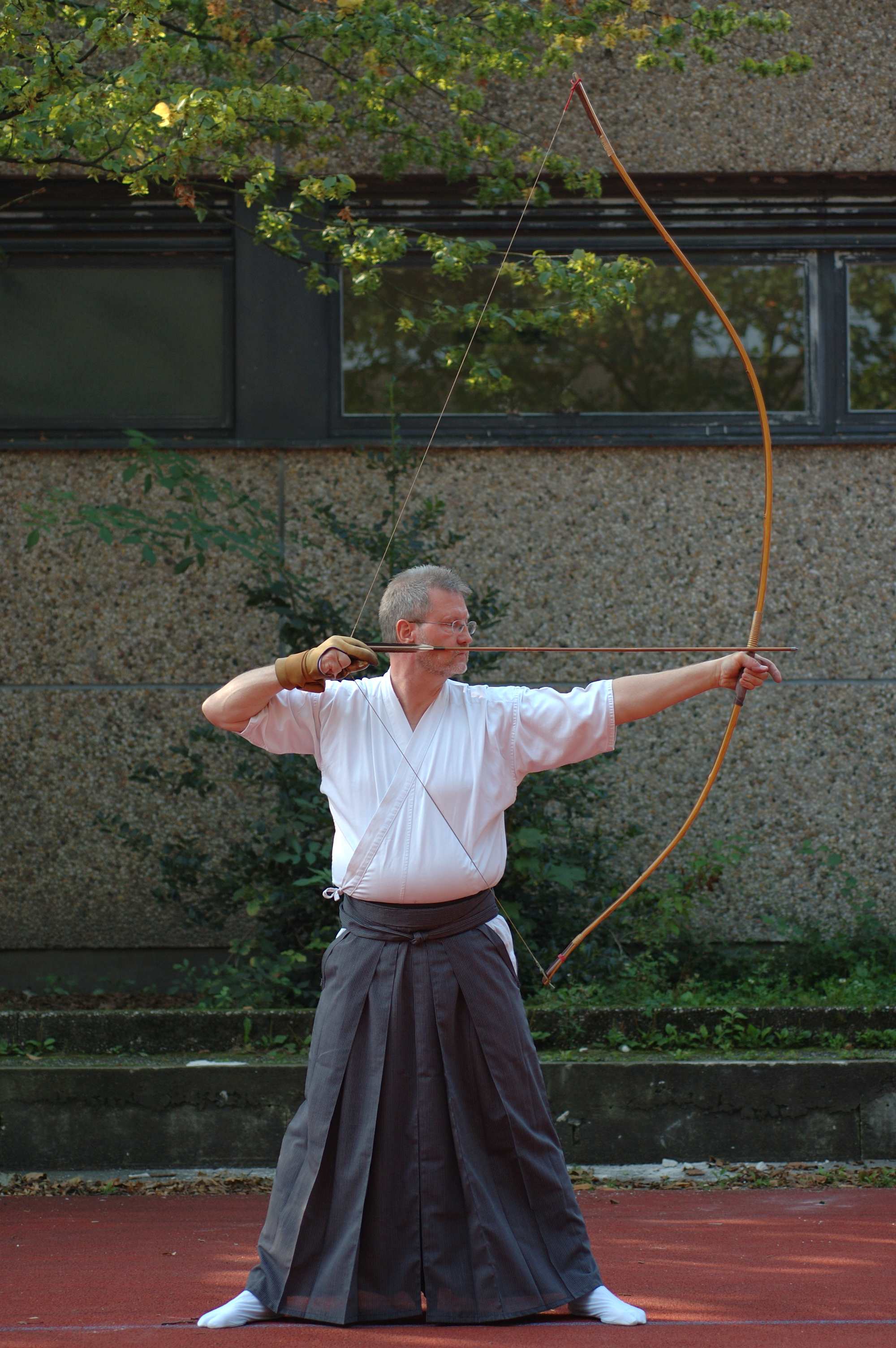
As I step away from some of my older hobbies, it looks like kyūdō—the Japanese martial art of archery—might be a new activity that arises to take their place.

People who know me will realize that when I commit to an interest, I dive into it with a unique intensity and dedication. Looking back, I’ve had numerous interests which I pursued for years and sometimes decades, such as Tolkien fandom and fiction writing during my youth, or cycling and meditation as an adult.

But every five or ten years, I step back and reevaluate my hobbies and how they fit into my life. Often I can tell when a chapter of my life is about to end because I feel that my interests aren’t helping me grow in the direction I want to go in. It’s at those times that I’ll suddenly walk away from things I’ve been devoted to for years, such as when I left my writers’ group after running it for more than a decade. At the same time, I feel myself looking for what new interests might come along to replace the old.

In the past year or two, I’ve set the groundwork for dropping two time-consuming hobbies. I’ve already publicized that after fourteen seasons, 2014 will be my last year riding in the Pan-Massachusetts Challenge, which will free up a lot of time I’d otherwise spend fundraising. In addition, I will soon stop tracking my money using the Where’s George website, after a ten-year run. These were great activities, but it’s finally time to move on.

Knowing that this would free up time and energy, I started kicking around ideas for what I might enjoy doing next: something I could get involved with that would also appeal to the very different person I have become.

And the first thing that seems to have arisen is kyūdō.

kyudoka

Kyūdō is a meditative martial art devoted to the traditional Japanese form of archery. It’s surprising that kyūdō is not widely known in the US, because it is extremely popular in Japan, where archery and its equipment are viewed as highly sacred. Kyūdō has been refined and distilled into a highly reflective, meditative practice, as reflected in the first western book on Japanese archery. Eugen Herrigel’s 1948 “Zen in the Art of Archery” was wildly popular and was the first book to use the now-popular moniker “Zen and the art of…”

So why have I been drawn to kyūdō? It’s hard to explain, but it boils down to six attributes that appeal to me: it’s social, meditative, physical, elegant, familiar, and Japanese.

Although the focus of the form of kyūdō is internal, participation and instruction are offered in the context of a small, friendly martial arts dojo of mixed ages and genders. This is imperative to me, since social life and connection is revealing itself as the primary project of my fifth decade of life.

I probably don’t need to belabor how kyūdō’s meditative focus complements my longstanding contemplative practice. As a form of meditation that involves a fair amount of movement, Kyūdō seems to nicely fit in the gap between rather sedate walking meditation and full-bore regular life.

For years, I’ve been looking for some technique for integrating physical exertion and meditation, which initially led me toward an exploration of yoga. However, being in a room filled with women in tight skinsuits—all rolling around on the floor in provocative positions—wasn’t especially conducive to internal exploration. Kyūdō allows and incorporates a focus on the body without the detrimental distractions.

However, like the asanas in yoga or the forms in tai chi, kyūdō is strictly choreographed. And when control of the human body and its motions is combined with the natural geometry of the bow, bowstring, and arrow, kyūdō epitomizes elegance and grace: attributes that I strive to embody.

And archery has always appealed to me. Even as a child, archery was my favorite activity at summer camp, and over the years I became pretty skilled at it. And in my medieval recreationist days I bought and used a very powerful English longbow, as well.

And for whatever reason, I seem to be in a phase where Japanese stuff is interesting, so it fits into that, as well.

So as you can see, kyūdō actually complements my interests quite nicely.

Practices are both convenient and a bit of a stretch. During the winter, they use an indoor aikido dojo in Union Square, which isn’t easily reached by mass transit, but is manageable. And in the summer they’re out in Lincoln, which would be really difficult, except that’s just one town over from where I would be training during a regular weekend bike ride, so I’ll probably combine the two.

I first started looking at their website around Thanksgiving, and saw that they were running a new student “first shot” training at MIT in January. However, it filled up before I could sign up.

So two weeks ago I showed up at the dojo just to observe. Fortunately, another new guy was there, and apparently we comprised enough interest for them to schedule another first shot training the following week. So I returned for a second visit and received instruction on most of the form from Joyce and Randy, with the expectation that I’d get to perform my first shots the next time.

This past weekend, I returned for part two of the training. Although the other new guy wasn’t around, I received additional instruction from Joyce, and then Don covered some more details before encouraging me to step up and take my first shot.

To put that into perspective, in Japan new students often take weeks, months, or sometimes years drilling the techniques before they’re allowed to shoot. Due to Americans’ typical impatience, our school has disposed of that, but it’s still a big milestone.

So I felt some anxiety as I stepped up and went through the movements and fired two arrows. When we move outside, we’ll fire at targets 28 meters away, but indoors we shoot at cardboard bales from a distance of about ten feet. I managed to remember most of the steps, but forgot to flip my right arm back upon my first release; I corrected it for the second.

What was interesting to me was how intensely the body experienced it. When I stepped away, my heart was racing and I was breathing heavily. I think much of that is due to the selfconsciousness of taking my first shot under the sensei’s gaze, combined with the physical stress of drawing the bow and the loud thunk of the arrow striking the target.

Of course, I haven’t mastered anything as yet. It’s frustrating but entirely predictable that some of the things I do wrong are common both to kyūdō and cycling, such as tensing and hunching my shoulders. And I also need to pay better attention to keeping my body facing perpendicular to the target, rather than turning toward it.

But it was successful! I’d followed the forms and properly fired and lodged my arrows into the target. So at least I’ve got the basics down.

Over time, I hope to embody some of the elegance that you can see in some of the YouTube videos or Vimeo videos about kyūdō. And if I stick with it, perhaps someday you’ll even get to see a photo of me in a hakama!

I recently completed my sixth “sandwich” retreat at CIMC: a nine-day non-residential meditation retreat that starts with all-day sittings on Saturday and Sunday, then evening sittings all week long, followed by another weekend of all-day sittings. All told, it adds up to about 50 hours on the cushion and a lot of sleep deprivation.

First let me relate some of the odd circumstances of the retreat.

Four days before the retreat, I had just begun my regular Tuesday night sitting at CIMC when we felt an earthquake shake the building. That was interesting.

Then, two days into the retreat we began feeling the effects of Hurricane Sandy, which caused them to cancel Monday night’s sitting. It also canceled my planned trip to Foxwoods, and delayed the delivery of my new laptop for two days.

And then on Saturday, one of the cooks came in early that morning and fired up the stove and filled the building with natural gas, such that once everyone arrived at the center, the teachers chose to evacuate the building until the gas company gave an “all clear”.

So it was an interesting week. Combine all that with the usual sleep deprivation, a birthday, a doctor’s appointment, and my mother’s shoulder replacement surgery, it was pretty stressful.

padlock shackle

Another interesting bit happened when I was outside, doing walking meditation in a local park. I looked down and saw the shackle of a padlock on the ground. Someone had used bolt cutters and cut the lock. When I’m on retreat, I’m always on the lookout for stuff like this; the obvious symbolism being unlocking one’s heart. It was only later that I read the word stamped onto the shackle: HARDENED… A very nice addition to the symbolism.

I really wasn’t expecting any major revelations. After all, this was my sixth sandwich retreat, and I knew what to expect: a whole lot of sitting and walking. But I actually came back with four major insights, which I’ll share in abbreviated fashion here.

One thing I’d been kicking around before the retreat was how much of our suffering is purely a fabrication of the mind. For the most part, when we’re suffering it’s because of an image of what things were like in the past, or how they are going to be in the future. If you stop and look at your real, present-moment experience, we’re almost never actually experiencing painful circumstances. It’s all just our minds telling us how bad things will be once we get to some future time. It’s like being afraid of shadows on a scrim.

Another item. I have a longstanding story that I’m different because when I meditate, no big emotional traumas come up. But this time I suddenly remembered something that does come up for me that doesn’t bother most people: physical discomfort! But how to work with it? It didn’t seem to me like there was much wisdom to be gained in just watching your own pain…

Well, I asked Michael in my teacher interview, and he had some great observations. He agreed that relaxing into the pain was a pretty useless pursuit. He also said that one could watch one’s relationship to pain, but that too wasn’t all that fruitful.

Instead, he recommended whole-body awareness as something that he’d found useful from his Chan practice, and that was later reinforced when I talked to Narayan. So I guess I’ll be trying a little of that, although I find it a challenge not to narrow the field of attention down to a specific part of the body.

Another thing that came up during a group discussion with Michael was the idea of continuity of mindfulness. He was of the opinion that it would be freeing and effortless, while I challenged him by asserting that it would be tiring and require continuous mental effort not to get distracted.

After talking it over with Narayan, I think the difference is between concentration practice and wisdom practice. In concentration practice (samatha), one must exert effort to continually bring the mind back from any distractions to the object of concentration (usually the breath); whereas wisdom practice (vipassana) is more relaxed, focusing on accepting present-moment life as it is. The only mental effort involved in wisdom practice is in staying in the present moment by steering clear of thoughts of the past or projections and planning about the future.

So in that sense, I’ve been spending a lot of time on concentration practice, and not so much on wisdom.

One final revelation actually related to the “homework” that usually accompanies the sandwich retreat. This year we were to observe when resistance arose and how we could detect it. I was pretty interested, because I tend to be a resistant type, and that resistance manifests as frustration, which then can sometimes escalate into anger.

For me, it was pretty easy to spot, because in most instances I started swearing to myself. Once was when I learned that a package I was expecting (my new laptop) hadn’t been delivered; another was when a magnetic card reader failed to read my card on the first swipe.

The connection between the triggers I observed was immediately apparent to me. In each case, I had an expectation that something would transpire in a way that was beneficial to me, and that expectation hadn’t been met. Even though they were minor things, they were upsetting because they impacted me. In other words, it was clear that the problem was that I was living from a place where my ego was dominant.

From there, I started playing with the idea of living from a place where ego wasn’t so central, relaxing my grip on my “self” (or its grip on me). I found that really interesting. Narayan cautioned me not to take the ego as a concrete thing; by viewing it as just a passing sense of self, I could avoid setting up a futile battle royal between my “self” and myself. Good advice.

So although I didn’t expect it, I came away with a number of things to work with, so it was a surprisingly productive retreat.

It’s been a standing joke for as long as I can remember: what is Ornoth’s body fat percentage? Well, after my recent purchase of a scale that includes body composition, we now have a definitive answer.

Sort of.

Before this posting, I solicited guesses from our studio audience. There were four non-outlier responses: 5, 11, 12.4 and 17.5, which yields an average of 11.5 percent. And now I’m ready to reveal the answer. Or answers, actually…

The problem is that the scale has two modes—athlete mode and tuber mode—and if I measure myself in both modes, the readings I get vary by nearly eight percent, which is a huge difference. So how do I know which mode better reflects reality?

Fortunately, the manufacturer provides a helpful definition. An athlete is “a person involved in intense physical acivity of approximately 10 hours per week and who has a resting heart rate of approximately 60 beats per minute or less.”

But that doesn’t really help. In the summer, my cycling usually qualifies me for athlete status, even though my actual measured moving time doesn’t always break the 10 hour minimum. But in the winter, I’m about as sedentary as anyone.

So what to do? Do I switch between modes as the seasons change? Do I consider myself a 70 percent athlete and do some specious math to come up with a guesstimate? There’s no easy answers.

But you want to hear my numbers, not a bunch of disclaimers. So here they are. If you use athlete mode, my body fat percentage averages 6.6 percent, but it jumps to 14.1 percent if you use Average Joe mode.

Based on that, it’s probably safe to say that I have a body fat percentage in or close to single digits. But if I want to get a more reliable measurement, I have to wander down to the Weymouth Club and pay $60 to use their Bod Pod.

On the positive side, if you pick one mode on my scale and stick to it, the measurements are quite consistent, so you can track relative changes. You just can’t get a single, absolute, irrefutable number.

But that’s okay; it would only just depress you, anyways… ;^)

Last year at this time, I reported back from my first Buddhist retreat, CIMC’s “Sandwich Retreat”, so called because it has all-day sessions on two consecutive weekends, and three-hour sessions every weekday evening in between. If you care, last year’s length summary can be found here.

It’s now been a week since this year’s Sandwich Retreat, and it was just as rewarding—and exhausting—as last year’s.

Like last year, I intentionally set my expectations low. I anticipated that we would sit a lot and walk a lot, and I wasn’t disappointed. I knew I was right on the money when I arrived on Saturday morning and read the following agenda for the day:

sit
walk
sit
walk
sit
lunch
sit
walk
sit
walk
sit
tea
sit
talk
walk
sit

At a high level, the retreat is all about bringing the practice into your regular life. As such, there’s a weeklong exercise that you are asked to bring into your daily activities during the work week. This year’s homework was to exercise full-body awareness.

The first couple days, I thought I did pretty well. I went back to first principles, which state that one can only know something through the six sense stores. However, most of the senses provide little insight into the body. Taste and sound are pretty worthless, and thinking more so. You can smell other people, but it’s hard to smell yourself. Sight is okay, but again there’s no major revelations to be had by gazing at your navel.

So my first understanding was that we primarily know the body through feeling. This was confirmed at that evening’s debrief, when everyone who talked about their experiences throughout the day started their description with “I felt…”

What are some of the things I observed? Well, you can feel things on the surface of your body, but there’s much more going on internally. There’s also a difference between what someone might be feeling (pain, discomfort, pleasure) and what might be apparent to an observer (calm).

Feeling can also be really subtle. Somehow, this sense tells you when you need to blink your eyes, when a sneeze is coming, when you need to crack a joint, when your belly is full, or when a pimple is forming. The blind read braille using their fingers, a feat of bodily sensation that has always amazed me.

But perhaps the most interesting feeling I observed was the innate human sense of balance. Walking is often described as a perpetual fall, and even standing still requires constant adjustments based on this innate sense. I spent one whole walking period standing on one foot, observing how rapidly my body adjusted to my sense of balance in order to keep me balanced and upright. And I had the opportunity to observe myself and several of my fellow meditators as our heads bobbed, on the verge of falling asleep. Even though our conscious minds were already asleep, the sense of balance caused us to start every time the body started to droop and tip. It’s amazing that such a sophisticated sense can operate even though the operator is unconscious!

The other thing I noticed is that it’s really difficult for me to observe the sensations of the whole body at once. Most of one’s other senses take in a small field: there’s only a limited number of things you can taste, smell, hear, or think at one time. But the sense organ for feeling is the entire body, and while it’s easy to observe discrete parts (my knee hurts, my nose itches), it’s very difficult for me to attend to the entire body’s sensations simultaneously, as a single sensation.

So all that—and a lot more that I’ll spare you—was what I learned from my first two days’ exercise in whole-body awareness. Then came Tuesday night’s debrief with Larry, one of CIMC’s three teachers. Almost the first thing out of Larry’s mouth was that we weren’t doing whole-body awareness practice in order to gain insights into the body, but as a way of using the body to ground our attention in the present moment, as opposed to endlessly drifting off to fears and plans about the future or reverie about the past. Doh!

So midweek I had to make a big correction, paying less attention to the body for itself, and focusing instead on using the body as a reminder to be present with what is. Unfortunately, at first I didn’t find whole-body awareness made me any more present than I was before. While it was good when I was doing something physical like walking or perhaps cycling, I found it less useful when sitting or conversing.

Wednesday I had my teacher interview with Michael. I told him about how I’d started out being too analytical about the full-body awareness, and how I was struggling with the body as too big a field to deal with at one time.

I also told him about my two other current practices, which are also both analytic. The first is just observing the vedenas, the feeling tones of pleasant/unpleasant/neutral that come up in response to every stimulus. I’ve gradually come to believe that the feeling tones aren’t absolute, but conditioned and somewhat arbitrary, such as a country-dweller finding a police siren jarring, when a city-dweller might not even notice it.

My other practice is to try to notice every volitional movement I make—even down to where my eyes track—and examine the motive and the quality of the intention behind that movement. And on the cushion, where you’re not doing any real volitional movement, you can examine the movements of your mind, and the motives behind them.

After hearing all that, Michael concluded that I was too much in my head and needed to be more grounded in the simple act of observing the present moment. What he suggested was to simply periodically check in and consciously relax the eyes and the muscles of the face. I expanded that to include my shoulders, which I’ve known for years carry a lot of tension, as well. For years I’ve futilely tried to consciously relax my shoulders while I’m cycling, where the tension induces a lot of neck pain.

For the remainder of the week, in trying that practice on, I found it made a huge difference. From the shoulders up is a convenient subset of the body to work with, and for me it feels like the base of where my thoughts and my feelings reside. As such, relaxing the face seems to produce a general relaxation, improving my mood, receptivity, and empathy, all attributes I’ve wanted to cultivate for some time. It reminds me somewhat of cognitive-behavioral therapy, where you model the way you want to be, even if you don’t feel it, and then it gradually starts to feel real to you; similarly, relaxing the face and shoulders might help me become truly more relaxed and receptive overall.

During the interview, I also inquired about having more of an ongoing relationship. I’m at a point where I’ve exhausted reading and dharma talks as learning tools. In a sense, I know everything I need to know about the dharma. The next step is to bring more of it into my daily life, and that’s where someone who knows my particulars can help. Knowing this, and knowing that opportunities to talk with the teachers are very rare, I arranged with Michael to have periodic check-ins every 6-8 weeks. This had been a major goal when I signed up for the retreat.

I picked Michael for a few reasons. I’ve felt some rapport and also some dissonance with each of the three teachers, so no one of them resonated more than the others. Larry and Narayan are more popular, but that also means they have less time and longer lead times for interviews. As a former intellectual, Larry might be useful in helping me overcome my analytic side, but it might be just as good to go with someone completely different. After a particularly good dharma talk a month or so ago, I finally decided I’d at least start out with Michael.

So those were the big themes of the retreat. Now let me go into a few of the smaller items, just so that they get recorded for later reference.

This year my weekend “yogi job” was end-of-day cleanup, which was great. That meant that unlike most retreatants I had our whole lunchtime break as free time, which I usually used to go sit in the sun at the Cambridge City Hall. On the long 9- and 12-hour weekend days, it was nice having that long break in the middle. I used one of those to hit the hardware store and pick up silicone sealant for my shower, which apparently has started leaking into the downstairs.

And, by luck of the draw, I shared this year’s yogi job with Shea, one of my dharma friends who only recently returned to the group. So that was a real pleasure.

In Larry’s first-day introduction, he used the “No matter where you go, there you are” line. I wonder if he knows he’s quoting Buckaroo Banzai

As an object of meditation, you can choose the breath, the body, sound… or the smell of the onions cooking downstairs!

I generally haven’t got a lot of suffering in my life, but what I do have manifests itself as either irritation or planning. That seems to imply that I desire predictability and control more than anything else.

Ethics and religion really aren’t anything more than a radical acceptance of responsibility for one’s actions.

Don’t eat jawbreaker candy during a sitting.

While outside doing walking meditation in the neighborhood around the center, I met two cats. One was a calico doing a great imitation of a flower in a window box. The other was a very friendly longhaired tiger cat. For future reference, they were both on Cleveland Street.

Retreatants have one teacher interview on each weekend, and one during the week. Ideally, you’re supposed to get to talk to each of the three teachers, but this year Maddie stepped in to help due to the large number of retreatants. I got her, making this the second year in a row that I haven’t had any interview with Narayan.

There’s this Buddhist concept that the body is vague, permeable, that its borders are fluid and ill-defined. I generally disagree with this, but then one might ask whether dental work is part of you body. Or glasses? Clothing? A pacemaker?

Tuesday’s sitting was interesting, because it was election day, and everyone was on pins and needles anticipating the results. I wasn’t very nervous, because I didn’t expect any meaningful results before we broke at 9pm. But when they let us go, Michael noted that “Someone won Pennsylvania”, which caused everyone to cheer.

I missed Friday’s session because I was sick as a dog with nausea and a headache. I slept right through from about midnight to 5pm on Friday.

The food continues on last year’s pace of being edible exactly one time in four. I know, most of you would love the wholesome vegetarian fare cooked with love and all that rot, but I don’t. Fungus is fungus, no matter how you chop it. The one exception was the ominous-sounding “celery stew over rice”, which was surprisingly savory.

My interview with Larry could be summed up as “relationships are hard, and the form of practice is irrelevant—it’s all about how it impacts your life”. Then he got up and gave me a big hug. Larry?

I remain unclear about where the line is between practice and seeing practice as a self-improvement project.

Sunday morning, as we began our ninth straight day of sitting, I passed a note to my buddy Mark that read, “What’re we gonna do today, Brain?”. He was amused. The appropriate response is, of course, “The same thing we do every day: sit and walk, walk and sit…”

People often report that they have a hard time at the beginning of a retreat, but that when it ends, they felt that they were just getting on a roll. I have the exact opposite experience. I can fall into meditation pretty easily and stick with it for a couple days before I start getting restless. But by day nine of nothing but sitting and walking, I’m at the far limit of mental fatigue and I’m ready for a wholehearted binge of lying, cheating, stealing, drinking, having sex, murdering, eating meat, and lots and lots of sleeping!

The Sandwich Retreat is the only lengthy retreat that CIMC offers, and in my experience it’s the only place at CIMC where I got the sense of sangha, or community. It’s kinda hard creating community when you only get together once a week and spend those three hours together with your eyes closed and not speaking!

This year, that sense of sangha even more pronounced, as I fostered relationships with a number of people. Of course, I enjoyed the company of my dharma friend Mark, and it’s awesome to have Shea back, as well. I also met Dylan, who is a new resident at CIMC, and John, an MIT prof who is trying to get a group of guys together to go cycling, of all things. And it was good to see old friends like Tim and Amy and Whispering Deer, as well.

So despite nine days of sleep deprivation and mental fatigue, I think this year’s Sandwich Retreat was a success. I met my expectation of sitting and walking, achieved my goal of initiating an ongoing relationship with a teacher, cultivated more of a sense of sangha with new and old dharma friends, and of course learned more about myself and the world around me in the process.

Let’s talk biological functions, okay? Here’s the deal. See if you can spot the pattern, and the one biological function that breaks the pattern…

Picking boogers: unacceptable in public.
Popping zits: unacceptable in public.
Ejaculation: unacceptable in public.
Vomiting: unacceptable in public.
Defecation: unacceptable in public.
Urination: unacceptable in public.
Flatulation: unacceptable in public.
Vaginal flatulation: unacceptable in public.
Menstruation: unacceptable in public.
Breast-feeding: generally unacceptable in public.
Bleeding: generally unacceptable in public.
Belching: mildly unacceptable in public.
Sneezing: mildly unacceptable in public.
Blowing one’s nose: mildly unacceptable in public.
Spitting: mildly unacceptable in public.
Eating and drinking: often a public event, and socially required.

So this raises the purely rhetorical question: how is it that literally every body function known to man is stigmatized, but eating is virtually required to be a ritualized social event? What’s so special about eating? Why isn’t it as stigmatized as, say, its direct opposite: vomiting?

Yeah, yeah, I know there are arguments to be made about how it needs to be social. Communal cooking and all that rot. And yes, I know of two body functions—breathing and crying—which actually are socially acceptable.

But none of that invalidates the obvious contrast: eating is a social event, but every other bodily function is unwelcome and considered unclean. I could easily envision a society where public eating would be shunned as socially unacceptable, just like everything else. And sometimes I have felt uncomfortable eating in public, or being with someone who was eating in public.

Dunno. It’s just a thought. The contrast between how this bodily function is viewed versus all the others intrigues me, and irritates my sense of order and logic.

Frequent topics