Although it didn’t start out that way, I guess this qualifies as a “memorabilia” post, given that it deals with stuff I’ve kept for the past 33 years…

Everyone has their own way of relating to significant purchases like a car, computer, television, camera, or stereo. Some people love buying new stuff when it’s on sale. Others pride themselves on getting a bargain by buying used. My M.O. has always been to buy the absolute best I can find, mostly irrespective of cost, then making it last as long as humanly possible… often long after newer, better things have made it obsolete. I take pride in having top-quality stuff and keeping it forever, and because of that I often form an emotional attachment to the objects I’ve acquired.

I can’t say that my first stereo was one of those things. It wasn’t very noteworthy, but it provided a lot of pleasure during my high school and college days.

But as I graduated college, got married, and moved into the workforce, digital audio arrived in the form of compact discs, and in 1992 my cheap high-school era stereo was decidedly worn out and in need of replacement. And my first job after college provided the necessary cash to splurge on something nice.

As fortune would have it, my then-spouse was working at a local electronics specialty store called Leiser and could get top-quality stereo components at cost. We wound up buying a hand-picked ensemble, spending around $1,500 on equipment that would have retailed for around $3,200 (which translates to about $7,000 in 2024 dollars).

I really loved that system, and was always proud to show it off. I’ll say more about that in a bit, but first let’s follow its history.

The majority of that system stayed with me following our divorce and my half-dozen subsequent moves, although I used it less and less over time, and the remaining components spent the last decade-plus stored away in their boxes…

Until recently. While noodling around YouTube I stumbled onto a tiny product that is essentially nothing more than a Bluetooth audio receiver with stereo outputs that could be hooked up directly to the auxiliary input of a traditional preamp. Such a device would allow Inna & I to stream any audio from our computers or smartphones directly through my audiophile rig. That was enough to spur me to finally dig up my beloved 33 year-old components and set them up for our enjoyment in 2025.

Of course, a couple of the old pieces are gone. The CD player that we received as a group wedding present from several university friends eventually self-destructed, and there wasn’t any point in keeping the old cassette tape player from my high school stereo. And I’d tossed my huge trunk-sized Infinity 7 Kappa speakers when the cones had dry rotted. I’d also discarded my old speaker cable and patch cords, but those were easy to replace.

But the most important three core pieces of my system were still there – my preamp, equalizer, and power amp – which needed little more than a thorough dusting. Lemme do a little show-and-tell about those, because I still hold a lot of affection for these three components.

Let’s start with my graphic equalizer. An EQ is useful to boost or cut specific frequency ranges in an audio signal. Got speakers that sound tinny? Use the sliders to boost bass and midtones. Don’t want to wake the baby on the other side of the house? You might quiet the bass a little while leaving everything else normal. Got a room where one speaker has to be placed in a back corner? Boost the left channel or reduce the right.

My 12-channel Denon DE70 graphic equalizer is a quality and useful piece of equipment. It’s always provided great service, and I find its lit bank of 24 faders visually appealing. It’s a bit unique in that the faders for the left and right channels are interleaved as paired green and yellow LEDS, rather than the more common setup that uses two physically separate banks of sliders. And there’s my little Bluetooth receiver perched at top left:

Denon DE70 graphic equalizer

Next, the crown jewel: my power amplifier. A power amp has just one job: take a microwatt “line level” audio signal and boost it to the tens or hundreds of Watts necessary to drive one’s chosen loudspeakers. It’s the final device in the audio processing sequence, connecting to and controlling the output from your speakers.

My power amp was manufactured by Carver, which comes with a bit of backstory.

Bob Carver was a legendary audiophile engineer, especially known for his innovative and impressively powerful amplifiers. I was first introduced to his work in high school, when my friend Paul showed me his brother’s stereo, which included Carver’s M400 old-school vacuum tube power amp, a radical-looking 7-inch square black cube that could pump out 200 Watts per channel: a ridiculous amount of power for a home system at that time. It made quite an impression on me!

The Carver TFM-4.0 power amp that I bought in 1992 is one of Carver’s followup models, offering a ludicrous 375 Watts per channel. It’s a great amp by a great engineer, but because Carver only produced this model for one year, it’s a rare and collectable component even within Carver’s exclusive lineup. Like the M400 that Paul showed me back in 1981, its only display is six sets of LEDs to show the power level of the signal it’s sending to the speakers; and in all the years I’ve owned it, no matter how high I pumped up the volume, I’ve never been able to light any but the first, lowest power level LEDs. The thing is a 23-pound workhorse!

Carver TFM-4.0 power amp

That just leaves my preamplifier, which is like the central conductor of a stereo system, orchestrating inputs from various sources (e.g. CD player, radio tuner, turntable, tape deck, microphone, and now even Bluetooth devices), sending a normalized signal out to the EQ and back, and then downstream to the power amp and speakers.

Like my EQ, my preamp is a decent piece of equipment. Being a CT-17 preamp/tuner made by Carver, it matches my power amp, but doesn’t have anywhere near the same cachet as his power amps. But the built-in radio receiver is a convenient combination.

Carver CT-17 preamp/tuner

Which brings me to the final, missing piece of the puzzle, the thing that kept me from setting up my stereo over the past decade-plus: the lack of speakers.

A good stereo is worthless without good speakers, and for a long time I wasn’t able to justify spending a lot of money on a set that would do justice to my other components. But I finally found a set of bookshelf speakers with positive reviews, that wasn’t too exorbitant, and which – if I bought them refurbished – would fit neatly within the credit card rewards bucks I was about to liquidate.

So let me introduce you to my one brand-new component: a set of Polk Audio R200 bookshelf loudspeakers. While I haven’t had them long enough to form a strong opinion of them (or bond with them), they seem to be doing a good job so far. They’re noteworthy in having a very flat response, which means considerably less tweaking of the frequency curve on the equalizer than I’m used to. I only wish I could move them a little farther from the wall, to better distribute the bass.

Polk Audio Reserve R200 speakerPolk Audio Reserve R200 speaker

Although this didn’t start out as one of my official “memorabilia” posts, overall I’m delighted to have my old components back in service again. Despite being 33 years old, they still deliver great sound quality, and it’s really nice having a Bluetooth connection to stream music at will from any of Inna’s and my laptops and phones. I’m really glad I lugged this equipment around with me for all these years!

LOVE IT OR HATE IT, THE CAPS LOCK KEY IS A THING. AND IT’S DEFINITELY ONE OF MY THINGS! OR MAYBE ABOUT A HUNDRED OF MY THINGS…

THERE ARE PEOPLE OUT THERE WHO GET FULLY CHEESED OFF AT THE CAPS LOCK KEY, NESTLED NEATLY ON THEIR KEYBOARD’S HOME ROW BETWEEN THE TAB AND SHIFT KEYS.

THERE ARE ORGANIZATIONS DEVOTED TO THE KEY’S ERADICATION. GOOGLE EVEN BANNED IT FROM THEIR LINE OF CHROMEBOOK LAPTOPS, REPLACING THAT SPACE WITH (WHAT ELSE WOULD YOU EXPECT FROM, GOOGLE?) A SEARCH BUTTON.

BUT EVERY DISPUTE HAS TWO SIDES, AS SHOWN BY A SIMPLE GOOGLE SEARCH FOR “TURN CHROMEBOOK CAPS LOCK ON”, WHICH RETURNS 114,000 RESULTS.

TO ME, THE ANGER TOWARD THE CAPS LOCK IS REMINISCENT OF THE HATRED DIRECTED TOWARD THAT OTHER ICON OF EARLY PERSONAL COMPUTING: THE COMIC SANS TYPEFACE.

BUT THAT WASN’T ALWAYS THE CASE. BACK IN MY CONSULTING DAYS, EVERY NEW CLIENT PROJECT MEANT SETTING UP A NEW LAPTOP, AND THE FIRST THING I DID WAS REMOVE THE CAPS LOCK KEYCAP. AT THE TIME, HATING ON THE CAPS LOCK KEY WAS JUST ONE OF MY PERFORMATIVE WAYS OF GETTING ATTENTION.

BUT SINCE THOSE MACHINES WENT BACK TO THE CLIENT AT THE END OF EACH PROJECT, I HAD TO HANG ONTO THAT KEYCAP, PUTTING IT BACK IN PLACE WHEN THE LAPTOP WAS RETURNED TO THE CLIENT.

AROUND THAT TIME I ALSO USED TO HANG OUT IN THE I.T. SUPPORT OFFICE, AND ONE DAY SPIED THEIR BOX OF BROKEN KEYBOARDS. HAVING ALREADY ESTABLISHED THE HABIT OF POCKETING AND SAVING CAPS LOCK KEYCAPS, I STARTED LIFTING THEM FROM DEAD KEYBOARDS, FROM MY OWN HOME COMPUTERS, AND ANYWHERE ELSE I COULD REASONABLY GET AWAY WITH IT.

AND SO, A COLLECTION WAS BORN.

Array of CAPS LOCK keys

SINCE I STOPPED WORKING, I NO LONGER GET AS MANY OPPORTUNITIES TO GROW MY CAPS LOCK COLLECTION.

BUT PERHAPS MORE IMPORTANTLY, MY QUIET HOME LIFE DOESN’T NEED THE IDIOSYNCRATIC, PERFORMATIVE BEHAVIOR THAT I RELIED UPON FOR ATTENTION BACK WHEN I WAS WORKING DIRECTLY WITH OTHER PEOPLE.

IN FACT, AS I TYPE THIS POST, THERE ARE CAPS LOCK KEYCAPS STILL FIRMLY AFFIXED TO MY BOTH MY MACBOOK AND MY WIRELESS MECHANICAL KEYBOARD, WHERE THEY’RE LIKELY TO STAY…

… UNTIL I’M DONE WITH THOSE DEVICES, OF COURSE! ONCE THEY’RE NO LONGER BEING USED, THEIR CAPS LOCK KEYCAPS WILL JOIN THE SCORES OF OTHERS HOUSED IN MY PERMANENT COLLECTION.

Recently, in my post about my new computer keyboard, I mentioned that punch cards were still in use when I was in college. Did you question that story? Well, lookee here!

Saved punch card deck

Now, I didn’t say they were common. There was only one card punch and one card reader in the university computer center, and by the time I graduated, even these peripherals had been removed. You didn’t see them very often, but every so often you’d see an old card deck lying around, possibly abandoned.

That’s how I came across a box of cards labeled “Egypt Dictionary” and adopted it.

Why bother? For one thing, they were a disappearing rarity. But I’d also grown accustomed to using them for jotting down lists and notes, kind of like then-recently-invented Post-It notes, only free, a more usable size, and more robust thanks to being made from card stock. Although I gotta admit that blank cards would have been a lot more convenient than cards that already had holes punched in them!

And lest you think the University of Maine was some rustic relic still using peripherals that were backward-compatible with rocks, here’s a very stylish customized punch card that I procured while visiting the City University of New York’s Queens College computer center in 1985:

CUNY punch card

But while we’re discussing the computer equivalent of the Stone Age, here’s Page 218 from Pugh, Johnson, and Palmer’s 1991 book, “IBM’s 360 and Early 370 Systems” showing one of IBM’s early innovations for permanent storage: Mylar punch cards!!!

Early IBM fixed storage: Mylar punch cards

How, you might ask, did I know that image was on Page 218? Well, I found it quickly because I’d left a bookmark on that page in my copy. That bookmark was, in fact, an exceptionally appropriate use for one of my old punch cards!

Imagine a Smurf. Little blue guys in white pants and cap singing “La la, la-la la la…”

Now imagine a disease-infected Smurf with black skin, clenched fists, and angry red eyes, whose only actions are hopping around, shouting “Gnap!”, and biting other Smurfs on the ass (which then turns the victim into another Black Smurf).

That was actually the premise for a 1963 comic by the Smurfs’ creator, Peyo. In it, all the Smurfs wound up turning into Black Smurfs – even Papa Smurf, who was working on an antidote – but the world is saved when the Black Smurfs cause Papa Smurf’s lab to explode, scattering his in-progress antidote into the air, where it does its job of resetting the plot.

That story was also adapted in the 1981 Hanna-Barbera Smurfs cartoon, although they chose to depict the infected Smurfs as purple rather than black. Perhaps appropriately, the episode debuted on Halloween of that year.

I found this rare collectible Black Smurf figurine in 1982 in a tourist gift shop called The Smiling Cow in Camden, Maine, while on a date with my first girlfriend, Jean. I didn’t know its background at that time, but the uncharacteristically angry and Black Smurf figure (literally?) screamed to be purchased. It’s been a conversation piece and highlight of my memorabilia box ever since.

I’m pretty sure that the Black Smurf figurine was quickly recalled, or at least discontinued, making it something of a rarity and a collectible. Pretty interesting, if more than a little bit dubious.

Black Smurf figurine

Here I was, all set to post my first of these new “Memorabilia” blogpos, when this happened:

These too shall pass...

See that big black gaping hole in the toecap of my pine green Chuck Taylor sneakers? Yep, they bit it. Now let’s talk about why I care about a dirty old pair of Chucks…

Out of all the pairs of Chucks I’ve had, this was my only real custom order. Back in 2011, I used Converse’s custom sneaker configurator to build this pair up from scratch, with gunmetal grey stitching and eyelets, green highlight stripes, and a gingham patterned inner lining. But the topper was the silver embroidered “T2SP” on both outer heel panels.

The significance? It’s a reference to an old fable about a monarch who commissions a ring to make him happy in times of sadness. The ring is inscribed with the phrase This too shall pass… hence “T2SP”.

Although the story is Persian in origin, it echoes the central Buddhist doctrine of impermanence, anicca, one of Three Characteristics of Existence. Something well worth keeping in mind at all times!

While they were my favorite pair of sneakers for most of the past fourteen years, impermanence finally caught up with my Chucks this past week. Into the bin you go!

Eighteen years ago, in one of my more sentimental moments, I blogged this:

This is what it's like to grow old.

I've lived my life thinking: while I'm young, I'll live it up. That way I'll have a huge collection of wonderful memories to relive when I get old, and can't do all those fun things anymore.

I guess I'm over the crest of that proverbial hill, because when I look back, I'm filled with hundreds upon hundreds of memories of my life.

I see now why old people feel isolated. It's not because they're alone; it's because they've lived an amazing, deeply touching novel that no one else will ever read.

So many people and places and events have touched my life, but no person will ever share the things I remember, the things that even today bring up deep feelings that toss me around like a toy boat toy boat toy boat.

Nearly two decades of life experience later, that image – of one’s life being a rich and meaningful story that no one else can ever fully appreciate – remains a powerful truth. That’s doubly so because most of our lives only persist within our own memories, locked within a single mind with no effective way to share them.

Don't Look Yet!

Don't Look Yet!

But all is not entirely lost. For many of us there are, in fact, a few precious, long-buried and boxed-up artifacts from those distant times. Fragments of the past that can be seen and touched, perhaps even photographed and shared.

So partly to share them with those of you who care, and partly just to honor the sacred memories of my life, today I begin what will probably be a long and ongoing new project: digging up and posting about some of the more interesting memorabilia that I’ve collected over six decades of living, laughing, loving, and adventuring.

I hope you’ll join me on this journey back through the times of my life. Maybe some of you will even see an item you recognize from our shared past. That would be delightful!

My plan is to share one item at a time, posting regularly, maybe once or twice a week. Photos will be accompanied by a brief writeup. Everything will be tagged “memorabilia”, and I’ve added a link to that growing collection of posts in my blog’s sidebar.

But the journey has already begun, in some sense. There are a handful of artifacts that I’ve already highlighted in past blogposts. So along with this introduction, I’ll begin by linking to those.

In vaguely descending order of their age, here are:

I’ll leave you with those for now, but you can look forward to lots more, as I begin this new series of postings. I’m certain I’ll enjoy it, and I hope you do, as well.

Say you were a young college student taking a programming class, and your aging computer science professor’s first assignment was for each student to write a program to print out their name and telephone number.

Struble's Assembler Language Programming

That wouldn’t be the least bit sus, now would it?

Apparently, back in 1984 it wasn’t! Lemme tell you a story…

I was recently bedridden with both a back injury and my first case of Covid. And having already purged many of my old books, I really had to stretch (metaphorically, of course) to find something to entertain myself with.

One book that followed me through my migrations – from Maine to (five different locations in) Massachusetts, then Pittsburgh, and finally Texas – was a college textbook that was highly cherished by most of the CS majors I knew back then: George Struble’s “Assembler Language Programming for the IBM System/370 Family”.

Yes, I was so bored that I started re-reading a 40 year old textbook on one of the driest topics in all of computer science, for a computer that no longer exists!

Chapter 1 is a snoozer (not unlike the rest of the book). It’s all about how mainframe computers used combinations of ones and zeroes to encode numbers and characters. Like any textbook, the end of Chapter 1 had a dozen exercises for the student to solve, to promote active learning and demonstrate a practical understanding of what’s been taught.

Here’s the text of Problem 1.3: (emphasis mine)

Each byte of storage in the IBM System/370 contains eight bits of information and one parity bit. The parity bit is redundant; it is used only to guarantee that information bits are not lost. The parity bit is set to 1 or 0 so as to make the sum of 1’s represented in the nine bits an odd number. For example, the character / is represented in eight bits (in EBCDIC) by 01100001. The parity bit to go with this character will be 0, because there are three 1’s among the information-carrying bits. The character Q is represented by 11011000, and the parity bit is set to 1, so there will be five 1-bits among the nine. These representations with parity bit (we call this “odd parity”) are also used in magnetic tape and disk storage associated with the IBM System/370. Using the character representation table of Appendix A, code your name and telephone number in eight-bit EBCDIC representations, and add the correct parity bit to each character.

That’s right: on just the third exercise in the entire book, Struble is asking the student to provide their personal contact info, presumably to their instructor. I can only imagine the repercussions if a professor presented this exercise to his or her class today.

To be fair, when Struble’s book came out (in 1969, then revised in 1974 and again in 1984) such an assignment simply wouldn’t have set off the red flags it does today. The author and his editors probably felt safe in the assumption that women wouldn’t be taking hard-core mainframe assembler classes. And for the odd exception, what harm could possibly come from a young coed revealing her phone number to an upstanding member of the academic community?

What harm, indeed.

I’m not one to condemn past generations for not living up to more modern social norms, but still… Today that exercise just screams of inappropriateness and invasion of privacy. For me, reading that was a head-scratching moment of astonishment from an unexpected source, a true blast from my past.

Today, kids grow up with their entire lives digitized and at their fingertips, but those of us over sixty rarely get a high-fidelity look back into our childhoods.

Sure, there might be some faded Polaroids or 35mm slides from major holidays, but those aren’t particularly vivid or easily shared. A majority of our lives—who we were and everything we experienced—exists only in brief flickers of increasingly fragile human memory, ultimately unsharable except as tediously repetitive verbal anecdotes, like those our grandparents told us when we were kids.

So when one uncovers an item that triggers lots of childhood memories and emotions, it’s worth expending some effort to preserve it. In this case, a 40-year-old cassette tape bearing a very special song, which I recently digitized.

Therindel and Daeron cover

Therindel and Daeron cover

Therindel and Daeron On Ravenhill cassette

Therindel and Daeron On Ravenhill cassette

In 1978 I was only fourteen years old and about to start high school. I’d recently devoured J.R.R. Tolkien’s “The Hobbit” and “The Lord of the Rings” trilogy, and had gotten in touch with a handful of other young fans to found the New England Tolkien Society.

NETS had two publications: I produced a big annual called “MAZAR BALINŪ” (The Book of Balin) that featured art, poetry, fiction, and such (read more about that here); but our regular newsletter was a monthly called “Ravenhill”, named after a fortified spur of the Dwarves’ Lonely Mountain, which was the ultimate goal of Bilbo & Co.’s quest in The Hobbit.

Our Tolkien fan group’s meetings were infrequent, because we were spread out all over the northeast, but we made up for it with enthusiasm, taking on Hobbit or Elven or Dwarven personae, dressing up in costumes, having period feasts, hosting Tolkien trivia contests, and the all-important mushroom-rolling race (using only one’s nose, of course).

Those events were always uproarious fun. Contrary to my home life as a very strong introvert, under my Hobbit persona I surprisingly found myself loosening up and expressing a fun-loving, impulsive side at our gatherings. For me, they were incredibly important experiments in my adolescent social and emotional growth.

It was in that context where, at one of our very earliest meetings, we were joined by a local musician named Tom Osborne, who went by the name “Dæron”, after a minstrel mentioned in Tolkien’s works. He played guitar and sang a folk song he’d composed around a poem written by Marthe Benedict (aka Therindel), a Tolkien fan of international renown.

The song, “On Ravenhill: Gimli’s Song of Parting”, is a poignant one. You may or may not recall that Gimli was the Dwarf who joined the Fellowship of the Ring to help Frodo bring the One Ring to Mordor. Tom’s song takes place long after the conclusion of the War of the Ring, as Gimli says farewell to the Lonely Mountain and Middle-earth, before joining his Elvish friend Legolas in sailing to the Undying Lands: something no Dwarf had ever been permitted to do.

Between the stirring words, so wonderfully performed, and the direct connection to our newsletter “Ravenhill”, everyone who heard it at that early gathering was near tears, despite the fact that we were mostly teenaged boys. There was something about Tolkien’s works that had touched each of us—the sense of wonder, the magnificence of nature, the freshness of youth, the sentimentality and romanticism—and Tom’s music and Therindel’s words captured all of that perfectly. It’s no exaggeration to say it resonated in my heart and lodged itself permanently in my memory.

The version I have on cassette… Over the past 42 years I never played it very often, but—knowing that it was important to me—I hung onto it through my many moves and all the changing roles and circumstances of my life. I’m happy that after so many years, it’s still in adequate condition for digitizing and posting (here’s the MP3), even if the quality isn’t up to modern standards.

Now, like Gimli, in old age I find myself looking back upon an astonishingly diverse, full, and fulfilling life with immense appreciation. I’m not quite ready to depart for the Undying Lands, but I can look back at the many treasures I have found, and savor precious memories such as those evoked by this deeply meaningful song of parting.

Far down the Lonely Mountain’s southern arm
I stand on the grey rocky height
Whence oft of old was sounded the alarm
And winged messengers soared in urgent flight.

(BEGIN CHORUS)
Only on Ravenhill—can you believe it still?
Looking across the green lands;
Mining the metals we shaped with our hands each day
Under the mountain where mystery lay.
(END CHORUS)

Here sun and wind and rain shaped the stone;
Here blood of kinsmen slain have soaked the clay;
And here I stand bent by the years I’ve known
To hear the echoes of a fading yesterday.

CHORUS

I am a living part of all this land—
Each standing stone, each tree a treasured friend,
Each glint of the sun a gem within my hand—
And yet beneath the sun all things must have an end.

CHORUS

I will surrender all I held as worth
And take the westward road across the sea.
A Dwarf of Durin’s race, a son of the earth,
Who dared to crave the lofty Elvish destiny.

CHORUS

So here I forfeit all my mortal right,
And here I render up my earthly will.
I shall leave it all to seek the light,
For I have bid the past farewell.

CHORUS x3

A couple months I ago I received an email from the eBay auction site, indicating that one of my few remaining product searches had been triggered. In this case, the search text was “MAZAR BALINŪ”. What the heck does that mean?

Welp, I recently posted that in high school I was a big fan of J.R.R. Tolkien, the author of “The Hobbit” and “The Lord of the Rings” trilogy. And that I was one of the founders of the New England Tolkien Society.

NETS had two publications: a monthly newsletter called Ravenhill that my friend Gary put out, and a (nominally) annual literary magazine called MAZAR BALINŪ that I produced. The name is in Tolkien’s Dwarven language and translates to “The Book of Balin”, which was an artifact that the LotR fellowship found in the mines of Moria.

It wasn’t easy to get the artwork, articles, and stories I needed, so only two issues were ever published: in 1980 and 1983. I photocopied issues and mailed them to our members, which were probably less than a hundred people. So it was pretty amazing to discover 40-year-old original copies on eBay, being sold by someone in the Netherlands!

But seeing them got me thinking. To my knowledge, there are no copies of MB online, and I’m not even sure any exist in public collections. So I scanned my archived originals and compiled them into the two PDFs that I can share with you now.

MAZAR BALINŪ I

MAZAR BALINŪ I (pdf)

MAZAR BALINŪ II

MAZAR BALINŪ II (pdf)

As an interesting postscript, MAZAR BALINŪ’s focus on original artwork, poetry, stories, and articles was the antecedent for my subsequent internet-based electronic magazine, FSFnet. FSFnet, which I founded in college in 1984, was renamed DargonZine in 1988, and has held the title of the longest-running electronic magazine on the internet for decades. While it still exists today in a torpid, nominal form, we’ll still celebrate the 40th anniversary of its founding later this year.

I’m not a packrat, but I have an eye for memorabilia, socking away strange little keepsakes that would otherwise land in a dumpster. Examples include circuit boards from the PDP-11 system I managed in college, and the brass corporate mission plaque from MediQual, my first post-college employer.

Another such item is a poster-sized oil painting that hung over Sapient’s front desk back in 1995, when I was first hired by the nascent internet consulting company.

Boston Painting

It was an original composition by Courtney, Sapient’s receptionist, who had recently graduated with a bachelors degree in studio art at Dartmouth College. Painted a year earlier, it depicts a streetscape of brownstones in Boston’s South End, where she lived.

During her years at Sapient, Courtney left the front desk and led new employee orientation, then ran Sapient’s People Strategy Organization (aka HR), and finally took overall responsibility for corporate culture. Over that time we had several moves and refreshes of our office space, and her painting was thrown into permanent storage and forgotten.

When the Dot-Com bubble burst, Sapient needed to shrink its physical footprint. Being a curious little opportunist, one day I accompanied our Operations team as they cleaned out one of the storage areas. Unearthing Courtney’s painting, and knowing that she was no longer around, I received permission to adopt it.

That was around 2002, toward the end of my tenure at Sapient, and just after my purchase of a condo in Boston’s Copley Square. When I brought the painting home, it took pride of place on the brick wall in my front entryway. And there it hung.

Years later, before I left Boston, I reached out to Courtney and offered to pay her or give the painting back. Despite initial interest, she never made arrangements to pick it up, and I never heard from her again.

The painting has been with me for nearly two decades, and now graces our Pittsburgh dining room. It is a treasured reminder of Boston, my time at Sapient, and the Back Bay condo I loved.

I wouldn’t say my mother was a natural cook, but she was willing to try anything that struck her fancy. While building her repertoire, she used an old typewriter to commit her favorites to index cards that she stored in a hinged wooden recipe box.

Over the years, I sifted through her recipe box countless times, looking for her instructions for sour cream cookies or nisu bread or the family’s traditional spaghetti sauce.

After she died—a year ago today—my brother and I sifted through her belongings, finding homes for all the things she left behind.

Naturally, I went through that recipe box, intent on preserving everything I wanted before passing it on to other family members.

At the back of the box, hidden behind everything else, was another unremarkable index card, yellowed with age like all the others. It looked like this:

A Testament

Although she didn’t note it, those lines are the final stanza of a poem called “A Testament”, published by American sculptor and poet William Wetmore Story in 1856, a hundred and sixty-two years ago.

As you can see, the index card is old and hand-typed… It had clearly been sitting in the back of that recipe box for years and years, although I had never seen it before. Perhaps she wrote it back in 1991, after her dramatic multiple-bypass surgeries, or then again, maybe some other time.

And yet why keep it there, of all places? If she had intended it to be a parting message, she could have left it in her home safe or her bank safe deposit box with all the rest of her important papers.

But if it wasn’t an intentional message, then why was this poem stored in her recipe box? That might have been a good place to leave a hidden message to her husband, but my father passed away twenty years ago.

Irrespective of whatever her design was, finding this note shortly after her death was startling. It remains no less moving, a year later.

Reflecting back on the hundreds—if not thousands—of concerts I've been to, there are a couple that stand out as tremendously disappointing, and they have quite a bit in common.

Yes 9012Live shirt

In September 1984 I saw Yes in Portland ME, touring in support of their immensely popular 90125 album. My date and I wound up leaving toward the end of the show when she freaked out after losing a treasured piece of jewelry.

A year later, my future wife and I were at the very first show in Rush's Power Windows tour, coincidentally also at the Portland civic center. We were at the edge of the stage when—during their single "Big Money"—fake dollars bearing the band's portraits rained down from the rafters above us.

These were both widely-known and unquestionably talented groups near the height of their popularity, with a huge back catalog of hits, videos in constant rotation on MTV, and deep-pocketed promoters. So why did these shows suck so badly?

Some of the problem stems from the collision between high expectations and a very pedestrian reality. But beyond that, in both cases the band members simply stood there and played their stuff, with no movement, no emotion, no stage presence, and no connection with the audience whatsoever. Despite their immense reputations, they just phoned it in.

It doesn't help that the albums were heavily overproduced, very characteristic of the mid-1980s. The early use of sound samples reduced much of the performance to triggering pre-recorded bits in sync with a click-track. That left damned little room for improvisation, spontaneity, or even variation.

I know some people see a band to hear them perform their repertoire in a familiar way. But I don’t see any point to a live, in-person performance when the band’s involvement is reduced to mechanistically playing a note-for-note reproduction of what appeared on the album. The music was obviously incredibly tedious for the bands to play, which sucked all the energy and excitement out of the crowd.

The best thing I can say about those shows is that they both had cool concert tee shirts. The kind you’d wear around to show everyone that you’d seen this really cool tour… Even though it had been about the most disappointing show you’d ever seen.

Neil Peart money

I haven’t made a lot of noise about my mother’s death in January, and I don’t intend that to change. Everyone has their own method of dealing with loss, and I feel that making a big emotional scene is about the least respectful thing I could do in most cases.

I’m also not going to devote any more space in my blog to the hardships of five months away from home, enduring a very much unwanted Maine winter. There’s no need to discuss my role as caregiver during the ups and downs of her hospitalization, my tasks arranging the funeral, dealing with probate, selling her car and furniture, closing her apartment, and wrapping up her finances. I’ll even skip over seeing members of my family and a few long-lost high school friends I caught up with.

Happy family at camp
Forceps
I can't believe it's... butter

I’ll only briefly mention the powerful sense of relief once I had all those things behind me, and how very, very, very good it has been to finally be back home.

It sounds like I’ve ruled out just about everything I could possibly write, thus obviating any need for this post. But no, there is one thing I do want to share, and that’s a handful of laughs. One of that trip’s bigger realizations was how deeply important humor is to me, and its usefulness as a way to cope with even the most stressful times.

Amidst all the difficulties of the past four months, there were a handful of precious smiles worth remembering. Here’s a few.

One morning my brother and I were at her nursing home with my mother when she required emergency transport to the hospital. When the EMTs showed up, I briefed them on her condition, what medication she was on and when she had last taken each, the measures the nursing home had taken in response to her situation, and so forth. I was apparently so organized and on top of the medical lingo that—as I later found out—they actually thought I was the resident doctor!

During her emergency room trips, my brother and I sometimes hung out in the ER’s little kitchen area. Being me, I snooped through their cupboards and was surprised to find a gallon jug of molasses. Wondering what the heck they’d need so much molasses for, I consulted Google and immediately regretted it. Whatever you do, *DO* *NOT* google “emergency room molasses”!

At one point she was in the cardiac unit and a nurse and I were helping her walk. She fainted in our arms, and since the nurse was unable to reach a call button, she slapped a button pinned on her uniform. “CODE YELLOW, CCU ROOM 1! CODE YELLOW, CCU ROOM 1!” blared over the intercom and more than a dozen doctors and nurses ran into the room. Apparently “code yellow” is their shorthand for “patient out of control”, normally used for unruly or violent situations; kind of silly for an unconscious 90 year-old!

She was in and out of the hospital several times, occupying a dozen different rooms. However, after a two week stay in Room 118, her next readmission was coincidentally right back in to the same familiar room.

At one point, a prisoner from some local jail was in for treatment, with a policeman posted outside his room. His family brought a cat in with them for a visit, which is pretty surprising to begin with, in a hospital. But apparently the cat got loose in the middle of the night, resulting in a penitentiary-style lockdown of the ward and all the patient rooms until they recaptured it!

Whenever a newborn was delivered in obstetrics, they played a lullaby tune over the intercom. My mother enjoyed hearing it, although it felt very odd to hear it playing during two of my mother’s worse sessions.

The hospital allows visiting family to raid the small kitchens in the ward, so my brother and I started enjoying free ice creams during our occasional opportunities to step out of her room. I joked that I was doing my part to increase US healthcare costs.

One of the few things my mother would reliably eat was milkshakes, made with two cups of ice cream. So when the floor ran out of ice cream, my brother and I blamed her (even if we’d eaten more than our fair share)!

The doctors also ordered that the staff keep tabs on my mother’s blood sugar levels. We joked that it was because so much of their ice cream had disappeared…

It confused the hell out of me that I couldn’t buy a sugared cola drink anywhere in the entire facility: not on the floors, not in the ER, not in the cafeteria or coffee shop, nor in any of their vending machines. Apparently sugar is strictly verboten! But I couldn’t square that with all the free ice cream stocked on the floors for patients and family!

Ordering lunch one day from “Room Service” (when I worked there as a high school student, it was called “Dietary”), my mother wanted tomato soup. Asked if she wanted a bowl or a cup of soup, mom asked for a bowlful of tomato soup, but in a cup…

Auto-on, motion-detecting faucets… Great for keeping one’s hands sanitary, but a complete disaster when they’re placed in the only open section of countertop in the room. On multiple times someone would move mom’s dinner tray to the counter next to the sink, only to have the faucet helpfully spray the tray, the person, and entire room with water.

Although we came to know most of the hospital staff by name, one day a new nurse came in. Seeing two guests, she asked, “Husband and son, I presume?” Yeah, no. My brother might be aging, but he was still 22 years younger than my mother. I might better understand “Son and grandson”, since there’s nearly a full generation between he and I…

Her treatment included regular doses of morphine, which naturally zonked her out. Even at her worst, just before a new dose she would relate a list of things like medications that the nurse should know about and take care of before she “lost time” due to the effects of the morphine. My mother was always both very organized and very much a take-charge person.

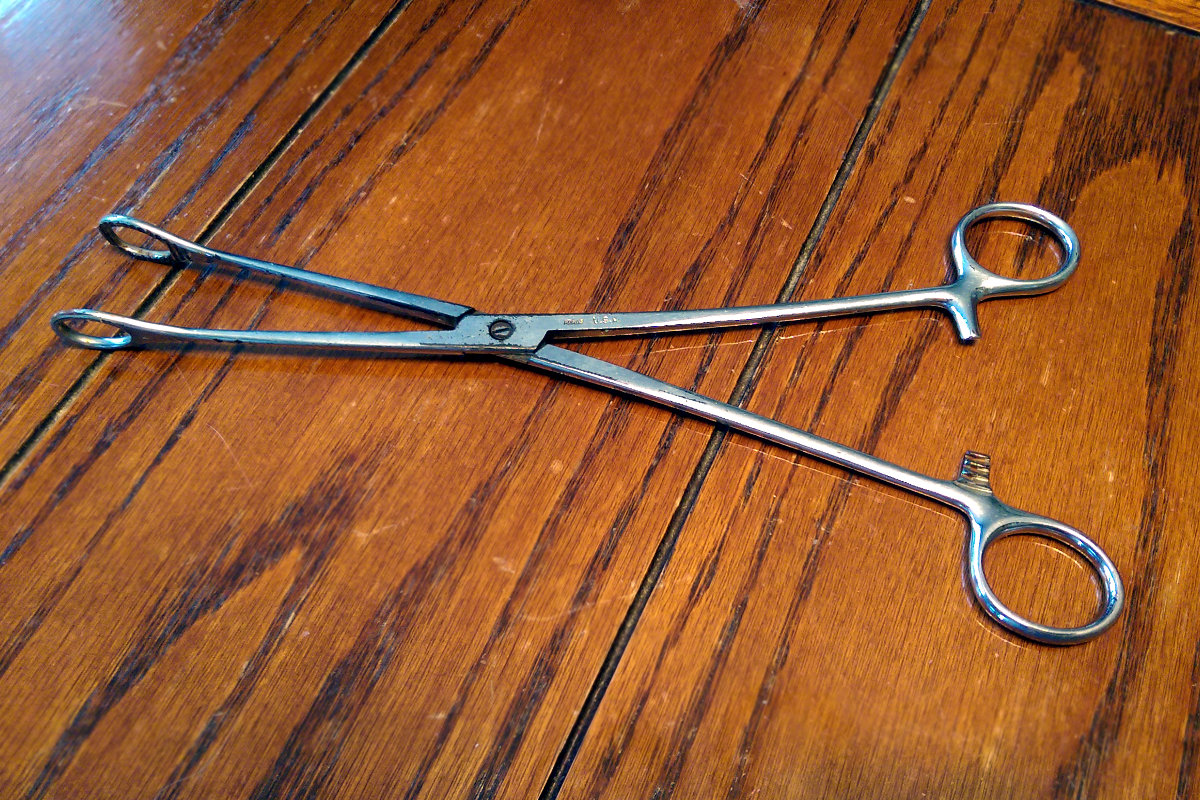
She had been a lifelong nurse, so there were some things in life that were normal for us but which seem strange in retrospect. For example, most kitchens have a pair of tongs for grabbing hot items like baked potato or corn on the cob. We didn’t have that… Mom had several old pairs of stainless steel surgical forceps that she used for cooking!

And finally, the thing I think is ludicrous but which no one else seems to appreciate. Mom would naturally use empty cans or plastic containers to store stuff in. In cleaning out her freezer, I came across a couple plastic tubs that originally held a spread product called “I Can’t Believe It’s Not Butter!”, which my mother used for storing… (wait for it…) butter! Doh!

These were the kinds of things that kept us on our toes and provided brief moments of much-needed levity during an incredibly stressful time. Looking back, some of them remind me that my mother was a normal person. Normal people have all kinds of quirks and idiosyncrasies, which you discover during the rare times when you have to pore over their belongings in detail.

I’ve posted before about the random insult generator that I wrote back in college. If you don’t remember, you can read the backstory here, here, and here.

After starting with only a couple dozen possible sentence fragments, it now relies on a database of 43,000 data items from 28 different parts of speech.

Having recently gotten bored and installed a perl interpreter on my phone, I decided to see how easy it would be to port Insult to Android. To be honest, it was a piece of cake. I didn’t even have to alter the data files, just make a couple small tweaks to the main program.

The fun part is that the scripting engine provides ridiculously easy access to Android’s text-to-speech synthesizer. So not only can I generate random insults with a single touch, but the phone will also read them aloud!

Isn’t technology marvelous?

This one is two of my favorite stories. Really!

As far as I can tell, there are only about five Liscomb Streets in the US: one in Los Angeles, two in Texas, one near Detroit, and the only one anywhere near me: a tiny little side street in Worcester, Mass.

Way back when, on January 4 1989, I drove from Maine down to Massachusetts for an interview with a company called MediQual in Westborough. A couple weeks later, they’d given me my very first post-college job offer.

Inadvertent wheelie

When I next drove down it was to look for apartments. Of course the first thing I did was grab the local paper, the Worcester Telegram, to look for apartment listings (this was way before teh Intarwebs). I picked up the January 27th issue, and on page two, a picture caught my eye: the one you see (badly) reproduced at right. Apparently the driver of the sanding truck was trying to go up a really steep hill in Worcester, when his load shifted and the truck popped a permanent wheelie. It was left on its back, pointing straight up in the air!

Now that’s pretty damned funny in its own right, but if you read the caption, you’ll see that it happened on none other than Liscomb Street! Now, how improbable is it that on the one day that I went down to scout out apartments—the only time I’d ever even seen that newspaper— there’d be a picture of something like that happening on that street? C’est impossible, non?

And now for the rest of the story…

My wife and I lived in Shrewsbury for several years, only two miles from Liscomb Street. Then things started going south. One night I returned from a business trip to find Linda packing. She was off to live with a girl friend of hers. I bet you can’t guess where this friend of hers happened to live…

Yup. Linda, who had of course taken the name “Liscomb” when we married, left me and took shelter with a friend who had an apartment on none other than Liscomb Street! That must have been incredibly bizarre…

So those are my two Liscomb Street stories, both of which seem ludicrously implausible to me. It’s all a bit surreal, but every word of it is true, BIOFO!

Cover Girl

Sep. 8th, 2004 09:55 am

NESAD catalogSo yesterday evening I mosey on down to the New England School of Art and Design at Suffolk University (NESAD) for the first session of my penultimate graphic design class. Incidentally, it’s a class with a female instructor and twelve female students—most of whom I know from previous classes—and me.

I walked in and before I could even sit down, Ellen is giving me shit about presumably being on the cover of some NESAD brochure. I express my disbelief in typically eloquent fashion, but follow up on her challenge to go check it out.

In a couple of the literature racks around the building I find a white 5.5 x 8.5" brochure—NESAD’s continuing ed fall 2004 course catalog— and, yes, I’m right there on the cover.

I’m there in full skinhead glory, wearing my green Toasters tee shirt, jaw hanging open, cutting a mat for a print in Ken Martin’s spring photography class. Clearly, it was one of the shots he took while we were working. Goof.

Amusingly, the image is repeated on page 12, the “Administrators” page, but it’s been mirrored, so that I’m facing left instead of right. Like no one is gonna notice that? Amateurs…

But I must say, it’s pretty amusing to think that they’d choose my image to sell the school, even to continuing ed students. But, hey: I made the cover! Makes me wonder about whether I should have pursued that modeling career I looked into ten years ago…

Frequent topics