大成功

Jan. 4th, 2026 02:56 pm

Time for a brief update on my kyūdō practice.

You may recall that after 2½ years of painful struggle and utter failure in this martial art of Japanese archery, I attended a seminar in South Carolina in hopes that our sensei would be able to correct my constant misfiring, which I wrote about at length here.

That was four months ago. So how has it gone?

Holding the tally board following Austin Kyūdō's 108 Arrows Shoot 2026.

Holding the tally board following Austin Kyūdō's 108 Arrows Shoot 2026.

Pretty well. Putting sensei’s feedback into practice has helped immensely. While I’m still far from perfect, I’d say I’m able to shoot nearly as reliably as anyone around me, which is an amazing degree of improvement.

Which brings me around to yesterday’s practice session: our annual ceremony of shooting 108 arrows to begin a new year.

Ironically, the meaning behind the ceremony is Buddhist in nature, as a way to recommit to overcoming the 108 Defilements. In her email to the group, our club leader phrased it as “letting go of tension, frustration, mistakes, grudges, and anything else we carry from the past year.” I think those words perfectly encapsulate my attitude toward my shooting in 2025.

So this was a very intentional opportunity to make a break with the struggles of the past, and begin a new year with a clean slate.

In previous years, my terrible form and lack of confidence made this ceremony uncomfortable for me, and I contributed very little to the group effort. But with newfound confidence in my shooting, this year I was eager to push myself and publicly demonstrate my progress. Plus this would be exactly the kind of shooting-focused practice I need.

One way I prepared was working out with my bow while the group was on hiatus over the holidays. I specifically wanted to develop the strength to hold a full draw for longer, and the endurance to do so repeatedly. To that effect, I did daily workouts, building up to three sets of three draws with my 12 kg bow, holding each one for 24 seconds before release.

On the day of the ceremony a dozen of us showed up, so math suggested each person should aim for about 9 or 10 shots. Whatever! I was the first archer to the firing line, shot the club’s first arrow of the year, and spent the most time at the line.

And at the end of the session, I tallied 36 shots, well more than anyone else, and tying (intentionally not surpassing) the current record for most shots during the annual ceremony.

Not all of them were perfect, of course. About a third of the way in, three of my shots ricocheted off the target, but I realized what I was doing wrong and corrected my form from that point forward. And even if I count those as misfires, that’s still a 92% success rate, which I haven’t enjoyed since early 2023.

So yeah, my shooting has definitely improved, and I’m pretty happy with where I’m at, with an eye toward improving even further in 2026. Or, as the Japanese would say, “Daiseikō!”

Aside from general improvement, one of my next steps is joining the local archery range and getting proficient at distance shooting. The range is open all day, every day, and is a very convenient 10 minute drive from home.

I also have the option of formal testing and advancing in rank, but – having begun in a different school of kyūdō that doesn’t have tests or ranks – those things aren’t of any interest to me. Nor am I particularly interested in flying out to South Carolina (or further) every few months for seminars.

For now, I’m perfectly happy taking my time and refining my form, free of the significant downsides that come with formal testing and ranking systems.

Though I will say that after 2½ years of stress, insecurity, and failure, being the top dog at the dojo – even if it was just for this one day – felt really, really good. If this were a TV drama or sports anime, this would have been the climactic episode of my redemption arc! And it was a deeply satisfying way to begin a new year.

My Austin kyūdō group doesn’t have a teacher; it never has. But we fall under the distant tutelage of a Japanese archery group based in Greenville, South Carolina. The South Carolina Kyūdō Renmei (or SCKR) is run by Blackwell-sensei, one of the most senior kyūdō teachers outside Japan, and his wife Reiko-sensei.

SCKR hold kyūdō seminars a couple times a year, which are attended by local South Carolina practitioners, Austin kyudoka, as well as people from all over North America.

Given my well-documented and very fundamental beginner struggles, I never attended a seminar. I didn’t want to take sensei’s time away from his many advanced students to deal with my remedial problems, and I didn’t want to waste an expensive trip if I wasn’t going to get the attention I need.

However, sensei offered to run a seminar just for us, only open to the comparatively junior members of Austin Kyūdō. It was an irresistible opportunity to get sensei’s help in a way that didn’t feel like I was imposing on other archers. So in September I joined ten other Austinites for a three-day kyūdō intensive.

And “intense” is the right word to describe my experience, from beginning to end. There’s way too much to be able to share it all, but I’ll do my best to briefly share the important parts of where I started, what I went through, some of the things I learned, and where I go from here.

The Honda Prelude

O
O
O&P

Just two weeks before the seminar, I was ready to call off the trip and quit kyūdō entirely. After two and a half futile years enduring consistent failure in stoic silence, I had finally reached my breaking point.

While everyone around me – even complete first-timers! – demonstrated basic competence and increasing proficiency, I simply couldn’t successfully fire a bow without injuring myself or damaging equipment. My arrows would fly through the air sideways and clang off the practice target, or flop feebly to the ground only a few meters downrange. I broke strings, stripped the feathers from arrows, and bruised my forearm. And the months I’d spent trying dozens of different ways to correct it had all been for naught.

In the interest of moving on, I’ll leave it at that for now. But to get a better idea how frustrated I was, I’d encourage you to read the blogpost I wrote eight months ago, entitled “All the Gear and…”. Just take all the anguish in that post and amp it up to eleven.

Ironically, that week I had a promising insight: that I clenched the fingers of my right hand so tightly that they were interfering with my release. That didn’t solve all my problems, but it seemed like a clue: one piece of the puzzle. But I didn’t even have time to put it into practice before the seminar was upon us.

So that was my mental and emotional state going into the trip: off-the-scale frustration, extreme pessimism, and the only thing I wanted out of the seminar was for sensei to fix me… Although I was skeptical whether he would, or could.

It was – if you’ll excuse the pun – “my last shot” at being a kyūdō practitioner.

The Tyranny of Logistics

Bearing so much emotional distress, I wasn’t very tolerant of the usual discomforts of travel. Other than two trips between Pittsburgh and Austin when we were deciding where to move, I hadn’t flown in six years: since before the COVID-19 pandemic. And it was my first time flying Southwest Airlines, whose asinine unassigned seating policy makes boarding a complete free-for-all.

Things didn’t get a lot better once we arrived, either. I had to share a room with another person, which added some more stress. Not only were we going to prepare communal meals, but because no one had bothered to communicate with one another, sensei and his friends had also prepared meals for us too, which was yet another stressor for everyone.

Even the seminar provided some unexpected wrinkles. Sensei vetoed my use of the familiar bow I’d brought. I’d purchased some used zori sandals for outdoor use getting to the dojo and fetching arrows, but those promptly broke, necessitating a special trip to the store to buy replacements. And although the seminar was supposed to be for his Austin students only, we were sporadically joined by 5-10 local practitioners. Despite being able to use the dojo 365 days a year, they took shooting spaces and sensei’s time away from those of us who had traveled from far away for a precious 2½ days with him. And I have to admit I got frustrated by seeing other kyudoka improving much more rapidly than I did.

But the underlying message here is that the seminar was extremely mentally, physically, and emotionally draining. In addition to my already-charged emotional state, I was dealing with lack of sleep, poor and insufficient eating, muscle fatigue, dehydration, headaches and nausea, social stress, and of course the emotional rollercoaster of judging every shot I took.

It was, in short, an incredibly draining experience.

Nana Dan the Sensei

I’m gonna be honest: I felt a lot of trepidation going into my first experience with Blackwell-sensei. In speaking with my friends who had worked with him in the past, my preconception was of a teacher who was willfully terse, irritable, intolerant, and easily offended. But after telling their daunting stories, my friends would always add the postscript: “… but as long as you’re serious about kyūdō, he’s really great!”

During the seminar, Blackwell-sensei was actually very willing to give me the benefit of his time and instruction, and he patiently listened to my observations and needs. Despite my skepticism and obvious frustration, he was able to see the mistakes underlying my problems, and gave me clear strategies for correcting them. And he did so with patience and graciousness.

While fixing my issues will take lots more practice and reinforcement, my shooting did begin to improve by the end of the seminar, thanks to his valuable and generously-offered instruction.

Not that he isn’t surly and cantankerous and all that. But I think it shows up in his interactions with more experienced students, with whom he has higher expectations and more established relationships.

My Threefold Incompetence

So what exactly did I get out of the seminar? Well, there were lots of little, specific learnings, but those will be documented in my kyūdō notebook, rather than here. And as far as I was concerned, the only thing that really mattered was figuring out the cause of my constant misfires.

Over the course of the weekend, we identified three specific issues with my release. I’ll distill them down as briefly as possible.

First, my grip on the bow was incorrect, which was causing the string to slap my wrist and the bow to invert itself. Fixing it requires both holding the bow more loosely, plus making small changes in how my fingers configure themselves on the grip.

SKCR's kyūdō dojo

My second issue was what I’d identified just before the seminar: by locking my fingers around the string, they interfered with the string when I released it, causing the arrow to fire off-kilter, with very little power, and stripping some of the fletching. Ideally, I wouldn’t lock those fingers at all during my draw, but for the time being I’m simply trying to consciously loosen those fingers before I release the string.

I developed the habit of locking those fingers because the string was prematurely coming out of the groove it’s supposed to sit in within the glove. Sensei gave me several techniques to counteract this tendency during my draw, including: keeping my right hand flat; being careful to keep my thumb level or pointed up, rather than downward; making sure my right elbow comes down and back as I draw; not drawing the arrow all the way down to the chin; and not holding my full draw for very long.

Of course, there’s an immense difference between a conceptual understanding of what one has to fix versus actually physically performing it reliably each time one steps up to shoot. And because I’ve spent two years developing muscle memory of improper techniques, my attempts to correct my form feel completely unnatural and wrong. So even though I know what I should be doing, it’s going to take time and lots of practice to learn new habits.

The Fourth Problem

As chance would have it, our kyūdō trip coincided with two Zoom calls that I wanted to attend, both organized by Cambridge Insight Meditation Center, where I practiced meditation for 12 years, and which has been an important part of my growth for more than two decades. Saturday’s call was in honor of CIMC’s founding teacher, Larry Rosenberg, who is in his nineties and in poor health; and on Sunday we celebrated the 40th anniversary of CIMC’s founding. These were intensely moving for me, and featured several of my dear old friends. A shaved-headed version of Ornoth even showed up in the background in part of the “community reflections” video they shared!

The main reason why I mention these here is because those celebrations included poignant messages about looking at how one relates to the challenges and suffering that arise in one’s life, and to pay close attention to what one is attached to, especially ego-based ideas about who one is and how one wants other people see them.

The applicability of these ideas to my kyūdō practice couldn’t have been clearer, and really put the past couple years into perspective.

To clarify further, here’s a citation from a recent article in Lion’s Roar magazine that stated things rather well:

Often a problem at home or at work isn’t just troubling because of the surface issue that the problem is about. It’s what the problem makes us feel and think about ourselves that is disturbing. Taking the time to examine those feelings and thoughts using our meditative practices often shows us that we have some internal hook by which the external challenge has grabbed us.

[…]

Try answering this self-exploratory journal question: “What is the difference between the actual problem posed by my situation and my perception of and feelings about my situation?”

A neutral observer would see that there’s really nothing objectively painful about my kyūdō practice, other than maybe an occasional abrasion. The towering mountain of anguish I’ve endured is entirely due to the meaning I’ve attached to my practice, specifically my need to be seen as a competent – if not a skilled – archer, both in my own mind as well as in the estimation of others.

My need to be a skilled kyudoka was the source of a great deal of pain: that is the fourth problem with my archery practice.

I would free myself from an immense quantity of suffering if I were able to let go of that need, or at least hold it more lightly. Like changing my shooting technique, that’s easier said than done, but just having that mind-shift cleared some space for me to relate to myself and my struggles with more ease, more compassion, and hopefully a little more freedom.

Since my early days as a tech consultant, I’ve known that I don’t thrive in my “stretch zone”; I thrive in the “comfort zone”. I want to enjoy life as it comes, in accordance with my own values, without unnecessary effort or discomfort. I don’t understand people who fixate on personal growth, always striving for something more, wanting to leave their mark on the world. To me, that sounds like living in a perpetual hamster wheel: lots and lots of effort, achieving nothing of value. Or as Devo sings: “Toil is Stupid”.

I had an exchange with one of the senior kyudoka from South Carolina which was especially discouraging. He told me that he enjoyed having the younger Austin people visit, because they reminded him that practicing kyūdō could actually be fun. If enjoying kyūdō is an alien concept to such a longtime practitioner, that raises a big question about whether I even want to continue. What’s the point, if there is no enjoyment?

Kyūdō challenges my self-image, my attachment to how I am perceived by others, and the basic values I hold toward life. Hopefully I can work through those challenges and find a better way to relate to them, so that I don’t have to suffer as much as I have for the past two years.

Seeking the Target

So where do I stand?

Sensei actually gave me both hope and a number of specific changes that I can incorporate into my shooting technique. It would be logical to make a sincere effort to adopt his suggestions, to see whether they actually improve my shooting or not. That will take time and practice to prove out, but that’s an investment I’m willing to make.

I’m also willing to work on my relationship with kyūdō. It’s important that I learn how to let go of the frustration that comes with identifying as a competent archer, while at the same time asking myself whether kyūdō’s endless self-improvement treadmill is something I am able and willing to tolerate over the long term.

As such, I am not going to quit kyūdō… yet.

But at the same time, I am only suspending judgement long enough to work with sensei’s suggestions. Those changes might not help, and I might still decide that I can’t cope with kyūdō’s perpetual challenges and frustrations.

So we’ll see. The arrow’s journey continues, for the time being.

Like golf, kyūdō is supposed to be a little humbling. Part of this Japanese martial art is to provide the archer with opportunities to observe and reflect on his emotional reaction to stress, adversity, frustration, and failure.

I really don’t think it’s supposed to be this hard, tho.

But before I talk about what’s going wrong, let’s talk about what’s gone well: buying things!

Ornoth practicing kyudo at full draw

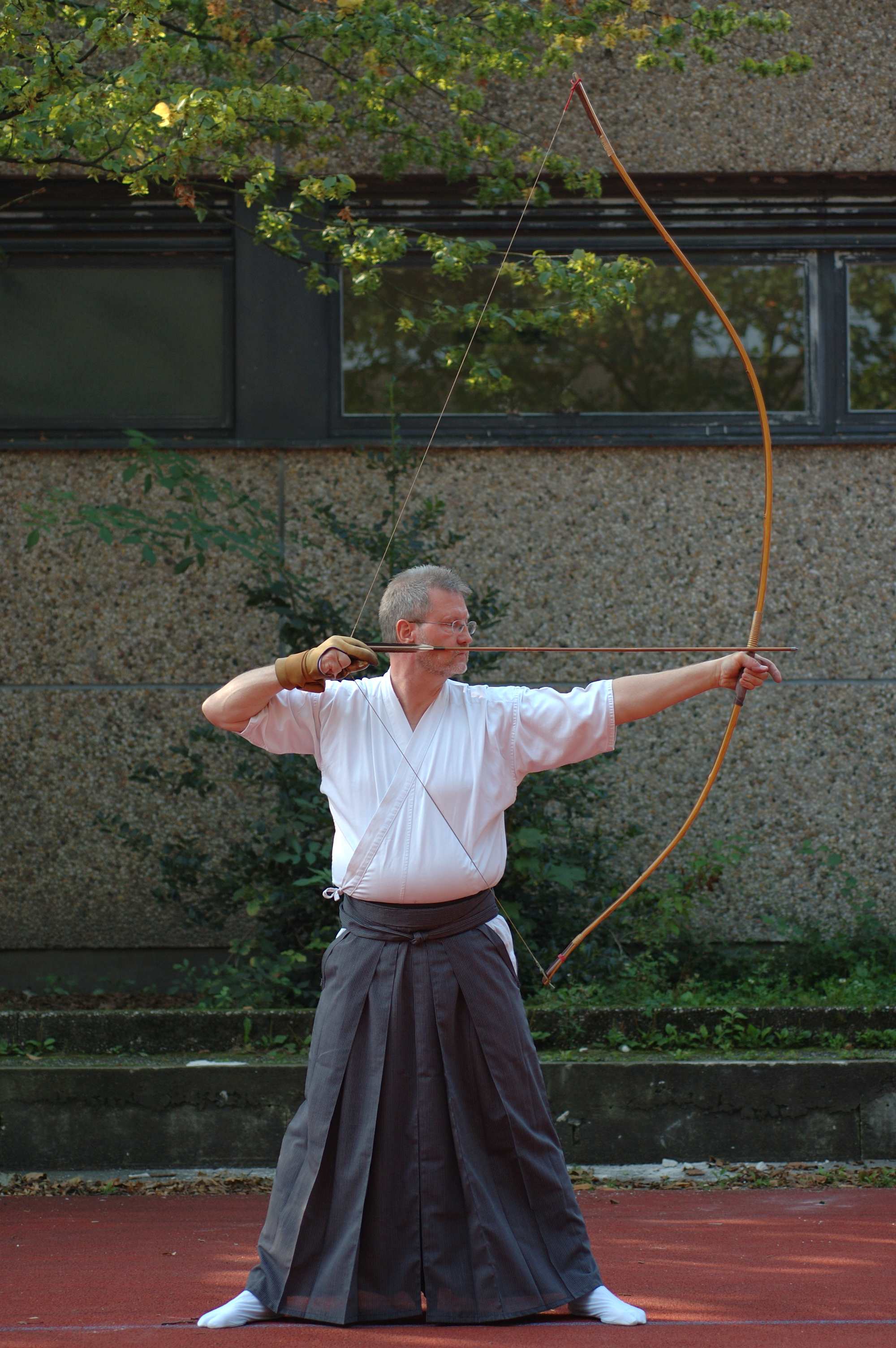
Soon after restarting my lapsed kyūdō practice in a new lineage, I purchased a basic kyūdō uniform: a dogi, kaku obi, hakama, and tabi (i.e. shirt, belt, pleated skirt-pants, and footwear). Plus my first yugake (shooting glove), custom-sized for my hand and specially crafted in Japan.

Last year I added the essential equipment. I ordered four semi-fletched arrows from respected kyūdō teacher Dan DeProspero in North Carolina for close-range indoor use with a makiwara target. Then I gained a beautiful set of six fletched arrows for long-distance shooting, which my buddies picked up for me while they were attending a workshop at Blackwell-sensei’s dojo in South Carolina. And I topped it off with a new, extra-long (yon-sun), 12kg draw weight Jikishin II composite bow in a group order from Japan’s Sambu Kyuguten.

I definitely look the part. So what’s the problem? Literally everything else!

But taking aim at the main problem: I can’t release an arrow properly. Sometimes the arrow launches feebly and bounces off the practice target. Other times it flies thru the air sideways and clangs off the target. Sometimes the string tries to rotate around the bow so violently that the bow “flips” and inverts itself, requiring a manual reset. I’ve even broken the string on one bow. And every misfire produces eye-wateringly painful abrasions and bruising on my left thumb or wrist.

This kinda thing happens to archers from time to time. With a normal problem, you would diagnose what you’re doing wrong, correct it, and move on with your practice; but it’s been more than 18 months, and I’ve tried so many things, with no success in fixing my release. In the past six months, I’ve made just 23 successful shots, against 31 misfires of various kinds. And I sat out three entire practice sessions purely out of fear of shooting. I’ve even had actual nightmares about kyūdō.

These days, I panic before every shot, anticipating the painful abrasions and bruising that accompanies yet another humiliating misfire. Obviously, my “release anxiety” isn’t helping matters at all.

Another frustration is the number of plausible fixes I’ve tried. At first I thought that the glove on my right hand wasn’t holding the string securely, causing it to slip free unexpectedly, with my other fingers impeding its release. When fixing that didn’t solve my problems, I started looking at my left wrist, which is weak and thus has a tendency to buckle inward or outward at full draw. Then we tweaked my grip on the bow, even swapping in a larger grip, because my fingers are considerably longer than those of the average Japanese archer. I tried rotating my right arm vertically on release rather than horizontally, in case that motion was interfering with my release. I tried changed where the arrow was positioned against my glove and putting less torque on my right hand, thinking my glove might be nudging the arrow out of nock. I’ve perpetually been advised to loosen my grip on the bow, but that’s something I’m pretty cognizant of, and doesn’t seem to be the main problem. Because I’ve been afraid of doing a full draw for so long, I tried altering my stance to force myself to fully extended my left arm, in case that was influencing the flight of the arrow. And most recently, I’ve tried focusing my grip on the bow with my middle finger. Out of all these things I’ve tried, nothing has worked.

A complicating factor is that our club doesn’t have an actual experienced teacher among us. Our most senior member is still pretty junior, only recently graduating from Second Dan. So although I get a ton of well-intentioned advice from other members, it’s mostly amateur guesswork and is sometimes contradictory. So many different suggestions have been piled on simultaneously that I can’t adequately test whether any of them are working. Especially when we are only able to shoot three or four arrows per weekly session!

As I said above, part of being a kyūdōka is learning how to manifest stoic strength, showing neither elation nor disappointment in one’s performance. So I’ve been exceptionally patient, never showing any overt emotional response. Meanwhile, I’ve helped new practitioners, who began with considerably less skill and self-awareness, advance far beyond me in skill. Although I really don’t care about rank at all, after nearly two years of incompetent struggle, I’m not improving, and I’ve finally exhausted my willingness to suffer in silent solitude.

A normal kyudoka would long ago have called on the experience of their teacher. For better or worse, our Austin group falls under the auspices of a Seventh Dan teacher who lives in South Carolina and runs his own group there. He never comes to Austin, and we can only travel to see him once or twice a year, when he holds kyūdō seminars that are well-attended and open to the public. At those seminars, he prefers to work with his advanced students, and I don’t want to show up on his doorstep asking for him to solve some aging stranger’s beginner struggles. Ideally, I’d get my problems cleared up and develop some basic competence before working with him. But until that happens, I’d be too ashamed to show up with such fundamental problems, and it would be a pointless waste of a trip if I was unable to participate in shooting.

While I expect my struggles to continue, there are two potential options for possibly getting help.

Our sensei has mentioned the possibility of hosting a weekend seminar specifically for our Austin group. This could be a way for me to meet him and get some personal instruction without taking his precious time away from his favored students. The challenge would be getting a critical number of students to schedule travel together to South Carolina to make it worth sensei’s time. And meanwhile, I’ve got an upcoming surgery that’ll prevent me from flying for six months.

Another possibility might be sending video clips to him for his critique. This has the advantage of being easier to make happen, but it would limit how much sensei can see, as well as how quickly I could test out his suggestions and get rounds of feedback. Plus it would still be an imposition, and he’s known for being terse and a poor correspondent.

At any rate, I’ll be taking the month of March off from kyūdō following my upcoming surgery. I have no idea whether that downtime will be a useful reset for my technique or an opportunity for me to atrophy and fall even further out of practice.

This is all an immense challenge to the air of competence and Buddhist stoicism I usually try to exemplify. Despite my obvious struggles over the past year and a half, I successfully remained nonchalant and kept my frustration on a low simmer. But at this point the pressure has built up and reached an explosive level where it has to come out. It’s been a very long time since anything has frustrated and humiliated me so thoroughly as kyūdō.

After two years of continuous struggle, it would be illogical to think anything is likely to change. So there’s no way to end this post optimistically. Just venting, while documenting my lengthy, painful, and ongoing struggle.

Cambridge Massachusetts, February 23, 2014: I grab a Japanese bow, walk to within two meters of a target, and inexpertly bury two arrows into it. Thus began my excursion into the meditative / martial art of kyūdō. There’s some background info on kyūdō and my “First Shot” ceremony in this blogpo.

However, 18 months later, I moved to Pittsburgh, where the lack of a kyūdō group forced me to step away from the practice. Seven years passed.

When Inna and I were recently evaluating cities to move to, kyūdō was an important consideration for me, and I checked out the local groups when we visited Raleigh/Durham, Denver/Boulder, and Austin. So when we finally moved to Austin, one of my first stops was Austin Kyūdō.

My Second First Shot

My Second First Shot

In Japan, there are several schools of kyūdō, each with their own slight differences in philosophy, terminology, and technique. Of those, there are only two that are active in the United States. There’s the All Nippon Kyūdō Federation, which I’ll shorten to ANKF, that came out of a postwar attempt to unify all the diverse styles into one common form. That’s what’s typically taught as an activity in Japanese high schools. The other presence in the US is the Heki-Ryu Bishu Chikurin-ha school, which I’ll call Zenko, which is one of those older schools, traditionally headed by the Shibata family of bowmakers to the Japanese nobility, and which was supported somewhat by the Shambhala organization.

Sadly, there’s some rivalry and mutual condescension between these two schools. While that might make more sense back in Japan, it seems pretty counterproductive here in the US, where the differences seem trivial and – since neither has much of a following – a spirit of mutual cooperation would benefit everyone.

All this pertains to me because my practice at Byakko Kyudojo back in Boston was in the Zenko style, but Austin Kyūdō is affiliated with the ANKF. So I’m effectively switching schools and starting over. While there is a Zenko group in Houston with occasional practices in Austin (Emiko Kyudojo), it makes sense for me to get back into kyūdō with the more active local group and consider returning to the Zenko fold after developing a greater level of proficiency.

From the perspective of an American and a novice, the differences between ANKF and Zenko are few, but worth enumerating. Philosophically, Zenko is more focused on the internal, meditative aspect of archery (which appeals to me), and seems more focused on individual practice rather than coordinated group shooting. And – being run by a family of traditional bowmakers – Zenko requires practitioners to use bamboo bows, whereas ANKF is happy to use composite bows that are cheaper, more forgiving, and require less care. ANKF has also added formal ranks, requiring written exams and shooting demonstrations to advance in levels.

With that as background… After arriving in Austin, I learned that Austin Kyūdō was holding a six-week beginners’ course. Between a seven year layoff and joining a different school, that “starting over” route made sense for me. I joined two other newbs for their training series, which culminated on Saturday April 1th with our “First Shot” rite… Which was actually my second First Shot ceremony, having been through Zenko’s equivalent back in 2014, as described up top.

While it’s wonderful being a full-fledged kyudoka again, I’m far from satisfied with my first shot. While passable, my form wasn’t up to my own expectations, so I have plenty of “stuff” to work on.

But I was also put off because my hands are too large for any of the group’s dojo-owned gloves for students. In addition to a bow and arrows, a kyūdō-specific glove is an absolutely essential piece of equipment, since it is the glove that actually holds the bowstring when it is drawn. For my first shot, I wound up borrowing another student’s brand-new glove, and the bow just wasn’t cooperating with it.

While I always intended to send away to Japan and invest in my own custom-made glove, the lack of a dojo glove to practice with has made that purchase a pressing need. The fabrication and shipping will take 2-3 months, during which I really can’t do any shooting, either at distance or at a close-range practice target, as in the photo above.

Despite that frustrating delay, there’s still a lot I can work on in the meantime, so that when my glove arrives I can dive back into practice with diligence, energy, and more confidence in my form.

As I step away from some of my older hobbies, it looks like kyūdō—the Japanese martial art of archery—might be a new activity that arises to take their place.

People who know me will realize that when I commit to an interest, I dive into it with a unique intensity and dedication. Looking back, I’ve had numerous interests which I pursued for years and sometimes decades, such as Tolkien fandom and fiction writing during my youth, or cycling and meditation as an adult.

But every five or ten years, I step back and reevaluate my hobbies and how they fit into my life. Often I can tell when a chapter of my life is about to end because I feel that my interests aren’t helping me grow in the direction I want to go in. It’s at those times that I’ll suddenly walk away from things I’ve been devoted to for years, such as when I left my writers’ group after running it for more than a decade. At the same time, I feel myself looking for what new interests might come along to replace the old.

In the past year or two, I’ve set the groundwork for dropping two time-consuming hobbies. I’ve already publicized that after fourteen seasons, 2014 will be my last year riding in the Pan-Massachusetts Challenge, which will free up a lot of time I’d otherwise spend fundraising. In addition, I will soon stop tracking my money using the Where’s George website, after a ten-year run. These were great activities, but it’s finally time to move on.

Knowing that this would free up time and energy, I started kicking around ideas for what I might enjoy doing next: something I could get involved with that would also appeal to the very different person I have become.

And the first thing that seems to have arisen is kyūdō.

kyudoka

Kyūdō is a meditative martial art devoted to the traditional Japanese form of archery. It’s surprising that kyūdō is not widely known in the US, because it is extremely popular in Japan, where archery and its equipment are viewed as highly sacred. Kyūdō has been refined and distilled into a highly reflective, meditative practice, as reflected in the first western book on Japanese archery. Eugen Herrigel’s 1948 “Zen in the Art of Archery” was wildly popular and was the first book to use the now-popular moniker “Zen and the art of…”

So why have I been drawn to kyūdō? It’s hard to explain, but it boils down to six attributes that appeal to me: it’s social, meditative, physical, elegant, familiar, and Japanese.

Although the focus of the form of kyūdō is internal, participation and instruction are offered in the context of a small, friendly martial arts dojo of mixed ages and genders. This is imperative to me, since social life and connection is revealing itself as the primary project of my fifth decade of life.

I probably don’t need to belabor how kyūdō’s meditative focus complements my longstanding contemplative practice. As a form of meditation that involves a fair amount of movement, Kyūdō seems to nicely fit in the gap between rather sedate walking meditation and full-bore regular life.

For years, I’ve been looking for some technique for integrating physical exertion and meditation, which initially led me toward an exploration of yoga. However, being in a room filled with women in tight skinsuits—all rolling around on the floor in provocative positions—wasn’t especially conducive to internal exploration. Kyūdō allows and incorporates a focus on the body without the detrimental distractions.

However, like the asanas in yoga or the forms in tai chi, kyūdō is strictly choreographed. And when control of the human body and its motions is combined with the natural geometry of the bow, bowstring, and arrow, kyūdō epitomizes elegance and grace: attributes that I strive to embody.

And archery has always appealed to me. Even as a child, archery was my favorite activity at summer camp, and over the years I became pretty skilled at it. And in my medieval recreationist days I bought and used a very powerful English longbow, as well.

And for whatever reason, I seem to be in a phase where Japanese stuff is interesting, so it fits into that, as well.

So as you can see, kyūdō actually complements my interests quite nicely.

Practices are both convenient and a bit of a stretch. During the winter, they use an indoor aikido dojo in Union Square, which isn’t easily reached by mass transit, but is manageable. And in the summer they’re out in Lincoln, which would be really difficult, except that’s just one town over from where I would be training during a regular weekend bike ride, so I’ll probably combine the two.

I first started looking at their website around Thanksgiving, and saw that they were running a new student “first shot” training at MIT in January. However, it filled up before I could sign up.

So two weeks ago I showed up at the dojo just to observe. Fortunately, another new guy was there, and apparently we comprised enough interest for them to schedule another first shot training the following week. So I returned for a second visit and received instruction on most of the form from Joyce and Randy, with the expectation that I’d get to perform my first shots the next time.

This past weekend, I returned for part two of the training. Although the other new guy wasn’t around, I received additional instruction from Joyce, and then Don covered some more details before encouraging me to step up and take my first shot.

To put that into perspective, in Japan new students often take weeks, months, or sometimes years drilling the techniques before they’re allowed to shoot. Due to Americans’ typical impatience, our school has disposed of that, but it’s still a big milestone.

So I felt some anxiety as I stepped up and went through the movements and fired two arrows. When we move outside, we’ll fire at targets 28 meters away, but indoors we shoot at cardboard bales from a distance of about ten feet. I managed to remember most of the steps, but forgot to flip my right arm back upon my first release; I corrected it for the second.

What was interesting to me was how intensely the body experienced it. When I stepped away, my heart was racing and I was breathing heavily. I think much of that is due to the selfconsciousness of taking my first shot under the sensei’s gaze, combined with the physical stress of drawing the bow and the loud thunk of the arrow striking the target.

Of course, I haven’t mastered anything as yet. It’s frustrating but entirely predictable that some of the things I do wrong are common both to kyūdō and cycling, such as tensing and hunching my shoulders. And I also need to pay better attention to keeping my body facing perpendicular to the target, rather than turning toward it.

But it was successful! I’d followed the forms and properly fired and lodged my arrows into the target. So at least I’ve got the basics down.

Over time, I hope to embody some of the elegance that you can see in some of the YouTube videos or Vimeo videos about kyūdō. And if I stick with it, perhaps someday you’ll even get to see a photo of me in a hakama!

Frequent topics