I’ve always been a little – sometimes a lot – older than the friends I hang around with. So I figure some folks might be wondering how it’s going following my recent stroke… What it’s like to live with the realization that a portion of my brain is, literally, dead.

The most pertinent fact is that my stroke is over. Actually, it was probably over by the time the EMTs showed up, but then there was the whole diagnosis and treatment protocol and investigation and followup plan. But now, six weeks later, that episode is as much a piece of history as my first driving test.

Physically, I’d like to say that I have no lingering aftereffects. Sensation returned to my left hand over the first 48 hours, and that numbness had been the only significant aftereffect.

The psychological impact was more lasting, manifesting in several flavors that’ll fill the balance of this blogpo.

Betrayal

Easily the most prominent emotion has been the feeling that I was betrayed by my body. For sixty years, I knew in my bones that my body could thrive and succeed no matter what outrageous demands I placed on it. Eating like a 14 year old? No problem. Bike 150 miles in a single day? Piece of cake! Going out drinking and nightclubbing until 4am and getting up at 6am to facilitate meetings with Fortune 500 clients? Easy-peasy! Work 80 to 120 hours per week for nine months straight on a death march project? BTDT.

But completely out of the blue one morning, the body I’ve relied upon all my life suddenly betrayed me, with no warning, while doing nothing more strenuous than walking down a staircase, something I do dozens of times every day.

I can’t tell you how much of a shock that was. I’ve been through the classic responses: anger, grief, bargaining. The only one I missed was denial, because it just wasn’t possible to ignore.

Mistrust

Trust, once broken, is difficult to restore.

Even after the hospital sent me home, I didn’t feel that I could just go back to a normal life. Even though that episode was over, I didn’t trust that I wasn’t still in imminent danger. I still felt that I had to stay vigilant, on guard against anything that might come up, even though I know that I’m not in full or direct control of my body’s health. Once bitten, twice shy.

Hyper-awareness

Because of that, I’ve been hyper-aware of every little niggle that arises… and in a 61 year old body, there are plenty of them.

I have developed some neuropathy in my feet, and any time a body part “falls asleep” sets off stroke alarms in my head. And that pain in my armpit: could that be a lymphoma? The stitch in my side kinda feels like a kidney stone, or maybe diverticulitis. The pain in the opposite side is probably pancreatic cancer, or maybe just liver failure. And my chest pains might be a symptom of atrial fibrillation, which is a huge risk factor for stroke.

I’m not normally prone to hypochondria, but nor am I used to waking up one morning and having a stroke. Even after consulting my physician, I can’t say for certain whether all these maladies are complete fiction, or real but minor discomforts, or something far worse.

Fear

What does the future hold? How much longer will I live? The truth is that I have almost no information and very limited influence.

That’s hard. It’s a cause for anxiety, uncertainty, and unease. In a word: fear. Raw existential dread. Not something I’ve ever had to face directly, so it’s one of those unpleasant “learning experiences”.

During the day, there’s enough stuff going on to distract me from all this, but the fears are more insistent at night. Keeping one’s imagination in check is a full-time job!

Living a normal life in this midst of all this is not easy! But then, what’s the alternative?

Fortunately, every morning I get up and notice that I don’t appear to be fatally ill. And after six weeks of evidence to the contrary, my worst fears have weakened to the point where life has started to feel normal again.

Coping

What helps? Good question.

Has my longstanding meditation practice helped? Somewhat. Meditation taught me how to distinguish between skillful thoughts and unskillful thoughts as they arise; that I don’t need to give full credence to everything a fearful mind envisions; and how to short-circuit the mental proliferation that can fuel unnecessary fear about the future. It also allows me to see that my moods and emotions are intensely charged interpretations of one possible future – not reality itself – and that they are essentially both transitory and empty of real substance.

That doesn’t mean that I’m able to dispel all my fears, especially in the dark, lonely silence of a late night, with nothing to think about other than my body, its ephemeral nature, and its treacherous sensations.

The thing that seems to help most is the simple passage of time. As I mentioned above, day after day, the worst case scenario doesn’t seem to happen. And that data has slowly piled up into an irrefutable conclusion that I seem to be mostly okay, at least in this moment.

Not that I feel like I can trust that just yet. But it does seem more and more plausible as each day goes by.

Conclusion

I am subject to aging. I am subject to sickness. I am subject to death.

These irrefutable truths are hard to face, and they’re a rude awakening that every one of us will have to come to terms with, at a time and in a manner we do not control. And this society does a shitty job preparing people for this immense challenge.

I’ve had a conceptual understanding of these truths since my sister died following a stroke fifty years ago. In my life, they’ve been reminders of the preciousness of life. Now they’re more omens about the precariousness of life. My life. My very finite life.

A while back, I came across an article entitled “These are the bad things about early retirement that no one talks about” (sic).

Although I haven’t (to my knowledge) retired, I have some firsthand experience, having successfully avoided working for 11 of the past 18 years. And I don’t think the article contains any significant revelations.

Let’s look at the author’s five main points about early retirement, before I tell you the meaningful lessons I’ve learned from taking time off.

  1. You will suffer an identity crisis for an unknown period.

    I think this only applies if you largely derive your identity from your employer. In a time when corporations offer zero loyalty to employees, identifying with an ephemeral job is a dangerous, outdated delusion.

    Since I’ve always had a strong sense of personality outside the workplace, time off didn’t erode my identity. Instead, it gave me the opportunity and time to fully indulge in activities that I valued, which has been extremely rewarding.

  2. You will be stuck in your head.

    This problem will only arise if you cannot fill your free time with meaningful activities.

    And even if you can’t, a little time for introspection is probably good for you. But free time usually amplifies our existing inclinations: if you are by nature content, in retirement you’ll find lots of contentment; whereas if you’re a doubtful or insecure type, you'll probably be plagued by lots of doubts and insecurities.

  3. People will treat you like a weird misfit.

    If you've lived a full life, you’re probably already used to stepping outside other people’s narrow-minded expectations of you.

    But if you stayed comfortably “inside the box” that society expects, then don’t you think it’s high time you stepped out and tried life as a weird misfit? It’s a lot more interesting!

  4. You’ll be disappointed that you aren’t much happier.

    If you’re financially able to retire early, you've probably already discovered the importance of having rational expectations. But if not, let me clarify for you:

    When you retire, you will have lots of free time and the ability to choose how you spend it. Unless you spend that time doing things that make you happy, you won’t be any happier in retirement than you were before.

  5. You constantly wonder whether this is all there is to life.

    Yes this is, in fact, all there is to life. And it’s a miracle! You have all the time in the world, financial security, complete freedom, and lots of resources to find how to make that time meaningful and rewarding. If you do nothing but sit on the couch waiting for the world to entertain you, you’re clearly doing it wrong!

So that’s my response to the author’s absurd early retirement handwringing. Let’s dismiss this amateur’s fear-mongering and talk about the real issues surrounding early retirement.

  1. The inertia of rest is insidious.

    To be fair, the article’s author kinda dances around this vital life lesson that everyone should bear in mind. Rest, comfort, and sticking with the familiar can be important elements of stability, and can help you break your enslavement to compulsive productivity. But rarely will they provide a sense of achievement, satisfaction, or lasting happiness. A rewarding life requires initiative and effort, not lethargy and passivity.

  2. Manage your fear of running out of money.

    There are probably a few people who don’t have to worry about money during their retirement, but for most of us managing our shrinking nest egg will be our single biggest preoccupation.

    It’s important to spend time on financial planning, but it’s just as important to develop the emotional skill of setting those worries aside. Don’t fill all that hard-earned free time with worry, fretting, and panic.

  3. Plan for medical expenses.

    The biggest threat to our nest egg is healthcare. Unfortunately, our health—and the amount of money we need for it—are completely unknowable.

    However, that doesn’t mean they’re unmanageable. As a reasonable person, you can soberly address the risks up front, become an informed consumer, obtain professional advice, stick to a plan, and cultivate the trust that you will be able to manage through whatever circumstances arise.

  4. Find the right balance between thrift and indulgence.

    Again with money! Though to be honest, these issues aren’t really about money itself, but about how you relate to it.

    My point here is to find a way to relate to money that allows you to plan and feel secure about your future, while also putting your savings to use in service of your own happiness, whatever that looks like.

    It might be travel; it might be charity; it might be assistance for your grandkids. But the important part is relating to your nest egg in a way that’s mature but not obsessive, and fulfilling but not shortsighted.

So there you have it. In a nutshell: take responsibility for how healthily you relate to your most precious resources: time, money, energy, and health.

As a smart kid growing up in an economically depressed area, my adolescent ambition—and that of many of my peers—could be summarized in the two-word mission “Get out!” As in: get out of this backwater state and find an interesting place to live where you can meet intelligent people and make a good living doing challenging work that has a real impact on the world.

High school friends

High school friends

Once I fulfilled that goal, I used to take satisfaction in comparing my achievements to those of the friends I used to hang out with back in high school. I judged them and their lives by the degree to which they succeeded in getting out and making something of themselves: criteria which many of them had espoused back in our high school days.

Now that the struggle for status and success is much farther behind me, my definition of success has finally loosened up. While I still enjoy looking at the lifestyle choices of my childhood friends, the rush to judgment has receded; instead of gauging success by whether or not someone got out of Maine, I simply find interest and occasional amusement at the paths they have taken and the lives they have constructed.

There are, of course, the inevitable filters. Who settled down and raised a family, and who remained single or childless? Who actively tried to bring their dreams to life, and who were content to passively let things transpire? Who stayed in small-town Maine, and who distanced themselves from the safety of friends and family? Who chose a rural, pastoral life, and who was called to the big city or international travel? Even in the absence of judgment, these are very interesting questions.

As is life’s nature, there are surprises: ambitious people who—for whatever reason—settled for less than their potential, and folks who soared way beyond what you would ever have guessed. These are the stories I find most interesting: what people made of their life, and how their choices changed and evolved over the long years of adulthood.

I don’t think my life story would surprise anyone who knew me in high school. I was a smart but geeky and introverted kid, and no one would be shocked that I left town in search of a career in the tech field, where I did reasonably well.

In addition to being in-line with my nature, my choices thankfully led to my success and long-term happiness. I’ve experienced a vast spectrum of life’s offerings, and throughout it all, I’ve been genuinely and deeply happy with a lifestyle that has changed over time, but always suited me extremely well.

Whatever lifestyles my old friends crafted as a result of their life circumstances and decisions, I hope their paths have suited them just as well.

Although it’s a completely arbitrary marker, this is the time of year when people look back and take stock, with the aspiration that things might be different from this point forward.

I am entertaining that same hope this year, because the past 18 months have been pretty brutal. There have been a number of really great things, but also a hell of a lot of adversity to overcome.

I’ve already described much of it in the pages of this journal, so I don’t need to get into the details. Instead, I just wanted to list them out in bullet points… To preserve the big picture, and to share this impression of all the challenges, failures, and victories I’ve faced.

With that as introduction, here’s a list of the major stressors and changes that have come about for me in the past 18 months. They’re color coded: green is good, red is bad, and yellow is something in-between.

  • Had a bike crash trying to avoid a car that ignored a stop sign. Ensuing physical recuperation, plus medical expenses and bike repair costs.
  • Surpassed $100,000 in lifetime fundraising for the PMC, earning a lifetime achievement award.
  • My job ended quietly after my employer being bought out. Although I did get to have another year-long sabbatical.
  • Grew my hair out to normal length after 10 years clean-shaven.
  • Turned 50 years old.
  • Spent that birthday on a tiny Caribbean island I’d long dreamed of visiting. Some stress from the tiny eight-person commuter flight from San Juan, and a bit of loneliness that I had no one to share it with.
  • Had a big misunderstanding with a friend that caused a lasting rift between me and my Kalyana Mitta spiritual friends group.
  • Very emotionally intense 10-day meditation retreat at IMS, including having someone barge into my room while I was sleeping the night after they announced that a thief had broken into people’s rooms.
  • Started a promising friendship and potential relationship only to have it explode in flames in my face.
  • Lost my mentor, benefactor, and hero Bobby Mac to cancer.
  • Stopped a ten-year hobby of tracking my spending at Where’s George.
  • Committed to trying to make a relationship work with my best friend Inna.
  • Survived a frigid 51st New England winter. Working on number 52 now.
  • Committed to moving south, out of New England, where I’ve lived my entire life.
  • Started an expensive new hobby in kyūdō, traditional Japanese archery martial art.
  • Celebrated ten years of meditation practice.
  • Put a lot of energy into a big project to reach out to others socially, with limited results.
  • Another bike crash resulting in a mild concussion, plus another round of medical expenses and bike repair costs.
  • The ER nurse botched an IV insertion so badly that a hematoma covered my entire arm, and I was unable to move it or ride for six weeks thereafter.
  • Participated in my final Pan-Mass Challenge ride.
  • Left my Kalyana Mitta spiritual friends support group with significantly mixed feelings.
  • Pretty much ended all involvement at my meditation center, including the longstanding Experienced Practitioners group, the annual Sandwich Retreat, and my volunteering to MC the regular Wednesday night dhamma talks.
  • Put my meditation practice on long-term hold.
  • Took my beloved cat for vaccinations which he had a severe reaction to. Just as he seemed to be recovering, the hospital called and I was forced to tell them to let him die.
  • I developed abdominal pain which took a long time and considerable expense to diagnose and treat, resulting in gall bladder removal: the first surgery of my life.
  • Began renovating my condo with a goal of putting it on the market, finally undertaking several repairs I’d put off for years.
  • While doing renovation, discovered that the living room drywall needed to be replaced, and there was a gaping 12-inch diameter hole from the bedroom to the outside that should have been bricked up and insulated.
  • Major financial issues as a result of unemployment, mortgage, medical bills, and home renovations.
  • Raided my 401k in order to fund renovations and medical bills.
  • The usual self-questioning during my job hunt.
  • Started a new job at Buildium, which will require me to learn quickly and prove myself again without any direct mentoring.
  • Discovered that gall bladder removal didn’t address my abdominal symptoms, so will begin 2015 back on the restrictive diet and undergoing further diagnostic work, while hoping it’s not something serious.

So as you can see, I’ve had a lot to deal with, including quite a bit of negative stuff, which is happily atypical for me. It’s definitely taxed my energy, morale, and coping resources.

While my health problem is front and center, and there are more big challenges to come in the next couple years, I’m hoping that things will start going a little more smoothly. Although I don’t believe that changing the calendar has any meaningful impact, it would be nice if things started getting back on track again.

After all, I’m not used to life being quite this difficult and exhausting.

Da Bomb

Apr. 24th, 2013 03:22 pm

Patriots’ Day is a state holiday, which my employer honored until this year, having been purchased by a company in Las Vegas that doesn’t think particularly much of Massachusetts’ Revolutionary War history.

The Boston Marathon, which takes place on that day, finishes a block—150 yards—from my condo. Between setup, tear-down, and cleanup, it royally screws up transportation for most of a week. Street closures bring most of the neighborhood to a standstill. They close my MBTA station (Copley) and you physically cannot cross Boylston Street without going a mile out of your way.

Since I would be unable to get to work (or back), I chose to work from home on this year’s Patriots’ Day. In the evening, I also had an appointment to pick up my new bike and do a full fitting, although I didn’t know whether I’d be able to get through the crowds to get to the bike shop!

For most of the day, I ignored the race. Public events are common where I live, whether it’s the Walk for Hunger or a pride parade or a Critical Mass ride or a sports team celebrating a championship or a free concert or a political rally or the Santa Speedo Run or whatever. I mostly tuned out the race’s PA announcer, the shouting vendors, and the partying revelers. Once or twice I looked out my window to see the crowds of exhausted runners walking down Boylston Street, having just crossed the finish line.

Just before 3pm I heard a loud boom. Yes, it might have sounded like a canon, but the first thing I thought of was that someone had taken a huge dump truck and dropped it from 20 feet up. It was an echoing heavy metal sound, like a big truck carrying steel I-beams hitting a wall. Except the concussion was a lot stronger than that. My building was rocked, and a dozen building and car alarms were going off.

Twelve seconds later, as I wondered what was up, I heard the second blast. It was further away from me, but still didn’t sound normal. I got up and went to the window and saw hundreds of panicked runners, spectators, and volunteers streaming out of Copley Square, running down Dartmouth Street toward me. (That’s my condo in the news photo at right.)

Something very bad had obviously happened in the square. I looked for the smoke that would be the tell-tale sign of an explosion, but there was none that I could see above the single row of five-story brownstones between me and the finish line.

My first instinct was to share the news. I went to Facebook and entered what I knew:

Something bad at the marathon… People running all over. Two huge booms, whole building shook, emergency vehicles all over the place.

My next instinct was that this was going to be national news, and I should reach out to friends and family who might wonder if I was injured, so that was my next task.

After that, there was just a whole lot of news watching, and checking out my window as runners, volunteers, and spectators fled the area, rescue vehicles swarmed in to assist the injured, and law enforcement units sealed off the neighborhood.

As it turned out, the first bomb blast was a block from me (see the map), right near my bank and across the street from the Boston Public Library. The second was a block further up, across from Lord & Taylor and my walking route to my neighborhood grocery store.

Although cell service was initially flooded—and despite persistent reports that the police had intentionally terminated cell phone service city-wide—service freed up as people gradually left the neighborhood. I spent the next couple hours fielding inquiries from friends via cell phone, Facebook, instant messaging, and text messages.

Despite all the chaos, I still thought that I could make my bike fitting appointment across town, and brought my old bike down to the lobby. On the way out the door I heard another muffled boom which apparently was a controlled detonation of an abandoned bag that wound up being completely innocuous.

On the street, thousands of people were milling around aimlessly, and the cops had cordoned Dartmouth street off at Commonwealth Avenue. What that meant is that my building was squarely on the edge of the lockdown zone; We could go in and out the main (north) entry, but the side (east) and rear (south) doors were off limits.

I biked off through streets that were largely empty of cars, but with a large number of pedestrians walking around obliviously. Once I got to the bike shop, I saw the “closed early” sign and turned around and made my way home. Knowing Comm Ave would be a mess due to the marathon, I took my only other alternative: the Charles River bike path.

While crossing the Dartmouth Street footbridge over Storrow Drive, one matronly lady headed in the other direction yelled at me, “Don’t go there! The police are there!” to which I, of course, responded, “I live there.”

A few minutes after I got settled back into my apartment, our fire alarm started going off. I assumed the cops had decided to evacuate us, but I checked the hallway and actually smelled smoke. So I started going through the handy list of evacuation tasks I keep by the door. Grady the cat, who up until now had shown absolutely no evidence of concern, was (justifiably) spooked by the blaring fire alarm and it took me a while to corner him and get him into his carrier.

As it turned out, one of the residents had burned dinner. What an irresponsible thing to do, given all the other stuff going on in the neighborhood that needed the fire department’s attention! After a bit of fresh air, the residents were let back inside to soothe our now doubly-jangled nerves.

As night fell, outside my window Newbury Street—which was within the lockdown zone—was absolutely deserted except for cops and military personnel. Absolutely no one was allowed into or out of most of the Back Bay. Huge situation response trucks took up station as the police began to comb through what they termed a “crime scene” that was several square miles in area.

I had planned to take the next day (Tuesday) off to ride my new bike. Despite not having the bike, with the entire neighborhood sealed off there was very little point in trying to get to work, so I took it as a vacation day. And if I could get out and pick up the bike, then I’d take it for a bit of a shakedown cruise.

That morning, one positive development was that the cops opened up Newbury Street to traffic, reducing the lockdown zone a bit and ensuring that my building, at least, would be accessible.

I wasn’t home for much of the day, tho. It was an amazingly stressful and hectic day, made worse by the continuing closure of the Copley MBTA station. At a high level, it went like this…

Walk half a mile to Hynes station. Get past National Guard troops. Take the trolley to the bike shop in Brighton. Take the new bike for a 16-mile test ride outside of the city. Take the trolley back to Boston. Walk half a mile home from Arlington station. Have a Pop-Tart and a glass of juice. Ride the old bike two miles back out to the bike shop. Have an abbreviated fitting done. Ride the old bike two miles back home. Walk half a mile to Arlington station. Take the trolley back out to the bike shop (don’t forget all the National Guard watching this). Ride the new bike two miles home. Turn around and walk half a mile back to Hynes. Hop an MBTA bus to Central Square in Cambridge. Inhale a burrito. Walk to my meditation center for my Tuesday night practice group. Meditate for an hour, then socialize a bit. Walk back to Central and hop the MBTA bus back to Hynes. Walk down to the Fenway Whole Foods, since the two grocery stores that are nearer to me are in the lockdown zone. Too late; they’re closed, so buy milk and OJ at a nearby CVS. Shlep those another mile back home. Collapse.

After just five hours’ sleep, Wednesday I went back to work. The lockdown zone shrank a bit more—down from 17 blocks to 12—freeing up Hereford, Berkeley, and Clarendon. Investigators concluded that the bombs had been constructed of pressure cookers, nails, and metal pellets, and announced that they had obtained surveillance video evidence showing a suspect.

Thursday President Obama (and many others) came to town for an inter-faith ceremony. That night the FBI released photographs of the two suspects.

Friday I was going to bike to work, because it was going to be the warmest day in more than six months, but that plan came to a crashing halt when I learned that shortly after the photos had been released, the bombers had engaged the police in firefights in Cambridge and Watertown, and one of them had been killed. The police had most of eastern Massachusetts completely locked down: no Amtrak, no MBTA, no commuter rail, no cabs, all businesses closed, and residents were told to stay indoors all day.

Despite live news broadcasts all day long, literally nothing happened in the 18 hours after the firefight. After a fruitless search of the neighborhood in Watertown where the surviving suspect was last seen, the police gave a press conference wherein they lifted the stay-put order. On the good side, that meant that the Amtrak would be running Saturday morning, when I had plans to travel to Maine.

But going outside sounded like the height of folly to me, because the second suspect was still armed and on the run. I guess the cops were probably hoping that he’d just turn up somewhere.

Which, as it turns out, was exactly what happened. A man just outside the cordoned-off part of Watertown found the remaining fugitive injured and semi-conscious, hidden in a shrink-wrapped yacht in his backyard, and the police came and took him into custody.

With the second suspect on the way to the hospital, the whole area burst out in celebrations. Of course, even despite the all-clear and the police high-fiving one another and the T being opened, Copley Square MBTA station remained closed, and the entire 12-block area around my apartment was still off-limits to the public.

That pretty much killed the day Friday.

On Saturday I did manage to get out of town on the Downeaster, and returned again on Sunday night. Copley and my neighborhood still off limits.

Monday. Still off limits. On the way home from work, I stopped at the grocery store, then lugged my provisions a mile and a half home. But the FBI turned the site back over to the city of Boston.

Tuesday. Still off limits. CIMC had a special evening gathering, led by the three guiding teachers.

Finally, on Wednesday morning they opened things up. After nine days of being unable to use my MBTA station or cross my neighborhood, the marathon (in both senses of that word) was finally over!

So that’s what happened. Now for a few thoughts…

One oddity is that I remember having the thought—sometime in the week leading up to the marathon—that we hadn’t had any major national emergencies in a long time, and that we were probably due. I don’t recall what prompted that thought, but I am certain it happened.

Although thinking back on it, Back Bay has been through a lot lately. We just got through a region-wide road closure due to a massive blizzard, but before that we spent 48 hours without power after a substation failure, and a week without drinking water when a 10-foot water main broke out in Weston. And then there were hurricanes Sandy and Irene.

I’m disappointed that I didn’t do more to help other people over the past week, to put my compassion practice into action. While I was probably right in telling myself that I wasn’t needed at the bomb scene, I probably could have helped stranded runners or traumatized spectators. But I guess there’s something to learn from my inaction, and hopefully I’ll do a better job next time.

On the other hand, one close friend said it was unexpectedly thoughtful of me to let people know that I was okay. And another friend used the word “compassion” as one of the three things that she thought I epitomized. So that was mildly reassuring.

Speaking of compassion and first responders, I saw an interesting reaction to the bombing that spoke eloquently to me about how men’s manifestations of love and compassion go unseen and unacknowledged. Here:

I had an amazing insight about men. This one insight seems life-changing to me: “Acts of heroism are acts of love.”
 
Why is this life changing? Because I don’t think the narrative out there right now is that men are constantly involved in deep, fundamentally good, acts of love. All the time. Men are not talked about, as a group, as being demonstrative of their love. Of being ongoing catalysts for acts of goodness. And yet they do that all the time. I think the narrative is that men take heroic actions because they are told it’s a role they must play, because men are “supposed” to be strong, supposed to be brave. Because they are “manning up” the way they were taught to. If love is talked about with men, it is in the context of sexuality. When men are called “lovers”, it is often code for “womanizers”. But men act in love, and show that love, all the time. For some unfathomable reason, we call it something else.
 
I don’t think men get enough credit for love.

I think my meditation practice really helped me deal with a situation that would otherwise produce a lot of anxiety and emotional discomfort. While I saw and acknowledged my own emotions, I was much more intrigued by the reactions of the people around me.

For several days, the main question on people’s minds was the search for “who”: who did it?

Lots of people either undertook their own search for the culprit based on photographs that had been posted or formulated their own opinions based on little to no data. But realistically, no private citizen was going to identify the bomber; that’s what we pay our law enforcement agencies for. Get out of the way and let them do their job!

As my teacher pointed out, this compulsion comes entirely from mental discomfort, because the identity of the bomber has absolutely no relevance for most of us. In fact, if the bomber had never been found, it would have made absolutely no material difference in most people’s lives. So why did they spend so much mental energy and anguish trying to answer this question? That kind of desperate, undisciplined thought is the symptom of someone with an undeveloped sense of self-awareness.

Then, after it was learned that the suspects were pretty average Cambridge kids, the next question everyone was asking was “why”: why would someone do such a thing? This was prevalent both in my family as well as from other practitioners at CIMC, and it really surprised me.

I think the very question is indicative of cultural bias. While many of us say that we respect and value other cultures—especially in a highly educated, multi-cultural town like Cambridge—very few of us understand what that means in practice. It’s frustrating that I have to spell it out, but people from other cultures will have different values! They won’t be the same as ours.

While a Buddhist might value non-harming above all other things, and your average American Christian might value order and stability, someone from a foreign culture might consider those less important than individual freedom or cultural preservation or economic fairness. Why would someone bomb innocent civilians? Because it’s important to them within the framework of their values.

I don’t understand what is so mysterious about the fact that other people might have different values than yourself. Why is that so incomprehensible? But people really seem to operate on this unspoken assumption that everyone shares their values. That’s not true even within a family, never mind across vast ethnic, religious, geographic, and political divisions!

I heard the phrase “I don’t understand” so many times that I wanted to grab people and shake them. Of course you don’t understand! You’re not *trying* to understand. A criminal’s actions only make sense when viewed through *their* value system; of course it doesn’t make sense if you insist on viewing it through your very different values. That’s like wondering why birds don’t save their energy and just drive south like the rest of us, rather than fly. Of course it doesn’t make sense if you insist on interpreting bird behavior using human norms and values!

But this question of “why” is even broader than that. Sure, any seemingly “inexplicable” act (criminal or otherwise) can be partially explained by understanding the values espoused by the protagonist. But what about acts of nature or acts of “god”? Aren’t people are just as prone to ask “why” in response to a tsunami or a wildfire or a landslide or a cancer diagnosis?

I find this baffling, because change is inevitable and life is very fragile. These aren’t just platitudes to make you feel better (in fact, they should make you feel quite insecure). But more importantly, these are the incontrovertible base assumptions and conditions that we live under! There doesn’t need to be a *reason* for something bad to happen, because bad things are a part of life, an indisputable fact. All this breast-beating and asking why they happen is like asking why nitrogen happens or bemoaning the law of gravity. If you are asking why it happened, you really need to reexamine the mistaken assumptions you live by.

In contrast, I suppose I should point out something uplifting, too. With so much focus on the bombers and their actions, consider the correspondingly much greater number of people and acts of kindness and compassion that took place over the past week. We should all be heartened by the vastly larger outpouring of support for those affected.

I want to particularly highlight two tweets that crossed my feed shortly after the bombing. In the midst of the chaos and terror, many people thought of giving blood to help the injured. But still, I was amazed by this:

Red Cross reporting sufficient blood in banks at this time. Some marathoners ran directly to MGH to donate after blasts.

I can’t imagine finishing a marathon, running an extra mile, and then having blood drawn. Simply amazing! Not especially smart, but amazing.

But I really felt a deep pride in my city when I read the next tweet. How does Boston respond to a terrorist attack? Like this:

I have no idea how we are supposed to react to something like this, other than love each other more.

I’ve always loved this city. It’s a wonderful mix of ambition and compassion, competitiveness and brotherhood, pride of place and openness, history and innovation, intelligence and grit, vibrant city culture and outdoor activities for the athletically inclined. Boston isn’t perfect, but it strives mightily to be the best. And contrary to the intentions of these terrorist wannabes, the marathon bombing they undertook did something very special: it provided us with a rare opportunity to demonstrate love for our city and our fellow Bostonians, and it bound this great community together more tightly than ever before.

I love that dirty water. Aw, Boston you’re my home.

Heck, I’m so moved I might even include Cambridge…

If you know anything about Asian religion, you probably know that Buddhism has an awful lot of symbology associated with it. From depictions of a seeming multitude of deities to elaborate mandalas to lots of ritual adornments, and a plenitude of mythical stories passed down from generation to generation.

We are generally told that this symbology does not reflect belief in the literal images, but that they are primarily metaphoric in nature. Manjushri is depicted with a sword, which represents how penetrating wisdom cuts through ignorance and delusion. Avalokitesvara, the embodiment of compassion, has eleven heads with which to hear the cries of the suffering, and a thousand arms with which to aid them.

This kind of symbolic representation extends deeply into the Buddhist canon, but it’s rarely discussed amongst western practitioners, who often struggle to accept it, viewing the mythic elements as extraneous and decorative and not a central part of the core teachings.

But there are some topics which Asians (and the canon writings) are quite emphatic about. Asians assert the literal reality of things like rebirth and the ability to recollect one’s past and future lives, which westerners usually are reluctant to accept at face value. To a westerner like myself, those concepts seem like they might be yet another instance of densely-piled Asian symbolism, but no one ever seems to come out and admit it.

Well, here’s where it gets personal…

My commutes to and from work this fall have included reading “The Collected Teachings of Ajahn Chah”, a book that I snapped up while visiting Abhayagiri Monastery, the final destination of the California Buddhist Bicycle Pilgrimage I took back in September. For those of you who don’t know, Ajahn Chah was essentially the root teacher of modern Theravada Buddhism. And because he welcomed foreigners to his monasteries, he’s like the grandaddy of one of the most successful branches of Buddhism in the west.

So in the middle of this book, I read the following passage. I cite it here almost entirely because I think the context and the sequence of points is important. Emphasis is mine.

The Collected Teachings of Ajahn Chah

Anger is hot. Pleasure, the extreme of indulgence, is too cool. The extreme of self-torment is hot. We want neither hot nor cold. Know hot and cold. Know all things that appear. Do they cause us to suffer? Do we form attachment to them? The teaching that birth is suffering doesn’t only mean dying from this life and taking rebirth in the next life. That’s so far away. The suffering of birth happens right now.

It’s said that becoming is the cause of birth. What is this ‘becoming’? Anything that we attach to and put meaning on is becoming. Whenever we see anything as self or other or belonging to ourselves, without wise discernment to know it as only a convention, that is all becoming. Whenever we hold on to something as ‘us’ or ‘ours’, and then it undergoes change, the mind is shaken by that. It is shaken with a positive or negative reaction. That sense of self experiencing happiness or unhappiness is birth. When there is birth, it brings suffering along with it. Aging is suffering, illness is suffering, death is suffering.

Right now, do we have becoming? Are we aware of this becoming? For example, take the trees in the monastery. The abbot of the monastery can take birth as a worm in every tree in the monastery if he isn’t aware of himself, if he feels that it is really ‘his’ monastery. This grasping at ‘my’ monastery with ‘my’ orchard and ‘my’ trees is the worm that latches on there. If there are thousands of trees, he will become a worm thousands of times. This is becoming. When the trees are cut or meet with any harm, the worms are affected; the mind is shaken and takes birth with all this anxiety. Then there is the suffering of birth, the suffering of aging, and so forth. Are you aware of the way this happens?

[…] You don’t need to look far away to understand this. When you focus your attention here, you can know whether or not there is becoming. Then, when it is happening, are you aware of it? Are you aware of convention and supposition? Do you understand them? It’s the grasping attachment that is the vital point, whether or not we are really believing in the designations of me and mine. This grasping is the worm, and it is what causes birth.

Where is this attachment? Grasping onto form, feeling, perception, thoughts, and consciousness, we attach to happiness and unhappiness, and we become obscured and take birth. It happens when we have contact through the senses. The eyes see forms, and it happens in the present. This is what the Buddha wanted us to look at, to recognize becoming and birth as they occur through our senses. If we know the inner senses and the external objects, we can let go, internally and externally. This can be seen in the present. It’s not something that happens when we die from this life. It’s the eye seeing forms right now, the ear hearing sounds right now, the nose smelling aromas right now, the tongue tasting flavors right now. Are you taking birth with them? Be aware and recognize birth right as it happens. This way is better.

What’s being said here—and the flash of insight that came to me on my way to work—is that the concept of rebirth is a metaphor for attachment. When something becomes so important to you that you have to have it, you are setting yourself up to suffer when it inevitably changes. When you can’t stand something so much that you have to push it away, you’re setting yourself up to suffer because you cannot control it. That is what Luang Por Chah is referring to when he talks about the abbot taking birth with each tree: if he is attached to the trees, he (metaphorically) lives, suffers, and dies with them.

In that way, you are “reborn” as many times as there are things that you become attached to.

That also elucidates the nihilistic-sounding descriptions of nibbana as freeing oneself from the endless cycle of birth, suffering, and death, never to be reborn again in this world. It’s not about some crazy kind of metaphysical suicide; it’s about never placing ourselves in the position of experiencing the suffering that comes from seeking lasting happiness from something that itself is impermanent and subject to suffering.

And so I can say with no trace of irony that I do recall my past lives, and that I have in the past been my parents, my lovers, my friends, and many of the places and plants and animals in nature. Because in some way I have grasped after them deeply enough to become attached, causing myself some degree of suffering when they eventually changed.

Have you never felt the pain of visiting the neighborhood where you grew up and seeing how it has changed? Or lost a dear pet? Or found that you had grown estranged from your best friend? That’s the kind of rebirth that ajahn is talking about.

Similarly, in that metaphorical sense I can foresee my own future “lives” by looking at the things that I am drawn toward. My cat? Of course I’ll suffer when he dies. Cycling? Yeah, that’ll be hard to give up. Nature? My affinity for nature will someday cause me a great deal of suffering when I’m no longer able to get out and enjoy it. In a sense, I am “becoming” these things, because my sense of self has become firmly attached to them.

Even if it’s obscured by a somewhat opaque veil of metaphor about rebirth and past lives, this remains one of Buddhism’s core teachings: eventually, all our attachments come back to bite us, unless and until we learn how to let go of them gracefully.

There have been innumerable joys in my life. The awe-inspiring places I’ve seen, the events I’ve experienced, and most importantly the truly amazing people who have touched me and shared my journey. These things I remember.

In the quiet of the night, when I look back at my life I’m astounded by the intensity of that joy. It’s like a summer sun that reveals the wonders of the world and warms you to the core, endlessly giving the gift of life to all. But it’s also intense: the heat and light sometimes becoming too much to bear. It seems impossible for one man’s heart to encompass so much joy. And yet I’ll carry the flaming memory of those joys for the rest of my life.

The sorrows… I’ve been lucky; it doesn’t seem like I’ve had as many sorrows. Mostly they’re about loss: places that I’ll never see again, experiences that cannot be repeated, and the realization that my remaining time on Earth is limited.

But like my joys, my deepest and most intense pains are for the loss of the people whom I have loved, whether that loss comes from death, estrangement, or merely the inevitable changes that come with the passage of time. The only analogy that comes to mind for such pain is of a white-hot bar of steel, burning deep inside. These, too, I remember, and will bear every day that I live.

Lying awake at 4am, thinking about the people I’ve known, I find myself incapable of containing so much joy and sorrow. It leaks out, uncontrolled and raw.

I am the heart of a flame, raging with the heat of innumerable joys and the searing intensity of my sorrows.

For a man who since childhood has been accused of not having any emotions—and I often question it myself—I can’t even begin to conceive of what it would be like for someone to feel these things more intensely than I do, when I allow myself to open my heart to them.

Maybe I’m just particularly good at hiding those feelings, even from myself. It’s something I’m working to overcome.

Let’s meme a meme.

Time?
14:06 EST
Can you fill this out without lying?
I try my best to never lie, so lying would be more difficult for me than being truthful.
What was the last thing you put in your mouth?
A homemade chicken quesadilla, followed by two 400 IU Vitamin D-3, washed down with 3 cups of Langers Berry Punch fruit juice cut 1:1 with water.
Have you ever kissed anyone named Scott?
Not that I recall.
Where was your profile picture taken?
On Rock Harbor Road going through the salt marsh in Orleans, Massachusetts during the 2010 Pan-Mass Challenge. Approximately (41.797871, -69.99278).
Can you play guitar hero?
I have never tried.
Name someone that made you laugh today?
Probably Inna.
How late did you stay up last night and why?
I went to bed early last night, shortly after 10pm, because I've underslept the past several days and can only make that deficit up on the front side.
If you could move somewhere else, would you?
I would retain my current residence, but I would also maintain a summer home on Cape Cod and a winter residence in the Caribbean.
Ever been kissed under fireworks?
Probably. Ailsa and Inna are the most likely culprits.
Which of your friends lives closest to you?
Probably Roopa.
Do you believe ex's can be friends?
I am friendly with nearly all of my exes, and it's highly probable that they would be friendly to one another, as well.
How do you feel about Dr Pepper?
Like any soft drink, it's terribly unhealthy for you.
When was the last time you cried really hard?
I don't recall.
Where are you right now?
Home, at desk.
Who took your profile picture?
An official Pan-Mass Challenge event photographer.
Who was the last person you took a picture of?
Aside from my cat Grady, I shot someone's handbag; I think it was Kaela's. And before that, someone's feet; that might have been Zeenat. And before that, Ranjeev.
Was yesterday better than today?
Today's pretty good, but it would be difficult to beat the day I had yesterday, which featured a major life development.
Can you live a day without TV?
I have lived over 16 years without a television. I'll go out to a pub to watch the NBA playoffs if the Celtics are in contention, but that's about it.
Are you upset about anything?
Being upset is an indicator of emotional immaturity and denial of responsibility for one's internal state.
Do you think relationships are ever really worth it?
They probably are, but I tend to prefer relationships which are easygoing and undemanding. Most relationships aren’t worth a lot of drama.
Are you a bad influence?
I wouldn't be the right person to ask.
Night out or night in?
Usually in. Out can be fun, with the right small group of people.
What items could you not go without during the day?
There aren't any particular items that I require every day.
Who was the last person you visited in the hospital?
Possibly Inna or maybe an uncle.
What does the last text message in your inbox say?
"up?????"
How do you feel about your life right now?
Generally quite satisfied at the strategic level, although the aging process is a bit of a challenge. At the tactical level, there's some tension, as I'm in the middle of a transition period.
Do you hate anyone?
I try not to.
If we were to look in your facebook inbox, what would we find?
Messages from recruiters. Spam. Anke's recipe for aloo mutter. A thank-you note.
Say you were given a drug test right now, would you pass?
Drug have never been part of my life, and I haven't touched alcohol in three years.
Ever been arrested?
No.
Has anyone ever called you perfect before?
Many times. I do my best to live up to that expectation.
What song is stuck in your head?
None. I've taken to avoiding music recently for precisely that reason. Although I did recently receive a pointer to Madness' "Night Boat to Cairo" video, and Madness is one of my two worst bands in the world for earworms (the other being Bim Skala Bim).
Someone knocks on your window at 2am, who do you want it to be?
Ed McMahon, with a very large check.
Wanna have grandkids before you’re 50?
Not in ten thousand years.
Name something you have to do tomorrow?
Test my bike out by doing a workout on the indoor trainer, since I just lowered my handlebars. Bring my bike down to the LBS for its five-year overhaul. Reserve a car for a Foxwoods trip. Register for the Old Ironsides 4th of July turnaround cruise lottery. Let the maintenance staff into the condo to test the fire alarms. Run the monthly backup and defrag jobs on my laptop.
Do you think too much or too little?
I find it unlikely that you'll be able to convince me that there is such a thing as too much thought.
Do you smile a lot?
A whole lot more than I used to, that's for sure.
Who was your last missed call on your Mobile phone?
Inna.
Is there something you always wear?
During the summer, I usually wear sandals, and I'm always wearing my cycling sandals while riding. I also usually wear my PMC wristband during the summer.
What were you doing 30 minutes ago?
Flipping the stem on my bike's handlebars, in order to lower them.
Did you have an exciting last weekend?
Not bad. Dhamma book club was good, and hanging out with Jay was good, too, although I probably shouldn't have eaten that entire calzone.
Have you ever crawled through a window?
Numerous times.
Have you ever dyed your hair?
Blue, red, blond.
Are you wearing a necklace?
No.
Are you an emotional person?
What are these emotions you speak of?
What's something that can always make you feel better?
Bike, ice cream, sunbeams, kitteh, money.
Will this weekend be a good one?
Probably. Dinner with Carla, and my Kalyana Mitta group, at minimum.
What do you want right now?
Wanting is a self-destructive behavior. The less wanting you do, the more satisfied you will find yourself.
Have you ever worn the opposite sex's clothing?
Of course.
Have you ever worked in a food place?
Several.
Does anyone know your facebook password?
No. Even *I* don't know my F*c*book password, as all my passwords are maintained by a password safe, and you have to go to special lengths to view them. And even if I did see it, it's unlikely I'd remember it, since it's a meaningless random string of several dozen characters and symbols.

I must admit, I’ve always been kinda confused by vegetarians.

Many, if not most, vegetarians avoid meat out of compassion for other living beings. This is, of course, a laudable sentiment that I personally agree with and support. If I were a vegetarian, this would be my primary motivation.

On the other hand, vegetarianism that’s based on the sanctity of life doesn’t make much sense if you agree that plants are just as much “living beings” as animals. Is killing and eating a plant really any less violent than killing a cow or a lamb? Why? Is it because we feel more “kinship” with that cow than we do, say, a turnip?

The history of human ethical development can be viewed as a glacially slow progression of extending respect to other life forms. We began back in the caveman days, when Grog came up with the revolutionary idea that he shouldn’t cross the river and kill Kracken’s whole family, since they were kinda the same as his family.

Tens of thousands of years later, mankind is still struggling with the idea that people from the neighboring country are kinda the same as we are, even though they talk funny; that people are still people, even if they worship ridiculous pagan gods (or, heaven forbid, some blasphemous variation of our own); and that we are all one, even if our skin color isn’t.

Here’s where I give vegetarians credit: they’ve extended that idea of kinship, and the compassion that comes with it, to other mammals. You don’t eat cows and pigs and dogs and lambs because, dammit, there’s something about them that we can identify with and care about. We don’t want them to suffer and die just for our convenience. Well done, Captain Vegetable!

But that’s just one more incremental step along a long path of ethical development: one more case of us realizing that just because something is different doesn’t mean it isn’t worthy of our honor, respect, and compassion.

The next steps in our ethical development are obvious: extend that same degree of compassion to birds, fish, shellfish, and insects. Giving mammals preferential treatment over other members of the animal kingdom makes about as much sense as giving Jews preferential treatment over Muslims.

Oh. Right. We’re not quite there yet, are we? Maybe someday.

Objectively, fish and insects are life forms just like you and I, and the more we respect life, the more we must care about their suffering, too. There are already people who, instead of swatting them, escort their household bugs outside, being careful not to harm them.

Assuming we finally manage to extend our compassion beyond our fellow humans and other mammals, to fish and insects, it’s only a matter of time before we finally admit that plants are living beings, too.

And here is where I must ask of my vegetarian friends: why is the life of one stink bug more precious than our annual destruction of millions upon millions of tomato plants, or corn stalks, or Christmas trees?

The precedent has already been set of humans taking action to save an individual redwood or a swath of forest from being clear-cut. That action makes no sense unless the idea has begun to take root that all life—even vegetables!—is worthy of our respect and compassion.

Of course, I’m not arguing that vegetarians should stop eating vegetables, or ethically regress by resuming eating meat. It’s an unfortunate and unavoidable fact that right now, humans must eat formerly living beings in order to survive.

That’s an interesting realization, because it establishes an ethical dilemma for us: our survival requires us to kill living beings. Since most religions say that killing is one of the worst actions one can perform, doesn’t that mean that mankind is inherently evil?

That’s an interesting contrast to what we normally hear, which is that humans have a favored position in the universe. Judaism, Christianity, and Islam all assert that man was created in God’s image, and Buddhism says that a human rebirth is a rare and precious opportunity to attain enlightenment. A good example is this quote, attributed to Anagarika Darmapala at the 1892 World Parliament of Religions:

To be born as a human being is a glorious privilege. Man’s dignity consists in his capability to reason and think and to live up to the highest ideal of pure life, of calm thought, of wisdom without extraneous intervention.

But how do we reconcile this self-congratulatory view of ourselves with the gory fact that every day of our lives we must kill and eat our fellow living beings?

Now let me set the question aside and take a bit of a side track, because that idea dovetails nicely with some of my own feelings concerning the sanctity of nature, and particularly trees.

Since childhood, when my summers were spent along wooded lakes in Maine, I’ve felt a deep spiritual respect for trees. In college, there was a particular pine tree deep in the woods behind campus that was “my tree”, where I’d go to commune with nature, and more recently I have similarly rooted myself to a particular spot near the Arnold Arboretum’s “Conifer Path”.

Combining this with my previous train of thought has given me a better reason to admire trees from a spiritual standpoint. Think about it: unlike us, trees don’t need to kill anything in order to survive. In fact, trees do zero harm at all, yet they have the longest lifespans of any complex living organism on our planet.

From a Buddhist perspective, trees are the epitome of equanimity, stoically accepting life as it is, with no need to control it or change it. They are equally connected to the air, the earth, and to water.

As a result, it is no surprise that euphemisms like “the Tree of Life” fill our language, and that trees play a central and symbolic role in all major religions, be it the bodhi tree that the Buddha reached enlightenment beneath, or the Judeo-Christian images of the olive branch and Tree of Knowledge.

I seem to be in implausibly diverse company in my respect for trees’ spiritual nature:

  • Willa Cather: I like trees because they seem more resigned to the way they have to live than other things do.
     
  • George Bernard Shaw: Except during the nine months before he draws his first breath, no man manages his affairs as well as a tree does.
     
  • Friedrich Nietzsche: The pine tree seems to listen, the fir tree to wait, and both without impatience. They give no thought to the little people beneath them devoured by their impatience and their curiosity.
     
  • Ralph Waldo Emerson: The wonder is that we can see these trees and not wonder more.
     
  • Mikhail Gorbachev: To me, nature is sacred; trees are my temples and forests are my cathedrals.
     
  • Ronald Reagan: A tree is a tree—how many more do you need to look at?

Trees give us a model of simplicity, acceptance, and meditative silence. If you searched the world over for the best master meditation guru alive, you could do no better than to follow the example of a tall, strong tree, standing silently while the world flows and transpires all around him.

If I was to be reincarnated after this life is over, I think, contrary to most people’s belief, that coming back as a tree might well be the wisest choice one could make.

And if you were looking for evidence of divinity in our world, I think this is where you should look. Surely the pattern of growth rings in a tree are the literal fingerprints of whatever force—personified or otherwise—created us.

Ruminations

Jan. 4th, 2010 09:17 am

American Buddhists really like Rumi, the prolific Sufi (Islamic) poet and inspiration for the proverbial dervish dancers.

I can’t count the number of times he’s been cited in the dharma talks I’ve heard and publications I’ve read. So while my reading list was at an ebb, I picked up and read one of Coleman Barks’ Rumi collections, entitled “The Soul of Rumi”.

The Soul of RumiNow, I’m a prose guy. Despite the fact that words are my preferred medium of artistic expression, poetry rarely connects with me. So it should come as no surprise that I wasn’t particularly whelmed.

The elements of Rumi that appeal so much to Buddhists—his praise of silence and the meditative state, and his immersion in the present moment—aren’t the primary themes of his work. He is much more fixated on the mysteries of faith and the ecstatic experience of God, which make for kind of flat reading for someone as skeptical and practically-minded as myself.

But having said that, there are three bits that I thought I would pull out for contemplation.

The first two actually come from the same passage, where Rumi is, in typically non-linear fashion, addressing himself to hidden truths. Among the rambling, disconnected thoughts is the following sentence:

Look for the answer inside your question.

For me, this gets at one of the first premises of Buddhism, one of the ones westerners never seem to examine. When we are suffering the angst that comes from an unfulfilled desire or unanswered questions, we typically do not consider the quality of the motive behind our desire or question. Is it a wise question? Is it the right question to ask? What does that question tell us about ourselves and our spiritual maturity?

The Buddhist suttas include stories that describe times when the Buddha was asked metaphysical questions about the meaning of life, or the existence of God(s). When asked such theoretical questions, the Awakened One refused to answer, explaining that such unanswerable questions are not useful. They have no practical influence on how one should live one’s life, and thus are distractions from the cultivation of wisdom.

There will be times when you find yourself with philosophical questions like why justice and fairness do not prevail, or how a man can do harm to another, or why there is suffering. Before you look for the answer, look first at your question: what is motivating you to ask it, and is it a useful question to ask? You may find more wisdom in understanding the reasons behind your question than you will by letting the question lead you around in a fruitless quest for an answer.

A few sentences later, still addressing the source of answers to our spiritual questions, Rumi goes on:

The answer lies in that which bends you low and makes you cry out. Pain and the threat of death, for instance, do this. They make you clear. When they’re gone, you lose purpose. You wonder what to do, where to go.

The longer I live, the more I see how pivotal our understanding of death is to our happiness. As humans, it is our nature to take all our gifts for granted until they are taken away from us. A cell phone or a car or a television is just another everyday appliance until we have to live without it. But we take just as casual an attitude about our comfortable homes, our eyesight, and even our ability to string coherent thoughts together. We only properly appreciate these things when there is a real and imminent possibility that we shall lose them.

The ultimate possession we’ll lose is our experience of sentient life. Ironically, we spend most of our lives taking it for granted, assuming that we and everyone around us will live to a ripe old age just because it’s statistically more likely than not.

As Rumi says, you gain incredible clarity of purpose when you accept your own very real mortality. Every moment is to be savored; every experience—even every tribulation—is relished simply because it is the experience of life. You don’t need to ask yourself the meaning of life, because experiencing life provides meaning. You needn’t worry about what to do or where to go, because whether you are here or there, whether you are eating or playing racquetball, the fact that you are living outshines all other pleasures and pains.

But the person who doesn’t foresee their own death, who wrongly thinks they have all the time in the world, squanders their most precious commodities: life and time. They wander around aimlessly, without happiness, and without any sense of urgency other than an anxious feeling that their purposeless life has no meaning.

It’s an aphorism for a reason: life is short. It might sound ironic, but if you view life that way and value it like a precious commodity, you will enjoy it and find it more than fulfilling. Whereas if you view it as a given and value it like any unending resource, you are guaranteed to enjoy it less and find it empty and lacking in purpose.

Finally, Rumi has this to say about religious practice:

Hypocrites give attention to form, the right and wrong ways of professing belief.

I find this just as prevalent in Buddhism as any other religion. There are people who effuse about the retreats they’ve been on, the teachers they’ve studied with, the books they’ve read, and the objects of faith they’ve collected. It’s commonly referred to by Chögyam Trungpa Rinpoche's term “spiritual materialism”, and is usually not highly regarded among American Vipassana practitioners.

I feel this somewhat acutely, since I’m not particularly attached to the ritualized forms of practice. In fact, I’m naturally skeptical of any practice until I can be shown and convinced of its value. A good example would be metta practice, which I only took to recently, after realizing the specific manner in which it would contribute to my spiritual growth.

The Buddha would agree. As stated in the suttas, particularly the Kalama Sutta, all his teachings were offered with the attitude of, “Try this and see if it is of value to you. If not, then disregard it.” So far, I have chosen to focus on Buddhism’s meditative and ethical practices, and disregard the more ritualistic, mystical, and dogmatic elements of contemporary Buddhism, since I do not see how they would be of value to me in my situation.

Naturally, I try to keep that skepticism reined in when others describe their own practices. The point isn’t to judge others, but to confirm my own belief in what’s right for me, free of the judgments and expectations of others. But I still find it discouraging when I see someone who is enthusiastically engaged in the outward forms of Buddhism (or any spiritual practice) without regard for the vital inner work that it points to.

I recently attended a five-week practice group with CIMC’s teacher Michael Liebenson Grady entitled “Wisdom: From Reactivity to Discernment”. One of our homework exercises was to spend a week noting whenever we had a pleasant experience, and to explore the nature of our reaction to it.

So on the way home from that session, I started taking mental notes. I didn’t discern any particular clinging to pleasant experiences, but I did notice the quantity of them, so I started counting: one, two, three… By the end of the week I had noted over two thousand three hundred pleasant experiences, which translates to one every minute or two of waking time.

Now, granted, this was one of the first weeks in May, when everything was just coming into bloom. The week also included cherished time spent with my dharma friends and our expedition to see the Dalai Lama. But interestingly, the rate of pleasant experiences was highest when I was out on the bike, riding through the countryside, seeing a lot of sights.

Most striking, though, was the sheer number of positive experiences, especially in contrast with our homework the week before, which was to note negative experiences, which had numbered no more than a couple dozen.

That discrepancy really made me stop and reflect, and I’ve got a few thoughts about it that I’d like to share.

When you’re young, you spend an awful lot of time and energy focusing on improving the material quality of your life: getting a good job, a good family, and a good home full of material wealth. I did that once, and had some success at it. Below a certain point, there is a very real enhancement to quality of life by improving one’s material standing.

But there’s a limit. Contrary to the totemic human belief that more is better, beyond a certain level, wealth and stuff gradually lose their effectiveness in enhancing one’s happiness. At that point, how one relates to the world becomes more important than material desires.

I’ve long held the belief that, irrespective of circumstances, people make their own happiness and sorrow. Some people’s minds are just wired to see the good things in life, and they can see beauty in even the most unlikely places; conversely, there are people whose natural inclination is to overlook the good and see only the flaws and problems in life.

I was fortunate: I started transitioning from the latter to the former around the time I entered college, and I think I’ve made pretty good progress. These days, no matter where I go, I find myself surrounded with cool, interesting, and beautiful stuff: stuff worth not just noting, but thoroughly enjoying and celebrating. In the process, my perceived quality of life has increased dramatically, way out of proportion with the material reality.

But I was still surprised at the overwhelming number of positive experiences I was noting. Sure, I thought my life was good and I know I treasure parts of it that others fail to appreciate, but I never dreamed the balance was so radically lopsided. Sure, there are occasional, inevitable problems, but on balance I really, really love my life and the elements that comprise it, from the smallest to the largest.

I think the next step for me is to fully experience that imbalance and somehow integrate it into my overall sense of well-being and satisfaction. I still have a lot of behaviors, such as judgmentalism, that are lingering residue from a time when I thought life was less satisfying, less enjoyable. But if I am really that happy with my life, I need to put more effort into internalizing it, because someone with that strong a sense of satisfaction should project a very different presence than the one I’ve retained from my youth due to unexamined habit.

Granted, this wasn’t what the practice group was designed to bring out, but I find that the growth of wisdom is seldom so linear a process. It’s kind of like striking a vein of silver in the middle of a gold mine: unexpected, but equally precious.

I noted one other implication when I examined my reaction to all those pleasant experiences. According to Buddhist psychology, one would expect there to be some sense of clinging to a pleasant experience, a desire to preserve it or keep it from changing or fading away. While I looked, I noticed very little of that clinging in myself. I attribute that to the sheer number of positive experiences, and the confidence it gives me to let go of Experience X in full knowledge that there’ll be another pleasant Experience Y coming along very soon.

It remains to be seen whether this constitutes a more advanced form of clinging to pleasant experiences in general, as a class, rather than as singular individual experiences. Clearly, more sitting is required.

I’ll have another set of serendipitous revelations coming from that group, as well, but I haven’t gotten them down into phosphor yet.

I stare out the window at the passersby on Newbury Street, or sneak peeks at the anonymous bodies crowding a Green Line car and wonder. It’s easy to categorize people. Suits. Computer geeks. Asian students. Red Sox tourists. Construction workers. Counterculture rebels. So many thousands of people, all fitting neatly into a mental model that categorizes and reduces all those individuals into no more than a couple dozen stereotypical profiles, with no more depth than a cardboard cutout. We rarely even grant them the status of fellow humans; to us, they’re more like obstacles.

And yet, I cannot reconcile this with my own sense of individuality. Not because I think I’m so different or special, but because there’s no one out there who shares my experiences.

Those of you who have long-term partners probably won’t remember the terrible loneliness of knowing that no one knows your story, your history. You’ve made enough shared history together that your distant past doesn’t seem so pertinent to who you are anymore. You have today, something immediate that you share with another person, and you can tell stories about the rest. That’s nice, and in some ways I envy you.

Alone—and without summertime distractions like cycling—I can’t help but reflect on my life and its past events. Every place, every experience left some detritus on my memory and in my heart. Sure, I can tell you endless stories about my past. Sitting on the big granite boulder in front of our camp on Moxie Pond, trying to draw Mosquito Mountain. Watching endless cars stop-then-go on the hill in front of our house, which was part of the Maine driver’s test course (a particular treat in winter, when the road was slick and cars often slid backwards onto our front lawn). Playing wargames with 1/700 scale warship models on a gymnasium floor with the owner of Kennebec Books. Swimming in the quarry outside the town we jokingly called “Haiioweii” based on the poorly-designed sign of a friend’s dad’s hardware store. Nights driving home from Jean’s, traipsing around New York City with Linda, racing my new car down the slalom of a Westborough office park, the abandon of being at the edge of the stage for a Concussion Ensemble or Bentmen show… Sorry, I won’t continue. It would, indeed, take a lifetime to write down half the memories I cherish from this wonderful, blessed, broad and wandering life I’ve led. God help me if I’m ever impelled to write an autobiography!

The memory of these experiences is what I most wish to share with someone. In some cases I’m fortunate enough to still be friends with people who were there (probably including you, since you’re reading this). Just recently, three of my… well, three former girlfriends mentioned how much they value the times we shared, that I alone retain and preserve that memory of who they were, and how important that is to them. That’s endlessly gratifying for me, for those common memories are like jewels to me as well, locked away where few will ever see, yet they are the true treasures of my life.

The melancholy comes from the fact that there are people I’ve lost and memories I cannot share, and ultimately there’s no one person who shared and keeps it all, other than myself. People have come and gone throughout my life, and although I’ve been graced to share that path with some truly wonderful people, there’s been no one person who has remained, stayed to be part of it all, who can help me hold all those treasures… It takes more than my two hands, believe me!

I’m not bemoaning life as a bachelor, which (speaking from experience) suits me better than the alternative. It’s just that these memories are such a large part of who I am, and I derived (and still derive) so much enjoyment from them that I wish I could share them. If only I could stay close with the people I shared them with at the time, or find some way to effectively share those experiences with the people who weren’t. So that somehow there’d be a way for someone else to experience the full sum of who I am, who I have been, what I’ve done, and what I’ve seen. And that can never happen.

Bringing this back to where I started, it’s hard for me to reconcile the richness I sense in my own life with our natural inclination to categorize, summarize, and genericize the mass of people around us. I have seen so many things that no one else has, and I feel so attached to those memories… but hasn’t every person out there got the same kind of complex, meaningful, and completely unique history and set of experiences?

And I imagine that, like me, they’re seeking to preserve and share their unique stories. Perhaps the desire to somehow communicate and share that accumulation of memories is why our grandparents spent so much time sitting around telling stories.

I figured I’d spare you the long version, and only post this very abbreviated version of this year’s DargonZine Writers’ Summit travelogue.

Thursday I flew Boston to Denver to Portland, Oregon for this year’s DargonZine Summit. Neither flight was very pleasant, nor was the cab ride to the hotel.

Although I was in by midafternoon, this year’s host, Jim, wasn’t going to pick me up until the following morning, so I had the evening to kill. I opted for a Thai place that was within walking distance, but had to ad lib when I discovered that it was closed for renovations. Fortunately, my new phone (Sprint’s Samsung Instinct) has a GPS function which allowed me to find the next nearest Thai place and get directions.

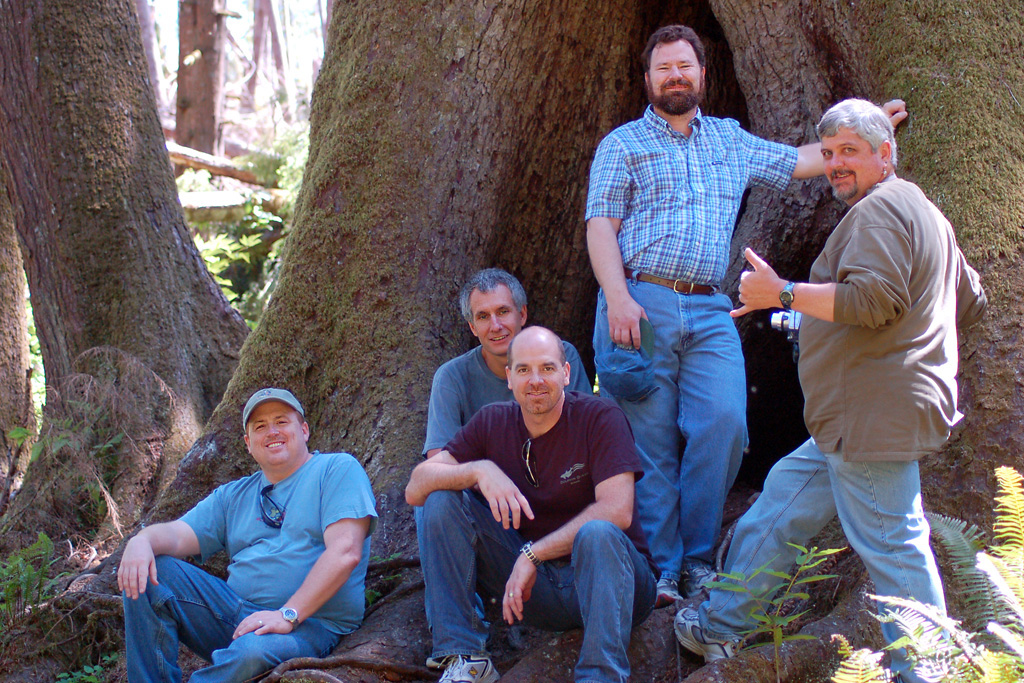
At Cathedral Spruce
Dafydd at Cannon Beach
Haystack Rock
Jon's got rocks
Jim was this year's host
It's the end of the ...

The food was tremendous. It really capped the day. On the way back to the hotel, I picked up some goodies at Safeway and was harassed by the cashier to pick up one of their store discount cards. Never mind that the nearest Safeway is 400 miles from home…

Friday morning Dafydd swung by to chat, and then Jim and his wife Naomi showed up with their car. We promptly stopped at 7-Eleven (on 7/11) to get our free Slurpees, which sucked. We stopped at a sushi place for lunch, where I had a decent pork schnitzel, carefully relabelled “tonkatsu” by the Japanese.

Then came the two hour drive to the B&B in Seaside, where we met Rena, Jon, Liam, and his wife Mayellen. Then we carpooled down the coast to Cannon Beach to eat, stroll the beach, and view the famous Haystack Rock monolith.

Back home, the power was out, but fortunately it came back on before sunset could interrupt our marathon four-hour session of land-grab game Carcassone, which I almost won.

Saturday working sessions included some administrative items from the guys who are running the show, now that I’ve bowed out. Then Jim sprang an unplanned 90-minute writing exercise on everyone, which kinda mucked up the schedule. While the group strategized about their next story arc, I grabbed Jim’s car for a quick bank run.

Lunch involved searching for a rumored but non-existant Thai place, then finding a Thai place downtown and turning away at the last second in favor of a really mediocre American family restaurant.

Then we rented two four-person surrey-style quadracycles and headed down the coast to the rocky edge of the beach, where I took the opportunity to wade in the Pacific Ocean. Then back to town to return the surreys and wander around at random, including some disappointing stores, bumper cars, and mini-golf.

We played crazy card game Fluxx until it was time for the lengthy drive to our dinner spot. Four of us grabbed a car and hopped to it, stopping only long enough to rouse the napping others, who wouldn’t get out of the house for fifteen more minutes.

Dinner was at a huge log cabin style restaurant called Camp 18 (not Latitude 18, which was a restaurant down in St. Thomas). The theme was an old logging camp, which felt to me like a huge YMCA camp lodge. We were seated as a private party in one of the two lofts under the rafters, overlooking the rest of the dining room, which was pretty cool.

Back home, we organized a poker game using the chips Dafydd had purchased for the Las Vegas Summit. I wound up losing $8, which is tolerable.

Sunday’s working session was nothing major, and then we hit the road up to Astoria, where we went up to the Astoria Column, a big column (surprise!) set atop one of the hills surrounding the town and overlooking the mouth of the Columbia River.

Having some time left over, we decided to hike about two thirds of a mile to the Cathedral Spruce, which is basically a big tree with a small hollow at the base. We got there, took a few pictures, and headed back.

Then it was down to the riverfront for a two-hour river tour on a stinky working fishing boat. We went upriver along the shore, then turned back into the wind and toward the estuary. The whole way back, the forty-foot boat was tossed up and down by four- to five-foot swells and bigger. We all got quite wet, but my pocket camera survived, unlike the two I brought Waverunning in St. Thomas.

Ashore, we found food at the unprepossessing wharfside Wet Dog Brewpub, where I indulged myself a bit with a milkshake, lemonade, and a burger with jalapeno and Canadian bacon.

Back to the house for an evening of Carcassone. I passed on it, and passed out on the couch.

Monday morning four of us were out of the house by 6:30am for the trip back to the Portland airport. Goodbyes all around, which were more difficult for me, since I may never see some of these people again.

One of the things I wanted to do on this trip was to let people adjust to the idea that I won’t be very involved in DargonZine anymore and achieve some closure for everyone. I’ve also made it clear that I will not be writing any more fiction, nor will I be attending any more Summit gatherings. It’s been two years since I announced my intention to step down, and I think everyone’s ready for it: myself, the project leadership, and the other writers.

I’ve already talked a little bit about how big a change this is for me. It’s letting go of one of my greatest creations, and closing the book on something that has been a large part of my life for nearly all of the past 24 years. There’s an awful lot that I’ll miss about it: the Summits, the people, the praise, the recognition, and the creative outlet. And I really don’t know what is going to arise to take its place in my life. But leaving DargonZine is one of several major transitions I’m going through right now, and I just have to do it and find out what’s next for me.

It might be a bit melodramatic to compare it to life as a whole, but DargonZine has been a long, wonderful ride, and I’ve been blessed to share the journey with dozens of people, many of whom have become very dear to me and important parts of my life. I really hope to retain those connections, even though I will not be participating in the project anymore.

Yesterday I was reminded of my introduction to fishing…

Each year, my parents and I would spend a week in the back woods of Maine at a camp owned by my uncle. My father fancied himself quite a sportsman, and I must have been about five years old when he brought me out in the boat with him for the first time.

While I don’t recall the specific event, I definitely remember the emotions involved. First you had to take a worm—pretty gross in and of itself—and then jab a hook through it multiple times. I didn’t know whether members of Phylum Annelida felt pain, but the thing was clearly displeased, squirming around in what appeared to be pain. I guess I didn’t really get why causing this thing pain was such a good thing.

Then there was actually catching fish. When you think about it, it’s an awfully brutal process. The fish attempts to ingest a barbed hook, then you drag the thing back to your boat by the hook, which is embedded in its face or esophagus, while it’s fighting against it all the time. Then you drag it into the boat, where it immediately begins to suffocate. Finally, if the little bugger doesn’t suffocate quickly enough to suit you, you club the little fucker with the little miniature baseball bat you keep just for that purpose. Even as a kid, I was repelled by the barbarism of it all.

Of course, that’s not the end of the story. You’ve still gotta cut the head and tail off, rip the scales off, and take all the guts out. And then you eat it, which never made any sense to me, since I’ve never liked the taste of fish, anyways.

I don’t know whether that event set the stage for a lifetime of sensitivity, or whether it was just the first time some existing predisposition of mine was violated. But either way, I find I’ve been sensitized about harming others. I know other people are different, and that’s fine, but harming any animal seems to be a very deep violation of my base character. Not that I particularly wanted it to be that way; that’s just what I’ve observed.

All this came up yesterday while I was meditating. I’ve taken to finding a quiet place near work and sitting for half an hour at lunch. Yesterday I found a dock near where the Charles empties into Boston Harbor

While I was sitting, two guys came along, cast a line into the harbor and immediately got a strike. As they hauled the fish in, I stayed and observed it all, including his partner enthusiastically egging the fisherman on about eating his catch.

It brought up all those visceral feelings I had about hunting and fishing, and made me think about this year’s New Year’s resolution: to eat vegetarian one day a week. I’d made that decision primarily for ethical reasons, and I’ve been able to keep to it without abrogation. On the other hand, it’s been kind of inconvenient, and I had begun thinking about whether I’d continue that practice once 2007 is over.

Needless to say, yesterday’s event convinced me to continue. The question now is whether I want to get more ambitious and go for two days a week. I’m undecided on that one. As I said a year ago, I really love meat, but on the other hand I’m making a concerted effort to live according to my higher principles. Perhaps I’ll just shoot for two days a week, but forgive myself if there are weeks where I only do one. After all, the goal is gradual improvement, and as many dieters know, viewing it as a binary all-or-nothing proposition just makes it more difficult to succeed.

But for now, I just figured I’d share those thoughts, and note that after my meditation, I decided I wouldn’t go for pastrami or my favorite cajun chicken quesadilla, but had cheese tortoloni instead.

Your life is not what you think

Five Years

May. 22nd, 2007 03:17 pm
5 years ago:
In mid-2002, I had just been let go after seven years of work at Sapient. I’d also just started my LiveJournal, and was about to leave for an amazing 12-day tour of Scotland with the DargonZine writers.
10 years ago: 1997
In mid-1997, I had just finished a four-month stint of grand jury duty, which was how I escaped a death march project at work. I had also just returned from the first open-attendance DargonZine Writers’ Summit, hosted by Jon Evans in Washington DC. My father was also suffering from terminal cancer.
15 years ago: 1992
In mid-1992, I moved from Shrewsbury to Natick, having separated with my ex-wife the previous summer. I was spending a lot of time clubbing and seeing bands with my buddies Barry and Sean.
20 years ago: 1987
In mid-1987 I was in my last year of school, and writing one of my favorite stories, “Legend in the Making”. I’d marry Linda and honeymoon at the SCA’s Pennsic war within a couple months.
25 years ago: 1982
In 1982 I was about to graduate from high school, and was in the middle of the first grand romance of my life, with Jean.
30 years ago: 1977
In 8th grade, I first read J.R.R. Tolkien’s “Lord of the Rings” and began writing my own derivative story. I also was a founding member of the New England Tolkien Society, and the editor of its annual literary journal, Mazar Balinu.
35 years ago: 1972
In 1972, having finished 2nd grade, my family moved from Portland to Augusta, Maine. This was the last year of my sister’s life.
40 years ago: 1967
In 1967 I was a pre-schooler. My family was living in Portland, Maine, having moved there from Gloucester, Massachusetts, where I had been born.

I recently read Rachel Naomi Remen’s book “Kitchen Table Wisdom”, wherein the author relates the story of how she went from her purely intellectual orientation as a physician to a more spiritual place, as well as the stories of other people she came into contact with that inspired her.

Kitchen Table WisdomOverall, the book didn’t really blow me away, but there was one story about the author’s childhood that struck a resonant chord, so I thought I’d record that here, since I think it directly addresses the anxiety that people feel about not knowing the “meaning” of their lives.

The author relates that her family always put together jigsaw puzzles without the aid of the picture on the box, in order to make it more of a challenge and a surprise. As a young girl, she was just learning what jigsaw puzzles were. She was attracted to the colorful pieces, but she intuitively disliked the darker ones, so she took the latter away and hid them, to the consternation of her parents.

As an adult, the author used this as a metaphor for how life’s meaning reveals itself to us. I’d like to share and extend that metaphor a bit.

Our lives are indeed like a jigsaw puzzle whose final image isn’t known until we place the final pieces. Each day we place another piece, but progress is slow and the picture only makes sense as it nears completion.

If you focus solely on what today is like, all you see is one minuscule piece of your life. Today’s piece of the puzzle might be light or dark, colorful or muted, busy or empty, but you really can’t infer anything about your life overall from this one little piece. And even if today is a dark or painful part, you can’t assemble a great picture without the contrast of light and dark pieces, just as you can’t go through life with only mindlessly saccharine-sweet days. You can’t complete a jigsaw puzzle or a meaningful life if you ignore, avoid, or deny the existence of its dark parts.

Our past is the part of the puzzle we have completed. We can step back and look at what our life has been like so far, what kind of image it makes and what meaning it holds. By looking at the past, we can begin to make some sense of our life, or at least our life so far. If you look at the past, you can start to see meaning, but things could—and will—change substantially from here forward.

The future is, of course, unknown. We know the shape and color of the past, but we only have limited knowledge about what our next piece of the puzzle might look like. It could be a carbon copy of today’s, or it might introduce a completely new theme, like the first appearance in a puzzle of a person or the edge of a building. Our lives might have been all ocean as far as we have seen, but the next piece could be the point where the sea meets a beach or a rocky coastline, or it could be the first part of a gorgeous sunset on a distant horizon.

One of the great lessons here is that looking for the “meaning” of your life is futile. Meaning isn’t something that you are handed; it’s not a mandate from family, church, or job. Meaning isn’t an input, but an output; you create that meaning with every decision you make and every action you take. Meaning is the result of living, and thus can only be seen retrospectively.

That’s not to say that we shouldn’t have principles that guide our actions. Just remember that the principles aren’t what gives your life meaning; meaning derives solely from the actions that those principles have promoted. Your principles die with you, and are only made visible to the world through your actions.

While at the same time, each and every action you take contributes to that meaning. Whether you live according to your highest ethics or just spend your time on autopilot, every day you contribute the exact same amount toward the ultimate meaning of your life. So if the meaning of your life matters to you, it’s imperative that you live each day according to the values you cherish most.

This is what I have learned: it takes great presence of mind and strength of will to live according to one’s highest values, and no one is perfect. We make mistakes. None of us are Mother Theresa, but over time we can gradually learn to see our autonomic behavior and then replace our mindless habits with better choices. That’s why Buddhism calls it “practice” and a lifelong path.

4:52am

Mar. 11th, 2006 06:30 am
4:52am.

It's like having just come from an incredible movie that touched you to the heart, over and over.

And no one else has ever seen it.

No one else has ever even heard of it.

And they'll never get the chance to see it.

You'll never be able to share it with anyone.

"Made mindless" and the Southern Cross.

Berg and the Nakeds.

From Ka-Ve to my wedding to the Paint Lady.

Car magazines and reading primers

Frankenstein and Philadelphia Freedom.

Corrugated fun.

Dodgeball and Seally Pond.

The Saco River and the quarry.

Garnet and Garnett.

Watching the most important person in my life dying in an ICU.

The Bentmen and Concussion Ensemble.

From group love in a Jersey suburb to a different kind of group love in a cottage on a Scottish loch.

Free Enterprise.

Disco duck and "sprots".

Frodo Lives! at the McClurg Court Theater.

Sink the buses and save the nukes.

He's an eviscerator.

Sweet, Abba, and Devo piped thru a jury-rigged speaker system.

Mosquito Mountain and the Devil's Triangle.

Miles and miles of roads and trails that no one else has ever seen.

The Klong Yaw.

Hundred thousand dollar tax bills, and one-cent bank statements.

The Great Lie, and Then Again, Maybe I Won't.

Blond. Egad.

The turn toward Race Point, and resting at the beach afterward.

The campanile of the New Old South Church.

Astoria, and the RR.

Nights at Bill's or the Pluff.

The Toxicmobile. The Glick. The Starship. The Devinci and the Plastic Bullet.

Quack and meow. I'm flabbergasted. Ay-ant! Juggo naiyo.

Fletcher Pratt. "Eh? Did you say munny?" Yes, shut up, Hal.

Playing ball against the wall of the DMV for years at a time.

Compersion, and the ten thousand and one unspoken crushes.

Suits, casual, and back to suits. Purple rugs everywhere. I think the Morale Committee should have considered that.

Pemaquid, Camden, Battie. My tree in Old Town.

The ComDisk, MJJWSMBB, and HSnet.

Mazar Balinu, Carmarade, and DAL-SYS.

Kenny Kinnikinnick, inventor of Gnip Gnop.

Silent summer drives back from girlfriends' homes.

And the Southern Cross.

This is what it's like to grow old.

I've lived my life thinking: while I'm young, I'll live it up. That way I'll have a huge collection of wonderful memories to relive when I get old, and can't do all those fun things anymore.

I guess I'm over the crest of that proverbial hill, because when I look back, I'm filled with hundreds upon hundreds of memories of my life.

I see now why old people feel isolated. It's not because they're alone; it's because they've lived an amazing, deeply touching novel that no one else will ever read.

So many people and places and events have touched my life, but no person will ever share the things I remember, the things that even today bring up deep feelings that toss me around like a toy boat toy boat toy boat.

If you've been part of my life, I owe you something I can never repay. You've honored me greatly, and no matter how small a part you played or how distant the events in question, rest assured that you have touched me, and I remember.

Though no one else can or will, I shall remember, until the end of my days. Namaste, my friend.

Think about how many times I have fallen.
Spirits are using me, larger voices callin'.
What Heaven brought you and me cannot be forgotten.

While listening to one of the Zencast Dharma talks on the way to work this morning, Vipassana teacher Gil Fronsdal made an interesting assertion: that the wisdom we usually associate with our elders might not be a result of a wealth of worldly experience, as most people assume. Instead, he posited that such wisdom comes from close proximity to death.

Think about it. There are comparatively young people who have had near-death experiences which have forced them to confront their own mortality. Almost invariably, they come out of those experiences transformed, with a tremendous new appreciation for the preciousness of the brief time we each have on this Earth.

Now, “proximity to death” doesn’t necessarily mean that someone has to come close to dying. The loss of one or more loved ones might cause one to reflect on how one lives one’s own life. What’s important isn’t one’s age or that one has had a near-death experience; this transformation happens when an individual openly contemplates their own death, sincerely accepts and internalizes their impermanence, and lets an omnipresent knowledge of their own mortality inform the decisions they make.

I’m always surprised when people say they find that kind of orientation morbid or depressing. It’s only morbid if you haven’t accepted the fact that you are going to die. Might be seventy years from now. Might be next week. But it also could happen before you finish reading this article. Living your life denying that it’s going to end someday just doesn’t seem the path of wisdom to me. Someone who lives like that will suddenly find themselves on their deathbed, wishing they’d done things they haven’t done, and wishing they’d said things to people that they’ve always left unsaid. In short, ignoring your mortality is a surefire way to end your life full of regrets.

At the other end of the scale, accepting your mortality doesn’t mean living in constant fear. Wisdom is about accepting that it can happen, and will happen one of these days. That knowledge gives you the impetus to find a way to do those things you really want to do and tell people the things you really want to tell them.

If you’ll forgive the horrible linguistic coincidence, it’s like the gentle pressure of having a deadline. If there are things you want to do “someday”, it’s more likely you’ll do them if you know there’s a deadline than if you can put them off eternally. And no matter how much you might wish otherwise, death will not be put off eternally.

That’s the real revelation here. Accepting the grim fact that our lives are ephemeral doesn’t make you depressive and fearful; instead, the knowledge of death liberates you. It encourages you to get the most out of each day and each relationship, and it prompts you to clean up your “stuff” with the other people in your life. That way, when you do reach your deathbed, you can be satisfied that you lived your life well and have left nothing undone or unsaid and—most importantly—with nothing to regret.

Ironically, this belief is something I’ve held for a long time. Whenever possible, I have tried to make decisions based on the criterion of which choice I would regret more, when viewed from the perspective of my deathbed. Somehow I stumbled onto that piece of wisdom years and years ago, and it has really served me extremely well. It’s very heartening to hear a Buddhist teacher sanction the same basic concept: that wisdom comes from proximity to death.

I can’t say whether it’s a philosophy that will work for you, but I offer it here for your consideration. I would be delighted if it helped you get more enjoyment and contentment out of your life. After all, as they say, you only go around once.

I appended the following to a discussion of life goals that my buddy [livejournal.com profile] awfief started in her journal. I figured the thoughts might be worth preserving in my own journal.

I've made my own happiness my life's study, so I'll share a some of the things I've found by responding to a couple statements I saw above... Hope the insight is valuable.

I'm already a very happy person, what more do I need from life?
I have been perfectly (and I mean perfectly) happy with my life upon three distinct occasions, each about 6-12 months in duration. The problem is that those points are ephemeral. Even if you've achieved everything you've ever wanted and you think your life is perfect, it's impossible to keep it that way. Happiness isn't something you achieve and are done with; it's a constant pursuit, because people constantly change, and your life circumstances also are under constant change. For me, the ultimate meaning of life is the constant struggle to maximize happiness. Oh, and one more tangential bit: the one thing you'd want from life, even if could perpetuate that perfect happiness, is, ironically, change. Even though most of us have this static vision of our goal of "happiness", we have a nasty habit of never being able to accept a static state for very long. Even when it's bliss...

If I ever got to a point where I wasn't still working towards any goals, I'd be pretty worried.
Why? To me, this sounds like the traditional modern American overachiever and acquisitiveness ethic. Why do you need to want more than you have, even if you are well off, and living in the most prosperous society the planet has ever seen? My response is that if you never let yourself be happy with what you have, then you'll die never having allowed yourself to be happy. That's really sad, and moreso when most of us are surrounded with luxury and priviledge.

I'm not necessarily basing my entire life around it...
IMO, if you're not basing your entire life around it, then it can't very well be a life goal, can it?

Just some thoughts. My apologies if they sound confrontational; they aren't meant to be, but I find that with this topic it's often beneficial to try to shake people up a little from their well-worn paths of thought.

Frequent topics