My Austin kyūdō group doesn’t have a teacher; it never has. But we fall under the distant tutelage of a Japanese archery group based in Greenville, South Carolina. The South Carolina Kyūdō Renmei (or SCKR) is run by Blackwell-sensei, one of the most senior kyūdō teachers outside Japan, and his wife Reiko-sensei.

SCKR hold kyūdō seminars a couple times a year, which are attended by local South Carolina practitioners, Austin kyudoka, as well as people from all over North America.

Given my well-documented and very fundamental beginner struggles, I never attended a seminar. I didn’t want to take sensei’s time away from his many advanced students to deal with my remedial problems, and I didn’t want to waste an expensive trip if I wasn’t going to get the attention I need.

However, sensei offered to run a seminar just for us, only open to the comparatively junior members of Austin Kyūdō. It was an irresistible opportunity to get sensei’s help in a way that didn’t feel like I was imposing on other archers. So in September I joined ten other Austinites for a three-day kyūdō intensive.

And “intense” is the right word to describe my experience, from beginning to end. There’s way too much to be able to share it all, but I’ll do my best to briefly share the important parts of where I started, what I went through, some of the things I learned, and where I go from here.

The Honda Prelude

O
O
O&P

Just two weeks before the seminar, I was ready to call off the trip and quit kyūdō entirely. After two and a half futile years enduring consistent failure in stoic silence, I had finally reached my breaking point.

While everyone around me – even complete first-timers! – demonstrated basic competence and increasing proficiency, I simply couldn’t successfully fire a bow without injuring myself or damaging equipment. My arrows would fly through the air sideways and clang off the practice target, or flop feebly to the ground only a few meters downrange. I broke strings, stripped the feathers from arrows, and bruised my forearm. And the months I’d spent trying dozens of different ways to correct it had all been for naught.

In the interest of moving on, I’ll leave it at that for now. But to get a better idea how frustrated I was, I’d encourage you to read the blogpost I wrote eight months ago, entitled “All the Gear and…”. Just take all the anguish in that post and amp it up to eleven.

Ironically, that week I had a promising insight: that I clenched the fingers of my right hand so tightly that they were interfering with my release. That didn’t solve all my problems, but it seemed like a clue: one piece of the puzzle. But I didn’t even have time to put it into practice before the seminar was upon us.

So that was my mental and emotional state going into the trip: off-the-scale frustration, extreme pessimism, and the only thing I wanted out of the seminar was for sensei to fix me… Although I was skeptical whether he would, or could.

It was – if you’ll excuse the pun – “my last shot” at being a kyūdō practitioner.

The Tyranny of Logistics

Bearing so much emotional distress, I wasn’t very tolerant of the usual discomforts of travel. Other than two trips between Pittsburgh and Austin when we were deciding where to move, I hadn’t flown in six years: since before the COVID-19 pandemic. And it was my first time flying Southwest Airlines, whose asinine unassigned seating policy makes boarding a complete free-for-all.

Things didn’t get a lot better once we arrived, either. I had to share a room with another person, which added some more stress. Not only were we going to prepare communal meals, but because no one had bothered to communicate with one another, sensei and his friends had also prepared meals for us too, which was yet another stressor for everyone.

Even the seminar provided some unexpected wrinkles. Sensei vetoed my use of the familiar bow I’d brought. I’d purchased some used zori sandals for outdoor use getting to the dojo and fetching arrows, but those promptly broke, necessitating a special trip to the store to buy replacements. And although the seminar was supposed to be for his Austin students only, we were sporadically joined by 5-10 local practitioners. Despite being able to use the dojo 365 days a year, they took shooting spaces and sensei’s time away from those of us who had traveled from far away for a precious 2½ days with him. And I have to admit I got frustrated by seeing other kyudoka improving much more rapidly than I did.

But the underlying message here is that the seminar was extremely mentally, physically, and emotionally draining. In addition to my already-charged emotional state, I was dealing with lack of sleep, poor and insufficient eating, muscle fatigue, dehydration, headaches and nausea, social stress, and of course the emotional rollercoaster of judging every shot I took.

It was, in short, an incredibly draining experience.

Nana Dan the Sensei

I’m gonna be honest: I felt a lot of trepidation going into my first experience with Blackwell-sensei. In speaking with my friends who had worked with him in the past, my preconception was of a teacher who was willfully terse, irritable, intolerant, and easily offended. But after telling their daunting stories, my friends would always add the postscript: “… but as long as you’re serious about kyūdō, he’s really great!”

During the seminar, Blackwell-sensei was actually very willing to give me the benefit of his time and instruction, and he patiently listened to my observations and needs. Despite my skepticism and obvious frustration, he was able to see the mistakes underlying my problems, and gave me clear strategies for correcting them. And he did so with patience and graciousness.

While fixing my issues will take lots more practice and reinforcement, my shooting did begin to improve by the end of the seminar, thanks to his valuable and generously-offered instruction.

Not that he isn’t surly and cantankerous and all that. But I think it shows up in his interactions with more experienced students, with whom he has higher expectations and more established relationships.

My Threefold Incompetence

So what exactly did I get out of the seminar? Well, there were lots of little, specific learnings, but those will be documented in my kyūdō notebook, rather than here. And as far as I was concerned, the only thing that really mattered was figuring out the cause of my constant misfires.

Over the course of the weekend, we identified three specific issues with my release. I’ll distill them down as briefly as possible.

First, my grip on the bow was incorrect, which was causing the string to slap my wrist and the bow to invert itself. Fixing it requires both holding the bow more loosely, plus making small changes in how my fingers configure themselves on the grip.

SKCR's kyūdō dojo

My second issue was what I’d identified just before the seminar: by locking my fingers around the string, they interfered with the string when I released it, causing the arrow to fire off-kilter, with very little power, and stripping some of the fletching. Ideally, I wouldn’t lock those fingers at all during my draw, but for the time being I’m simply trying to consciously loosen those fingers before I release the string.

I developed the habit of locking those fingers because the string was prematurely coming out of the groove it’s supposed to sit in within the glove. Sensei gave me several techniques to counteract this tendency during my draw, including: keeping my right hand flat; being careful to keep my thumb level or pointed up, rather than downward; making sure my right elbow comes down and back as I draw; not drawing the arrow all the way down to the chin; and not holding my full draw for very long.

Of course, there’s an immense difference between a conceptual understanding of what one has to fix versus actually physically performing it reliably each time one steps up to shoot. And because I’ve spent two years developing muscle memory of improper techniques, my attempts to correct my form feel completely unnatural and wrong. So even though I know what I should be doing, it’s going to take time and lots of practice to learn new habits.

The Fourth Problem

As chance would have it, our kyūdō trip coincided with two Zoom calls that I wanted to attend, both organized by Cambridge Insight Meditation Center, where I practiced meditation for 12 years, and which has been an important part of my growth for more than two decades. Saturday’s call was in honor of CIMC’s founding teacher, Larry Rosenberg, who is in his nineties and in poor health; and on Sunday we celebrated the 40th anniversary of CIMC’s founding. These were intensely moving for me, and featured several of my dear old friends. A shaved-headed version of Ornoth even showed up in the background in part of the “community reflections” video they shared!

The main reason why I mention these here is because those celebrations included poignant messages about looking at how one relates to the challenges and suffering that arise in one’s life, and to pay close attention to what one is attached to, especially ego-based ideas about who one is and how one wants other people see them.

The applicability of these ideas to my kyūdō practice couldn’t have been clearer, and really put the past couple years into perspective.

To clarify further, here’s a citation from a recent article in Lion’s Roar magazine that stated things rather well:

Often a problem at home or at work isn’t just troubling because of the surface issue that the problem is about. It’s what the problem makes us feel and think about ourselves that is disturbing. Taking the time to examine those feelings and thoughts using our meditative practices often shows us that we have some internal hook by which the external challenge has grabbed us.

[…]

Try answering this self-exploratory journal question: “What is the difference between the actual problem posed by my situation and my perception of and feelings about my situation?”

A neutral observer would see that there’s really nothing objectively painful about my kyūdō practice, other than maybe an occasional abrasion. The towering mountain of anguish I’ve endured is entirely due to the meaning I’ve attached to my practice, specifically my need to be seen as a competent – if not a skilled – archer, both in my own mind as well as in the estimation of others.

My need to be a skilled kyudoka was the source of a great deal of pain: that is the fourth problem with my archery practice.

I would free myself from an immense quantity of suffering if I were able to let go of that need, or at least hold it more lightly. Like changing my shooting technique, that’s easier said than done, but just having that mind-shift cleared some space for me to relate to myself and my struggles with more ease, more compassion, and hopefully a little more freedom.

Since my early days as a tech consultant, I’ve known that I don’t thrive in my “stretch zone”; I thrive in the “comfort zone”. I want to enjoy life as it comes, in accordance with my own values, without unnecessary effort or discomfort. I don’t understand people who fixate on personal growth, always striving for something more, wanting to leave their mark on the world. To me, that sounds like living in a perpetual hamster wheel: lots and lots of effort, achieving nothing of value. Or as Devo sings: “Toil is Stupid”.

I had an exchange with one of the senior kyudoka from South Carolina which was especially discouraging. He told me that he enjoyed having the younger Austin people visit, because they reminded him that practicing kyūdō could actually be fun. If enjoying kyūdō is an alien concept to such a longtime practitioner, that raises a big question about whether I even want to continue. What’s the point, if there is no enjoyment?

Kyūdō challenges my self-image, my attachment to how I am perceived by others, and the basic values I hold toward life. Hopefully I can work through those challenges and find a better way to relate to them, so that I don’t have to suffer as much as I have for the past two years.

Seeking the Target

So where do I stand?

Sensei actually gave me both hope and a number of specific changes that I can incorporate into my shooting technique. It would be logical to make a sincere effort to adopt his suggestions, to see whether they actually improve my shooting or not. That will take time and practice to prove out, but that’s an investment I’m willing to make.

I’m also willing to work on my relationship with kyūdō. It’s important that I learn how to let go of the frustration that comes with identifying as a competent archer, while at the same time asking myself whether kyūdō’s endless self-improvement treadmill is something I am able and willing to tolerate over the long term.

As such, I am not going to quit kyūdō… yet.

But at the same time, I am only suspending judgement long enough to work with sensei’s suggestions. Those changes might not help, and I might still decide that I can’t cope with kyūdō’s perpetual challenges and frustrations.

So we’ll see. The arrow’s journey continues, for the time being.

Like golf, kyūdō is supposed to be a little humbling. Part of this Japanese martial art is to provide the archer with opportunities to observe and reflect on his emotional reaction to stress, adversity, frustration, and failure.

I really don’t think it’s supposed to be this hard, tho.

But before I talk about what’s going wrong, let’s talk about what’s gone well: buying things!

Ornoth practicing kyudo at full draw

Soon after restarting my lapsed kyūdō practice in a new lineage, I purchased a basic kyūdō uniform: a dogi, kaku obi, hakama, and tabi (i.e. shirt, belt, pleated skirt-pants, and footwear). Plus my first yugake (shooting glove), custom-sized for my hand and specially crafted in Japan.

Last year I added the essential equipment. I ordered four semi-fletched arrows from respected kyūdō teacher Dan DeProspero in North Carolina for close-range indoor use with a makiwara target. Then I gained a beautiful set of six fletched arrows for long-distance shooting, which my buddies picked up for me while they were attending a workshop at Blackwell-sensei’s dojo in South Carolina. And I topped it off with a new, extra-long (yon-sun), 12kg draw weight Jikishin II composite bow in a group order from Japan’s Sambu Kyuguten.

I definitely look the part. So what’s the problem? Literally everything else!

But taking aim at the main problem: I can’t release an arrow properly. Sometimes the arrow launches feebly and bounces off the practice target. Other times it flies thru the air sideways and clangs off the target. Sometimes the string tries to rotate around the bow so violently that the bow “flips” and inverts itself, requiring a manual reset. I’ve even broken the string on one bow. And every misfire produces eye-wateringly painful abrasions and bruising on my left thumb or wrist.

This kinda thing happens to archers from time to time. With a normal problem, you would diagnose what you’re doing wrong, correct it, and move on with your practice; but it’s been more than 18 months, and I’ve tried so many things, with no success in fixing my release. In the past six months, I’ve made just 23 successful shots, against 31 misfires of various kinds. And I sat out three entire practice sessions purely out of fear of shooting. I’ve even had actual nightmares about kyūdō.

These days, I panic before every shot, anticipating the painful abrasions and bruising that accompanies yet another humiliating misfire. Obviously, my “release anxiety” isn’t helping matters at all.

Another frustration is the number of plausible fixes I’ve tried. At first I thought that the glove on my right hand wasn’t holding the string securely, causing it to slip free unexpectedly, with my other fingers impeding its release. When fixing that didn’t solve my problems, I started looking at my left wrist, which is weak and thus has a tendency to buckle inward or outward at full draw. Then we tweaked my grip on the bow, even swapping in a larger grip, because my fingers are considerably longer than those of the average Japanese archer. I tried rotating my right arm vertically on release rather than horizontally, in case that motion was interfering with my release. I tried changed where the arrow was positioned against my glove and putting less torque on my right hand, thinking my glove might be nudging the arrow out of nock. I’ve perpetually been advised to loosen my grip on the bow, but that’s something I’m pretty cognizant of, and doesn’t seem to be the main problem. Because I’ve been afraid of doing a full draw for so long, I tried altering my stance to force myself to fully extended my left arm, in case that was influencing the flight of the arrow. And most recently, I’ve tried focusing my grip on the bow with my middle finger. Out of all these things I’ve tried, nothing has worked.

A complicating factor is that our club doesn’t have an actual experienced teacher among us. Our most senior member is still pretty junior, only recently graduating from Second Dan. So although I get a ton of well-intentioned advice from other members, it’s mostly amateur guesswork and is sometimes contradictory. So many different suggestions have been piled on simultaneously that I can’t adequately test whether any of them are working. Especially when we are only able to shoot three or four arrows per weekly session!

As I said above, part of being a kyūdōka is learning how to manifest stoic strength, showing neither elation nor disappointment in one’s performance. So I’ve been exceptionally patient, never showing any overt emotional response. Meanwhile, I’ve helped new practitioners, who began with considerably less skill and self-awareness, advance far beyond me in skill. Although I really don’t care about rank at all, after nearly two years of incompetent struggle, I’m not improving, and I’ve finally exhausted my willingness to suffer in silent solitude.

A normal kyudoka would long ago have called on the experience of their teacher. For better or worse, our Austin group falls under the auspices of a Seventh Dan teacher who lives in South Carolina and runs his own group there. He never comes to Austin, and we can only travel to see him once or twice a year, when he holds kyūdō seminars that are well-attended and open to the public. At those seminars, he prefers to work with his advanced students, and I don’t want to show up on his doorstep asking for him to solve some aging stranger’s beginner struggles. Ideally, I’d get my problems cleared up and develop some basic competence before working with him. But until that happens, I’d be too ashamed to show up with such fundamental problems, and it would be a pointless waste of a trip if I was unable to participate in shooting.

While I expect my struggles to continue, there are two potential options for possibly getting help.

Our sensei has mentioned the possibility of hosting a weekend seminar specifically for our Austin group. This could be a way for me to meet him and get some personal instruction without taking his precious time away from his favored students. The challenge would be getting a critical number of students to schedule travel together to South Carolina to make it worth sensei’s time. And meanwhile, I’ve got an upcoming surgery that’ll prevent me from flying for six months.

Another possibility might be sending video clips to him for his critique. This has the advantage of being easier to make happen, but it would limit how much sensei can see, as well as how quickly I could test out his suggestions and get rounds of feedback. Plus it would still be an imposition, and he’s known for being terse and a poor correspondent.

At any rate, I’ll be taking the month of March off from kyūdō following my upcoming surgery. I have no idea whether that downtime will be a useful reset for my technique or an opportunity for me to atrophy and fall even further out of practice.

This is all an immense challenge to the air of competence and Buddhist stoicism I usually try to exemplify. Despite my obvious struggles over the past year and a half, I successfully remained nonchalant and kept my frustration on a low simmer. But at this point the pressure has built up and reached an explosive level where it has to come out. It’s been a very long time since anything has frustrated and humiliated me so thoroughly as kyūdō.

After two years of continuous struggle, it would be illogical to think anything is likely to change. So there’s no way to end this post optimistically. Just venting, while documenting my lengthy, painful, and ongoing struggle.

I’ve always been a little – sometimes a lot – older than the friends I hang around with. So I figure some folks might be wondering how it’s going following my recent stroke… What it’s like to live with the realization that a portion of my brain is, literally, dead.

The most pertinent fact is that my stroke is over. Actually, it was probably over by the time the EMTs showed up, but then there was the whole diagnosis and treatment protocol and investigation and followup plan. But now, six weeks later, that episode is as much a piece of history as my first driving test.

Physically, I’d like to say that I have no lingering aftereffects. Sensation returned to my left hand over the first 48 hours, and that numbness had been the only significant aftereffect.

The psychological impact was more lasting, manifesting in several flavors that’ll fill the balance of this blogpo.

Betrayal

Easily the most prominent emotion has been the feeling that I was betrayed by my body. For sixty years, I knew in my bones that my body could thrive and succeed no matter what outrageous demands I placed on it. Eating like a 14 year old? No problem. Bike 150 miles in a single day? Piece of cake! Going out drinking and nightclubbing until 4am and getting up at 6am to facilitate meetings with Fortune 500 clients? Easy-peasy! Work 80 to 120 hours per week for nine months straight on a death march project? BTDT.

But completely out of the blue one morning, the body I’ve relied upon all my life suddenly betrayed me, with no warning, while doing nothing more strenuous than walking down a staircase, something I do dozens of times every day.

I can’t tell you how much of a shock that was. I’ve been through the classic responses: anger, grief, bargaining. The only one I missed was denial, because it just wasn’t possible to ignore.

Mistrust

Trust, once broken, is difficult to restore.

Even after the hospital sent me home, I didn’t feel that I could just go back to a normal life. Even though that episode was over, I didn’t trust that I wasn’t still in imminent danger. I still felt that I had to stay vigilant, on guard against anything that might come up, even though I know that I’m not in full or direct control of my body’s health. Once bitten, twice shy.

Hyper-awareness

Because of that, I’ve been hyper-aware of every little niggle that arises… and in a 61 year old body, there are plenty of them.

I have developed some neuropathy in my feet, and any time a body part “falls asleep” sets off stroke alarms in my head. And that pain in my armpit: could that be a lymphoma? The stitch in my side kinda feels like a kidney stone, or maybe diverticulitis. The pain in the opposite side is probably pancreatic cancer, or maybe just liver failure. And my chest pains might be a symptom of atrial fibrillation, which is a huge risk factor for stroke.

I’m not normally prone to hypochondria, but nor am I used to waking up one morning and having a stroke. Even after consulting my physician, I can’t say for certain whether all these maladies are complete fiction, or real but minor discomforts, or something far worse.

Fear

What does the future hold? How much longer will I live? The truth is that I have almost no information and very limited influence.

That’s hard. It’s a cause for anxiety, uncertainty, and unease. In a word: fear. Raw existential dread. Not something I’ve ever had to face directly, so it’s one of those unpleasant “learning experiences”.

During the day, there’s enough stuff going on to distract me from all this, but the fears are more insistent at night. Keeping one’s imagination in check is a full-time job!

Living a normal life in this midst of all this is not easy! But then, what’s the alternative?

Fortunately, every morning I get up and notice that I don’t appear to be fatally ill. And after six weeks of evidence to the contrary, my worst fears have weakened to the point where life has started to feel normal again.

Coping

What helps? Good question.

Has my longstanding meditation practice helped? Somewhat. Meditation taught me how to distinguish between skillful thoughts and unskillful thoughts as they arise; that I don’t need to give full credence to everything a fearful mind envisions; and how to short-circuit the mental proliferation that can fuel unnecessary fear about the future. It also allows me to see that my moods and emotions are intensely charged interpretations of one possible future – not reality itself – and that they are essentially both transitory and empty of real substance.

That doesn’t mean that I’m able to dispel all my fears, especially in the dark, lonely silence of a late night, with nothing to think about other than my body, its ephemeral nature, and its treacherous sensations.

The thing that seems to help most is the simple passage of time. As I mentioned above, day after day, the worst case scenario doesn’t seem to happen. And that data has slowly piled up into an irrefutable conclusion that I seem to be mostly okay, at least in this moment.

Not that I feel like I can trust that just yet. But it does seem more and more plausible as each day goes by.

Conclusion

I am subject to aging. I am subject to sickness. I am subject to death.

These irrefutable truths are hard to face, and they’re a rude awakening that every one of us will have to come to terms with, at a time and in a manner we do not control. And this society does a shitty job preparing people for this immense challenge.

I’ve had a conceptual understanding of these truths since my sister died following a stroke fifty years ago. In my life, they’ve been reminders of the preciousness of life. Now they’re more omens about the precariousness of life. My life. My very finite life.

The following text was composed in my hospital room, 72 hours after my episode, and shortly before my discharge home. Be warned that you might not want to read this at night, alone, or if you're prone to existential dread. Sorree!

I had a stroke.

I can't possibly begin to communicate what those four words mean to me.

I used to have an older sister named Martha. When she was 21 years old, she was newly married and a brand new mother. One night, in the middle of the night, she had a stroke and fell into a coma. She was placed on a respirator, and her husband and my parents were in the terrible situation of making the ultimate decision.

At the time I was only nine years old, but the loss of my sister left a deep permanent impression. I can't imagine what it was like for her to wake up in the middle of the night and what she went through. Nor can I imagine what her husband went through that night. Since then, I can’t count how many nights I’ve layed awake, next to my sleeping partner, with the horror of that memory playing through my mind.

I also had a grandmother, who after her stroke was left perfectly lucid, but anytime she tried to speak, all that would come out is, "Beh beh beh beh." Stroke is sudden, unpredictable, and absolutely devastating.

Those fearsome memories come back to me very often both in the day and the dark nights when I'm awake alone. So I've always been highly sensitized about stroke: its symptoms and causes, its devastating effects, and how vanishingly quickly life can change or be entirely snuffed out at complete random.

I can't describe to you the visceral horror that stroke has been throughout my life. It has always been my biggest dread of all.

I had a stroke.

The good news -- that you all want to hear -- is that somehow, miraculously, mine was vanishingly small, and at this very early point in my recovery, it seems likely that I will regain full functionality. So in a sense, I'm okay.

That doesn't mean that I will continue to be okay, or that I can simply resume living my life as if I hadn't had a stroke at all. For the first time I will be on long-term meds: blood thinners and statins, which have unpleasant side effects. And there's going to be a whole battery of follow-up tests and procedures. Although stroke symptoms last a long time, both recovery and the risk of recurrence can last years. It will take time to see if and how I can resume all the activities that I used to do, including cycling and kyūdō. And I'm finally going to have to start eating and hydrating like an adult.

For now, although I appear mostly okay physically, I can't begin to describe the mental and emotional impact on someone who was sensitized to stroke as a child. If you've survived one stroke, you're much more prone to have subsequent ones. That has doubled the dread that I've always felt and tried to manage.

In my meditation practice and in my personal philosophy, I've often referred back to my sister's death as the thing that defined my relationship with life and death. Her passing taught me at a very young age that death is very, very real; that it will take every one of us; and it can come without any warning at any time, no matter how healthily we live. That has been the justification for my attitude of enjoying every day as much as possible, realizing how precious and ephemeral each moment of life truly is. I've always considered it a blessing to have learned that lesson so early in life.

Of course, acknowledging death is a completely different thing when it's happening to you, when the proximity of death is part of your present-moment reality. And now I somehow have to figure out how to cope with this sudden increase in dread for the rest of my days, however many or few remain. It's hard. And it's inescapable. And it’s final.

Of course I'm thankful that for now I'm recovering well. Throughout my life, in many ways I've been incredibly lucky that things always worked out well for me. And I guess I have to thank my luck as well for this dreadfully ominous warning being such a benign episode. My stroke could very, very, very easily have resulted in major disability or death. So I'm incredibly appreciative of my miraculous good fortune... at least this time.

And I have the deepest, most heartfelt gratitude for the caring presence of my life partner Inna. She is the irreplaceable foundation of my life. But I’m also concerned about what'll happen when either one of us dies, since we're so dependent on each other. So to my many friends: if I were ever to predecease her, my dearest desire would be for those of you who care about me to reach out and offer your friendship and support to Inna: the most important person in my life, and the person whose life would be most impacted by my passing.

Having said all that, I don't have much of a way to end this post on a positive note. Facing one's own mortality is grim work. It’s very easy to face toward life and be thankful, joyous, and share as much love as one possibly can. But it's also wise to see, know, and come to terms with what the ultimate future holds for all of us. And now that death has gently tapped me on the shoulder and gotten my attention, it's time to start taking my own mortality very seriously.

With a heart and mind full of love, joy, and dread.

So we have a global health crisis on our hands. The COVID-19 virus has eluded even our harshest attempts at containment, and there’s no prospect of either a preventative or treatment, other than for associated diagnoses such as pneumonia.

With an unknown number of infectious but asymptomatic carriers wandering around, Inna and I have taken the only measure anyone can do, which is complete social self-isolation.

No more Monday or Wednesday meditation groups, and I prematurely ended my brief stint as a CMU brain research subject. Inna has cancelled a business trip, two seminars in Austin, and plans to take the salt cave women’s group she leads online.

We don’t plan on leaving our apartment except for safely isolated outdoor activities like hikes, or emergency grocery runs. We’re pretty well stocked with supplies, having each made major trips before our lockdown.

Thankfully, cycling will still be a good option for me, although I’ll curtail rides of more than two hours, rather than replenish at the usual convenience store.

It’s very reminiscent of the widespread lockdowns following the 2001 World Trade Center attacks, and the shelter-in-place order that followed the Boston Marathon bombing in 2013. It’s the same scope of disruption, and the same sense of separation from general society.

In the meantime, the stock market—which had been on a tear so far this year—has experienced unprecedented volatility. Like a good long-term investor, I’ve sat tight and gritted my teeth, and even made one opportunistic buy, but it’s nerve-wracking watching your money vaporize. Where I had been crowing about my growing wealth in February, in little more than two weeks I’ve experienced massive losses that bewilder the imagination.

Between the stock market’s gyrations, the fear of illness, the social isolation, the wholesale cancellation of all group activity, and the drama surrounding the Presidential primary elections, there’s been a surfeit of emotion to process, even for someone as stolid as myself.

No one likes uncertainty, and no one likes anxiety, but the situation is unlikely to change for several weeks, if not months. Rather than venting that discomfort in random ways (like a completely pointless run on bottled water), it’s important that each person discover how to accept their anxiety and be okay with it.

For me, my meditation practice provides a reassuring guide: acknowledge my feelings and my fears about the future, then take refuge in what’s happening at the present moment, because none of those fears have manifested in my present-day, lived experience. Life really isn’t that bad, so long as you have the mental discipline to stop the mind from fabricating and getting lost in wild doomsday scenarios.

And I’m blessed to be sharing my space with a partner who also manages her internal state with great insight and wisdom. Viewed from a less fretful perspective, this is an opportunity to deepen our relationship while also getting some goddamned housecleaning done!

Be well, my friends.

After sixteen years of vipassana meditation practice, I’ve heard a sizable swath of the dhamma. So it’s not very often that I run into something new: an idea that provides an exciting ah-ha satori moment of discovery, which happened so often when the teachings were new to me. So it’s a precious surprise when I find a new nugget of wisdom.

The Art of Noise

To be fair, this particular insight derives more from Western psychotherapy than Asian Buddhism, since it comes from Rhonda, a local meditation teacher who also doubles as a therapist. But that in no way detracts from its value.

In a recent post-meditation Q&A session, we were discussing a familiar character—the person whose life is overflowing with drama, problems, and chatter—and how difficult it can be to maintain inner quietude and offer compassion to someone with that kind of frenetic energy.

Rhonda offered a little phrase that—when brought to mind—can foster a sense of compassion for the embattled drama queen: “How much noise do you need to make in order to avoid feeling what you’re feeling?”

I found that a profound and novel way of relating to someone that in my own habitual judgment I’d view as annoying or problematic.

That question cuts through all their misdirection and reminds us that—beneath all the noise—there’s probably an underlying hurt or fear that the person may not even realize is causing their discomfort.

If you think it would be beneficial and they’re ready to hear it, helping them unpack and name that emotion might let them move forward without all the unnecessary drama.

But if you do so, tread carefully and lead with compassion. After all, you're essentially dismantling their avoidant coping method and asking them to face the problem, and not everyone will be ready or willing to go there.

But either way, I think this is potentially a useful and genuine way to stay connected—rather than withdraw—from someone whose primary relationship strategy seems like a demand for sympathy.

Ten months ago, I went out to the Insight Meditation Society for their 9-day New Years retreat. It was my first time doing a retreat of that length, and I found it vastly more dramatic and emotionally challenging than any retreat I’d ever experienced.

When I came home, I hoped to share my experiences in two separate blog posts: one public, the other friends-locked. Although I completed the first draft of the public post, I never shared it, because I was unable to adequately express the more personal stuff in the private post. And external events interfered, as well.

Nearly a year has passed now, and so much has changed since then. I guess I probably won’t ever complete the private half of my account, but I thought it appropriate to clean up and share the bit I’d planned to post publicly, for those of my friends who are interested.

So here’s my report on last year’s New Years retreat, albeit belated and edited for privacy.

New Years Eve at IMS
Winter in Barre
Cold Sunrise at Gaston Pond
Snow on IMS hiking path

Back in December, three women and I shared a car ride out to the Insight Meditation Society in Barre for their 9-day New Years retreat with guiding teachers Yanai Postelnik, Catherine McGee, and Pascal Auclair.

This was only my second time at IMS, the prior visit being a 5-day retreat two years before. After reviewing my blog entry from that first visit, I made damned sure to bring more than a single pair of socks!

As you might imagine, the weather in the Worcester hills at the end of December provided a spectacle of its own. The first three days were fairly mild (35-42°), and the ground was bare, so I took the opportunity to familiarize myself with the miles of walking trails through the woods behind the center.

That was followed by five straight days where it didn’t get above 22°, and dipped below zero for several nights. Thankfully, our rooms were kept comfortably warm, although I noticed one space heater being used to thaw some frozen pipes in the basement of one of the dorms.

We had two snowfalls of about 3 and 6 inches, neither of which stopped me from regular trudges through the wooded paths out back, as you can see from the photos at right.

While walking outside on New Years Eve (before the snows), I realized that the long hedge in front of IMS was made up of large holly trees. Having grown up in Maine, I have a deep affinity for holly, which thrives in similarly cold and desolate places. So I gathered a handful of holly leaves and berries from the ground and placed them along the windowsill in my room (see photo).

The cold weather peaked on day eight of the retreat, when I took what could be conservatively called a brisk 3-mile trek around Gaston Pond. The sunrise above the snowed-over pond was lovely, but I nearly lost my fingers taking the accompanying photograph in air that was seven degrees below zero! Ironically, that was during perihelion, the time of year when the distance between the Earth and the Sun is actually the shortest!

Then the temperatures miraculously shot back up to nearly 50° on a misty morning on the last day of the retreat. The fog only thickened as the week’s snows rapidly sublimated and completely disappeared.

I definitely didn’t sleep well, and heard similar reports from several others. My theory is that the amount of time spent each day with eyes closed, observing the mind, builds up so much momentum that it’s difficult to shut it down to go to sleep at night. But that’s just one theory.

On New Years Eve, the teachers led us through a ceremony that included writing something we’d like to give up or leave behind on a piece of paper, then depositing them into a container to later be burned. I was sitting next to the container, and it was interesting to observe how most people emphatically threw their unwanted attributes into it, often ritually ripping the paper into bits beforehand. And then a very few folks (including myself) were much more reluctant to drop theirs in, as if they were letting go of a safety blanket.

The second Saturday—day eight of the retreat—was the day that all hell broke loose.

After returning from that long, frigid sunrise walk I mentioned above, I noticed that my throat was really sore. I had come down with a cold. I had taken lots of careful precautions, knowing that retreats are ideal breeding grounds for disease, but it had still caught up with me. Thankfully, there were only two days left before we headed home!

But that was nothing compared to what followed. At the start of the midday sitting, the teachers asked us to immediately go and check our rooms and secure our valuables, because someone had gone into several meditators’ rooms (there were no locks on any of the doors) and taken all their cash! Eventually we learned that eight to ten people in one particular dorm had been robbed, and some prescription painkillers had been taken, as well.

Having spent an entire week opening their hearts and allowing themselves to work with their emotional vulnerabilities, it would be difficult to describe the sense of violation that my fellow retreatants felt. However, with the wisdom of the teachers, the group found some ways to respond to the invasion that helped people heal.

First, the entire retreat—more than a hundred people—took up the “om mani padme hum” chant and walked in a procession from the main building’s meditation hall, through my dorm, then across a passage to the affected dorm, and back again. The chant was moving and powerful, and the combined strength and goodwill of so many people helped the meditators in that building feel that we had “taken back” the space.

Then arrangements were made for small groups of people to voluntarily take shifts doing walking meditation in that building all night long, so that the residents would know that someone was awake and present at all hours to protect them in case the thief returned. I would have volunteered, but I knew that getting a good night’s sleep was imperative for fighting my oncoming cold.

I wasn’t particularly concerned about my own safety. My room was near the main building, and no one in my dorm had been robbed. I was mostly concerned for the others. But as we went to bed that night, everyone was on edge and emotionally primed to respond to the potential return of the trespasser.

So it was in that state of mind that I woke up at 2am when the door to my room was opened. In the dim light from the “Exit” signs I could see the silhouette of someone slipping into my room from the corridor. By the time I was conscious enough to respond, they’d begun backing up, but that was when it hit me that this could well be the guy!

My heart racing and barely aware of what I was doing in my panic, I threw off my bedding, grabbed the door, and screamed “HEY!!!” The interloper was backing off hurriedly, then cowered on the opposite side of the corridor from me, saying “Imsorry Imsorry Imsorry, I got confuuused!”

That wasn’t the response I would expect from a thief, so I froze in mid-leap. That gave me enough time to scan what I could see of the person’s features in the darkness. Out of a hundred complete strangers at the retreat, I thought I recognized one of the women I had shared a ride with… “Claudia, is it?”

Apparently it was. She apologized again, and I think I just said “Okay” and closed the door on her. I would have flopped right back to sleep, except my heart was pounding and I was chock full of adrenalin. No matter how still I laid or how much I tried to calm my mind, there was no more sleep that night.

The next day—the last full day of the retreat—the teachers held a a small session for people who still felt they needed to work through some of their reaction to the burglary. I decided I would go and just ask how to deal with my body’s response, because no matter how much my mind had settled, my heart was still racing along in fight mode.

Claudia also appeared at that meeting, and we talked through the event. Apparently she had been one of the people doing walking meditation during the night, and in returning hadn’t realized that the passage from the second floor of one dorm led to the first floor of the other. She had walked into what would have been her room if she had been on the second floor, but because she was mistakenly on the first floor, she’d walked in on me instead.

People going into the wrong room by accident isn’t unheard-of there, since the doors all look the same, and there weren’t any locks on them (there are now). Of course, having that happen to me at 2am the night after a burglary was pretty much the worst timing imaginable. Since it was conceivable that something like that could still happen again, the following night I slept with my bed frame blocking my door from opening at all. I didn’t want to go through that a second time!

The final day brought the closing feedback session, where I spoke a brief piece about how the retreat had affected me emotionally much more than any previous retreat. And Claudia and I and the other two women in our car were the last ones out of the center after the retreat ended.

So, that’s a good bit about the body of the retreat. Now I’ll talk a bit about some of the ideas that came to me while spending all that time in silence.

Everything we experience, which feels so personal and unique to us, isn’t; it’s actually just one instance of sensations that virtually all humans experience at some point in their lives. Viewing them as universal phenomena makes it easier to hold one’s own pain lightly and feel a lot more compassion for others.

I thought up two interesting metaphors for how we relate to time. One can only see what’s happening clearly by being fully engaged and aware in the temporal present. Our past experiences can be like the film on a dirty window, making it more difficult to accurately view what’s going on in the present; our histories leave a residue that obscures or filters one’s view of the present. One need to try to see through or beyond the obscuration, or somehow clean the obstructions away. Similarly, focusing on the future can cast a shadow that darkens and obscures one’s view of the present; you can either spend all your time planning for and living in the shadow of an as-yet unrealized future, or step out of the shadow and experience the present moment in its full, vivid brilliance.

There’s an old instruction that goes something like this: never miss an opportunity to make someone else happy. I had some opportunities to play with this during the retreat, and the results were rewarding. I’d like to remember to do this more often.

When dealing with strong emotions (positive or negative), the best way to relate to it is with curiosity. Trying to suppress it isn’t healthy, and conversely one can easily lose perspective by self-indulgently wallowing in those emotions. The correct prescription is to explore one’s emotions with a sense of curiosity, because then one can understand, see the value of, and learn from those feelings.

In meditation, we cultivate a separation between the observer and the observed. In that way, the part of the persona that is observed can experience an emotion like anger, while another a part of the mind is at a slight distance from the experience, observing it, and learning from it. This separation of the observer from the observed isn’t just useful to help us see ourselves more clearly. Conversely, for those of us who have difficulty with our emotions, or are afraid of giving them free rein, it’s also a good way to free part of one’s persona to be fully absorbed in our emotions without the fear of losing control or being overwhelmed by them.

The common conceptual framework we inherited tell us that the heart is the place where we feel emotion. But saying that the heart is the seat of emotion is no more accurate than saying you hear sound through your kneecaps. If the heart was truly where emotions were located, people with man-made artificial hearts would never feel emotion, and doctors would perform cardiac surgery to cure depression, rather than prescribe drugs that impact brain chemistry! It’s time to stop referring to the heart as the seat of emotion, which is merely fossilized lore from a distant time of human ignorance.

There’s a huge amount more to say about that retreat, but I’m afraid the rest of the story will have to wait.

I find my relationship to anger has changed pretty radically, thanks to an insight that you might not think is all that remarkable.

Perhaps it seems consequential to me because of the way I used to relate to anger. After surviving the usual angst-filled years of adolescence, as a young adult I pretty much exiled anger from my emotional repertoire. I’d often say that “I never get angry,” and meant it. I always equated anger with loss of self-control, and it was paramount that others see me as mature, self-sufficient, and safe to be around.

It’s only recently that I realized the reason why anger has so much energy: we only get angry when something has touched and threatened something we really care about. Any time that we invest that much of our emotional well-being in something external, we make ourselves vulnerable. And when something important is threatened or hurt, a common response is to become angry.

So the big revelation is just this: anger is a symptom of vulnerability.

For me, this explains the vast well of anger that I (and most of my friends) felt during puberty. We didn’t know it at the time, but we were desperately looking to be accepted and valued by our peers and the people we admired or were attracted to. At that point, we were looking to others to provide us with a level of self-worth that we could rely on as a base for constructing an independent ego. In a word, we felt intensely vulnerable.

When looked at from the perspective that it is a symptom of vulnerability, anger becomes a really useful thing (dare I say a “good thing”?) to see, because anger tells us (and others) what is important to us. But perhaps even more rudimentary than that, anger shows the world that (despite appearances) there’s something there that we deeply care about.

One of my biggest projects this year is to cultivate a deeper feeling of caring, especially toward people. As a result, I have to acknowledge that caring about something or someone puts me in a position of vulnerability. I’ve arrived at a point in my life where the rewards of caring relationships outweigh the risks to my ego. And ironically, seeing my own anger (and vulnerability) being manifested is one way I can actually measure how successful I’ve been at cultivating a sense of caring about others.

Hold me, hold me, hold me down
I love your anger; I love its sound
Burn me, burn me, on your way
I'll reach out to you this day
Older, wiser, sadder, blinder
Color, blisters, imagine the splendor!

So I’m starting to accept that it’s actually okay to feel angry, to admit feeling it, and to show anger publicly. It’s also okay to stay angry—even after receiving an apology, if I still feel hurt or that something I care about is threatened.

As an added bonus, I’m also seeing other people’s anger from a new perspective, and have learned some new and effective ways of relating to people when they are angry…

When we are interacting with someone who becomes visibly angry, we often either step away and distance ourselves, resist it by taking up an opposing stance, or invalidate their feelings. Whichever of these actions we take, it only reinforces and strengthens their anger.

We don’t often pause to ask about and discover what that person actually cares about and how it is threatened. During a tense situation, asking these simple questions shows respect and openness toward hearing what the angry person has to say. And it’s hard to stay angry when someone sincerely wants to understand the reason behind your pain.

All that is why I think it’s an insight worth sharing.

I’ve found it increasingly difficult to blog over the past couple months. That’s partly due to the content I have to write about, and partly you: my audience.

The content is tricky. Since December, I’ve been absorbed in an exploration of several very sensitive topics, such as emotional sensitivity, social life, group dynamics, gender relations, romantic relationships, and sexuality.

While I am extremely open about sharing what’s going on for me, this kind of content naturally leads me to reflect upon how much of this very personal material I want to share in a permanently-archived, public blog.

On top of that, the overall theme of my inquiry is social, so I have to be doubly careful about what I post. Instead of just worrying about my own privacy, I also have to consider the privacy of the other people I mention, and how they would feel if they saw my description of our interactions posted online.

Furthermore, I’m also embarking upon a job hunt, which introduces the question of prospective employers and coworkers discovering this blog. That too influences what content I feel comfortable posting at present. Although I hope that prospective employers would see the value in hiring someone with a complex, dynamic internal life, rather than a coding robot with no depth of personality.

So all those considerations have left me feeling pretty constrained.

That doesn’t mean I won’t be posting, but it might take more time than usual for important topics to show up (as you’ve seen by the delayed writeup of my New Years meditation retreat). And some important events might only get alluded to in passing, if at all.

As implied above, I have a ton of stuff going on right now; the past two months have been incredibly transformative, featuring lots of amazing developments and just as many heart-wrenching problems. Things are happening very quickly, so I’m having difficulty keeping up to date in sharing my thoughts and reactions.

I guess the bottom line is this: thanks for your patience, for your friendship, and for any role you’ve had in my life over the past couple months.

And there’s more to come, you can be sure…

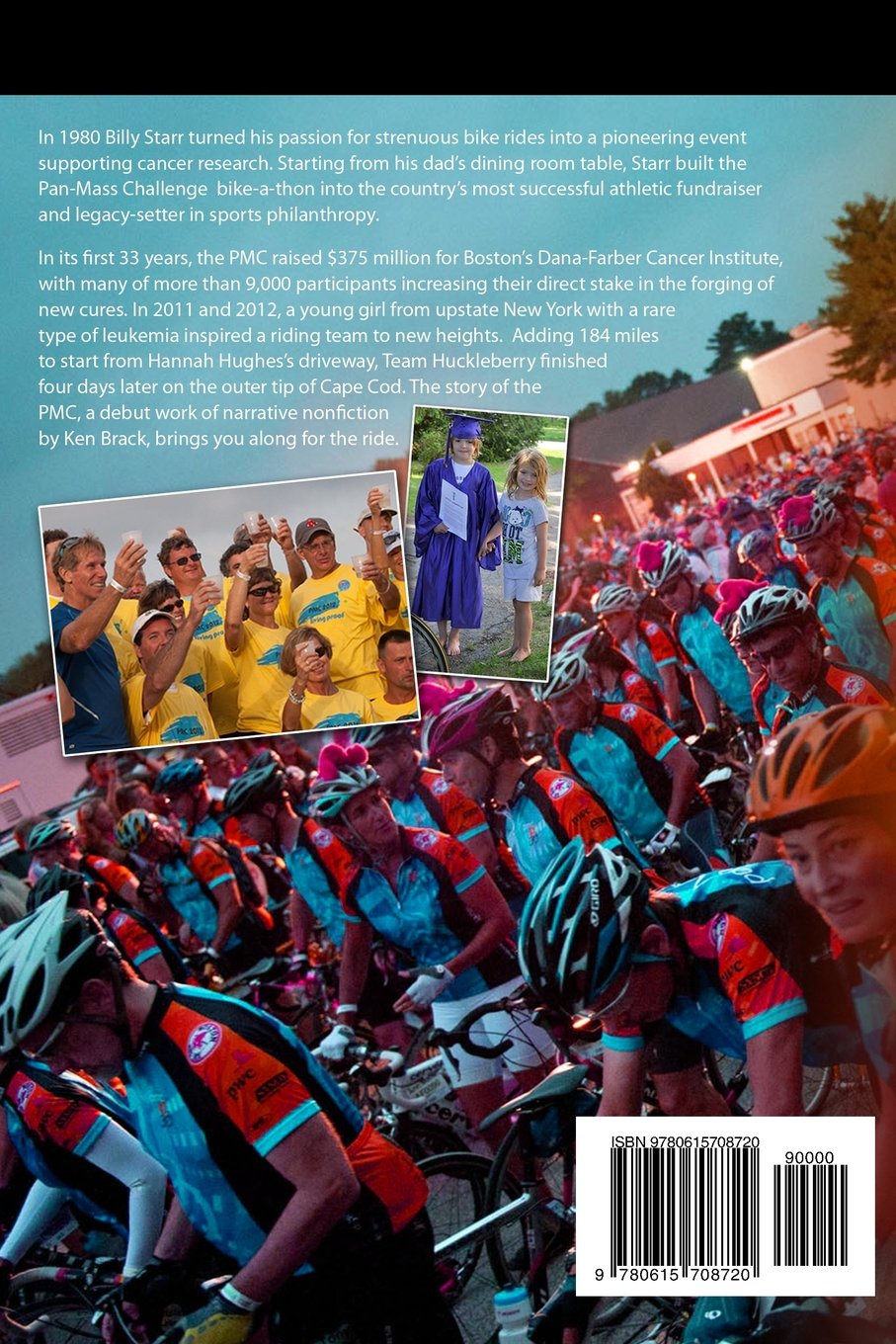
So someone finally wrote a book about the Pan-Mass Challenge.

If you are one of my friends who care about (or are just curious about) the event, you might be interested in picking it up. It’s short—just 150 pages—with a handful of greyscale photos. It’s inexpensive too—just $9 at Amazon!—and the author is giving 75 percent of the profits back to the PMC.

Front cover

The writing is first-person and informal. While that makes it readable, the author rambles around each chapter, covering diverse topics with no real focal point, yielding a book that also has no coherent theme other than the experience.

But to be fair, the PMC—the event—is all about that experience. The entire weekend is intensely emotionally charged, and that’s something that is nearly impossible to convey in words. This is astutely summarized in a quote from one teen rider, “When you explain it to a friend they sort of know what it is, but until they’re there, they don’t really know.”

Sure, there’s the obligatory nod to the event’s long history, including how the idea came to the founder during a ride in Boston’s Arnold Arboretum, how he ran the event for fifteen years from his father’s dining room, how everyone reacted to the first rider fatality, finally getting permission to use the campus of the Massachusetts Maritime Academy as an overnight stop, and the event’s phenomenal growth.

And there’s plenty of interesting factoids. On PMC weekend, riders will pedal a collective three-quarters of a million miles. 70 percent of riders return to the event each year, and scores of PMC kids rides serve as a farm club for the main event, iculcating future generations into a culture of philanthropy and caring about others.

Combine all the other single-event athletic fundraisers in the nation, then multiply that by 3.5—that’s what the PMC raises every year. Having passed 100 percent of rider-raised money through to the charity, the PMC constitutes 60 percent of the Jimmy Fund’s revenue and—at 20 percent of the Dana-Farber Cancer Institute’s entire budget—is DFCI’s largest single source of funding.

All this enables Dana-Farber to conduct over 700 clinical trials and 350,000 outpatient visits per year. But more importantly, the PMC gives Dana-Farber the power and security to do the impossible. The PMC has directly underwritten research that led to treatments and cures for rare pediatric cancers that threaten the lives of a thousand kids per year, a hundred kids per year, even just 32 kids per year.

The book tells the stories of a number of these kids, including the PMC’s poster boy: Jack O’Riordan, who at one year of age was cured of Wilms Tumor, which only six children had at that time. And how, after cheering on PMC riders for 14 years, he finally was old enough to do the ride himself (despite a broken leg).

The book also includes stories from the more than a hundred Dana-Farber staffmembers who ride, and gives a pointedly realistic assessment of Lance Armstrong’s single visit to the event in 2011, shortly before his confession as a doper and resignation from his own cancer-related charity.

Many of the people in the book provide quotes that further illustrate the attitude and atmosphere the event creates.

“There are widows and there are orphans, but no word exists for a parent who loses a child.” -One 17-year rider’s fundaising email

“At first when I get the call my heart goes out for the family; it’s so hard. But then my heart soars because they’ve found the right place, the right team.” -A pediatric oncologist who rides

“To the world you may be just one person, but to one person you just may be the world.” -One of hundreds of signs lining the route

“You’re never done, you’re never done with the event.” -A 25-year volunteer

For me as a 13-year rider, the book left me with mixed feelings. I so want to be able to share with others what the PMC experience is like. Although the book relates a handful of very emotional narratives, it’s simply impossible to capture all the amazing and heart-wrenching and grace-laden stories in an event that spans hundreds of miles with 5,500 participants, 3,000 volunteers, countless roadside spectators, and a quarter million sponsors over 33 years.

Back cover

One of the difficult things to capture about the PMC is the emotional impact. All weekend long, you’re primed, because you never know when you’ll see something that instantly moves you to tears, whether it be to the heights of inspiration or the depths of despair. Will it be the kid holding an “I’m alive thanks to you!” sign? Riding next to a Red Sox or Patriots player? Or exchanging greetings with an 80 year-old rider, or an amputee riding with only one leg?

Will it be hearing the story of someone who has raised a quarter million dollars, or a rider with a loved one’s photo or dozens of ribbons with names pinned to their jersey? The tandem bike with an empty seat, representing a lost loved one?

Will it be the sincerity and passion with which hundreds of people lining the route thank you for riding? Or watching the tens of thousands of people—riders, volunteers, sponsors, supporters, patients and their families, doctors, and nurses—who have come together to make a real, meaningful difference in each others’ lives this often impersonal and uncaring world?

As a longtime writer myself, I don’t envy anyone who tries to capture and communicate the PMC experience, in whatever medium. So I won’t criticize the author for falling short of 100 percent success. But I’m very glad he did it, and I think it’s well worth the $9 for anyone who has ever felt attachment to this singular and irreproduceable event.

And, of course, if you have yet to sponsor my upcoming 13th PMC ride, now’s the time!

Deep Rest

Apr. 17th, 2012 09:32 am

A (slightly tweaked) quote on depression from a disciple of Ajahn Chah:

This feeling of depression has just come for a visit; soon it will leave. Having gone it will come again. Just let it be and it will leave of its own accord. It’s only a visitor, it is not a resident.

Center your mind, not delighting, not despising, not being frightened; neither taking nor rejecting, just keep knowing. If we’re suffering or depressed, we simply know that suffering or depression exists. It’s not necessary for thoughts to proliferate on it. We are patient and observe those feelings. Just knowing. Sitting, just know; walking, just know.

If we keep observing we will begin to undertand more clearly. We will see that both suffering and depression are merely sensations; they are not our self nor do they belong to us.

There are several key points here. The first is that depression is a temporary state; it will surely pass, because nothing is permanent. The second is that there’s no benefit in being preoccupied with one’s depression; identifying as someone who is depressed can only prolong its duration. And, of course, it’s not who we are.

Another key insight here is that depression is “conditioned”: it arises under particular circumstances, is present for a period of time, and passes away when particular circumstances happen (notably, when new sensory input arises).

When I read the reference to sitting and walking, it sparked the following thought. Why do we think our emotional state is more meaningful than our physical state? Why do we think that emotions like depression or stress or anger are any different than the physical postures of sitting, walking, standing, or lying down? All these states arise as a result of conditions, last a while, then disappear as circumstances change.

When someone is standing up, they don’t make an issue out of it. They’re standing, but soon enough that will change. They don’t identify themselves by saying “I’m a *standing* type of person and I’ll always be that way. I’ll never be someone who can sit down.”

Are our day-to-day moods really any different than our posture? Sure, we have more conscious control over our physical posture, but like postures, our emotions—including depression—are unstable states that come and go over time. That is their very nature. Why, then, do people treat these passing moods as if they were permanent states, as if they defined the sum total of who we are?

Naturally, I imagine those readers who are invested in self-identifying as depressive will have issues with this idea. But I thought I would share these questions with you.

What would it be like if we related to our emotions with the same matter-of-fact practicality that we use when relating to our physical postures? Are these physical, mental, or emotional states really so different? Why are we are willing to identify with—and thus grant great power to—some moods but not others, even when they cause us such obvious suffering?

Just some thots. I’m sure YMMV.

There have been innumerable joys in my life. The awe-inspiring places I’ve seen, the events I’ve experienced, and most importantly the truly amazing people who have touched me and shared my journey. These things I remember.

In the quiet of the night, when I look back at my life I’m astounded by the intensity of that joy. It’s like a summer sun that reveals the wonders of the world and warms you to the core, endlessly giving the gift of life to all. But it’s also intense: the heat and light sometimes becoming too much to bear. It seems impossible for one man’s heart to encompass so much joy. And yet I’ll carry the flaming memory of those joys for the rest of my life.

The sorrows… I’ve been lucky; it doesn’t seem like I’ve had as many sorrows. Mostly they’re about loss: places that I’ll never see again, experiences that cannot be repeated, and the realization that my remaining time on Earth is limited.

But like my joys, my deepest and most intense pains are for the loss of the people whom I have loved, whether that loss comes from death, estrangement, or merely the inevitable changes that come with the passage of time. The only analogy that comes to mind for such pain is of a white-hot bar of steel, burning deep inside. These, too, I remember, and will bear every day that I live.

Lying awake at 4am, thinking about the people I’ve known, I find myself incapable of containing so much joy and sorrow. It leaks out, uncontrolled and raw.

I am the heart of a flame, raging with the heat of innumerable joys and the searing intensity of my sorrows.

For a man who since childhood has been accused of not having any emotions—and I often question it myself—I can’t even begin to conceive of what it would be like for someone to feel these things more intensely than I do, when I allow myself to open my heart to them.

Maybe I’m just particularly good at hiding those feelings, even from myself. It’s something I’m working to overcome.

Since 2009, I’ve oriented my meditation practice around the brahmaviharas, the Buddhist virtues of lovingkindness (metta) and compassion (karuna). I’ve just completed a year of intensive karuna practice and thought I’d do a quick debrief, much as I did last October after twelve months of metta practice.

I certainly found compassion a more productive practice than metta. I think part of that is because metta’s basic friendliness is my default mode to begin with, whereas compassion isn’t quite as natural and intuitive to me. After all, I’ve always been more prone to blame someone for causing their own problems than to empathize with them.

Compassion also has a proximate cause: it is a response to obvious suffering. So when someone is under mental or physical stress, that provides a prompt that reminds one: this is a situation that calls for a compassionate response. For me, that makes it easier to evoke than metta, which is just a vague kindness with no immediate intent behind it, rather than a response to an obvious need.

I used the Buddhist concept of the two arrows to structure my compassion practice. The first arrow is the painful event or situation: the basic discomfort that cannot be avoided, like the pain of a stubbed toe. The second arrow is the additional, unnecessary discomfort that we inflict upon ourselves: “Why am I always stubbing my toe? I’m such a klutz! I’m worthless and no one loves me and it’s always going to be this way until I die…” The second arrow is the self-generated fear and anger that proliferate as a result of how we relate to an event.

A couple of my insights this year had to do with the nature of these two kinds of suffering.

It’s odd to me that when people think about that first arrow—physical or emotional pain—they usually think of it as applying to humans. But it’s equally true that many animals experience pain in a very similar way. And a sensitive person might even leave open the question of whether plants experience some kind of analogue to the pain we feel. When we wish for everyone to be free from pain, I think it wise to extend that to all forms of life.

But the second arrow—the proliferation of painful mental states that we add to simple pain—that is indeed the exclusive birthright of sentient beings.

As my meditation practice grew, I came to see how we allow our mental states to compound this indirect suffering on top of simple, direct suffering. I also discovered that we actually choose to do this. The second arrow isn’t required; it’s completely optional, and if we are truly free, we can choose not to harm ourselves with it.

Ironically, this is how I discovered the primary thing blocking my compassion for others. While I find it easy to feel for someone who is experiencing a simple, unavoidable pain, I find it extremely difficult to empathize with someone who is allowing their own mental state to create additional, unnecessary suffering. It’s hard to feel compassion for someone when you know that the pain they are feeling is entirely within their control (or would be, if they were only self-aware enough to realize it). Again, I find myself falling back on blaming people for their misfortune, because I see their ignorance as something they have chosen, a shortcoming they have neglected to address.

Getting past that view will be one of my ongoing challenges.

Those are some of the insights I’ve experienced through my karuna practice, but they are more of a small side-effect of the practice, which was primarily oriented toward nurturing the experiential, felt sense of compassion, which doesn’t translate as well to a simple blog post.

As for what’s next, I can’t say. After two years of structured brahmavihara practice, I think I could use something a little less directed. And the two remaining brahmaviharas—equanimity (upekkha) and taking joy in the happiness of others (mudita)—I feel I already have a good handle on.

The only two things that stick out right now are being a little more relaxed in terms of letting more thoughts and emotions arise during meditation, and continuing to look more carefully at the body and the breath for any indication of physical manifestations of emotion.

But I think the main change will be giving up both such a structured, approach to meditation and such a strongly directed technique. After two years of focused practice, I think I’ll let things be a little more relaxed and free-form for a while.

I want to share a brief summary of the year-long intensive metta practice that I just completed. Metta is the Pali term for “loving-kindness”. If you need more of a refresher than that, you should go back and read the post I made last year when I kicked off my metta practice.

So yes, I did a whole year of metta. What did I get out of it?

One of the things I was looking for when I began was to change my default reaction to people. I described my habitual way of relating to others as obstacles or semi-animate objects to be manipulated, and my usual response of irritation toward them.

I originally approached metta practice with the idea that it would help me cultivate the empathy and kindness that I felt I lacked. While I didn’t experience any big transformative revelations, as the months of practice wore on, did find it easier to let go of my own need for people to be a certain way, which in turn eased my habitual reaction of anger. So I actually have to admit that yes, my outlook and behavior have definitely changed, even though I can’t point at when or how or why it happened.

As I practiced, I realized that in addition to cultivating a base level of loving-kindness toward everyone, I also needed to develop a greater sense of compassion and caring for people whose suffering is immediate and acute. After all, having put time into cultivating basic friendliness toward people, shouldn’t I be able to invoke stronger feelings for those whose lives are overflowing with suffering?

That was a fitting realization, because compassion (Pali “karuna”) is (like metta) another of the “brahmaviharas”, the four sublime virtues that are actively cultivated in Buddhist practice. So having completed a year of metta practice, I am now committing myself to a year of intensive karuna (compassion) practice.

The phrases I plan to use for compassion practice are “I care about your pain,” and “I care about your angst”. I feel those get to the heart of people’s suffering, whether it is physical or mental/emotional. I have not yet decided how to structure it in terms of progressive categories the way one does with metta (e.g. benefactor, friend, neutral, enemy), but I’m sure it’ll evolve of its own accord.

In a recent teacher interview with Michael, he suggested practicing karuna on the street, directing it toward the people one encounters in daily life, not unlike the way some people work with metta. I think that actually is better, because it’s less intellectual and more immediate, and has a lot more potential to influence my reactions and actions in daily life. He also emphasized the importance of making eye contact as an important way to connect with people’s innate humanity.

I’ll no doubt have more to say about the compassion practice in the future, after I’ve been working with it for a while.

But returning to metta practice, this was really my first attempt at a form of meditation that actively encouraged inner dialog, rather than discouraged it. As such, my perception was that meditation sessions felt much shorter and easier than when I was trying to simply quiesce discursive thought. However, it also felt like it wasn’t “real” meditation, because I still cling to the idea that the only “real” way to make progress in meditation is through quiescing the mind’s incessant inner talk.

So my final evaluation of metta practice is kind of contradictory. On one hand, I can’t point at anything specific that it “did” for me, and it didn’t even feel like meditation to me. At the same time, I do think my habitual judgments and irritation with other people have moderated, and it has inspired me to devote a chunk of time to actively cultivating compassion. So in that sense I think it was worth the investment of time. But I’m also looking forward to the karuna practice, because I think it might prove to be a lot more transformative for me.

There’s this one meditation technique called metta, “metta” being a Pali word that is usually translated as “lovingkindness”. You basically sit and wish people well.

For the longest time, I resisted metta practice, mostly because I saw it as hokey and stupid and a waste of time and effort. But as my practice has matured, I’ve come to understand the intent behind it, and to see how many of my own spiritual roadblocks might be addressed by metta practice.

I realized that the practice wasn’t about using prayer to influence someone else’s welfare, but on summoning the feeling of well-wishing within oneself, and becoming accustomed to invoking that, rather than the fear, mistrust, and hatred that our society and my dear friend Sartre tells us is the proper response to other people.

Metta practice actually has similarities to cognitive-behavioral therapy and neural plasticity. CBT (an acronym that always makes me chuckle, for reasons that will be obvious to those in the know) is a form of therapy that basically tells people that if there’s a change they want to make in their behavior, they should model the behavior, even if it feels inauthentic, and that as they become more comfortable with the behavior, the sincerity of the motivations will come later. It’s the “fake it til you make it” theory.

Metta practice is similar. By reciting specific phrases of well-wishing, the meditator gradually re-wires and strengthens the part of his brain’s dynamic internal circuitry that is devoted to lovingkindess and compassion. Over time, real, meaningful change is affected, and kindness comes more easily and naturally due to its familiarity.

Getting back to my particular roadblocks, probably my biggest issue is my judging other people, treating them as objects or even obstacles. Metta gives me a way to relax that judging mind and learn—at a deep level—that they deserve my respect for being just as real, complex, and vulnerable as myself.

Another example is the difficulty I have connecting with my own emotions. Metta comes at this head-on; the basic technique is to cultivate feelings of kindness, and become familiar and comfortable with them. If I can do that, perhaps I can come to know my other emotions better, as well.

So, with all that as preamble, last month I attended a metta practice group that met on the five Thursdays in October. The balance of this post is comprised of my observations.

The practice consists of silently directing metta phrases toward particular individuals, and progressing from one’s self to the most difficult people in one’s life. Many people tailor the phrases so that they are particularly comfortable, but I only made one minor tweak. While I plan on modifying my phrases in the near future, for the duration of the practice group, I stuck with these: may you be safe and protected; may you be at peace; and may you be fully at ease.

I found that rather than cycling through these in order again and again, if I repeated each phrase two to six times before moving on, it allowed me to better touch the emotion behind the words. In theory, the words can eventually fall away, and one can simply work with the feelings.

The first week we focused entirely on directing metta toward ourselves. This is traditionally viewed as the easiest person to feel kindness for, but the overwhelming majority of workshop participants had adopted such deeply-rooted self-loathing that the instructor really emphasized the importance of this step. Fortunately, I don’t have difficulty with being kind to myself, so this step wasn’t difficult at all for me. Still, there are a few key areas where I have confidence issues, and it would make sense to direct metta toward myself for those particular challenges.

In week two, we added sending metta to a meaningful personal benefactor. In week three, a good friend and someone you’re completely neutral about. And in week four, a very challenging person or enemy.

The neutral person is difficult because you have no strong feelings about them, so it can be hard to envision the person or stay focused on the practice. I had some difficulty with an enemy, because I don’t come into conflict with many people, especially outside the work context. So I picked the class of people who most trigger my judgmentalism: everyday strangers on the street.

One of the things I found odd was that we were instructed to stick with the person we had picked for each category, both within a sitting as well as throughout the month. It felt more natural to me to go from person to person, sticking within a particular class (benefactor, friend, etc), rather than always staying with the same person. I suspect there’s room for both of these methods within the practice.

I was also surprised that we were encouraged to wish the recipient well right now, in their current moment, rather than for some unspecified future period. Rather than viewing “may you be safe” as a wish for the future, the intent was that it be a wish for the present.

Naturally, we were asked to practice with this during the weeks between sessions. The instructor actually asked for 30 minutes a day, which is what my daily sitting practice had been in the recent past. So that got my daily practice back on track.

I have to say, it was very different than my usual meditation practice, which involves clearing the mind of all internal verbal discourse and practicing open field awareness. I haven’t spent a ton of time doing samadhi (concentration) practices, so it was something of a new experience. Having something to concentrate on made the sittings feel like they were half as long as usual, which was a pleasant change.

By the last session, I hadn’t had any major revelations, but my confidence and faith that metta practice will be important to me was unchanged. I felt it would be a productive line of inquiry, but that it is likely to be a very long road for me. I also pointed out that I was attending the annual nine-day “sandwich retreat”, which began only two days later, and that I planned to spend that time almost exclusively on metta practice.

But how that went is a story for another posting

It’s a common belief that women by nature have a more developed sense of empathy than men. Whenever a child cries or someone is treated unfairly, we usually expect a woman to respond in a more sympathetic manner than a man.

As the generalization goes, we think that men are cold, stony, and insensitive. A man simply isn’t capable of putting himself in someone else’s place, of understanding and responding to what someone else must be feeling.

The irony of this belief struck me recently, while I was observing some guys participating in a mildly competitive but friendly game of foos. The gentlemen were very engaged and animated, vocally sharing their excitement when someone benefited from good fortune or made an admirable shot, and commiserating over the occasional unlucky bounce. And they certainly were bonding with one another through those shared emotions.

Anyone who has any question about whether men are capable of empathy would have that misperception corrected by watching a man engaged in or observing any competitive pursuit. The reason why men get so visibly wrapped up sporting events is because he knows what it feels like. That might be a different kind of empathy, but it still meets the dictionary definition: the awareness and vicarious experience of another person’s feelings.

Tomorrow there’s a rather big sporting event going on. It might be a good opportunity to watch this masculine version of empathy in action. I’d be curious to hear what you observe.

Ironically, one of our female officemates came by during that foosball game and expressed her complete disinterest, and even joked about how “into it” the guys were, mocking the men for their emotional involvement in a mere game. Does that not mean women lack the ability to connect with others’ feelings, at least in this particular fashion? Perhaps so. And perhaps our preconceived ideas about “empathy” warrant a less gender-biased examination.

Moe Moe Moe

Oct. 2nd, 2006 08:20 pm

Wow… If you wanna get your LJ noticed, say something disparaging about love! I don’t think I’ve ever had that many responses to anything I’ve posted!

Two people agreed with my statement “Having loved once is once too many”. One person inquired what was up (in the form of a single questionmark). Four people felt the need to tell me that I was wrong, and one person posted a related quotation.

A couple general comments back…

First, it was an expression of emotion. Emotions aren’t right or wrong, nor do they reflect permanent truths. If I’d posted saying “I hate my mother!!!”, you’d probably take that as a temporary emotional outburst, rather than an expression of my deepest truth. No difference. It was one of those things that happens in the middle of the night. And honestly, Carlo’s song quote was absolutely spot-on: “What do I get to keep? A name, a face, a memory that burns in my sleep”. Specifically, at 2:13am last Tuesday.

Second, as one of those midnight moments of melancholy, it had its own poetry to it, at least in my head. It wanted to be said, shared. Part of my journaling is to record and share the depth of feeling I have, because I’m so horribly bad about revealing it in the moment. In the past I’ve written about my feelings about particular people, or about nature, or life in general; this was one attempt to capture a passing moment of melancholy. It’s no more fixed and permanent than anything else in this brief life.

I will say it surprised me how many people interpreted that statement as an integral part of my beliefs. It’s not; in fact, it’s pretty atypical. Maybe that’s why it needed to be expressed in that moment; I dunno. But it seems odd to me that people treated it as if I were making an assertion about Universal Truth, rather than just sharing another passing feeling, another moment of my all-too-humanity.

But that’s enough said. You don’t have to worry about me or my outlook on love. The ups and downs are part of the ride, and I was just sharing one particularly poignant moment. As they say, all such states arise and pass away, and wisdom is in recognizing that fact and maintaining one’s equanimity amidst the storm.

So I was having one of those initial get-to-know-you conversations with a new friend. She’d perused my blog a bit and had a couple interesting observations after reading my most recent post about feelings here.

In response to my lifelong question about whether I have emotions and to what degree, and my pursuit of those elusive feelings, she offered the following: Don’t confuse strength of emotion with depth of emotion.

That’s really an interesting thought: that one can have deep/meaningful emotions without being particularly demonstrative or effusive. Is it true? Can someone have such depth while still showing a placid demeanor to the world?

Certainly there are things I feel strongly about that I don’t visibly manifest for others’ benefit, and sometimes I’ve been criticized for expressing deep emotions in this journal that were hidden from others who were present at the time! So maybe it’s true: when talking about feelings, emotional strength and depth are independent variables.

The other thing dealt with gender roles and preconceptions.

We’re all very used to thinking about men as penile: all about probing and penetration and aggression. What people fail to remember is that men also have testes. And what do testicles do? They hang out. They’re there, but they generally don’t get in the way. They’re pretty simple and easygoing.

Can that be extended to our conception of masculinity? Certainly men have the ability to be laid back, easygoing, strong, and paternal, in a way that women generally do not manifest. It’s that quiet strength and calming presence that often gets very lost in the public conception of masculinity. My friend contrasted it with the nearly hysterical “dyke dramas” that spiraled out of control in an all-female household she’d lived in.

She also extended the metaphor to include the womb in childbirth as an alternative model for the feminine: embodying pushing, rejecting, and loss, rather than the usual welcoming and nurturing.

I don’t have so much to say about that, myself, but I thought it worth including as a point for thought. But I do definitely think we need to do a better job correcting the balance between the image of male as pushy, demanding, and violent versus that reassuring, protective, and steadying presence that is probably a more accurate depiction of masculinity.

Nothing's Wrong

I recently read David Kundtz’s “Nothing’s Wrong: A Man’s Guide to Managing His Feelings”.

I guess the first thing to relate is why that book interested me. I grew up in a family where little to no emotion was visibly manifested. I was extremely introverted and intellectual. As an adolescent, I found myself becoming ever more angry, selfish, and hateful.

Then I started dating, which was an immensely transformative experience for me. I was confused by how impulsive my first girlfriend could be, and jealous of her stunningly carefree demeanor. I decided to try to incorporate this lesson into my life, thereby gaining a previously absent appreciation for beauty, nature, kindness, and humor.

Back then, I didn’t think the intellectual and the emotional halves of my personality could coexist, so I created separate, distinct identities for them. “David” was cold, calculating, and intellectual, while “Ornoth” was impulsive, open, and joyous. One or the other would be predominant for six months to a year, while the other popped up at odd moments, and then they’d reverse. In those days, someone close to me could see in my eyes when I switched gears. That took me through college and into marriage.

Despite all that, I guess the trend was for the cold intellectual to gradually reassert itself. My ex-wife’s parting shot to me was to give me a Mr. Spock tee shirt for my birthday, an unabashed reference to my lack of warmth toward her.

In the fifteen years since my divorce, I’ve changed more radically than I ever thought possible, but the basic disconnect with my emotions has persisted. I’ve worked hard to develop compassion and generosity, but no matter how hard I look, I can’t seem to detect what most women tell me is the essence of life: my emotions.

It’s undoubtedly a difficult thing for a woman to understand: that a man really doesn’t have the emotional range or insight into his emotions that is so basic to her. I can’t speak for any other men, but I don’t think I’m alone when I admit that I’ve spent much of my life honestly doubting whether I have any emotions at all, and whether I could ever detect any I had, however hard I try.

Thus, the book.

The first thing the book establishes is that men need a different vocabulary to talk about their emotions. Women’s emotions come from their hearts, but men feel things “in their gut”. By drawing attention to the body’s physical reactions, Kundtz actually echoed themes I’ve heard in my Buddhist studies, which emphasize the physical form and its state changes as the place to look for evidence of emotional activity.

The next logical step is, of course, for a man to become more aware of the changes in his body. That would seem like a potentially productive line of inquiry, although I found the way it was presented a bit unhelpful.

“The very first and vitally important thing you have to do in dealing with any feeling is really something that you must *not* do. Don’t bury it. Don’t run from it and don’t cover it over. Just stay in the moment and feel it. Just feel it. Don’t bury. Don’t run. Don’t cover. […] Got the idea? Just stay put; don’t run. Just feel.”

That kind of rhetoric does nothing to help those of us who have stopped, have looked, and found nothing. “Just take a few deep breaths and feel whatever you’re feeling” is not only an unhelpful tautology, but it’s also thoroughly frustrating for someone who has no idea how to “feel what they’re feeling”.

Kundtz talks about this ability to notice one’s feelings and says “Without this first step, all else is doomed”, but then turns around and says, “It might also be true that at any given moment you may not be feeling anything very strongly”. Well, duh. I can’t say I’ve “felt anything strongly” in years!

The underlying, common assumption is that men are all actively suppressing their feelings, because everyone has feelings, don’t they? As someone who is reasonably mature and has actively tried to sense my own feelings and come up empty, I find that a decidedly hurtful way to dismiss my difficulties. I may indeed have emotions, but don’t accuse me of being dysfunctional simply because my emotions are not as overt as a woman’s. Defining women as normal and men as inherently abnormal is both prejudicial and hurtful.

Beyond that, as Kundtz himself is quick to point out, “Nothing’s Wrong is based on the strong conviction that there is a direct and causal relationship between violent behavior in males and their repressed (buried) feelings.” If that were true, one might well expect me to be a mass murderer, given my longstanding and lack of emotion, which can supposedly only be explained by active repression. But it hasn’t happened yet, so far as I know.

Anyways, leaving that particular issue aside for the mo’, let’s turn back to Kundtz’s three-step program to male emotional fitness: notice the feeling, name the feeling, and express the feeling. Assuming I find some way to get past step one—the real problem—there’s still this final step of manifesting the emotion.

The next question is *how*. Okay, I’m feeling happy, and maybe I can even recognize that; now how do I make a conscious choice between the myriad ways of depicting that emotion in my actions? Should I skip and jump? Should I whistle a tune? Should I go buy a drink for a cutie at the pub? How do I choose? And don’t you *dare* tell me something useless like “whatever you feel like doing”, or I’ll rip your throat out. It’s not that easy.

When he starts to talk about expressing one’s feelings, Kundtz cites a 1998 Newsweek article that reads, “when people regularly talk or even write about things that are upsetting to them, their immune systems perk up and they require less medical care”. Kundtz interprets this as “The talking or writing is the third step. It externalizes the feeling.”

That’s actually extremely good news for me, because I do a *lot* of written self-expression, as the length of this entry attests. The very first thing I turned to when my wife left me was email. Ironically, even today my real-world friends criticize me because they see more of what’s inside me by reading my blog than by talking on the phone or hanging out with me. Another funny bit is that Kundtz not only mentions writing, but also specifically calls out cycling, poker games, exercise, and meditation as other avenues for self-expression, and those are all things I do quite a lot of.

Another interesting bit is how thoroughly Kundtz disses isolation. He opens one section with a quote from Men’s Health magazine which reads, “Lack of social connection is ’the largest unexplored issue in men’s health’”. He follows with, “If there is only one change that you make as a result of reading this book, please make it this one. *Please!* Determine somehow, some way, at some time to regularly get together with friends.” I found that kinda interesting, considering I’m really the epitome of the isolated bachelor, and have recently been pondering how to reach out and craft a few new meaningful friendships.

I don’t want to give you the impression that I disliked the book. It was reasonably interesting, and successful at raising all kinds of topics for reflection. I just wish there was a little more depth to his analysis of how to detect one’s own emotions. “Just feel what you feel” isn’t helpful at all, although I’ll start watching my physiological responses to see if they provide any clues.

One last bit, which is something of a tangent. In addition to the Mary McDowell quote I’ve posted about already, Kundtz also cites the following quotation: “When I do good, I feel good. When I do bad, I feel bad. And that’s my religion.”

I think that’s about the most eloquent statement of the Buddhist law of karma that I’ve ever heard. Satisfaction comes from taking moral actions, and immoral actions produce dissatisfaction. And I’m blown away that the speaker added “And that’s my religion” as a postscript. Can you guess who the quote was attributed to? I’ll give you a hint: he has a wretched hairdo and spends most of his time on $5 bills.

Imagine what might happen if we had a president today of a comparable ethical standard.

I'm afraid this is going to be a lengthy one, even by Ornoth standards. It's a good example of how one inoccuous comment can trigger a whole series of discussion topics.

Inna and I have been very close for four years now. During that time, we've become more intimately familiar, and more open and forthright, with one another than with anyone either of us has known before. I think it goes without saying that our relationship is something I treasure immensely.

Certainly there's an investment in education there: we've taken the time to really get to know one another deeply and intuitively, which only comes through long months of shared experiences. Contrary to popular myth, that kind of understanding cannot happen overnight, or in a matter of weeks. But the investment of time certainly isn't the most important reason to value a relationship.

Instead, there's a special joy in sharing your life with someone who really knows you, and who interacts with you at a level of depth and real understanding and intuition that simply can't be approached without that investment. For someone to take the time to know me so well is priceless to me, for that is the baseline for genuine appreciation and understanding.

At the same time, offering that intimacy of understanding opens one up to unparalelled criticism. To let someone know you that well is also to let them see your worst and most feared faults, even the ones you choose not to acknowledge, and hide from yourself.

A couple days ago, on the way home from a dinner, I was walking across the Harvard Bridge, accompanied by Inna and two of her friends, when I made the apparently understated comment "This isn't bad".

All that night, Inna had been hounding me to express an opinion about the evening. It is, of course, one of her triggers, because she is excessively concerned with how others perceive the events she chooses to take responsibility for. In addition, her emotional state is influenced to a large degree by how demonstratively happy the people around her are. In a phrase, she is more affected by how the people around her enjoy an event than by the event itself. All this results in people's reactions being an emotional trigger for her.

On the other hand, I am extremely conservative in demonstrating my emotions and enjoyment of any given event. It's just the way I am (I'll get into the reasons for that in a moment). But you can see already how this combination of personality traits will result in Inna feeling insecure, and me feeling pressured or criticized.

Inna reacted to my comment by indicating that "This isn't bad" is "the highest praise possible from Orny", and going on to attack me for being so stingy with my emotions. I went on to defend myself, and the evening ended quite unsatisfactorily, with each of us feeling hurt and angry for expecting something different from one another. Nothing that won't get settled, it's just that I needed to relate that bit in order to proceed from here.

In the rest of this entry, I discuss why I am so reserved. It's a lot of self-analysis and some of it I admit will sound quite adolescent. It's naturally something I typically try to rise above, but at the same time, it's also still something that continues to influence my behavior.

So why am I so reserved? It would be easy to cite the familiar axiom that it's easier (or safer) to be negative than to be positive. In the past, that has certainly been a factor in my tempering my reactions, even recently. I think that I've made great progress on this one recently, thanks partly to Inna, and partly to my increased participation in the creative community. I'm learning, gradually, how to be more supportive and less judgemental, at least when the circumstances require it.

But there's much more to it than that. There are ultimately two big reasons why I'm not more demonstrative: first, I lack the ability to feel, express, and act on my emotions, and second, I fear what might come out if I tried.

I'm unable to feel, express, and act on my emotions? Isn't that the easiest thing in the world? Well, to many people it must be, but I've never been ruled by my emotions; I've always kept them under smotheringly tight control, to the point where today I have great difficulty even identifying when I have emotions, much less what they might be. I know that's probably counterintuitive to most people, but trust me on this one; I know of what I speak.

The root of most of my insecurities surely lies in my reaction of our family moving to an unfamiliar town when I was nine years old. I think it's typical that most children will react to such a traumatic event either by becoming extremely extroverted (in order to attract new friends), or by becoming extremely introverted (out of fear). I fell into the latter category, and never had a large number of friends until late in high school (see below). My family reinforced the value of intellect over emotions, and my life goal became to live forever, so that I could learn everything there was to know and know how the world would turn out. And after all, what use are emotions when you're alone?

When I began find myself attracted to women, my introversion and insecurity kept me from actually pursuing relationships. They of course seemed extraneous to my life's goals, but with no outlet, the unreleased sexual tension of adolescence worked inside me, turning me into a very hateful, judgemental racist: a very dangerous hooligan, but without the disregard for traditional values that would have enabled me to do real harm.

The stage was set for my first real romance, which took place during my final year of high school. Jean was, of course, everything I was not, but most especially she was positive, in touch with her emotions, and impulsive. My entire life turned around in one moment that took place in my parents' back yard. On a warm, lush spring day, I watched as Jean actually laughed and skipped down a set of rock stairs into the grass beneath a maple tree. I (quietly, of course) stood there dumbstruck, watching her suffused with joy to overflowing: an emotion I never let myself feel, expressed in a way that I could never express. That was my revelation, and I made a very conscious, deliberate decision to be more impulsive (ironic, eh?).

At that time, I was one of the principals in the New England Tolkien Society, a group of young fans of the author who wrote "the Hobbit" and "the Lord of the Rings". The group had one or two camping trips each year where everyone got dressed up in medieval garb and pretended to be hobbits or elves or whatnot. This was to be the testing ground for my new impulsiveness.

At NETS gatherings, I stopped caring what people thought of me, and actually pushed myself to become an extrovert. I started acting before thinking, incorporating random acts of silliness and flirtation into my behavior. Amazingly to me, I became quite popular, even with the girls. I had successfully been able to "flip the switch" from cold, hateful intellectual to outgoing, silly, and impulsive extrovert.

The problem was that I was still living at home, where that kind of behavior would never have been acceptable. So in order to rationalize my different behaviors, I borrowed from schizophrenia, describing myself as two separate people. David, the name I used up until college, was the master of intellect and self-control; Ornoth, or Orny, which I'd used as a name in Tolkien fandom and other medieval recreationist events, was the flirtatious, uninhibited fool. That was the situation when I graduated high school.

Throughout college and into my marriage, I went through several phases when one or the other of these two "personalities" were dominant. Any given phase would last about nine months, but within those larger phases, I might switch back and forth (intentionally or not) for a period of days or hours. Friends who knew me well said that they could see in my eyes when I made the discrete transition from one to the other.

But as my language indicates, these two halves were never integrated, and my intellectual half never learned how to demonstrate, or even see, my own emotions. Two decades later, Inna wisely told me that this division was contrived and that perpetuating it from adolescence was unhealthy, so I tried to set it aside. Unfortunately, for the most part that meant losing touch with my emotions, though I shouldn't lay the responsibility for that wholly on Inna. After all, my ex-wife's parting shot was to give me a Mister Spock tee shirt, effectively saying that my coldness and rationality were the equivalent of the Vulcan's banishment of all emotion. And while working for Sapient, I twice took the Meyers-Briggs Type Indicator, perhaps the most famous personality test in the world, and never scored so much as a single point on the "emotions" scale.

One thing I pride myself on is expressing myself accurately in written form, after I've had a chance to digest things and determine how I feel about them. But I am wholly inarticulate, unable to detect or describe my emotions in "real-time", as events occur. This was particularly well demonstrated when Inna and I spent a week on Cape Cod two years ago. At the time, Inna had no idea that I was enjoying the trip. To be entirely truthful, I don't believe I knew it, myself. But after coming back to Boston, I realized how much I treasured those memories, and how much I'd enjoy repeating them, and only then was I able to show Inna how much they meant to me. Of course, to her, who trusts emotions far more than words spoken after the fact, this sounded insincere.

So for more than a quarter century I've practiced a uniquely successful method of denying my emotions, to the point where today I find myself questioning whether I have the capacity for emotions at all, and if I did, how I could possibly recognize them in myself, much less allow myself to publicly demonstrate them and act upon them. There are, of course, both advantages and disadvantages to this way of life, but I think it would be nice (and healthy) if I had the capacity to choose whether to demonstrate my emotions or not, rather than having no choice at all because I cannot even register them.

And then there's the other question: if I demonstrated them, what might come out? As I mentioned above, I was a pretty angry kid in high school, and there is still some residue from that. I was hateful, racist, reactionary, and, more than anything else, judgemental. Those were the emotions that were most natural to me then; would they resurface? Of course, I've thankfully evolved out of most of those. I've put aside most of my racism and hatefulness and prejudices, and I've tried to be more supportive and less quick to judge.

But one thing remains with me: I'm really not fond of people at all. I can't say that I truly hate people anymore, which is good, but my tolerance and patience with them is extremely low. As my relationship with Inna proves, there are people out there whose friendship has immense potential for me, once it reaches a certain level of depth. I think my problem is that as an introvert, it just doesn't seem worth the effort to make that investment. Most people either aren't compatible with me (through no fault of their own, of course), or simply don't desire the depth of friendship which would make the investment of time and energy worthwhile. Most people operate at a very shallow level, and that bores me to tears. I need a few good friends who know me very well, who are intelligent and articulate, with broad interests which include some of my own, but also include other, new things that would help me grow.

But establishing those kinds of friendships takes time, during which you have to slog through all the common, surfacey stuff before genuine depth comes through meaningful shared experiences. And putting that time and effort into a surfacey friendship that might never "pay off" is what I, as an introvert, shy away from. And that's why I am so alone, though I live in the very heart of the city.

So my fear is that if I really allowed my emotions to show, my general impatience and intolerance of people would drive people away.

With such an attitude, one could reasonably ask why I need people in my life at all. For the most part, indeed, I have concluded that I don't. But there are certain reasons, most of which are either very practical or mundane.

First, being alone is dangerous. What happens if I have a heart attack or cannot live unassisted? That's a problem, but it's hardly a great basis for friendship!

I'm physically attracted to people. This is the one thing that I find most frustrating, this unquenchable desire. There's so much turmoil that I wouldn't have to face if I could just rid myself of my sexual desires. I've tried; that's just not going to happen...

People are necessary for my entertainment and growth. Even living a purely selfish life for my own amusement, I need what other people create. I need live music, interesting artwork, architecture, graffiti, fashion, literature, dining, modern technological innovation, and all kinds of shared activities. I need intellectual challenge, and people who can bring me new experiences and ideas. That's why I live in the middle of Boston, and why I can't just pack up and live in isolation up in northern Maine, even though that has its attractions.

Of course, none of these are terribly lofty reasons for interacting with people. The one thing that I really need from people, that I could never possibly deny, that makes everything worthwhile, is exactly what I described between Inna and I at the beginning of this entry: understanding.

What I need, more than anything else, is for someone to know me. Not just in a surface sense, but to really know everything about me, fully and deeply, and understand who I am, what I've seen, and where I want to go. Someone to share my pains with, to appreciate my fiction, to understand why I think DargonZine is an honorable life's work, to know what polyamory means to me as well as my negative opinions of marriage, to share the spiritual appreciation I feel of nature, to understand my philosophy and why I live the way I do, to know when to push me and when it's best to leave me alone, and to occasionally surprise me when they understand me even better than I know myself. And I want to be able to know them as thoroughly as they know me, and know the new experiences and ideas that they can bring me.

And, of course, I want them to understand the difficulty I have with feeling, expressing, and acting upon my own emotions, and help me to overcome it, rather than condemn me for this area of weakness.

Frequent topics