Pixelated!

Dec. 9th, 2021 03:31 pm

Having just picked up the new Google Pixel 6 Pro, specifically for some of its photo capabilities, it's time for me to share my first look at the Pixel's camera features and performance.

My previous two cellphones were the HTC One 11 and the HTC One M8, both of which received high marks for their cameras. But in 2017 Google bought most of HTC's R&D team and integrated them into their efforts to improve the Pixel lineup. So I've been closely following the Pixel line, and between the need to upgrade to 5G and the Pixel 6 Pro's new 4x optical zoom camera, its October release convinced me to finally replace my beloved HTC.

So on the first sunny day after getting my new unit all set up, I took a little photo walkabout in Pittsburgh's Southside, capturing the images that follow. All images were uploaded to Flickr exactly as they came out of the camera, unaltered in any way, although you have to click through to the full-sized versions to see the actual, untouched originals and their full level of detail.

Let's begin with a couple basic snaps that I took just because they caught my eye. These were taken at various levels of zoom (more on that in a bit). Under conditions of harsh afternoon light, the Pixel's HDR processing did a good job pulling detail out of the shadows, even if in some cases that was desired, and in some cases it wasn't.

Pixel6Pro Test Pixel6Pro Test
Pixel6Pro Test

Aside from the fairly subtle HDR, Google's next image processing trick is "portrait mode", which identifies a human subject in your shot, and then applies a not very subtle blur to everything else. Here's a couple portrait-treated shots, and a normal shot for comparison.

Pixel6Pro Test: Portrait
Pixel6Pro Test: Portrait Pixel6Pro Test

A couple shots to test the Pixel's color handling. Nothing too special here.

Pixel6Pro Test: Color Pixel6Pro Test: Color
Pixel6Pro Test: Zoom 1x Pixel6Pro Test: Zoom 2x Pixel6Pro Test: Zoom 4x

The number one reason why I got the Pixel 6 Pro variant is that it has a 4x optical zoom. Unlike a digital zoom, which just makes each pixel larger, an optical zoom can capture a much greater level of detail.

Here are three images shot from the same location, about 230 meters (760 feet) away from the north pier and tower on the opposite side of the river. The only difference in the images is the zoom level: 1x, 2x, and 4x.

The fact that these aren't just cropped and enlarged is clear if you click though to the full-size images and compare the clarity of the lettering on the road signs at the far end of the bridge, and on the buildings atop the bluff. You can even count the individual rivets on the bridge tower!

The extra detail and image quality provided by an optical zoom is an immense differentiator, putting this cell phone ahead of its competitors and much closer to a possible SLR camera replacement.

Next we have two panoramic images, as created by the Camera app's image processor. The stitching is pretty good, and produces very usable results.

Like any panoramic photo, the wider the scene, the more lens distortion occurs at the edges. While it's not noticeable in the first image, it's far more noticeable in the second, which spans a nearly 180° arc.

Pixel6Pro Test: Pano Pixel6Pro Test: Pano

Google has included beta versions of two tools that try to capture motion. The first motion capture mode is "long exposure". The idea is to simulate taking a long exposure, where static elements appear clear, but moving elements are blurred.

Sometimes this works well (the moving cyclist below left), and sometimes it doesn't (the ghost bicycle at right). Sadly, Google's camera app doesn't offer the kind of "clear image plus light trail" effect you'd normally get on an SLR with a flash synced to the front or rear curtain.

Note that in these cases where the Pixel is post-processing images, it saves both the altered image as well as the original.

Pixel6Pro Test: Long Exposure Pixel6Pro Test: Long Exposure
Pixel6Pro Test: Motion Pixel6Pro Test: Motion Pixel6Pro Test: Motion Pixel6Pro Test: Motion

The other motion capture tool is called "action pan", which does the exact opposite: bringing moving objects into focus, while blurring the unmoving background. This is supposed to simulate a standard camera panning to follow a moving object, like I did in this shot. But the Pixel does all of that in software; the user doesn't actually pan the camera himself.

Sometimes it works surprisingly well, like the first couple pictures at left. But it can be hit and miss. If you click through to the full-sized image of the second cyclist, you'll see what looks like a lot of pixelation surrounding him.

That's not actually pixelation or loss of data, but an artifact of the Pixel's software not being entirely sure where the dividing line is between the moving object and the static background. So what you're seeing is just a bit of in-focus background that the Pixel chose not to blur.

This is blatantly obvious in the final image in this series, where the autumn leaves to the left and right of the cyclist are motion-blurred, but the leaves you can see through the wheels are in perfect focus, yielding a ridiculous and completely unusable image.

The final feature I wanted to test was the Pixel's "magic eraser" function, which allows you to selectively remove unwanted objects in your photo, kind of like an intelligent version of Photoshop's healing brush.

The left photo below is another action pan shot I took, this time with two cyclists in the frame. The lead cyclist is in focus, but the trailing rider is a little blurry, so I chose to remove her.

She definitely was erased from the image, although I might not go so far as to call it "magic". The Pixel did a good job figuring out what I wanted to remove, and how to back-fill the area, and matched up the berm and railroad tracks well. But I did have to go back and run the tool a second time, in order to also remove the rider's shadow, an oversight that many users might easily make.

The overall result isn't bad, especially given how little user input it required. Good enough for casual use, but for better quality I'd still do the work in a desktop photo editor.

Pixel6Pro Test: Eraser Pixel6Pro Test: Eraser

Overall, I'd say I'm very happy with the results. Big plusses are graduating from my old phone's 12MP main camera to the Pixel's 50MP, and the amazing 4x optical zoom. I'm happy with the panorama mode, and am more than willing to play with the good but imperfect magic eraser and motion blur modes. I'm also looking forward to testing out the Pixel's improved low-light and video capabilities.

From a photographic point of view, there's very little to complain about. The Pixel 6's noticeable "camera bar" design hasn't been an issue for me so far. The only serious shortcoming I've noticed is that the front-facing selfie shooter is a meager 11MP, which is 31% smaller than the 16MP on my 5 year-old HTC.

That's all for today, but watch this space -- and my cycling blog -- for more images from the new Pixel 6 Pro!

Today being Begemot’s fourth Gotcha Day, and it having been nearly three years since my last Bigi photo compilation, don’t you think it’s time for another?

I know: less talk, more photos! Here they are. Click for “Bigness”…

Big in flight! Toofs at the ready!
I needed an exfoliation Where's my complimentary beverage?!?
Gawd life is so hard! Raise your paws in the air like you just don't care!
Get your own; this one's mine! Derp?
What, you need assistance, monkey? The crazy: it's in me!
Touch mah box an' I'll cut ya! Caught the interior decorator napping on the job
Hard night last night How's a guy supposed to sleep with all these sunbeams?
Where are we going today? Where's that cribbage board?
I've been photobombed!

And if you want more, here’s a link to all my Bigi blogposts.

Rows City

Nov. 5th, 2019 09:43 pm

With the end of cycling’s high season, I was free to spend a week with Inna checking out Portland. Not the familiar largest city in Maine, where I lived for eight years, but its namesake, the largest city in the state of Oregon.

Although we’d both visited before, neither of us had experienced much of the city itself. My 2004 visit was based an hour east of Portland, at Timberline Lodge on the slopes of Mt. Hood; and in 2008 my second visit was even farther away in coastal Astoria and Seaside. Inna’s only visit had been for a brief convention. So Portland was a new city to us. But we had pretty high hopes, based on its reputation and several friends’ experiences.

Wed 2 October

Inna framed by the Columbia River at Vista House

Inna framed by the Columbia River at Vista House

Travel day, flying Pittsburgh to Chicago to Portland. Upon arriving at O’Hare, we had to wait for another aircraft to vacate our gate; and a long delay because the jetbridge at the gate wouldn’t work. The second leg was no better: a delay on the taxiway, and the paid in-flight WiFi internet service was broken. That’s four strikes against United Airlines.

It didn’t get much better at Enterprise car rental, which had a line about 40 people long waiting for customer reps, followed by another dozen in line at the vehicle pool. At the counter Inna confirmed that she had premium status, so we’ll know to cut the line next time.

Finally we were on the road for the four-mile drive to the AirBNB Inna had reserved. We got into the cute and modern over-garage studio unit with no problem. It would provide a comfortable base and refuge for our time in town.

Still midafternoon, we went on a walking tour up and down nearby Alberta Street, one of Portland’s more “artsy” neighborhoods. At Melville Books I picked up “The Essential Dogen” and Jack Kornfield’s “The Buddha Is Still Teaching”. At cat shop Roar I picked up a tee shirt, sticker, and a krinkle toy for Begemot. Stuck my head in Gladys Bikes and got the local scoop while Inna hit the herbalist next door. Stopped at haute coiffure (sic) Salt & Straw ice cream for a malted shake, which was forgettable; Inna tossed most of her coffee-chocolate, which was disappointingly over-salted. Then dinner at Cha Ba Thai, which I’m pretty certain I visited back in 2008.

All that walking was hard for me due to an achilles injury I picked up in late August. But over the course of the week it would improve, despite the ton of walking we did.

Drooping, we headed home, catching one of our hosts on the way in. We admired the little kitty solarium built into the side of their house—although there were very few kitty sightings—and an apple left by a squirrel atop a high wooden fence between the neighbors.

We unpacked and were in bed around 8:30pm, tho to be fair, that’s nearly midnight Eastern time...

Thu 3 October

After a very satisfying shower, we had an expensive breakfast at Vita Cafe on Alberta, then visited Inna’s employer’s local office. As a satellite for the Seattle office, it wound up being little more than two guys in a suburban office park conference room.

Then a stop at Powell’s Books at Cedar Crossing. Inna was overwhelmed by choice, and I chose poorly, getting two books by my former meditation teacher Larry Rosenberg (one of which I later learned I already own), and a tiny book entitled “Rebirth Explained”. Thinking it was written by Bhavana Society founder Bhante G., it was only later that I realized that the author wasn’t H. Gunaratana, but V.F. Gunaratna. At least I'd only spent $1.95 on it! While browsing the manga section, I was amused to find “the life-changing manga of tidying up: a magical story” (sic) by cleaning (but apparently not grammar) guru marie kondo (sic).

Heading downtown, a quick but fruitless peek into Western Bikeworks was followed by a stop at Eb & Bean frozen yogurt; I had vanilla with chopped hazelnuts and white chocolate bits, which was serviceable but unremarkable, tho Inna enjoyed her ginger with streusel topping. Then the city visitors’ center, where the singleminded attendant piled us high with neighborhood-level brochures when we repeatedly asked for a city-wide map.

The most productive stop of the day was at West End Bikes, where I talked to a very forthcoming guy about the local road scene before it turned—horror movie style—into a mad soliloquy about sedentary car drivers being sheep and the desperate imperative of eating healthy.

After freeing myself, Inna and I hit Powell’s flagship downtown store, but by that point we were both too overstimulated to fight the crowds. We headed back to our home base, where we had another brief chat with the other half of our host couple. Then a stockpiling trip to the grocery store and a frozen pizza for dinner.

Fri 4 October

Orny & Inna after dinner at Kachka

Orny & Inna after dinner at Kachka

Panoramic view of the hiking trail in Forest Park

Panoramic view of the hiking trail in Forest Park

The view upriver from Vista House

The view upriver from Vista House

Multnomah Falls

Multnomah Falls

Pond & bridge @ Japanese Garden

Pond & bridge @ Japanese Garden

Sand & stone garden

Sand & stone garden

Tortured treelimbs

Tortured treelimbs

Pavilion and foliage

Pavilion and foliage

Full Portland Photoset

Fatigued, we took most of Friday off. While Inna slept, I turned in accumulated reward points for a timely $500 credit on my Visa card.

We stopped at an herb shop on Alberta, but for the second time found them closed. I gained nothing from checking into both River City Cycles locations.

Then dinner at Kachka, a restaurant founded by a second-generation Russian immigrant, and whose cookbook (of the same name) Inna enjoyed… although the fake Cyrillic font constantly misleads both of us to read the name as “Kdsnkd”. Inna's initial excitement wore off the more she ate; whereas I received a chicken leg and overcooked potatoes, which—due to my skepticism and narrow palate—I considered a culinary victory until I received the check.

Friday evening Inna dropped me off at the Portland Friends of the Dhamma meditation group. It seemed like a nice, friendly, focused group of a dozen experienced practitioners. We chanted the refuges in Pali, sat for 45 minutes, and participated in their ongoing discussion of the Vitakkasanthana Sutta (MN 20).

Afterward, I walked through a neighborhood full of bread factories and delivery trucks to where Inna had simultaneously attended a regular Portland Authentic Relating Meetup, where she’d met a new local friend named Lauren. We compared experiences on the drive back to our lodgings.

Sat 5 October

Saturday morning, Inna bounced out of bed like a Muppet in order to get to the big Portland Farmers’ Market at Portland State University, which we verified upon seeing dorm windows with My Little Pony drapery.

With such an abundance of agricultural crops in the Pacific Northwest, the market’s nearly 200 stalls were indeed impressive, including tons of fresh flowers, live pepper charring, and Mexican food fried on huge, round grills, but surprisingly no ice cream. Inna picked up mushrooms, chard, tempeh, and a rice ball, while I came away with chocolate-covered hazelnuts and cayenne kettle popcorn.

From there, we drove over to peruse the art offerings at the riverside Portland Saturday Market. Inna acquired some baseball cap technology, some tiles featuring chickadee artworks, and a “purrmaid” card from Whatif Creations for our catsitters, and I picked up a Bike Portland tee from Local922. We stopped to enjoy the sun, a burrito and ice cream, and watch people on a suicide prevention walk-a-thon along the river.

After an abortive attempt to park at the Portland Japanese Garden, we drove up into the hills and walked one of the trails through Portland’s wooded Forest Park. Although it was true all week long, this is a good time to mention that our visit coincided with some striking autumnal foliage, to Inna’s constant delight.

Some neighborhood exploring led Inna to another herb shop, while I scouted around and discovered Ruby Jewel, an ice cream shop with an unwelcoming, boarded up door, but which immediately won me over by playing Devo background music.

With weary legs, we turned back toward our local grocery store, where I picked up ravioli and alfredo sauce to cook at home, while Inna fried up her marketplace haul.

Sun 6 October

Sunday it was my turn to get up early, leaving Inna to sleep in while I drove to a 9am orientation group at the Portland Insight Meditation Community. The founding teacher, Robert Beatty, arrived late due to the Portland Marathon running through town. I spent the extra time staring out the window at the cats in the neighbor’s yard.

Eventually he arrived and asked myself and the seven women who’d showed up to introduce ourselves and say what question brought us there; my question was whether he knew the cats’ names. Then Robert provided a very eloquent summary of Vipassana meditation, punctuated by a squirrel pausing on a fence inches outside the window and staring in. Then it was time for the 10am sitting in the main hall.

PIMC owns a large former church, and around 90 people attended the sitting. They sung (not chanted) the Three Refuges in English (not Pali), accompanied by Robert on guitar, and the unexpected aura of American folk spirituality jangled my nerves. Then a 45-minute lightly guided meditation, followed by 10 minutes of qigong movements that I declined. Then Robert gave a rambling dhamma talk on afflictive emotions like anger. The group seemed to have the same basic lineage and connections as Portland Friends of the Dhamma, but more diluted and Americanized.

I made my way back to the house to catch a soccer game. Inna was out having brunch with her new friend Lauren, whom she subsequently brought over for a brief visit.

Other than that, we mostly hung around all day, taking it easy. I noticed that—with respect to my achilles injury—my heel felt better than it had in weeks, but for some reason my calf had begun hurting more.

Mon 7 October

After another aborted plan to hit the Japanese Garden, I offered to take Inna on the old scenic highway along the Columbia River Gorge, since she hadn’t seen the river yet. With some fall colors, the drive was very picturesque.

Our first stop was at Vista House, which I’d visited in 2005 with my DargonZine authors. As you’d infer, the little observation tower perched on a high bluff provides a great viewpoint up and down the great river.

Next we continued on to Multnomah Falls, which I’d also visited back in ’05. Despite it being a Monday morning, the limited parking area produced a real traffic jam, which we luckily avoided by having someone pull out of a parking spot directly in front of us as we inched along. We admired the staggeringly high falls, and climbed up to the footbridge perched between the upper and lower cascades.

I was headachey and the crowd was getting to both of us, so we turned back homeward. Inna picked a food joint along the way. McMenamin’s Edgefield turned out to be a huge 74-acre complex that began life as the county “poor farm”, but their restaurant fulfilled our needs.

After resting at home, we went to NEPO 42, a local pub, for burgers, and had a lengthy and enjoyable conversation with Lauren, who met us there.

Tue 8 October

Our final morning in Portland saw us pack up and leave the AirBNB at 11am, but we had all day (and evening) to kill before our midnight flight.

While a heavy rain passed, we took up residence at Cool Moon Ice Cream, which we both agreed was our best ice cream experience in Portland.

After the rain departed, we made our final, successful trip to the Portland Japanese Garden, which was wonderful and would have been amazing in better weather. The pictures do it more justice than any writeup.

A brief stop at The Meadow—a shop selling literally “Salt - Chocolate - Bitters - Flowers”—was followed by a terrible snack at The Fireside gastropub. Then off to the Game Knight Lounge, a gaming cafe where we killed a plateful of nachos and a few hours playing different games.

Then the usual dance of gassing up the rental car, dropping it off at the airport, getting through security, and finding our gate. True to form, our flight—which had only an 8 percent on-time record—was late arriving, which delayed our departure. And then...

Wed 9 October

The redeye flight was painful for me thanks to United’s ludicrous and Scroogian definition of “legroom”, and Inna was so uncomfortable that she barely got any sleep. When we arrived at our intermediate stop in Newark, they threw us another curveball by moving our outbound flight to a completely different terminal, necessitating a hurried shuttle bus ride. We hustled along as quickly as we could, and managed to make our tight connection just as they began boarding.

Then—let me be clear which airline this was—United hit us with a final insult by announcing that our flight was at least twentieth in line for takeoff, and they were multiplexing one runway for both takeoffs and landings, so we’d be delayed another 30 minutes. Fortunately, we didn’t have to worry about any further connections and could relax. Following the flight: the drive home, and an enthusiastic welcome home by the resident house-tiger. Job done!

Overall Impressions

Thinking about Portland as a possible place to live, let’s start with the positives. Like the other cities we’ve visited, it does meet much of our absolute baseline criteria. In addition, it doesn’t really snow in Portland. And for an outdoorsman, the environment is amazing: ocean, rivers, nice flat areas, hills, mountains, and even volcanos and hot springs, and woodland everywhere! It’s incredibly scenic and great for an outdoorsy person.

Unfortunately, that’s kinda it. In contrast, there are a pile of less-than-desirable features.

The climate is cooler, overcast, and drizzly, especially in winter. Not the nice, warm oasis I’m hoping for.

The entire town felt shabby, underdeveloped, run-down… even what passed for a central business district. Lots of boarded-up buildings. It didn’t show any signs of the vibrance and growth I’d been led to expect. It left me concerned about the tech job market. And despite—or perhaps because of—the drivers being extraordinarily timid, it was surprisingly slow/difficult to get around by car.

I didn’t get any sense that Portland has distinctive neighborhoods; there were no obviously affluent sections and no lower-income hoods, just an endless, undifferentiated mass of bland urban standalones amid strips of half-occupied, depressed-looking commercial buildings.

In the same way, also I found none of the ethnic diversity you’d expect in a thriving city. Just a lot of nondescript middle-class white people doing your average mainstream white people things.

Portland would also make it difficult for us to travel. The small airport has limited direct flights, necessitating connections on United at O’Hare, Newark, or Denver (and if you’ve read this far, you’ll already appreciate my feelings toward United). And it’s pretty prohibitively far from our preferred travel destinations: Pittsburgh, Albany, the Caribbean, Europe, and (potentially for Inna) Israel.

There’s also no kyudo in the city at all; the nearest group is three hours away in Seattle. And no casinos nearby.

So on balance, Portland doesn’t seem like the place I would pick if I had the unimpeded opportunity to choose where I want to live… and I do.

The Big Picture

This was the third expedition on our tour of places we might want to live, and the last of our “first tier” options, having hit Boulder & Denver in July, and Raleigh/Durham/Chapel Hill & Charlotte (no writeup yet; hopefully forthcoming) way back in March.

At this point, the routine is getting awfully tedious: making arrangements, traveling back and forth, trying to feed ourselves, driving around residential neighborhoods, interrogating the locals, asking the same questions. It’s a big expense and a lot of physical, mental, and emotional effort.

We have yet to hammer out our conclusions, but all these cities have their own advantages and disadvantages, which are different for the two of us. It would be silly to think we’d find any place that was absolutely perfect for either of us; and we’ve long known that—due to our perpetually mismatched preferences—no city could ever be ideal for both of us.

With that in mind, there’s no clear and obvious winner among our candidate cities. So our next step is to sit down and decide what compromises we can each live with, and whether it makes any sense to satisfice” or incur additional delay to look beyond our initial top picks for something else.

If brevity is the soul of wit, I’m surely both soulless and witless, because I find it impossible to write a travelogue of anything less than “War and Peace” proportions. Let’s see if I can tighten up the tale of our recent week in Boulder and Denver...

Boulder Flatirons

Boulder Flatirons

Orny & Inna @ Boulder Creek

Orny & Inna @ Boulder Creek

Boulder Creek

Boulder Creek

Zenko Kyudojo

Zenko Kyudojo

Liberty Puzzle

Liberty Puzzle

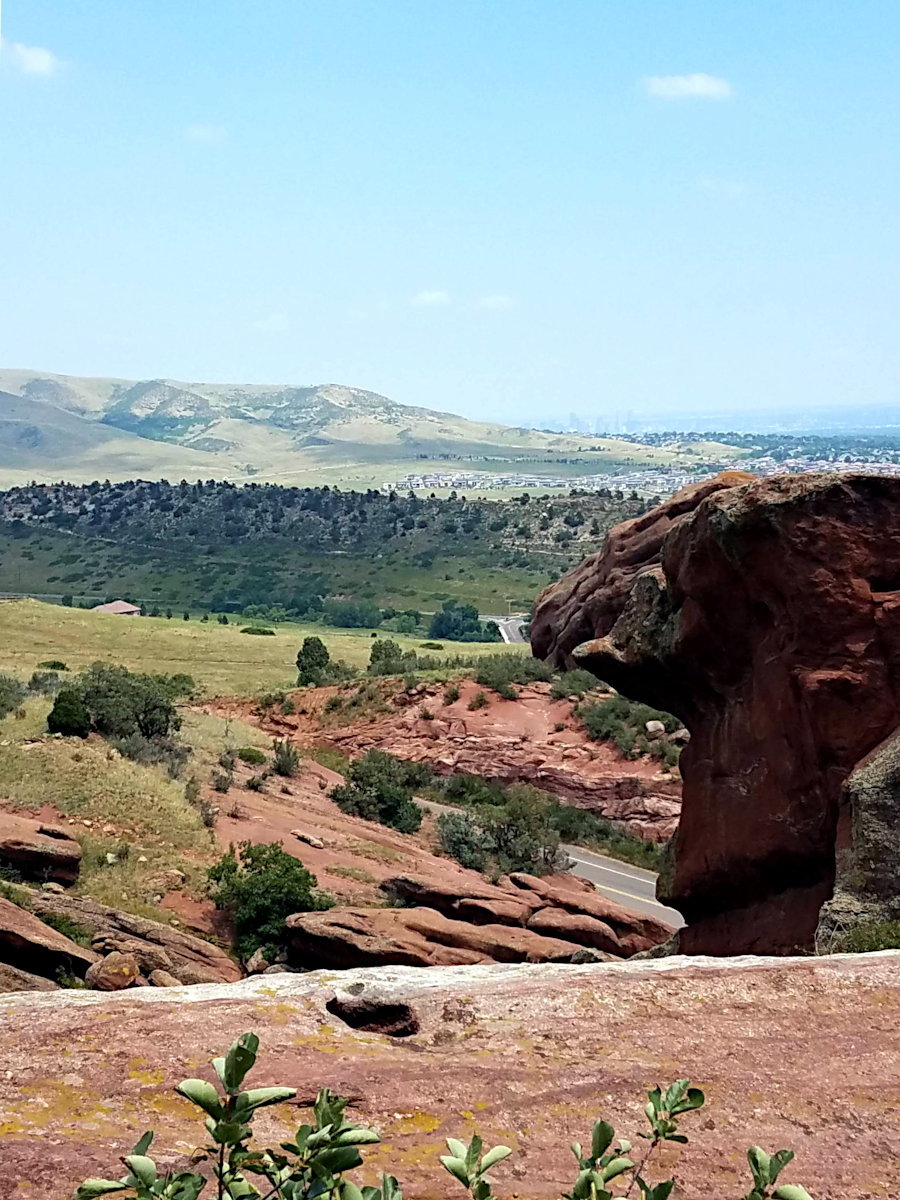
Red Rocks

Red Rocks

Denver From Red Rocks

Denver From Red Rocks

Red Rocks Amphiteater

Red Rocks Amphiteater

DIA 4am Monkey Dance

DIA 4am Monkey Dance


Wed 17 July

Travel day. First time flying Southwest.

Having just gotten approved for the TSA’s Global Entry, this was my first time using the TSA Pre✓ benefit. But even with Pre✓, I was delayed for a wipe-down search of my laptop and cell phone.

Inna and I arrived in the evening to find Denver in the middle of a heat wave.

Got our rental SUV and drove 45m to Boulder. At speed on the highway, the hood started flapping upward; the rental outfit (Enterprise) hadn’t properly closed it.

Arrived at family friend Valentina’s house and sacked out.

Thu 18 July

Breakfast at Dunkin followed by wandering Pearl Street—Boulder’s downtown pedestrian mall—in dry 100° weather. Inna bought a Liberty Puzzle, and I got a Motawi Tileworks and a book by Ajahn Sumedo at Lighthouse Bookstore. Other stops included the tourist info center, Häagen-Dazs, and University Bicycles, which was nothing special.

Returned to the SUV to find a parking ticket; I’d used ParkMobile, but had forgotten to change the plate number from our car to the rental's. Ticket was eventually waived upon appeal.

Scoped out residential neighborhoods, which seemed fine.

Finished with an excellent meal at Aloy Thai followed by chatting with our gregarious hosts. I was amused to learn that our Jewish intellectual hostess’ main concern about potentially changing her name would be how to get it updated on her old diplomas.

Fri 19 July

Breakfast with hosts before scoping out outlying neighborhoods like Table Mesa and Bloomfield. Followed that up with a very pleasant drive up Boulder Canyon into the mountains, stopping at 6,666 feet of elevation to rest and admire Boulder Creek.

Despite obvious coolness, as a small town we felt that we already had a pretty good understanding of what Boulder is like, so we hung out for a while in Barnes & Noble, where I picked up a manga volume.

Dinner al fresco with hosts featured a lot of talk about religion (Judaism, Buddhism), meditation, and finding meaning in life.

Sat 20 July

Our last morning in Boulder began with checking out the Pearl Street Arts Fest, which included playing cards under a canopy provided by Elevations Credit Union that featured cooling spray misters, and a return engagement at Häagen-Dazs.

Mid-morning I visited a beginners’ practice session by Boulder Taiko. Teacher Julia seems to have an active community. Amusingly, one of the students was a former kyūdō teacher who had just moved to Boulder from Georgia!

Leaving Boulder, we drove down to Denver and checked into our AirBNB, narrowly avoiding getting dumped on by a brief afternoon thunderstorm.

Having planned dinner with friends Max & Jenn, we synced up and made our way straight over to Colorado+ Brew Pub. Conversation was lively and informative while a violent thunderstorm swept through, repeatedly triggering all the cell phones in the building to blare emergency weather alerts.

Inna and I stayed up a bit too late into the evening working on putting her puzzle together.

Sun 21 July

While Inna slept in, I’d planned a full morning of activities back in Boulder, so I was up very early to make an 8:30am meditation group.

With the normal leader (Terry Ray) on retreat, they had a substitute leader and an abnormally small group (a total of four of us). The hour-long session was held in a sunroom in Ms. Ray’s home, the last house at the top of the foothills above town. With the sliding glass doors open to the morning sun, it was a nice, peaceful setting.

After a brief final chat, I hoofed it across town to the Zenko Kyudojo, the national headquarters for the school of kyūdō that I practiced with back in Boston. I was welcomed by Aki, the late founder’s granddaughter, who runs the Boulder dojo. We joined about a dozen others for a two-hour practice. They were very friendly, and it was a pleasure to chat and observe their form. As usual, the weather was gorgeous, to the point where people were actually excited at the prospect of coming rain! I found the practice very inspiring and it reminded me how much I enjoyed and miss kyūdō.

A couple tidbits: Practice was interrupted a couple times thanks to a rabbit whose warren was in the backstop behind the outdoor targets. I also learned that the standard draw is 90cm, but mine is about 100cm, and that you add 1kg of draw weight for every 5cm beyond 90.

A bit after noon I drove back to our Denver BNB. Although we only had three days in Denver and a lot of ground to cover, we weren’t up for sightseeing and took a down day: Inna napping while I walked to a solo lunch at Swing Thai before doing more work on her puzzle. Then we hit up High Point Creamery, the local ice cream shop, before I realized it was time for another meditation group.

This group, nominally led by the also-absent Lloyd Burton, was attended by about fifty aging white people in folding chairs in the basement of a church. The sitting and dhamma talk were provided by monastic woman Ayya Dhammadhira.

Afterward, Inna and I made a quick trip to the grocery store for supplies before staying up to complete her puzzle.

Mon 22 July

With a new day we went straight to Denver’s uninspiring downtown, hitting the visitors' center, their 16th Street pedestrian mall, and a quick tour of the local Accenture office.

Next we drove all over town, checking out residential neighborhoods, which all looked good, absent much information about home prices. Lunch was burritos at Illegal Pete’s, followed by ice cream at Häagen-Dazs.

Tiring of looking at the urban jungle, Inna wanted to do more sightseeing up in the mountains. We canceled lunch with my college roommate Ric and drove out to the spectacular Red Rocks park and amphitheater. We crawled around a bit, while Inna got her first experience with shortness of breath at altitude. We also took a scenic drive up into the hills to Kittredge and Evergreen, maxing out above 7,800 feet.

After a brief stop at Tattered Cover Books, Inna and I both attended another meditation group. This was another small group of about ten people, mostly beginners.

Then it was back to our BNB to pack up for the trip home.

Tue 23 July

3:35am. Yeah, that’s what time I wanna get up.

Trip back to the airport was easy, except when passing the notably odiferous Purina Cat Chow factory, where Inna loudly bemoaned, “It’s like we’re in Bigi’s mouth!!!”

Denver’s parting shot was that we couldn’t find our airline; it was like living in a real-life nightmare, where every airline on the planet had a ticketing area except Southwest. Just what you need at 4am on a Tuesday morning... But we eventually found it in a completely different part of the airport and successfully made our flight home.

Overall Impressions

Denver and Boulder claim to have tons of bright sunshine, more than just about any other temperate city. It’s true; the term “high desert” really does seem to fit, as it’s bone dry, but not devoid of tress and normal plant life. Boulder especially reminded me of California: sunny and very expensive, and expatriates love it; but without California's pretentious people, the job competition, and not imminently sinking into the ocean...

For such a large metropolitan area, insight meditation is surprisingly decentralized, with individual teachers doing their own thing, with their own small followings. I didn’t get any impression there’s a big retreat center nearby, either.

While I didn’t hit any bike shops in Denver, the ones in Boulder were all pretty lame: very little selection of road bikes, no real local maps or information about group rides, events, or clubs. There might be some shops that cater to roadies, but I didn’t find any.

Two things I feared really never materialized. Although there's a little bit of a western vibe, it's not particularly bad. At the same time there's very little ethnic diversity. And the drug culture is annoying, but it’s not quite as in-your-face as I feared. On the other hand, last week several events and venues were shut down after prairie dogs were discovered bearing fleas infected with (literally) The Plague, which apparently is a regular occurrence!

Aside from that, the biggest drawback to living there is exorbitant real estate prices, due to Denver’s growth and Boulder’s unique self-imposed limitation on sprawl. Ironically, Boulder’s limits on expansion haven’t resulted in any increase in population density; there’s no real urban core, as it’s smaller and less populous than Manchester, NH! Boulder in particular seems like any bland small town. There's great support for my interests (cycling, meditation, kyūdō, taiko...) but it just doesn't seem to have very much character.

Denver’s certainly more urban and diverse and has more employment opportunities, and is somewhat more affordable.

In the end, I’m sure I could enjoy living in the area, although as with any other city, there are trade-offs that must be weighed.

Red Rocks Pano

It having been over a year since my initial Begemot photo post , I suppose it’s time for a few more images of our special guest star.

He still exhibits completely catatonic midafternoon shutdowns, as described last time, which Inna & I take as ideal times for molestation.

But he has developed one really cute/strange behavior. One of his first toys was a squeaky weasel stuffed animal. Every evening, about two minutes after we turn out the light, he trots off to find it. Once he’s got it, the little guy—who virtually never meows at all—starts howling and crying like it’s a bloody emergency. That lasts maybe 30 seconds until he trots into the bedroom, carrying the weasel in his mouth, and offers it to us. Then he quiets down and settles into bed for the night. And in the morning, he’ll usually get up and bring it with him into the living area (usually without the verbal announcements). It’s pretty hilarious, but equally adorable.

His other favorite toys include shoelaces, the brown construction paper sometimes used as packing material (see below), and he’ll come like a flash if he hears anyone crumpling up a credit card receipt. Between all that and his diverse collection of boxes, the floor’s always a bit of a mess.

It doesn’t take a lot to keep the boy happy, and he definitely has reciprocated by keeping Inna & I happy.

Click for teh bignesses.

Begemot in a box Contemplative Begemot
Begemot in the Group W box Begemot hunting in construction paper
Begemot thinking Begemot staying dry
Begemot and the queen-sized bed Begemot on the armchair
Begemot and Ornoth Begemot goulash

When I go back to Maine, it’s usually a quick trip that doesn’t involve anything more than visiting family and doing a few basic chores for them. After a long trip to get there, and facing an equally tiring trip back, the last thing I usually want to do is sightseeing or a lot of driving around.

O&I @ Pemaquid
O&I @ Portland Head
I's gone Battie
O's brother & neice
I @ Pemaquid Point
O&I @ Popham Beach

However, I recently brought Inna along on her first visit to Maine in decades, while my brother and niece were in also town. Because of that, we spent a lot of our time doing touristy stuff and taking photos, which makes the trip worth writing about and sharing.

We attempted to leave Pittsburgh Tuesday afternoon, but were thwarted at the gate when our first flight was delayed beyond our connection’s departure time. Worse yet, our fallback was a 6am flight the next morning, which meant we had to get out of bed at 3am!

After a pizza and way too little sleep, we drove back to the airport, to discover a longer security line than I’ve ever encountered in Pittsburgh. But we got through it, flew to Dulles, and happily made our connection to Portland. The only redeeming part of the early morning flights was the view as we flew directly above Boston.

Landing in Portland a little early, we grabbed our rental car and I took Inna on a quick tour of infinitely-famous Portland Head Light and the Eastern Prom before driving up to Augusta. Inna met the family, and we spent the afternoon swimming at Three Cornered Pond, which (as an ocean swimmer) was a new experience for Inna. After demolishing a roast turkey breast, we checked into our hotel and passed out.

Thursday Inna and I went off on our own and explored the coast. We drove up Mt. Battie, which provided an awesome view of Camden and the islands peeking above a thick sea fog. We also explored the wooded, rocky shoreline along Camden Hills State Park, which was interesting and new to me. Then came the inevitable tourist shopping crawl through Camden. After grabbing lunch, we were off down the coast to Popham Beach, where we hiked across the huge expanse of sand and dipped our feet in the frigid Atlantic Ocean.

Then it was time to head back to Augusta to meet the family for Thai food (or in Inna’s case, sushi). Although we covered a lot of territory, Inna and I hadn’t pushed ourselves beyond our already-exhausted state, and wound up having a really nice day together.

Friday was a whole-family expedition back down to the coast for a traditional lobster dinner at Shaw’s Wharf in New Harbor. Then we went on to Pemaquid Point, where Inna and I crawled around on the rocks for a few minutes. I was a little disappointed that the rest of the family wanted to turn homeward after visiting the gift shop, rather than spending any time enjoying the surf crashing on the rugged rocks. But even I was tired from eating and so much gallivanting around, and the responsible parties had to be home in time for a cable serviceman to hook up my mother’s new tv. So we headed home.

Inna and I said our goodbyes before going to the hotel, since we had to be up at 5am the next day (again!) to catch our 8am return flight. We hopped through Newark (our original layover location), where we had plenty of time to hang out before our afternoon flight back to Pittsburgh.

We were both dragging and eager to get home when we took the airport shuttle back to our car, only to discover that the battery was dead, putting up one final roadblock between us and getting home. That was corrected after an hour of sitting in a hot parking lot. We eventually pulled into our driveway and received a loud welcome from a our cat peering from the open bedroom window.

It was a very nice trip, and Inna and I both really enjoyed seeing the sights along the coast. It was unfortunate that we lost a day in Maine due to the travel mess. And all the early-morning travel thoroughly exhausted us, so we were both ecstatic when we finally got back home.

Oh yeah, and for the whole photo album, click here.

For three hundred and sixty-three days out of the year, our apartment is located a couple blocks from Schenley Park, the second largest municipal park in Pittsburgh. But for two days every July, the park—and our neighborhood—are taken over by the Pittsburgh Vintage Grand Prix, a free motorsports festival that draws hundreds of racers and a quarter million spectators. And from our house, the roar of the action sounds like a big hive of extremely angry bees.

Having been a racing fan in a previous life, I had to check it out. There really isn’t a lot of story to tell, but I did bring my SLR and took a few hundred action shots of the cars powering along roads I typically bike on. In this case, the photos probably tell the story better than words could.

Here are a handful of my better shots, but if you like these, you can see a couple dozen more in my PVGP Flickr album.

Prior to getting our own cat, Inna and I welcomed her mother’s cat into our house for three weeks while she was traveling. Kika aka Pumpy is quite a character, known for hiding her toys (and the occasional passport book) in caches underneath rugs, staring you down with her thoroughly cross-eyed gaze, and her extremely broad range of utterly incomprehensible vocalizations.

Here are a handful of shots I took to remember her visit by. As always, click for teh bigness.

Pumpy photo Pumpy photo

“Kinda bored on a Wednesday morning, I guess I’ll go see what’s shown up in the ol’ RSS reader. Ah, the Humor folder. Really nothing in there but LOLcats from the I Can Has Cheezburger site, but I like cats, and the captions are often worth a smile… Delete… Delete… WAIT A FREAKIN’ MINUTE THAT’S GRADY!

So that was my morning surprise. Yup, someone took one of my photos of my cat, posted it on ICHC, and over a dozen people have added LOLesque captions. And for whatever reason, one of them was posted to ICHC’s RSS feed and thus straight to my mailbox.

Although unintentional, that caption was particularly apt, too: Praying? No… Imagining this around your throat… Yes!

You can see them below and click for bigness, or just go to the photo’s index page on ICHC.

How do I know that’s Grady? Well, aside from knowing my own cat, I’m also a photographer and know my own pictures. The original was posted to Flickr here back in 2008. For more words and pictures about Grady, read my post after he died last year.

Interestingly, this isn’t the first time a photo of mine showed up on ICHC. Back in 2009, a coworker uploaded an embarrassing photo of an eagle that I’d taken on my trip to Scotland in 2002. You can see the resulting LOLpix and read my reaction in this blogpost. It provided a very handy template for this posting!

What I said then about the eagle pictures applies equally well to the LOLcats people have made of Grady: it’s a little slice of notoriety that I find amusing, and it’s interesting to see what captions other people have added to it.

I kinda wish he was here to see them…

Original Grady photo
Grady LOLcat Grady LOLcat Grady LOLcat
Grady LOLcat Grady LOLcat

Below is a screen cap from the front page of BostonGlobe.com, highlighting a story about Boston's real estate market, six years after the 2008 mortgage crisis. The article is accompanied by a Shutterstock photo that shows an aerial view of the Back Bay.

The first item to mention is that the largest and most prominent building in that picture is my condo, which occupies the bottom right. You can even see my living room’s oriel windows. It’s cool—but not too surprising—that my building would appear in an article about Boston’s real estate market.

But the timing is pretty noteworthy, knowing that after fifteen years of living here, I will be putting my unit onto the market within the next month or two.

Does that sound like mere coincidence? How about if I told you that the article happened to appear on my birthday? Using *my* condo—on *my* birthday!—in an article about Boston real estate, just as I’m selling my place… It seems awfully personal, don’t you think?

And I can’t say I’m a fan of the related article, entitled “Is buying a home around Boston worth it anymore?” Thanks for the uplifting (and personally-targeted) message, guys…

Boston Globe screen cap

Ten months ago, I went out to the Insight Meditation Society for their 9-day New Years retreat. It was my first time doing a retreat of that length, and I found it vastly more dramatic and emotionally challenging than any retreat I’d ever experienced.

When I came home, I hoped to share my experiences in two separate blog posts: one public, the other friends-locked. Although I completed the first draft of the public post, I never shared it, because I was unable to adequately express the more personal stuff in the private post. And external events interfered, as well.

Nearly a year has passed now, and so much has changed since then. I guess I probably won’t ever complete the private half of my account, but I thought it appropriate to clean up and share the bit I’d planned to post publicly, for those of my friends who are interested.

So here’s my report on last year’s New Years retreat, albeit belated and edited for privacy.

New Years Eve at IMS
Winter in Barre
Cold Sunrise at Gaston Pond
Snow on IMS hiking path

Back in December, three women and I shared a car ride out to the Insight Meditation Society in Barre for their 9-day New Years retreat with guiding teachers Yanai Postelnik, Catherine McGee, and Pascal Auclair.

This was only my second time at IMS, the prior visit being a 5-day retreat two years before. After reviewing my blog entry from that first visit, I made damned sure to bring more than a single pair of socks!

As you might imagine, the weather in the Worcester hills at the end of December provided a spectacle of its own. The first three days were fairly mild (35-42°), and the ground was bare, so I took the opportunity to familiarize myself with the miles of walking trails through the woods behind the center.

That was followed by five straight days where it didn’t get above 22°, and dipped below zero for several nights. Thankfully, our rooms were kept comfortably warm, although I noticed one space heater being used to thaw some frozen pipes in the basement of one of the dorms.

We had two snowfalls of about 3 and 6 inches, neither of which stopped me from regular trudges through the wooded paths out back, as you can see from the photos at right.

While walking outside on New Years Eve (before the snows), I realized that the long hedge in front of IMS was made up of large holly trees. Having grown up in Maine, I have a deep affinity for holly, which thrives in similarly cold and desolate places. So I gathered a handful of holly leaves and berries from the ground and placed them along the windowsill in my room (see photo).

The cold weather peaked on day eight of the retreat, when I took what could be conservatively called a brisk 3-mile trek around Gaston Pond. The sunrise above the snowed-over pond was lovely, but I nearly lost my fingers taking the accompanying photograph in air that was seven degrees below zero! Ironically, that was during perihelion, the time of year when the distance between the Earth and the Sun is actually the shortest!

Then the temperatures miraculously shot back up to nearly 50° on a misty morning on the last day of the retreat. The fog only thickened as the week’s snows rapidly sublimated and completely disappeared.

I definitely didn’t sleep well, and heard similar reports from several others. My theory is that the amount of time spent each day with eyes closed, observing the mind, builds up so much momentum that it’s difficult to shut it down to go to sleep at night. But that’s just one theory.

On New Years Eve, the teachers led us through a ceremony that included writing something we’d like to give up or leave behind on a piece of paper, then depositing them into a container to later be burned. I was sitting next to the container, and it was interesting to observe how most people emphatically threw their unwanted attributes into it, often ritually ripping the paper into bits beforehand. And then a very few folks (including myself) were much more reluctant to drop theirs in, as if they were letting go of a safety blanket.

The second Saturday—day eight of the retreat—was the day that all hell broke loose.

After returning from that long, frigid sunrise walk I mentioned above, I noticed that my throat was really sore. I had come down with a cold. I had taken lots of careful precautions, knowing that retreats are ideal breeding grounds for disease, but it had still caught up with me. Thankfully, there were only two days left before we headed home!

But that was nothing compared to what followed. At the start of the midday sitting, the teachers asked us to immediately go and check our rooms and secure our valuables, because someone had gone into several meditators’ rooms (there were no locks on any of the doors) and taken all their cash! Eventually we learned that eight to ten people in one particular dorm had been robbed, and some prescription painkillers had been taken, as well.

Having spent an entire week opening their hearts and allowing themselves to work with their emotional vulnerabilities, it would be difficult to describe the sense of violation that my fellow retreatants felt. However, with the wisdom of the teachers, the group found some ways to respond to the invasion that helped people heal.

First, the entire retreat—more than a hundred people—took up the “om mani padme hum” chant and walked in a procession from the main building’s meditation hall, through my dorm, then across a passage to the affected dorm, and back again. The chant was moving and powerful, and the combined strength and goodwill of so many people helped the meditators in that building feel that we had “taken back” the space.

Then arrangements were made for small groups of people to voluntarily take shifts doing walking meditation in that building all night long, so that the residents would know that someone was awake and present at all hours to protect them in case the thief returned. I would have volunteered, but I knew that getting a good night’s sleep was imperative for fighting my oncoming cold.

I wasn’t particularly concerned about my own safety. My room was near the main building, and no one in my dorm had been robbed. I was mostly concerned for the others. But as we went to bed that night, everyone was on edge and emotionally primed to respond to the potential return of the trespasser.

So it was in that state of mind that I woke up at 2am when the door to my room was opened. In the dim light from the “Exit” signs I could see the silhouette of someone slipping into my room from the corridor. By the time I was conscious enough to respond, they’d begun backing up, but that was when it hit me that this could well be the guy!

My heart racing and barely aware of what I was doing in my panic, I threw off my bedding, grabbed the door, and screamed “HEY!!!” The interloper was backing off hurriedly, then cowered on the opposite side of the corridor from me, saying “Imsorry Imsorry Imsorry, I got confuuused!”

That wasn’t the response I would expect from a thief, so I froze in mid-leap. That gave me enough time to scan what I could see of the person’s features in the darkness. Out of a hundred complete strangers at the retreat, I thought I recognized one of the women I had shared a ride with… “Claudia, is it?”

Apparently it was. She apologized again, and I think I just said “Okay” and closed the door on her. I would have flopped right back to sleep, except my heart was pounding and I was chock full of adrenalin. No matter how still I laid or how much I tried to calm my mind, there was no more sleep that night.

The next day—the last full day of the retreat—the teachers held a a small session for people who still felt they needed to work through some of their reaction to the burglary. I decided I would go and just ask how to deal with my body’s response, because no matter how much my mind had settled, my heart was still racing along in fight mode.

Claudia also appeared at that meeting, and we talked through the event. Apparently she had been one of the people doing walking meditation during the night, and in returning hadn’t realized that the passage from the second floor of one dorm led to the first floor of the other. She had walked into what would have been her room if she had been on the second floor, but because she was mistakenly on the first floor, she’d walked in on me instead.

People going into the wrong room by accident isn’t unheard-of there, since the doors all look the same, and there weren’t any locks on them (there are now). Of course, having that happen to me at 2am the night after a burglary was pretty much the worst timing imaginable. Since it was conceivable that something like that could still happen again, the following night I slept with my bed frame blocking my door from opening at all. I didn’t want to go through that a second time!

The final day brought the closing feedback session, where I spoke a brief piece about how the retreat had affected me emotionally much more than any previous retreat. And Claudia and I and the other two women in our car were the last ones out of the center after the retreat ended.

So, that’s a good bit about the body of the retreat. Now I’ll talk a bit about some of the ideas that came to me while spending all that time in silence.

Everything we experience, which feels so personal and unique to us, isn’t; it’s actually just one instance of sensations that virtually all humans experience at some point in their lives. Viewing them as universal phenomena makes it easier to hold one’s own pain lightly and feel a lot more compassion for others.

I thought up two interesting metaphors for how we relate to time. One can only see what’s happening clearly by being fully engaged and aware in the temporal present. Our past experiences can be like the film on a dirty window, making it more difficult to accurately view what’s going on in the present; our histories leave a residue that obscures or filters one’s view of the present. One need to try to see through or beyond the obscuration, or somehow clean the obstructions away. Similarly, focusing on the future can cast a shadow that darkens and obscures one’s view of the present; you can either spend all your time planning for and living in the shadow of an as-yet unrealized future, or step out of the shadow and experience the present moment in its full, vivid brilliance.

There’s an old instruction that goes something like this: never miss an opportunity to make someone else happy. I had some opportunities to play with this during the retreat, and the results were rewarding. I’d like to remember to do this more often.

When dealing with strong emotions (positive or negative), the best way to relate to it is with curiosity. Trying to suppress it isn’t healthy, and conversely one can easily lose perspective by self-indulgently wallowing in those emotions. The correct prescription is to explore one’s emotions with a sense of curiosity, because then one can understand, see the value of, and learn from those feelings.

In meditation, we cultivate a separation between the observer and the observed. In that way, the part of the persona that is observed can experience an emotion like anger, while another a part of the mind is at a slight distance from the experience, observing it, and learning from it. This separation of the observer from the observed isn’t just useful to help us see ourselves more clearly. Conversely, for those of us who have difficulty with our emotions, or are afraid of giving them free rein, it’s also a good way to free part of one’s persona to be fully absorbed in our emotions without the fear of losing control or being overwhelmed by them.

The common conceptual framework we inherited tell us that the heart is the place where we feel emotion. But saying that the heart is the seat of emotion is no more accurate than saying you hear sound through your kneecaps. If the heart was truly where emotions were located, people with man-made artificial hearts would never feel emotion, and doctors would perform cardiac surgery to cure depression, rather than prescribe drugs that impact brain chemistry! It’s time to stop referring to the heart as the seat of emotion, which is merely fossilized lore from a distant time of human ignorance.

There’s a huge amount more to say about that retreat, but I’m afraid the rest of the story will have to wait.

When we love someone, we hold their story within our hearts. When they pass, it’s incumbent upon us to bring that story forth and hold it shining like a gemstone for all to see.

Thus, I have to tell Grady’s story.

Two years after my first cat passed away, I was ready to add a new member to my household. In September of 2007 I went to the MSPCA’s Angell Memorial shelter and met a little gray cat. When I petted him, he had a very loud, easy purr, and I decided that he was the one.

The tag on his cage said his name was “Grady”, which is strange, because the previous owner had written “Grey” on the info sheet when she surrendered him. Of course, the tag also said he was “about 3 years old”, when the owner had said “one year”.

Grady
Grady perched
Grady belly
Grady boxed
Grady's neighborhood
Grady leaps
Grady snuggling
Grady Schemes
Grady begging

I’d thought I was getting an adult cat, but he really wasn’t much more than a kitten, and he had the energy and temperament to match. In the early years, he would often full-on attack me, drawing blood mostly with his teeth. When I got an animal behaviorist in, she tried to play with him until he was exhausted, but after 90 minutes of that without pause, she declared him “99th percentile”.

It got to the point where I was almost convinced that I would have to get rid of him, but we persevered, and I found that putting him in isolation when he misbehaved finally got the message through. He even figured out that if he really needed to play, he could come up to me, sit up on his haunches, and beg with his hands together. And if I wasn’t paying attention, he could tap my elbow with his paw first.

Play for him meant jumping for bouncing ping pong balls or leaping for potholders tossed like frisbees. He even played with little toy cars, rolling them around on the hardwood floor! But his favorite toys were the rubber wristbands that used to be popular; he’d run and chase them, then chew them up until they were destroyed. If you threw his stuffed toy pheasant, he’d run after it at full tilt, grab it with his forepaws, and do a complete somersault before administering a killing bite and bunny-hop kicks.

As he matured, he mellowed and came to trust me completely. Of course, whenever I came home, I could expect him to trot up and meet me at the door. He’d come snuggle any time I was on the couch, or nestle in the crook of my arm as I sat up in bed reading. If I was working at my desk, he’d come drape himself over my shoulder. We even got to the point where I could reliably hold him in my arms and rub his belly.

He was a good leaper, jumping across the kitchen from the island counter to the top of the fridge. He’d also jump several feet up and grab onto “his” particular part of the brick wall separating the kitchen and living room, or atop his scratching post. Every time I was on the toilet, we’d have to play grab-tag in the gap beneath the bathroom door. With people and loud noises, he was absolutely fearless… He had only one mortal fear: tinfoil!

Another daily ritual was feeding time. He was fed twice a day by an automatic feeder, and really knew how to tell time! Two hours before dinner, he’d start nosing around. With an hour to go, he would constantly prowl around. With 20 minutes left, he was downright agitated. And as feeding time neared, he’d pace around the feeder in high excitement, often biting it. I told him, “Don’t bite the device that feeds you!”, but that particular lesson didn’t seem to sink in very well. I think he knew exactly what it meant when I sang the “It’s almost time!” dinner song for him.

Speaking of music, Grady had both his own song, poem, and a special rhyming haiku. The song goes like this:

Grady, Grady, Grady cat:
Him not no average little ’fraidy-cat,
But him meows like a little lady cat…

His poem is:

My cat is full of grayness,
From his whiskers to his anus;
It seems to be quite painless.

And that rhyming haiku? Voilà:

My cat’s named Gradle;
He ate a raisin bagel:
It wasn’t fatal.

Perhaps his most unique trick was this: when he was watching you, if you held your hand out and rubbed your fingers together, his eyes would slowly close, as if from happiness. Very strange, but cute!

I’ve included a few good photos in this post, but I really suggest checking out all of Grady’s photos on Flickr. There are some real special pictures in that collection that capture his personality.

None of that, of course, says much about what he meant to me. Let’s just say he was a dear, dear friend, who made every day much better than it would have been without his warm presence.

So, what happened, and why is he gone?

On September 4th, we celebrated the seventh anniversary of his adoption with the traditional wet food treat. He was due for inoculations, so six days later I took him to the vet for his annual checkup. At that point, everything seemed fine, and continued that way for the following week.

The eighth day after his vaccination was Thursday the 18th, and he was his usual active self. The next day, he was lethargic and (for the only time in his life) ambivalent about food. I decided that I’d bring him to the vet if he didn’t improve overnight.

Since he didn’t improve, I brought him in to the vet first thing Saturday morning. He had quite a fever, so they kept him until 4pm, giving him IV fluid and antibiotics.

At the end of the day, he hadn’t improved, and since the vet was closing and wouldn’t be open on Sunday, they advised me to bring him to the animal hospital at Angell Memorial: the same shelter I’d adopted him from.

After an anxious cab ride, I brought him into Angell Saturday night. The doctor planned to run a bunch of tests and give him more fluid and antibiotics, which meant Grady would probably be in the hospital for a couple days.

Sunday his temperature had come down a little, but he wasn’t eating. All the tests they ran came back with only minor variations from normal. More tests needed to be done.

On Monday morning his temperature was back within the normal range. Monday afternoon I got a call from the doctor saying that he seemed normal and stable, but he still wouldn’t eat for them. Given that, she suggested I bring him home, in hopes that he’d be more comfortable and more liable to eat in a familiar environment. I just needed to wait a couple hours for them to get him ready to go, until 8:30pm.

At home, I cleaned out his food, water, and litter containers, in hopeful anticipation of his return. At 8pm, just as I was getting ready to leave, I received a telephone call from the woman who was getting him ready. “He’s in respiratory arrest. Do you want us to resuscitate him? We need an answer right now.”

What? But his fever had broken! The vet had pronounced him stable! Four days previously, he had been a lively and happy cat! And he was only eight years old! This wasn’t supposed to happen!

I was utterly staggered. Grady had spent three days in the hospital, but they had absolutely no idea what was wrong with him. The woman on the phone tried to be tactful while reminding me that even if they resuscitated him, it was likely to be only a temporary, short-term thing. Could I ask Grady to go through more trauma than he’d already endured? Was this his way of telling me that he’d had enough?

In the end, I took it as a sign that it was time for me to let him go. I told them not to resuscitate. They called back five minutes later to tell me that he was gone.

Grady—my lovely baby!—was gone!

I spent most of that night howling the horrible animal pain I felt. The comments I got from friends on Facebook were helpful, albeit to a limited extent. The next day, when I talked to the doctor, I agreed to spend the money to perform a necroscopy seeking answers about why he died.

Ultimately, the necroscopy was of no more use than any of the veterinarians who had treated him. Grady had a few minor health issues, but they found nothing life-threatening. Was his death due to a reaction to his vaccines? Was there anything the vets didn’t do (or anything they did) which contributed to his demise? There was simply no evidence to base an opinion on.

So now he’s gone, and we will never know why. It sucks mightily that we had such a short time together. I was so happy, and I really expected to have a lot more than just seven short years with him.

One of the most difficult emotions is my sense of responsibility for his unexpected and premature death. I mean, I used to look him in the eyes and tell him, “I *own* you…” And he trusted me so meekly when I brought him to the vet for his checkup. And yet, twelve days later he was dead, despite my feebly ineffective good intentions. And his well-being was 100 percent my responsibility. That guilt tears me up from the inside.

The condo, without him and all the cardboard boxes, the toys strewn all over, the food, water, and litterbox: it feels as if I’ve had a roommate move out. The place is silent and empty and lifeless. It might seem odd that living alone feels so radically different than living alone *with a cat*, but so it is. While my friends’ sympathy certainly helps, life just isn’t the same without my lovable little guy.

Seven weeks before Grady’s illness, I rode in my last Pan-Mass Challenge, and spent Sunday night after the ride at my hotel in Sandwich, on Cape Cod. Monday morning, my support person and I went and explored the Sandwich boardwalk, a quarter-mile foot bridge crossing a tidal marsh, connecting a parking lot to the town beach. After storm damage, it had been rebuilt in 1992 and again in 2013 with money raised by allowing people to purchase inscriptions in each wooden plank of the deck.

As we walked along, we read a sampling of planks. As I neared the beach end of the boardwalk, my eyes landed on one which simply read: ♥ U GRADY. Whatever the original intention had been, the plank reminded me of my little roommate, whom I hadn’t seen for four days. For all the feelings that reminder of him evoked, I stopped to snap a picture of it.

I didn’t know then that Grady had only a few weeks left to live.

That photo I impulsively took is now a very poignant memory and perhaps a fitting memorial in honor of my trusting and faithful little roommate, for whom I held so much affection, and who had brought so much warmth and joy into my life. Blessed be, my little one! I’m so, so sorry.

(heart) U GRADY

How does one find the words to eulogize a true hero: a dear friend, a tireless mentor, a great benefactor, and a true inspiration?

When I did my first Pan-Mass Challenge charity ride back in 2001, my coworker Jeremy—who was doing the AIDS Ride—told me about a group training ride starting at Quad Cycles in Arlington. “It’s run by this guy named Bobby Mac… You have to meet him!”

So one weekend I went out and rode with them. Bobby was a charismatic older guy who was the obvious center of the group. He’d bark out endless advice about how to ride, always interjecting a characteristic bit of self-deprecating humor or belting out snippets of songs from the 60s and 70s. He’d shamelessly (but harmlessly) flirt with the ladies, who all adored him. On the road, he always stayed with the slower riders, mentoring them and offering helpful advice for how to both survive and enjoy whatever charity rides they were training for.

Bobby Mac made riding fun.

Bobby Mac
Bobby Mac with Johnny H
Bobby Mac at Ferns during the Tour de Mac
Bobby Mac
Ornoth with Bobby Mac
Bobby Mac

Like so many other neophyte riders, I started out wearing canvas cargo shorts and a tee shirt, riding a heavy, flat-handlebar “hybrid” bike. Over the course of thirteen years with him, Bobby sculpted me into a spandex-clad veteran roadie who rides 10,000 kilometers a year on his carbon-fiber road bike and has raised over $100,000 for cancer research.

But I am just one person out of hundreds and hundreds of riders whom Bobby has encouraged over the years. Himself an inveterate charity rider, he and his team of “Quaddies” were often top fundraisers and volunteer crewmembers for several of the largest charity rides in the area. If you added up all the good works performed by Bobby Mac and the legions of riders he has encouraged, the sum total would be staggering.

As you can imagine, Bobby Mac was a huge part of the local community. He recorded several PSAs on behalf of charity rides and local cycling advocacy. No matter where we went, we’d always run into people who knew him. Whether you were a cyclist or not, it seemed everyone was friends with Bobby Mac. No matter who you were, he made it very easy to feel like you were his best friend.

We also loved Bobby for his idiosyncrasies. It was a mark of seniority if you could say that you’d seen him ingest anything other than Cytomax sports drink. Back when the ride stopped at Kimball Farm, Bobby proved that his popularity extended even to barnyard animals, as “Buff the Powerbar-Eating Goat” would run up to the fence to greet him and receive a treat.

As he aged, Bobby suffered from macular degeneration which gradually eroded his eyesight. I once watched him nearly ride straight into a sawhorse barrier that a road crew had put up when one of our regular roads was temporarily closed. It was a mark of real trust if Bobby let you lead him through a charity ride on unfamiliar roads he hadn’t already memorized.

Due to his worsening eyesight, we all feared that Bobby would eventually be unable to ride. Knowing that his time was limited, in 2006 we organized the first Tour de Mac, a special ride in his honor, complete with tee shirts, rubber wristbands, and an award presentation for the guest of honor. In 2009 we held another ride to celebrate his 60th birthday, which I recorded with an emotional writeup and video. Everyone loved Bobby, but despite repeated operations to maintain his vision, we all harbored silent fears about how much longer he would be able to ride.

However, Bobby wasn’t destined to live long enough for his eyesight to fail him. Three weeks ago, Bobby went into the hospital, suffering from pancreatic cancer that had metastasized. It was terminal, and last night he passed away in his sleep at home.

When his diagnosis first became public knowledge, the hospital’s staff very quickly learned how special Bobby Mac was. They weren't prepared for the hundreds of his friends who came to visit his bedside. The nurses put up signs, limited the duration of visits, and still more people kept coming, sometimes queueing up in shifts of ten at a time outside his hospital room.

The first time I visited him in the hospital, I had something special I wanted to share with him. When a rider surpasses $100,000 in fundraising, the Pan-Mass Challenge gives them a silver pin with the PMC logo as a lifetime achievement award. I had received mine six weeks before Bobby went into the hospital, after 13 years of riding and raising money for the Dana-Farber Cancer Institute.

I wanted Bobby to know about that accomplishment, and how it was due in large part to his inspiration. And that if I was only one of hundreds of riders he’d encouraged, then he’d achieved a whole lot of good in this world. His characteristically self-effacing response was to shrug off his role and emphasize mine, saying that I had long been the most dedicated of his charity riders.

It’s bitter irony to me that the man who was my hero and inspired me to ride the Pan-Mass Challenge was taken from us by the very disease I’ve raised so much money to combat. It goes without saying that this year—my final PMC ride—will be dedicated to the memory of my hero: Bobby Mac. It will be a very emotional ending when I reach the Provincetown finish line for the final time and lift my bike over my head, consciously copying Bobby’s signature victory salute.

With his innate charisma and his natural role as the center of a circle of people, Bobby reminded me a lot of my father, or what he might have been, if my father had been motivated by kindness and generosity. In that way, Bobby has been a role model for me, an inspiring example of what a fatherly male figure could be—and could accomplish—in this jaded, selfish world.

There’s one particular exercise in Buddhist meditation called “Brahmavihara practice”, wherein we use visualization to cultivate our capacity for friendliness, compassion, and joy in others’ happiness. Typically, we start by directing compassion toward someone whom it’s easy to feel affection for, then slowly work our way to people we feel ambivalent about, and then challenge ourselves to work with people we find difficult or hateful. But we start with someone who is often referred to as our “benefactor”.

Years ago, when I started that practice and was asked to identify someone whom I felt unalloyed affection for—someone whom I considered my benefactor—one person’s name immediately jumped to mind: Bobby Mac. Bobby was my exemplar of friendliness, affection, compassion, and generosity. In my opinion, Bobby was the absolute embodiment of the concept of a “benefactor”.

Bobby’s presence and personality made everyone’s world feel much more friendly, much more optimistic. He put a whole lot of love and goodness into the world.

And he took a whole lot of love and goodness with him when he left: both the love of his many friends which was directed toward him in his final years, and also the love and goodness that have gone out of this world with his passing. For everyone who knew Bobby Mac, the world feels a little colder and more lonely without his energetic encouragement and his incorrigible smile.

Here’s to you, my friend, my mentor, my benefactor, my inspiration, and my hero. As you enjoined us at the start of every ride, we will do our best to “ride with love in our hearts and smiles on our faces”, thanks to you, Bobby Mac.

I won’t belabor the ask, but if you wish to make a donation to fight cancer in Bobby’s memory and sponsor my PMC ride, you can do so here.

Most of my blog posts require a lot of words to get their point across. And then there’s ones like this, which only require a few images.

The following images are gathered from the first page of results from a Google Images search for:

<Location> Massachusetts person

It’s one of those occasions where the images speak for themselves. Which set of people would you like living in your town? What do the people in your town look like?

Back Bay
Allston
Cambridge
Somerville
Arlington
Carlisle
Weston
South Boston
Quincy
Brockton
Jamaica Plain
Provincetown
Gloucester

I find myself in the mood to record a brief rundown of the major events of 2011.

In terms of my Buddhist practice, a few nice things happened. I completed a year of dedicated compassion practice, I became a paying member of CIMC for the first time, I began volunteering to read announcements at Wednesday evening dhamma talks, I continued attending CIMC’s Long-Term Yogis practice group, did another sandwich retreat, and attended our kalyana mitta group’s first weekend retreat. My daily practice thrived, partially due to finding time to sit during my lunch hour at work, and partially thanks to the mild competition fostered by the Insight Timer Android app, which allows one to earn badges and see how often one’s Facebook friends are sitting. Overall, I am comfortable with my meditation practice and happy with the results.

As alluded to, I also went back to work after a 2-year hiatus. Like any job, the new gig has its ebb and flow of both rewards and annoyances, but the influx of cash is certainly welcome. And despite having to overcome frequent outbreaks of stupid amongst my coworkers, I am getting to do the frontend design and development work that I enjoy. Unfortunately, it’s the longest commute I’ve had in a long time, but during the summer that gives me the opportunity to get some weekday bike rides in.

On the cycling front, the miles I gained by commuting didn’t quite offset the fact that working for a living meant I couldn’t spend summer days riding, so this year my mileage dropped from 5,000 to 3,000. But the income gave me the opportunity to do a long-needed complete overhaul of my bike and buy a new mapping GPS cyclo-computer. And I still did all my major events, racking up seven centuries, only one less than I rode in 2010. Notable rides included a rainy Jay Peak in Vermont with my buddy Jay, and a rainy three-state century with Paul and Noah. And I even had a training question published in the online magazine RoadBikeRider.

This year’s Pan-Mass Challenge was very memorable, as well. I began the season by attending my first PMC Heavy Hitter banquet and also the dedication of the PMC Plaza that comprises the entrance to Dana-Farber’s brand-new Yawkey Center for Cancer Care. I shared the ride itself with Jay, who enjoyed his first PMC. And despite riding on a loaner wheel because I discovered cracks in mine at the last minute, I still did my fastest Saturday ride ever. After the ride, I was delighted to find that a photo of me leading a paceline occupied the PMC Home Page for more than three months, and then was used again in a thank-you advertisement that Dana-Farber placed in 105 local newspapers throughout Massachusetts. Being the PMC’s poster boy and attending the dedication of the PMC Plaza both made me immensely proud of the years of work I’ve dedicated to the PMC and the Dana-Farber Cancer Institute.

Despite all that, I have to say that I was frustrated by this year’s cycling season. This was the first time that I had clearly lost ground against my riding buddies, who admittedly are 20 years younger than I am. I don’t know whether that fall-off was because my competitive spirit has lessened, because work prevented me from training more, because of the natural fall-off due to aging, or whether there might be something more serious going on. All I know is that some of my rides (especially the Climb to the Clouds and the Flattest Century) were really painful, unpleasant slogs this year.

In the same vein, this was the first year where I felt that my health had declined. I found myself fighting frequent intense headaches that often included nausea and vomiting, especially when I traveled (which turned the Flattest Century and Jay’s Labor Day ride around Mt. Wachusett into terrible experiences). I also noticed that I sometimes experience cardiac issues when riding flat-out, where I feel a sharp, intense pain in my chest and my heart rate drops by about 15 bpm for 30 to 60 seconds. These have, of course, been added to the list of things that I need to bring to my PCP, but they’re also the first indications that my body is starting to decline. Which brings me right back around to my spiritual practice!

In other noteworthy events, I observed my tenth anniversary of buying my condo, and remain extremely pleased with that. I got to see the Cars perform live, which was truly a once-in-a-lifetime event. I got around to making ice cream flavored with Pixy Stix candy with SweeTarts bits mixed in, which was fun but not quite the confectionery orgasm that I was hoping for. And I decided to punt on my planned trip to California for the second year in a row; the good news being that I am more committed than ever to making it happen in 2012.

Speaking of which, I’m not making too many plans for 2012, but there are already some themes emerging. I’m going to spend a week on the Riviera Maya (outside Cancun) with Inna. I’m finally doing my first residential meditation retreat at IMS (5 days). I’m once again going to try to make California happen in September. Of course I’ll be doing my 12th Pan-Mass Challenge and probably Outriders, but I also hope to do some new cycling events, such as the Mt. Washington Century, the Eastern Trail Maine Lighthouse Ride, and/or the Buzzards Bay Watershed Ride.

So if things work out, 2012 will be an interesting year, too. With just nine hours until it begins, here’s hoping!

Sometimes you’re fortunate enough to know when something historic is about to happen. When I heard that there was going to be a formal dedication of the PMC Plaza at the Dana-Farber Cancer Insitute’s new building, I had to be there.

Think about it: Dana-Farber—the place where chemotherapy was invented—hasn’t opened a new clinical building in 36 years. At that rate, it’s an incredibly rare honor to have the building’s main entrance named for your organization. It is a very concrete, tangible method of recognizing how important the Pan-Mass Challenge is to the Dana-Farber’s mission of curing and eradicating cancer.

PMC logo in light
DFCI President Benz & PMC President Starr
PMC Plaza
PMC's Billy Starr speaking
PMC Plaza ribbon cutting
Full Photoset

Leading up to the dedication, details were difficult to come by. I knew the date, and was tipped off to the time earlier that day. Although I hadn’t planned it out, I left work early so that I could swing by my place and grab my camera.

I wasn’t even sure the event was going to happen. Most of New England was under a thunderstorm and tornado watch. The sky was ashen, with a fierce wind blowing debris around the streets of Boston. As I descended the stairs to catch the subway from Copley to Longwood, a deafening thunderclap rattled the headhouse and the lights flickered. If the ceremony hadn’t been canceled, at least there’d be a dramatic backdrop for it!

Arriving at Longwood, I saw that the celebrants were gathering inside the lobby of the new Yawkey Center for Cancer Care building. Uninvited and underdressed, I pulled my camera out and made like I was supposed to be there. I later learned that due to space constraints, only 20-year-plus PMC riders had been invited, due to space constraints. But no one challenged the guy behind the camera, a mere 10-year rider, and I wasn’t about to let such a historic moment pass me by. My one nod to propriety was that at least I didn’t eat any of the hors d’oeuvres!

So I played photographer, and got a few good pictures out of the deal. I even got a bit of photographer-level access to the bigwigs, which amused me.

The sense of being on observer of history was reinforced during the speechifying. This recognition was arguably the most important moment in the entire history of the Pan-Mass Challenge, and it was a moment of deepest pride for me, standing there in a new building that the PMC’s donation was the lead gift for. In his remarks, Dana-Farber president Dr. Ed Benz articulated for the first time the astounding next milestone in the PMC’s fundraising road: a third of a billion dollars.

I won’t say much about the plaza itself. There are three granite planters/benches with “Pan-Mass Challenge Plaza” engraved that separate it from Brookline Avenue. There are dozens of granite pavers in a long line, each one representing one of the towns that the PMC route passes through. There’s two standing arcs of granite that comprise a sculpture called “Tandem”. And a plaque, which reads:

PMC PLAZA
This plaza is dedicated to the Pan-Massachusetts Challenge (PMC): to its cyclists, volunteers, and donors whose life-affirming efforts through the decades have provided critical support for cancer research and patient care at Dana-Farber Cancer Institute. Tandem is a tribute to the indelible bond between the PMC and Dana-Farber and reflects the extraordinary impact when two vital organizations work in tandem.

Yeah. Being part of an organization with that kind of power to do good: that’s something to take pride in. And as the inscription says, it’s not just about the riders. It’s the partnership between the riders, the thousands of volunteers, and a quarter million people a year like you who sponsor riders. And that’s just the PMC’s side of its partnership with Dana-Farber, its doctors and researchers, support staff, and cancer patients and their families.

I’m deeply proud to be one part of that extended family.

Last weekend’s Pittsburgh trip: not much to talk about.

Saturday morning, a package I’d ordered arrived: new Teva sandals. I put them on and went for lunch at the Prudential mall food court, which was overrun with costumed attendees of the Anime Boston convention. Pretty surreal.

Joy of Life
Allegheny Cemetery
Pumpy cat
Prawn the cat
Full Photoset

Grabbed my bag and left home, but on the way out, I received another package I’d been waiting for: a second battery for my video camera. Threw that in my bag and made my way to Logan.

The flight was fine except the descent into Pittsburgh was bumpy due to wind. The woman next to me squealed on touch-down. Weather a balmy 82 degrees but overcast.

Hit a grocery store that Inna wanted to visit, then dinner at Maharaja, an Indian restaurant tucked inside a Days Inn by the highway. It was set in a long-abandoned ballroom, with used dinner plates littering several of the many empty tables. To my horror, Inna violated my first rule of Indian—never order the buffet!—and it delivered in spades. Spots in the steam table labeled rice and naan were empty, and what food there was looked like it had been sitting on the Sterno for months. At least they didn’t serve Goat Bone Curry like Ajanta used to!

Since Inna’s mother was traveling, we stopped by to feed her cats Theo and Pumpy, then called it a day.

Sunday was Easter, so I tried to get Inna to sample a chocolate bunny, but she refused. We spent a mostly lazy day doing not much of anything, since most places were closed for the holiday. We walked around Shadyside and had ice cream at Oh Yeah!, then drove around at random, ending up having a nice walk around the reservoir at the summit of Highland Park.

After feeding mom’s cats, we went to a place called Thai Cuisine on East Liberty, which was unmemorable, then home so that Inna could study.

Monday I walked down to the Fifth Third Bank and snagged some small bills, then off for ice cream at Klavon’s. Drove around Lawrenceville, and saw three deer in Allegheny Cemetery. Back in Squirrel Hill, we stopped at Radio Shack to pick up Livestrong wristbands for the cats to play with, and chocolate for us.

Dinner was a burger at the Elbow Room in Shadyside, which wasn’t bad, then we went home and played “Wits & Wagers” and some “World of Goo” game on Inna’s Wii.

Tuesday I packed up and we hit the Waterworks Mall where Inna shopped for clothing while I picked up some Eneloop batteries and found a kitten to play with at Petco. We made our way out to Moon Township and had a tasty lunch at Mad Mex before saying our goodbyes at the airport.

All told, it was a very low-key visit, which seems pretty typical of Pittsburgh. Atypical, however, were the mediocre meals, since my experience has been that the thing Pittsburgh usually gets right is its food. But the weather was pretty gorgeous for early April, which made a nice change from the freezing cold of my previous two visits. Mostly it was good to see Inna, since she’s been buried up to her eyeballs all year with work for the one-year sustainability MBA program she’s enrolled in.

Car Talk

Feb. 19th, 2010 02:28 pm
Bob Libby

Yes, I’m a cyclist and I haven’t owned a car for 15 years, but that doesn’t mean I hate cars. In fact, I was quite an automotive enthusiast for most of my childhood.

My father dragged me down to the local race tracks even when I was very young. I grew up with photos of my favorite racecar drivers adorning my bedroom. To this day I remember battles between local heroes—now enshrined in the Maine Motorsports Hall of Fame—like Homer Drew and Bob Libby at places like Beech Ridge, Oxford Plains, Wiscasset, and Unity raceways.

Richard Petty

In addition to watching NASCAR legends like Richard Petty, David Pearson, and Cale Yarborough on television, I had a whole fleet of plastic model cars that I’d built up, and a slot car track to play with. I would spend endless hours pedaling my Marx Big Wheel in counterclockwise circles around the driveway in imaginary races… wearing out at least three Big Wheels in the process!

Naturally I had the full set of racing flags: red, green, yellow, checkered, white, black, and the blue and yellow “move over” flag. I sometimes confused people driving through our neighborhood by playing race car flagman at the intersection in front of our house.

At even that young age, I didn’t think I had the cojones to be a world-class stock car driver, so I chose the next best thing. When I grew up, I wanted to be a race car mechanic. Never mind that I had no mechanical aptitude whatsoever, nor any access to cars, parts, and tools to tinker with!

Hot Rod magazine

At eight years of age, I was already an avid reader of magazines like Hot Rod, Road & Track, and Car & Driver, as well as the wonderful and memorable CarTOONs comic book.

NADA guide

My buddy John Gousse and I would dumpster dive behind the local car dealerships, picking up discarded NADA blue books so that we could study the body styles and engine options of all the current models. I could not only identify any car’s make and model on sight, but also its specific year, options package, engine size, and zero-to-sixty time.

With that kind of upbringing, it shouldn’t be a surprise that I suffer from the typical American affinity for the automobile. Growing up, one of the biggest questions in the world was what kind of car I’d own once I got my drivers license.

Well, let’s talk about that a bit, because the main point of this post is to take a look back at the family cars that I remember most vividly. The photos that follow are close approximations of the vehicle we had, although the colors were often different. A couple of the later photos are of our actual vehicles.

1961 Chevy Impala

There’s only one place to start this list. The first car I remember us having was also the one with the most character and style: my father’s 1961 Chevy Impala. Its gloss black body was in bold contrast to its fire engine red interior. But what captured my imagination were its lines: all fins, sweeping curves, V-shapes, and daggerlike arrows, with six bullet-shaped tail lights. Even the emblem carried crossed red and checkered flags! It screamed speed and class and elegance.

It also was the protagonist in one of my family’s most memorable misadventures. In the days before my brother was to get married to a girl from Texas, he and my father went to Boston’s Logan Airport to pick up the bride’s family, our future in-laws. The car’s engine had been replaced improperly, and as they drove through the Sumner Tunnel beneath Boston Harbor, thick black smoke started pouring from the tailpipe, and the car died just as they reached the end of the tunnel. Welcome to the family!

1970 Plymouth Fury

My father’s next car was a green 1970 Plymouth Fury III. The contrast with the Impala couldn’t have been starker. Big, boring, bland, and boxy, the Fury (or “Furry”, as I’d call it) was a typically sturdy but boatlike American Chrysler sedan.

What scares me is that this car actually stands out in my mind. After the Fury, my father went through three consecutive Oldsmobile Delta 88s, none of which had any personality whatsoever. They were big, comfortable, and reliable, crossing the continent numerous times, but it still makes me sad. My father must have been quite an automobile enthusiast himself, but the last four cars he owned were utterly mediocre.

1970 Datsun 510

Over his lifetime, I believe my father owned eleven cars, none of which were imports. On the other hand, five out of six of the cars my mother owned before my father’s death were imported. I vaguely remember a green Volkswagen Beetle—my mother’s second one—in the driveway of my childhood home.

But the earliest car I truly remember was a yellow 1970 Datsun 510 sedan. A very basic Japanese econo-box, at the time of the 1973 Mideast Oil Crisis, it must have been a blessing for my folks. It was nothing but a curse, however, after they sold it to my brother, who claimed it misfired, overheated, and ate oil. The Datsun mark eventually was incorporated into the Nissan brand.

1975 Chevy Vega

The Datsun was followed by my mother’s only American car and first brand new car: a 1975 Chevy Vega. It was bright red, with a black vinyl top, kind of reminiscent of that old Chevy Impala. This was the car I learned to drive on, and the car I took my license test in. My mother liked the color, and I generally liked its sporty styling; it was, after all, our first car with any character since that old Impala. Its aluminum block engine burned oil, though.

The car my mother—and therefore, I—had during high school was a white 1981 Subaru GL wagon. I nicknamed it “Ur-a-bus” for its utilitarian design and because that’s what you get when you spell Subaru backwards!

1981 Subaru GL

A grossly un-cool car for a high school student to have, it made up for it in one key way: it had a neeto space-age glowing amber dashboard with digital readouts and an overhead schematic of the car that indicated open doors. This earned it the nickname “the Starship” from my friends, who then referred to me as “the Admiral”.

The Starship accompanied me through gaming conventions, SCA events, move-ins and -outs from college, and many dates and late-night returns from girlfriends’ houses. Unfortunately, it was also the victim of my “learning experience” of causing two accidents within two weeks. In one, I rear-ended someone while driving a girlfriend to a concert; in the other, I attempted a U-turn on a busy street from a parallel parking space, and got hit from both directions. I still have a piece of paint that flaked off from one of those impacts in my scrapbook for 1983!

Despite the number of times I bounced it off other vehicles, my mother kept that Subaru until my father died, at which point she adopted my father’s habit of buying American: a mid-sized Olds, and then a Buick. Only in 2005 could I convince her to buy a Toyota Camry. It’s served her well, despite Toyota’s current recalls and troubles.

1982 Mazda GLC

Meanwhile, once I started living off-campus at school, my girlfriend Linda and I needed a car of our own. With college bills and student jobs, our choices were limited. We wound up with the used blue 1982 Mazda GLC you see at right: basically, another underpowered Japanese econo-box. My buddy Mike Dow co-signed for our car loan.

The one cool thing about the GLC—the “Glick”—was that it had a moonroof. That was tremendous! It was the car we took off in after our wedding, and our transportation for several trips to Pennsic. Along the way, we made our own air conditioning by turning canisters of compressed air upside-down and blowing the freon onto ourselves.

We used that GLC hard. We dented the driver’s side door by throwing it open without catching it. And one Christmas Eve, an entire rear wheel assembly flew off on the highway and we spent the rest of the day frantically looking for someone who would perform the repair so we could get to my parents’ for the holiday. It was a good car, but when I got my first job in the real world, it was time to splurge.

1984 Dodge Daytona

But before I get to that, I have to mention one other used car. With Linda and I both working, it became clear that we needed our own cars, and Linda found a friend who was getting rid of a maroon 1984 Dodge Daytona. It wasn’t in great shape, but it was functional, and certainly sportier than the GLC. So she drove that car for a couple years, eventually taking it in the divorce. I only mention it here because yeah, it was in a sense one of the cars I’ve owned.

But the car I bought when I joined the working world was another Mazda: the blue 1990 MX-6 GT sport sedan shown below. It was my first new car, and it too came with a moonroof—one you didn’t have to hand-crank! It was nicknamed the Toxicmobile after it’s licence tag: 869-TOX.

1990 Mazda MX-6 GT

The best part about the MX-6 was its turbocharger. After the Glick’s feeble 98 horsepower, the MX-6’s 145-hp was delightful. The only issue was its horrible turbo lag; you could literally floor it, then count four seconds before the engine suddenly kicked in. But it was a wonderful car, and I thoroughly enjoyed my daily ride to work, which concluded with a fast, downhill slalom through Westborough Office Park. Finally, a car that handled, accelerated, and just overall kicked ass!

Sadly, the Toxicmobile’s story doesn’t end well. It suffered a couple rear-enders on infamous Route 9, and had to have the whole transmission replaced. Then, when I moved into Boston proper, it sat unused for months, except for the times I had to drive it to the shop after some Red Sox fan smashed a window. It became clear that I didn’t need a car in the city, and I’d save money by renting a car whenever I needed one.

I miss the Toxicmobile a lot. As my first new car, it was a mark of success. As a sport sedan, it was just a ton of fun to drive. And it was an integral part of my life from 1989 to 1995, a period that saw my first real job, my divorce, a two-week road trip to Austin and back, a new career at Sapient, a new relationship with my first girlfriend from high school, turning 30, moving into Boston, and lots of involvement in the local music and alternative scenes.

Jeep Wrangler

But I also just miss driving. For now, I have to limit myself to enjoying the cars I rent for business and pleasure, although I rarely get to drive them very hard. I managed to scrape up a little Honda Fit econo-box on a recent work trip. And figuring out how to pilot the right-hand drive car we rented in the Caymans was a learning experience, that’s for sure! And I totally fell in love with the Jeep Wrangler we rented in St. Thomas; those things are just stupid fun!

It still amazes me that after being such a car freak as a kid, I’ve lived without a car since 1995. Fast and unique cars always seemed to be one of the great pleasures of adulthood, but now that I’m here, I find them an extremely expensive luxury. But if money weren’t an object, I know two things that would be at the top of my shopping list: a Jeep Wrangler for bouncy, sun-drenched fun, and a 263-hp Mazda Speed3 for screaming fast fun.

Mmmmm… Cars!

Air Wolf

Jul. 14th, 2009 11:04 am

Sunday my buddy Jay dragged a bunch of us out to the Old Rhinebeck Aerodrome for their 50th anniversary airshow. They’ve got a collection of a couple dozen antique flying machines, plus a few automobiles and miscellanea from the early 20th century.

I’m not going to launch into a huge writeup; instead, I’ll just point you at my Old Rhinebeck photo set, of which the following are just a small subset.

The one thing I will mention is the 10-minute ride we took in a 1929 biplane, which was pretty superlative. I brought my GPS and recorded our flight path, which you can see here (sadly sans altitude data). We went 10.5 miles, taking off and landing around 60 mph at 345’ and maxing out at 82 mph and 1225’, which would be 880’ above ground level.

On the descent, I was even able to fire off a quick status update to Twitter and Facebook: aloft aboard an 80 year old biplane. HALP!

All in all, it was an excellent trip, providing a dash of adventure, contact with friends, plenty of sunshine, and lots of awesome photo opportunities.

1929 New Standard D-25 Jay's Historic Moment
Going up! 1917 Curtiss JN-4H “Jenny”
It flies! 1917 Fokker Dr.I banks
See the full photoset

On May 2 I got to see the Dalai Lama. Hosted at Gillette Stadium by the Tibetan Association of Boston, tickets were not difficult to come by, since we ordered them early. Our contingent consisted of four people from CIMC (Mark, Shea, Erin, and I) and three friends (Annie, Andrea, Nancy).

I got up at 5:30am on a Saturday in order to catch a bus over to Central Square to meet up. The weather was light rain, with more precip predicted before it cleared up late in the day, so I rigged for wet weather. However, by the time we met up at 7:30am, the rain had stopped, at least for the moment.

The drive down to Foxboro was uneventful until we got off the highway and joined a large line of cars headed to the stadium, following mobile signs indicating “Dalai Lama ------>”.

We parked and joined a long line waiting to get in; and the line was growing longer at a rate almost as fast as a person could walk! Soon enough, we got through security and onto the concourse, where a bunch of Tibetan-themed vendors were set up. One of the vendors spoke to us about how the Dalai Lama didn’t want to use the throne the Boston Tibetans had fabricated for him, preferring a simple chair.

But there the throne was, set up on a stage at the fifty yard line on one side of the field. VIPs were seated in a small section on the field itself, while most guests were seated in the stands opposite the stage. Our seats were in two groups, at opposite ends of the field, but within the first three rows.

We were running a bit late, so we missed a couple of the preliminary bits, but almost as soon as we were seated a huge entourage of dignitaries and security thugs passed through an ornately-decorated gateway onto the field, including His Holiness, who climbed up to the summit of the throne and offered anjali to the crowd.

Dalai Lama anjali
Dalai Lama Jumbotron
Dalai Lama farewell
Dalai Lama group
Parking lot of Samsara
Full Photo Set

After a few more preliminaries, including a speech by Congressman Bill Delahunt, His Holiness began a two-hour teaching on the foundations of Buddhism, including the Four Noble Truths, non-self, and dependent origination. For me, most of it was familiar, but there were several bits worth noting.

He asserted that while mankind has made a lot of progress caring for our bodies, we’ve spent very little effort in caring for the health of our minds. He talked a lot about the Buddhist concept of non-self, and equated that to the Xist concept of submission to God. He also asserted that anything that arises solely as a result of existing causes and conditions must itself be empty.

I found it refreshing and inspiring to be in the presence of a major religious leader who could talk confidently about the Big Bang, Darwinian evolution, and religious pluralism without any sense of contradiction. However, I couldn’t help but feel that he was, like so many others, unable to successfully communicate the value of Buddhist practice to the average American. It also was kind of ironic to see his image shown up on the stadium Jumbotron, surrounded by tacky advertisements for coffee, automobiles, and credit cards.

His much-lauded sense of humor was demonstrated when he used his monk’s robes to cover his head to protect himself from the raw morning breeze, then bullied his fellow monks on stage to do the same. Later, he laughed when using his gall bladder removal as an example, showing that everything is impermanent and subject to change.

One bit that tickled me was his use of the term “Definite Goodness” as a synonym for enlightenment, liberation, or Nirvana. He used it repeatedly to refer to a very specific concept, so apparently “Definite Goodness” is something I should be aiming for!

The morning ended with a voluntary Bodhicitta ceremony, which includes the Refuges in the Buddha, dharma, and sangha, plus the Bodhisattva vow to work for the enlightenment of all beings. This was to take the form of chanting three verses that appeared on the stadium Jumbotron. Unfortunately, the phrases cycled much faster than anyone could read them, and what should have been one of the most inspirationally moving parts of the day devolved into chaos thanks to the ineptitude of Gillette Stadium’s staff.

The lunch break was two hours long, and rather than fighting 15,000 people for stadium food, I spent that time studying the crowd. It was an odd mix of lifelong Buddhist monks, lay practitioners, Tibetan exiles of all ages, local luminaries, secular progressives interested in the battle for Tibetan freedom from China, and Joe the Plumbers who just wanted to say they’d seen this famous Lama guy everyone’s talking about. We even saw one punk kid wearing a tee shirt that said, in blackletter: Meditate and Destroy. Huh. Since the Dalai Lama draws such a diverse crowd, it must be incredibly difficult for him to formulate a speech that doesn’t bore or go over the heads of 40 percent of his audience.

An hour later, I went a grabbed a tiny lunch: two french fries and a bottled water for nine bucks. While waiting in line, I was amused by the anachronism of a robed monk walking around with his McDonald’s bag and drink.

By 2pm, the morning’s rain clouds had burned off, providing an auspiciously sunny day. The Dalai Lama returned for another two-hour talk. The ornate Tibetan throne had been retired and replaced with a simple chair, no doubt as a compromise between His Holiness and the local Tibetans. With the sun in his face, he wowed the crowd by putting on a bright red New England Patriots cap, which he wore for the rest of the day. He also used an umbrella as a sun shade for a time, and bullied his translator into taking off his suit jacket.

In the morning session, while talking in detail about the Buddhist tenets, he’d relied on his translator about half the time, but the afternoon session was almost entirely in English, since it was less technical and directed at a more general audience.

The afternoon centered around the idea that there is a set of common inner values underlying all religions: refrain from bad, and do good if you can. He also asserted that this must also be at the core of any secular set of ethical values. That allowed him to skilfully promote inner values equally well, whether the recipient of his message was Buddhist, Christian, agnostic, or atheist, without deriding any one of those paths toward those universal moral truths.

He also addressed the alienation of modern society by reminding us that man is by definition a social animal, and the importance of warmheartedness in cultivating connections and relationships with one another. One practice to undertake in order to promote this sense is to perceive the people around you as friends and comrades, rather than the more common daily assumption that you are surrounded by enemies.

After taking a few prepared questions, the day ended on the strange note of an accounting of the event’s attendance, revenue, costs, and profit, which will be used to establish a Tibetan Heritage Center in Boston. That completed, the retinue filed off the field, but not before a final wave goodbye from the 74 year old man, still wearing his Patriots cap.

Our crew regrouped in the parking lot to debrief. I discovered I had a mild sunburn on my newly-shaven skull. We then drove back to Cambridge, where some folks split off and the rest of us made our way over to Amber’s for movie night (Enlightenment Guaranteed), but that’s another story.

Overall, I’d say it was a very interesting day. While both a foreign head of state and the leader of one part of a major world religion, the Dalai Lama is also an eloquent speaker, a Buddhist scholar and monk, a refugee and leader of a people without a home, and a very humble person. It was enjoyable seeing each of those in him, and doubly so given his limited time left with us. His teachings were meaningful and of potentially great value to all the different types of people who attended. It was quite a day, and one I’m certain I will always treasure.

Frequent topics