![[personal profile]](https://www.dreamwidth.org/img/silk/identity/user.png)
Jhana Come Lately
Jul. 13th, 2018 04:39 pmOver the solstice, I attended an 8-day silent meditation retreat with Bhante Gunaratana at his Bhavana Society retreat center in West Virginia.
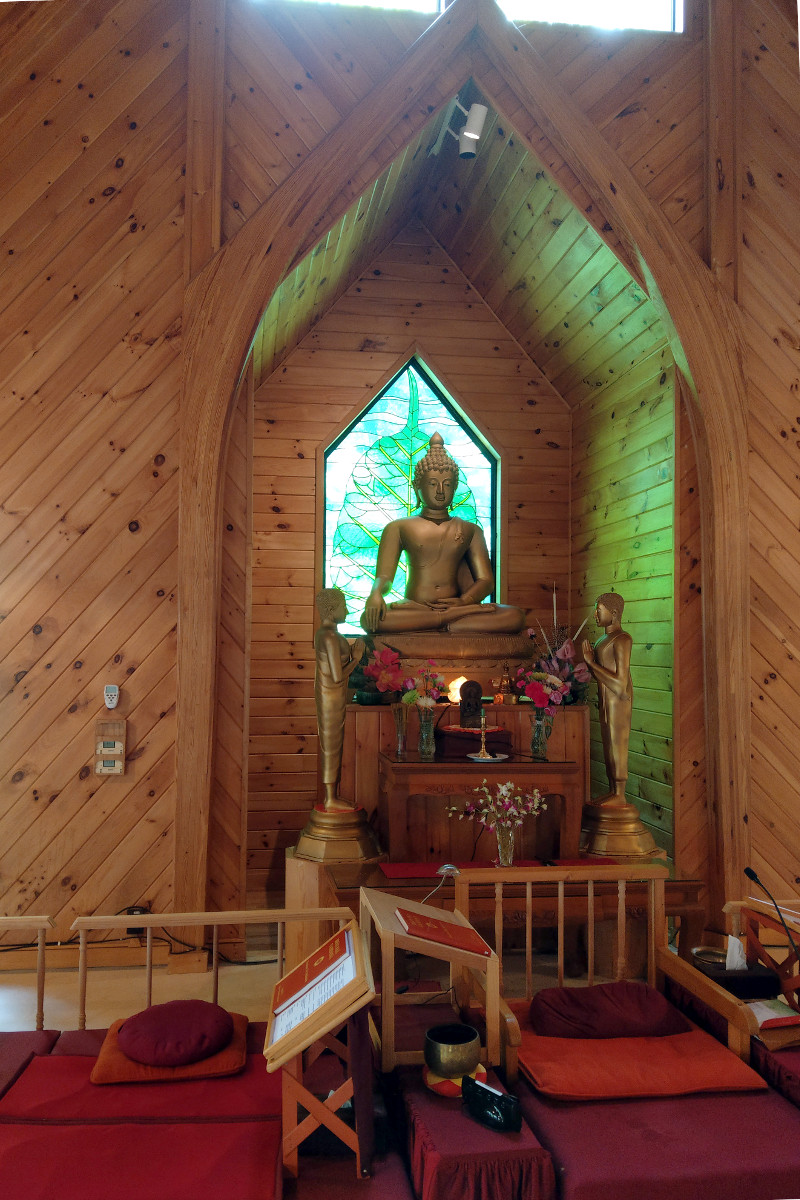 Buddha in Bhavana's main hall |
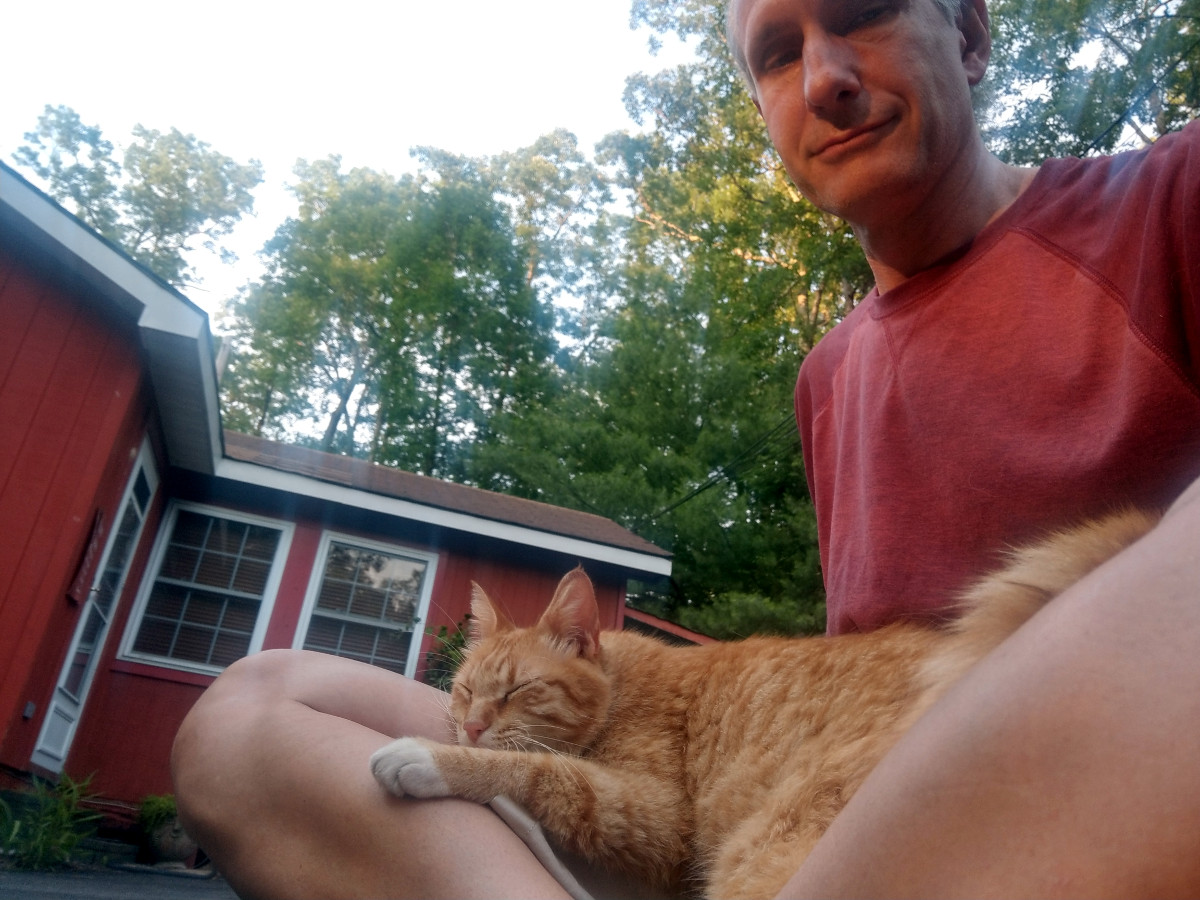 Bhavana Buddies |
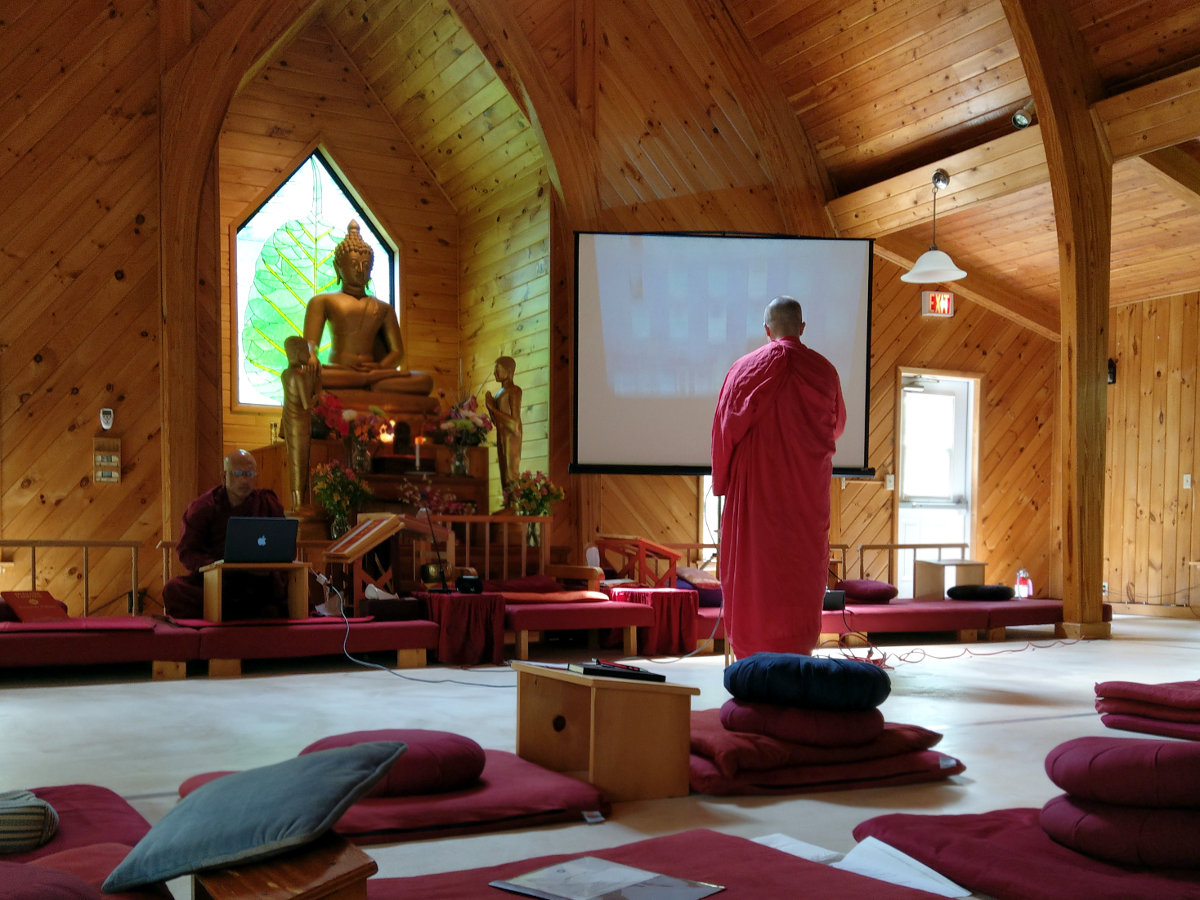 Is this a dhamma talk? |
 My Kuti |
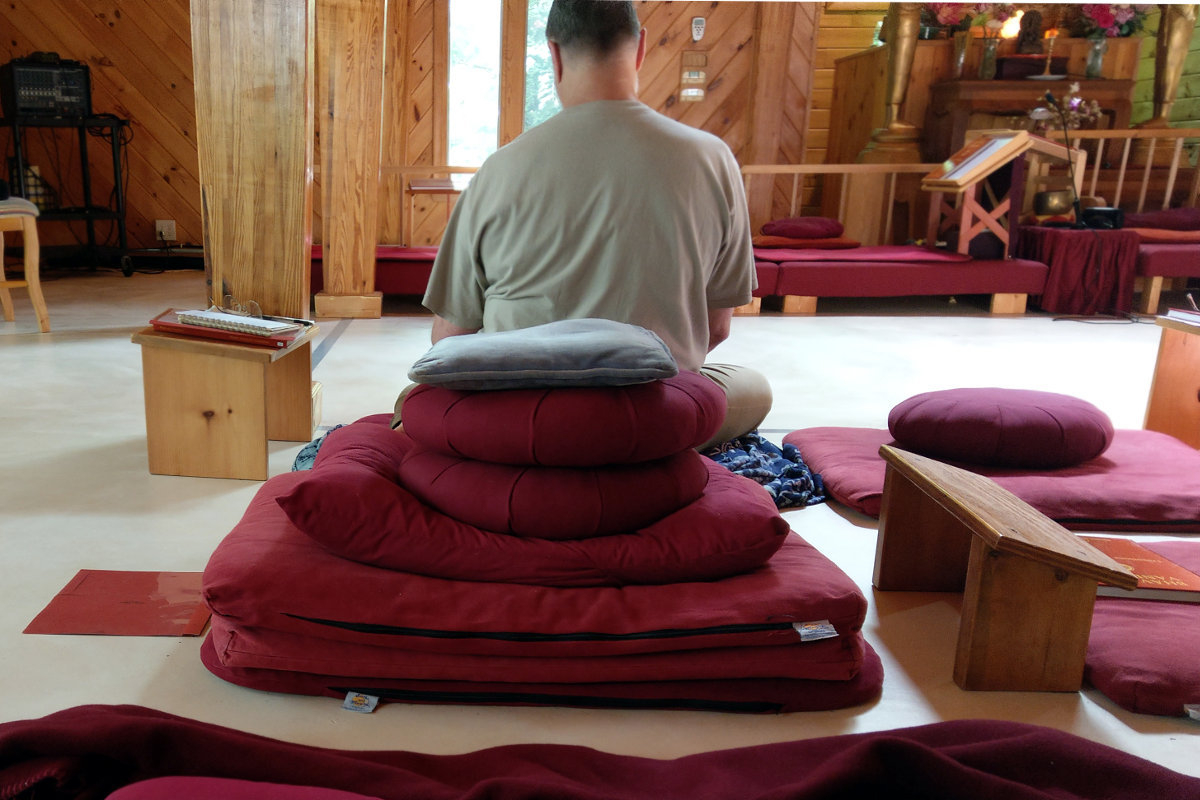 What Eighth Precept? |
Bhante G. is a well-known Sri Lankan Buddhist monk, the author of the widely-read manual “Mindfulness in Plain English”. To be honest, I didn’t know he was located so close. When I learned that Bhavana is a three and a half hour drive from Pittsburgh, I was immediately motivated to go do a retreat, especially since I wouldn’t be inconveniencing Inna, who has been out of town for months on business. And at 90 years old, Bhante G.’s advancing age gave me an added sense of urgency.
Last spring, when I looked at the Bhavana Society’s schedule, one event immediately stood out: a jhana retreat planned for the end of June.
What’s “jhana”? Jhana is an intensive concentration meditation practice which predated the Buddha, which presumably leads to four increasingly subtle and esoteric mental states.
The jhanas comprise Right Concentration: the eighth component of the Buddha’s Noble Eightfold Path leading toward the ultimate goal of practice: the cessation of suffering. Once you have developed a high degree of equanimity through the jhanic concentration practice, you can use it (and the impermanence of those states) as a tool in Vipassana practice: the development of insight/wisdom through the internalization of the Three Characteristics of Existence (impermanence, unsatisfactoriness, and non-self).
That sequence—practice concentration, then use it to develop wisdom—is one of two ways that people approach Buddhist practice. The other approach, called “dry” or “pure” Vipassana practice, does it the other way around: meditators work directly to realize the Three Characteristics, and let their concentration skills develop as needed. Meditating on the Three Characteristics through Vipassana meditation comprises the seventh element of the Noble Eightfold Path: Right Mindfulness.
Virtually all modern western Insight Meditation centers go the latter route, teaching Vipassana meditation exclusively. They rarely talk about the jhanas, and often discourage jhana practice, believing that the preoccupation with mental attainments is an unnecessary diversion from the development of wisdom… if those presumed attainments even exist at all! Having “grown up” in that Insight tradition, I dismissed jhana practice for years as little more than legacy Asian mysticism.
But ten years ago I decided to read some of the original Buddhist suttas, specifically the Majjhima Nikaya: the Middle-Length Discourses (my 2007 blogpost). There I discovered that there’s a passage describing how a skilled meditator enters the jhanas as a preliminary part of practice. Moreover, that standardized passage is repeated in a lot of suttas: about 30 percent of them, IIRC. Appearing so frequently, it was clearly something the Buddha considered extremely important. From then on, I knew I couldn’t simply dismiss jhana practice; I needed to give it a fair and openminded trial.
I bought books and did online research, but couldn’t get past my confusion. On one hand, the “jhana factors” that arise are familiar to me: applied thought, sustained thought, single-pointedness, happiness, bliss, and equanimity. But on the other hand, the four jhanic states are subtle and difficult to judge, and I certainly hadn’t experienced any of the mental imagery (nimitta) or magical powers that supposedly precede them. Were they merely metaphorical? As an avowed empiricist, I had difficulty reconciling the presumed importance of these concentration practices with the mystical bullshit that accompanied them.
As a followup to his best seller, Bhante G. also wrote a book about the jhanas called “Beyond Mindfulness in Plain English: An Introductory Guide to Deeper States of Meditation”, which I also read. So when I learned his center was nearby and that he’d be leading a jhana retreat, I figured the time was right to go and try to resolve my longstanding confusion. That’s why—due to an unfortunate scheduling coincidence—I decided to stay home at our Tuscan villa on the day the Giro d’Italia bike race came by: so that I could guarantee my spot in Bhante G.’s jhana retreat as soon as they opened online registration.
To conserve Bhante G.’s strength, activities like dhamma talks, Q&A, and teacher interviews were shared, with three different monks taking responsibility for two days each. As a result, my understanding of the jhanas changed and evolved over the course of the week.
The first two days we were in the care of Bhante Jayasara, a young American novice. He addressed the groundwork for jhana practice: specifically, suppressing the negative mental states called the Five Hindrances: a straightforward and familiar practice.
During his Q&A, he shared his personal experience of a nimitta: a sign of deep concentration that’s often perceived as a bright light. I found his sharing informative and inspiring, especially his confirmation that the nimitta is not a visual perception, but a purely mental one.
Interestingly, he could only share this with us because he’s not yet a fully-ordained monk, since the Vinaya—the Buddhist monastic rules—forbids monks from contradicting the canon or discussing their own personal experiences and attainments. So if you’re looking for practical advice based on personal experience, don’t bother asking a monastic!
During his Q&A, I asked which of the Five Hindrances compulsive planning fell under and how to practice with it. Of course, the answer was somewhat nuanced. Planning is often useful, but could also be an expression of anxiety and discomfort with uncertainty. In the moment when the compulsion comes up, one should consider three things: what is the appeal of planning, how it might be problematic, and how to reframe one’s habits of mind to avoid following that pattern out of compulsion. As Bhante Jay summarized: “The gratification, the danger, and the escape.”
After that, the middle two days were handled by Bhante Seelananda, a middle-aged monk who was born in Sri Lanka and became a monk at age eleven. As a lifelong academic scholar, he has exceptional knowledge of the Pali canon (the Buddhist scriptures).
His talks covered Buddhist academic theory relating to the jhanas in unrestrained detail, reciting a litany of passages in Pali and lists of theoretical esoteric mental states. Less of a dhamma talk and more of a collegiate lecture, it was the first dhamma talk I’ve ever attended that included a slide deck presented with an overhead projector and laser pointer!
With a straight face, he reported the magical powers the canon associates with the jhanas: the abilities to fly, read minds, recall past lives, and clairaudience.
At no time did he share any personal reflections or practical advice, limiting himself to reporting the content of the Pali canon as if it were literal truth. I’m not sure whether that was because the monastic rules prohibited him from contradicting the Buddhist writings, or whether his childhood upbringing within the monastic community rendered him an indoctrinated faith believer incapable of critical thought.
In either case, he had zero practical advice to share that would have benefited his audience of lay practitioners. As you might imagine, his circular reasoning and arguments from false authority didn’t sit well with an objective materialist like me.
After coming into the retreat with an open mind and specifically looking for practical help, I was getting discouraged and felt that I was wasting my time. I was ready to conclude that the jhanas are simply not a useful concept. Sure, concentration practice is important in habituating oneself to meta-thinking; the Five Hindrances are things we can all relate to; even the “jhana factors” I listed earlier make sense in the context of quiescing the discursive mind. But the four jhana states themselves sound like abstract, magical mumbo-jumbo.
And even if they are real, someone has got to find a better way to teach them. One doesn’t learn how to whistle by being told “Just blow long enough, and it’ll happen”; and one doesn’t learn how to swim by being told “Keep splashing around on your own and one day you’ll magically become a master swimmer”. You need someone to directly show you the techniques of how to whistle, how to swim… and how to meditate, achieve, and recognize these abstract, theoretical mental states.
For me, no matter how much of the official doctrine Bhante Seela cited, the jhanas simply don’t pass the Kalama test. In the Pali canon’s Kalama Sutta, the Buddha tells the Kalama tribe to accept as true only those teachings that one has personally verified are skillful, blameless, praiseworthy, and conducive to happiness; and to expressly reject teachings that derive from blind faith, dogmatism, and belief spawned from specious reasoning. And the jhanas demand a whole lot of the latter.
After Bhante Seela’s academic theorizing, the final two days’ talks were given by Bhante G., and I was eager to hear how he would follow up. Thankfully, as a non-academic, Bhante G. is more personable and more encouraging than Bhante Seela, which was reassuring in itself.
In the meditations he led, he ended each sitting by reciting verse 372 of the Dhammapada, one of the earliest Buddhist texts:
There is no concentration without wisdom,
Nor wisdom without concentration.
One who has both wisdom and concentration
Is close to peace and emancipation.
This is the central theme of his teaching. Here “concentration” is a reference to jhana practice, and “wisdom” is shorthand for Insight or Vipassana practice. While the two are often considered completely separate practices, Bhante G. says they are parallel roads, different but complementary ways of reaching the same destination. After all, Vipassana constitutes Right Mindfulness, the seventh element of the Buddha’s Noble Eightfold Path, while Right Concentration (the jhanas) comprises the eighth. That helped me put concentration practice into a better perspective.
But where I most benefited from Bhante G.’s wisdom was in the group interview I attended, where I was able to ask “How can you tell you’ve reached a jhana state if you don’t experience something as unmistakable as those bright-light nimittas?” His answer was packed with insightful nuggets.
First, one should look at those factors that co-arise with jhana: applied thought, sustained thought, single-pointedness, happiness, bliss, and equanimity. Those are a lot more concrete than the four abstract jhana levels. He said that entering the first jhana isn’t that hard to do for an experienced practitioner, but it’s a subtle and difficult thing to see. He said I might have achieved it many times, but who can say? You just have to judge for yourself. The important thing is to just practice. Concern yourself with your own mind, not the esoteric theories about signs and levels.
His advice was personal, immediate, practical, and encouraging… way more useful than any of the infographics Bhante Seela had presented. I’m so glad that I got into this retreat and had the opportunity to have an exchange with him, while he is still well enough to teach. It was touching when, on the last day of the retreat, I ran into him on his daily walk and we exchanged smiles.
So where did I wind up as far as jhana practice? While I didn’t get confirmation that jhanas exist or not, I did get a degree of practical clarity. Taking Bhante G.’s words to heart, I’m not going to pay a lot of attention to the jhanas. I’ll continue to practice meditation of various flavors (Vipassana/Insight, concentration, and samatha/calmness), with the main focus on evolving my relationship to desire, aversion, impermanence, ethics, and renunciation.
With that, let’s dump all this philosophy. “How was it?” I hear you asking. Well, lemme tellya…
Long retreats hurt. Despite their obvious benefit, I dread them. Even though I use a meditation bench, long periods of sitting hurt both my knees and back, and my knee pain turned severe this time. On top of that, my yogi job was washing dishes, and their sinks are definitely not at a height for normal-sized humans.
There’s also an odd kind of discomfort associated with heightened mindfulness. I would spend all day building up my mindfulness, only to find it difficult to relax and fall asleep at night, because I was so busy noticing and observing everything. Once you’re in that mental state, you can’t simply shut it off, which in my experience leads to a particular kind of retreat fatigue. I find that far more uncomfortable than the more-frequently reported discomfort returning to mainstream society following a long retreat.
Rather than being put up in a dormatory, for the first time ever I got my very own kuti, a tiny one-person cabin off on its own, used as a living space by monastics. It was little more than an uninsulated wooden shed, with a twin mattress and just enough space to squeeze around it on three sides. No electricity, but two windows. I guess it fit the modern idea of a “tiny house”. Thankfully, there weren’t too many insects inside, though I was still glad to have brought bug repellent. I was assigned the cabin named “Panna”, which is Pali for “wisdom”.
The weather. The first three days were hot and sunny, which I enjoyed, despite the lack of aircon. Although the heat was supposed to hold all week, the weather turned very rainy and cold from Wednesday through Sunday. Several times so much rain fell that the short, grassy downhill path to my kuti spontaneously turned into a rushing brook!
Flora and fauna everywhere. Poison ivy. Fireflies. A deer outside my kuti one morning. Termites or something loudly trying to bore into the kuti all day and night long until the rains came and drove them off. Ridiculously loud and annoying tree frogs that trilled back and forth to one another from 8pm to 11pm, sounding for all the world like dueling car alarms. Great for practicing equanimity, but not so great for actually sleeping.
And Buddy. We were told that we’d see Buddy, their tabby cat, who might come and sit in your lap. Monday evening, during a ten-minute break between sittings, I ran into him outside the main building, introduced myself, and made friends. I sat cross-legged in the driveway, and he climbed into my lap and promptly fell asleep. I saw him a couple more times, but he too disappeared once the rain started. I mused that although I hadn’t experienced the Buddhist concept of “no-self”, I did understand “no-Buddy” (nobody).
Other oddities, for your amusement…
Bhavana’s retreat FAQ suggests bringing earplugs, and those were key! I’ve already mentioned the nightly amphibian car alarm chorus and the termites or whatever was chewing its way into my shack. On top of that, the kuti came with a battery-powered clock whose second hand ticked louder than its built-in alarm; I yanked its batteries on the second day. Then the pounding rain on the kuti’s roof topped it all off. Without my earplugs I wouldn’t have gotten any sleep at all.
There’s always one… Normally people claim a spot in the meditation hall and have one zabuton (mat) and one zafu (a tall cushion) or meditation bench. One guy sitting a couple rows in front of me built and sat atop a ziggurat composed of no less than three zabutons, a square cushion, two zafus, and another square cushion, with a bench nearby, just in case. He was perched more than two feet off the floor! Which I think is a violation of the vow we took on the first day to uphold the Eight Precepts, specifically the vow to refrain from using high or luxurious beds and seats. Ridiculous!
The food. Normal people always crow about how great retreat food is; I’m too finicky for that, but I found everything surprisingly palatable. Plus there were a couple treats, such as Nutella, Gatorade, and one day we got orange juice. They also provided Sriracha sauce, which I found helped many dishes, except loading up on it wasn’t always the best idea, since I usually didn’t fetch anything to drink with my meal! Still, when the retreat ended, I made a quick stop at Dairy Queen for a Dilly Bar, then grabbed a cola and potato chips to enjoy on the drive home.
My yogi job washing dishes provided some entertainment. I’m used to turning dishwashing gloves inside-out to dry, which is difficult to do unless you know this secret: blow into them like a balloon to reverse the fingers. But somehow I managed to explode two gloves by blowing too hard into them! They blew up with impressively loud bangs during an otherwise silent retreat!
At one point (for some unknown reason) the cook pulled me aside to tell me he thought I looked like Frank Zappa. “Maybe it’s the ponytail?” That’s a new one on me. In the past I’ve drawn comparisons to David Beckham, Steven Seagal, Fabio Lanzoni, and (in a swipe from the ex-wife) Star Trek’s emotionless Mr. Spock.
Even with all this zaniness, it was a good and productive retreat, although three weeks later my knees are still recovering. I was able to meet and practice with Bhante Gunaratana, a cherished teacher whose career is nearing its conclusion; and I gained some clarity about how to practice with and relate to the jhanas (or not). It gave me what my practice needed, and was quite a memorable experience.
Upon coming home, I felt a huge sense of relief. Not because of the retreat, but because I had concluded four months of frequent travel: two weeks gallivanting around Asia in March, a week in Italy in May, and another week on retreat in West Virginia in June. It’s nice to visit new places, but home will always be home, and I was eager to hole up for a while in a familiar place. I wouldn’t mind if there were a few less-eventful weeks in store for me now!