So someone finally wrote a book about the Pan-Mass Challenge.

If you are one of my friends who care about (or are just curious about) the event, you might be interested in picking it up. It’s short—just 150 pages—with a handful of greyscale photos. It’s inexpensive too—just $9 at Amazon!—and the author is giving 75 percent of the profits back to the PMC.
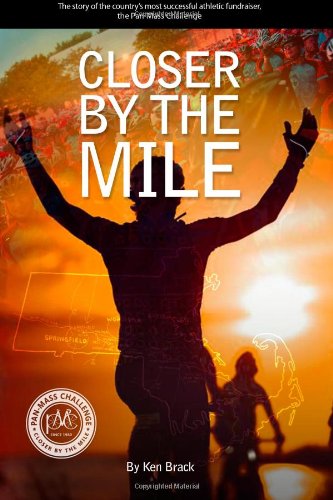
Front cover

The writing is first-person and informal. While that makes it readable, the author rambles around each chapter, covering diverse topics with no real focal point, yielding a book that also has no coherent theme other than the experience.

But to be fair, the PMC—the event—is all about that experience. The entire weekend is intensely emotionally charged, and that’s something that is nearly impossible to convey in words. This is astutely summarized in a quote from one teen rider, “When you explain it to a friend they sort of know what it is, but until they’re there, they don’t really know.”

Sure, there’s the obligatory nod to the event’s long history, including how the idea came to the founder during a ride in Boston’s Arnold Arboretum, how he ran the event for fifteen years from his father’s dining room, how everyone reacted to the first rider fatality, finally getting permission to use the campus of the Massachusetts Maritime Academy as an overnight stop, and the event’s phenomenal growth.

And there’s plenty of interesting factoids. On PMC weekend, riders will pedal a collective three-quarters of a million miles. 70 percent of riders return to the event each year, and scores of PMC kids rides serve as a farm club for the main event, iculcating future generations into a culture of philanthropy and caring about others.

Combine all the other single-event athletic fundraisers in the nation, then multiply that by 3.5—that’s what the PMC raises every year. Having passed 100 percent of rider-raised money through to the charity, the PMC constitutes 60 percent of the Jimmy Fund’s revenue and—at 20 percent of the Dana-Farber Cancer Institute’s entire budget—is DFCI’s largest single source of funding.

All this enables Dana-Farber to conduct over 700 clinical trials and 350,000 outpatient visits per year. But more importantly, the PMC gives Dana-Farber the power and security to do the impossible. The PMC has directly underwritten research that led to treatments and cures for rare pediatric cancers that threaten the lives of a thousand kids per year, a hundred kids per year, even just 32 kids per year.

The book tells the stories of a number of these kids, including the PMC’s poster boy: Jack O’Riordan, who at one year of age was cured of Wilms Tumor, which only six children had at that time. And how, after cheering on PMC riders for 14 years, he finally was old enough to do the ride himself (despite a broken leg).

The book also includes stories from the more than a hundred Dana-Farber staffmembers who ride, and gives a pointedly realistic assessment of Lance Armstrong’s single visit to the event in 2011, shortly before his confession as a doper and resignation from his own cancer-related charity.

Many of the people in the book provide quotes that further illustrate the attitude and atmosphere the event creates.

“There are widows and there are orphans, but no word exists for a parent who loses a child.” -One 17-year rider’s fundaising email

“At first when I get the call my heart goes out for the family; it’s so hard. But then my heart soars because they’ve found the right place, the right team.” -A pediatric oncologist who rides

“To the world you may be just one person, but to one person you just may be the world.” -One of hundreds of signs lining the route

“You’re never done, you’re never done with the event.” -A 25-year volunteer

For me as a 13-year rider, the book left me with mixed feelings. I so want to be able to share with others what the PMC experience is like. Although the book relates a handful of very emotional narratives, it’s simply impossible to capture all the amazing and heart-wrenching and grace-laden stories in an event that spans hundreds of miles with 5,500 participants, 3,000 volunteers, countless roadside spectators, and a quarter million sponsors over 33 years.
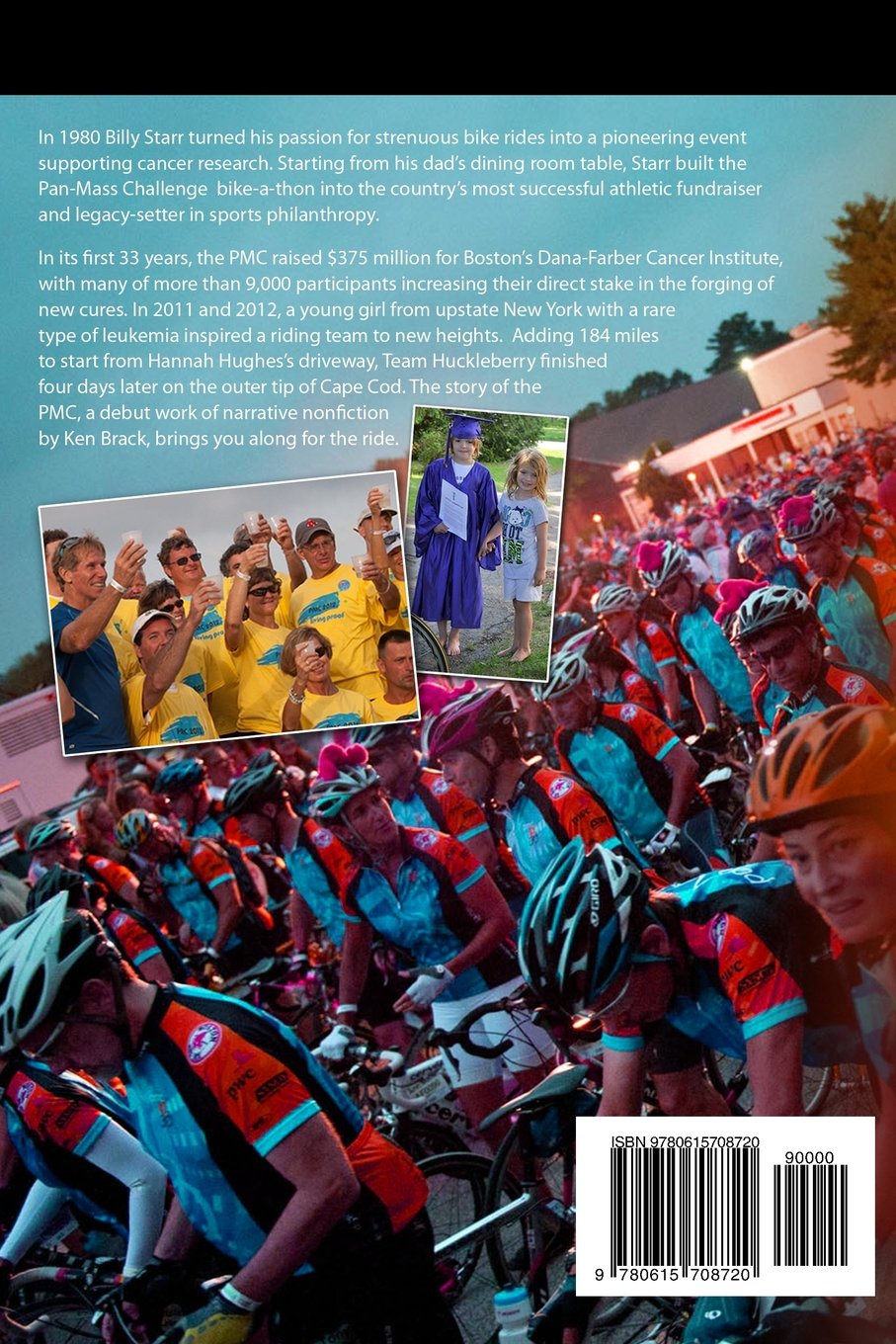
Back cover

One of the difficult things to capture about the PMC is the emotional impact. All weekend long, you’re primed, because you never know when you’ll see something that instantly moves you to tears, whether it be to the heights of inspiration or the depths of despair. Will it be the kid holding an “I’m alive thanks to you!” sign? Riding next to a Red Sox or Patriots player? Or exchanging greetings with an 80 year-old rider, or an amputee riding with only one leg?

Will it be hearing the story of someone who has raised a quarter million dollars, or a rider with a loved one’s photo or dozens of ribbons with names pinned to their jersey? The tandem bike with an empty seat, representing a lost loved one?

Will it be the sincerity and passion with which hundreds of people lining the route thank you for riding? Or watching the tens of thousands of people—riders, volunteers, sponsors, supporters, patients and their families, doctors, and nurses—who have come together to make a real, meaningful difference in each others’ lives this often impersonal and uncaring world?

As a longtime writer myself, I don’t envy anyone who tries to capture and communicate the PMC experience, in whatever medium. So I won’t criticize the author for falling short of 100 percent success. But I’m very glad he did it, and I think it’s well worth the $9 for anyone who has ever felt attachment to this singular and irreproduceable event.

And, of course, if you have yet to sponsor my upcoming 13th PMC ride, now’s the time!

The following is a letter from the President of the Dana-Farber Cancer Institute to the PMC organization.

I have chosen to share it with you and my sponsors to give you a better idea exactly how the money we raise is spent, and how vitally important it is to their lifesaving mission. And, of course, so you too can receive the thanks you deserve for your support of my ride.


Dear Fellow PMC Members:

First, thank you from the bottom of my heart. Thank you on behalf of so many who work so hard to conquer cancer, and even more people who count on us to do just that, and on behalf of everyone at Dana-Farber and all of the people who depend on us. You, individually and collectively, have been absolutely phenomenal. The financial support that you have provided has enabled groundbreaking research that has saved lives and will ensure that we will be able to save more lives in the future. Of equal importance, is the extraordinary spirit and positivity that you bring to your effort. This is enormously uplifting, motivating, and sustaining to all of us who work on the frontline of trying to conquer cancer.  You are right there with us, and that is enormously heartening. I thought it would be a good time to update you about what is going on in the world of cancer research and what your incredible support is doing to allow cancer research to move forward at Dana-Farber despite one of the worst external environments in the history of medical research.

Among the most important things unrestricted funds supports is our ability to recruit and retain the world's most incredible faculty of cancer care givers and researchers. You have met many of them; Nadler, Demetri, Winer, Partridge and more. Nearly all of them are here because we were able to use the unrestricted support that you provided to invest in their recruitment and to support their early work, work at the cutting edge, before it was a "sure enough bet" to be funded by the National Institutes of Health or other agencies. Indeed, these faculty members have become so important and prominent that they are the target of enormously attractive recruitment packages from many other institutes. Because of the PMC's record breaking support last year, I was able to use these funds to support retention programs that kept them here to continue their work. PMC support helps convince them that we can commit the resources they need to make the maximum impact on cancer outcomes on now and in the future at Dana-Farber.

PMC funds support work for ground-breaking, out of the box projects by our investigators in their own research programs; other funds allowed us to invest in key equipment such as state of the art sequencing and imaging facilities. One of the world's first small imager Cyclotrons, a multimillion dollar piece of equipment needed for the imaging capabilities at the frontiers in research, is being used on more mouse models in cancer. It was partly funded by the PMC. To get the remaining funding, we were able to leverage your support to obtain matching funds from the Commonwealth of Massachusetts. We now have the finest animal imaging facility in the country used to study mouse models of cancer, and we will make it available to collaborators within Harvard, and outside to the biotech and pharmaceutical world.

This past Friday, I had the honor of presenting the Osler Young Investigator Award to Dr. Kimberly Stegmaier, one of our rising faculty stars who was supported in her early work by the funds that you raised. She is now a world class developer of novel agents for the treatment of childhood leukemias and neuroblastoma using innovative genomic technologies that we used PMC funds to support. PMC funds allowed us to purchase equipment and collaborative services both at Dana-Farber and the Broad Institute. This has sustained a unique collaboration between two world-class institutions in the conquest of cancer.

This past spring, Drs. Ken Anderson and Paul Richardson and their collaborators from the Medical School and the pharmaceutical industry received the highly prestigious Warren Alpert Award from Harvard for their work in developing novel therapies at record speed. These have been the driving advances resulting in the tripling of survival time for patients with multiple myeloma. A significant amount of the funds that made this work possible came from PMC teams that have ridden in support of Drs. Anderson and Richardson. Perhaps even more importantly, some of the very earliest work of this group, working before its value was apparent, was supported by unrestricted funds that were generated by the PMC.

These are just a few of many examples that provide tangible proof that you are allowing us to forge ahead in very difficult times. In virtually every one of our disease centers and our departments, there are young investigators whose careers were launched by funds raised by the PMC. In every one of our cores and centers, equipment, expert scientists, computational capabilities, expensive supplies and expert personnel are there because we are able to support them with PMC funds. Every one of our clinics and clinical trials are supported by your funds.

You truly are marching with us on the front lines in the war to conquer cancer. It seems almost impossible to do even more than you are doing. However, if ever there was a time for even more effort and generosity, it is now. The federal government allowed "sequestration" to happen, this has resulted in a cataclysmic cut in the NIH budget. Cancer research is disproportionately affected. In addition, Massachusetts and federal healthcare and payment reform are reducing clinical reimbursements.  And, in this time of highly constrained resources, competition from many other worthy causes for traditional forms of philanthropy is more intense than ever.  It is only through the PMC that we can hope to remain aggressive and optimistic about making a difference in the lives of patients with cancer and saving even more lives in the future. Thank you as always for the incredible work that you do on our behalf.

Sincerely,

Edward J. Benz, Jr., M.D.

Sometimes you’re fortunate enough to know when something historic is about to happen. When I heard that there was going to be a formal dedication of the PMC Plaza at the Dana-Farber Cancer Insitute’s new building, I had to be there.

Think about it: Dana-Farber—the place where chemotherapy was invented—hasn’t opened a new clinical building in 36 years. At that rate, it’s an incredibly rare honor to have the building’s main entrance named for your organization. It is a very concrete, tangible method of recognizing how important the Pan-Mass Challenge is to the Dana-Farber’s mission of curing and eradicating cancer.

PMC logo in light
DFCI President Benz & PMC President Starr
PMC Plaza
PMC's Billy Starr speaking
PMC Plaza ribbon cutting
Full Photoset

Leading up to the dedication, details were difficult to come by. I knew the date, and was tipped off to the time earlier that day. Although I hadn’t planned it out, I left work early so that I could swing by my place and grab my camera.

I wasn’t even sure the event was going to happen. Most of New England was under a thunderstorm and tornado watch. The sky was ashen, with a fierce wind blowing debris around the streets of Boston. As I descended the stairs to catch the subway from Copley to Longwood, a deafening thunderclap rattled the headhouse and the lights flickered. If the ceremony hadn’t been canceled, at least there’d be a dramatic backdrop for it!

Arriving at Longwood, I saw that the celebrants were gathering inside the lobby of the new Yawkey Center for Cancer Care building. Uninvited and underdressed, I pulled my camera out and made like I was supposed to be there. I later learned that due to space constraints, only 20-year-plus PMC riders had been invited, due to space constraints. But no one challenged the guy behind the camera, a mere 10-year rider, and I wasn’t about to let such a historic moment pass me by. My one nod to propriety was that at least I didn’t eat any of the hors d’oeuvres!

So I played photographer, and got a few good pictures out of the deal. I even got a bit of photographer-level access to the bigwigs, which amused me.

The sense of being on observer of history was reinforced during the speechifying. This recognition was arguably the most important moment in the entire history of the Pan-Mass Challenge, and it was a moment of deepest pride for me, standing there in a new building that the PMC’s donation was the lead gift for. In his remarks, Dana-Farber president Dr. Ed Benz articulated for the first time the astounding next milestone in the PMC’s fundraising road: a third of a billion dollars.

I won’t say much about the plaza itself. There are three granite planters/benches with “Pan-Mass Challenge Plaza” engraved that separate it from Brookline Avenue. There are dozens of granite pavers in a long line, each one representing one of the towns that the PMC route passes through. There’s two standing arcs of granite that comprise a sculpture called “Tandem”. And a plaque, which reads:

PMC PLAZA
This plaza is dedicated to the Pan-Massachusetts Challenge (PMC): to its cyclists, volunteers, and donors whose life-affirming efforts through the decades have provided critical support for cancer research and patient care at Dana-Farber Cancer Institute. Tandem is a tribute to the indelible bond between the PMC and Dana-Farber and reflects the extraordinary impact when two vital organizations work in tandem.

Yeah. Being part of an organization with that kind of power to do good: that’s something to take pride in. And as the inscription says, it’s not just about the riders. It’s the partnership between the riders, the thousands of volunteers, and a quarter million people a year like you who sponsor riders. And that’s just the PMC’s side of its partnership with Dana-Farber, its doctors and researchers, support staff, and cancer patients and their families.

I’m deeply proud to be one part of that extended family.

The Emperor of All Maladies

I also recently plowed through Siddhartha Mukherjee’s “The Emperor of All Maladies: A Biography of Cancer”.

This is an imposing book. The text runs to 470 pages, and there are no less than 60 pages of back-notes. It’s quite a lengthy read.

On the other hand, the reviews I’d read were all effusively positive, calling it touchingly personal, citing its approachability, and even using the phrase “page-turner”.

I generally agree with that assessment. It’s very engaging and readable, deftly melding the author’s first-person experiences in his oncology residency with interesting stories of man’s early history with this disease. It goes on to add more depth to cancer’s more familiar recent narrative and solid insight into the current state of the art. Although the later chapters tend to rely a bit more on technical jargon, Mukherjee keeps things moving so that the reader doesn’t lose interest.

Part of the reason why he undertook this work was because as a neophyte oncologist, he was so buried in the tactical concerns of fighting the disease that he was unable to answer his patients’ more strategic-level questions about where we are in the overall battle and whether the increased attention of recent years has translated to improvements in prevention, treatment, and outcomes.

Throughout its long course, the book hits on most major forms of cancer—lung, breast, leukemia, Hodgkin’s Disease—and several obscure ones. For a time it follows the search for a single root cause, touching on carcinogenic chemicals like Asbestos and cigarette smoke as well as the cancers precipitated by viral infections like HPV.

But if I had to single out the primary theme of the book, however, it would have to be the hubris of physicians throughout the ages in misunderstanding and underestimating cancer, as well as overestimating their ability to cure it with a single, massive intervention.

In Rome, Claudius Galen attributed the disease to an overabundance of an unknown and unobserved liquid called “black bile”, setting our understanding of cancer on a wrong track for the following 1500 years.

Next up were the surgeons, whose simplistic answer to recurrent breast cancer was to cut deeper and deeper, until the standard preventative practice was to remove the entire breast, the lymph nodes, the muscles of the chest, the clavicle, several ribs, and part of the lung. Better to cut too much than too little, right?

As surgery began to give way to chemotherapy in the 1950s, the next group of oncologists fell for the same old “more is better” fallacy, prescribing massive doses of multiple drugs, eventually concluding that the best policy was to completely destroy the patient’s ability to generate new blood cells, then rebuild it by transplanting new stem cells (either one’s own, harvested before treatment, or transfused from a donor).

Even today, with the mapping of the human genome and gene therapy providing an historical breakthrough in cancer treatment, geneticists have once again fallen into the same mental trap as Galen did 2000 years ago, of thinking that this new technology would spell the end of cancer. Cancer is an incredibly deft, diverse, adaptive, and opportunistic disease, and its defeat is just not going to be that simple.

Despite all these unfortunate missteps, each generation of treatment has produced significant improvements in outcomes. Surgery, chemotherapy, radiation, gene therapy, targeted drugs, and combinations of these can each be the right treatment for the right patient.

And Mukherjee’s book does do a wonderful job depicting some of the fortuitous coincidences that led to the discovery of these new treatments. For example, who knew that a humble jar of Marmite was the key that unlocked the broad spectrum of chemotherapy drugs that have saved so many lives?

Aside from the knowledge that cancer was the result of uncontrolled growth, it wasn’t until the past twenty years that we actually began to understand exactly how and why cancer works at a cellular and genetic level. Before 1970, oncologists could only develop treatments by trial and error. But armed with our new understanding of what cancer is, researchers can now identify cancer’s specific biochemical vulnerabilities and start developing therapies such as Herceptin that precisely target those weaknesses.

In the end, the reader comes away from the book with a much better understanding of why cancer is so difficult to combat, and that each person’s instance of cancer is so unique that it requires an entirely individual treatment.

As a Pan-Mass Challenge rider, I was proud to discover how central Sidney Farber, the Dana-Farber Cancer Institute, and the Jimmy Fund have been. They take center stage in much of Mukherjee’s narrative, as does Mass General, MIT, and the American Cancer Society.

Before I picked up the book, I saw Dr. Mukherjee at an author talk he gave at the BPL. I took the opportunity to ask him whether the recent discovery that the human genome is not identical in every cell had any implications for gene therapy.

Between his response and my readings, it was clear that it isn’t the human genome that matters so much as the characteristic modifications cancer makes to it. By designing drugs that recognize and respond to the unique cancerous fingerprint of a particular genetic alteration, it is possible to starve tumors or at least deactivate their growth. The challenge right now is to catalog those fingerprints and discover drugs that match them.

It’s probably true that you need some curiosity about cancer or medicine to get through this book. But those with sufficient interest will find it informative, entertaining, and very readable.

Last week I went to a talk and book signing by Dr. David G. Nathan, who has written a book called “The Cancer Treatment Revolution: How Smart Drugs and Other New Therapies are Renewing Our Hope and Changing the Face of Medicine”.

The Cancer Treatment Revolution

Of particular note for anyone involved in the Pan-Mass Challenge, Dr. Nathan is the former president of our beneficiary, the Dana-Farber Cancer Institute. He is the predecessor of Dr. Edward Benz, whom you should recognize from his regular appearances in support of the PMC. Dr. Nathan is also one of DFCI founder Sidney Farber’s contemporaries. So he’s unquestionably one of the most authoritative sources to speak on the topic, and his talk was very inspiring.

The book recounts the technical details of the amazing progress made against all forms of cancer during his fifty years in oncological research, and the equally amazing and heartening prospects for the future, thanks to the ongoing development of improved methods of detection and less toxic smart chemotherapy drugs, which more specifically target the cells which cause the unchecked growth of cancer.

He does this through the actual stories of three typical patients: an infant with a variety of leukemia that until recently was considered untreatable, an older woman who beat a very aggressive form of breast cancer, and a man who turned to very early clinical trials of emerging smart drugs to treat a rare and almost certainly fatal intestinal tumor that had burst.

Having spent much of his professional life working with or for the DFCI, the book has a lot of specific detail about the work which the Dana-Farber has done in the fight against cancer: work which has been made possible largely due to the nearly two hundred million dollars brought in by people who have donated to DFCI through the Pan-Mass Challenge.

Dr. Nathan’s successor, Dr. Benz, was also on hand at the reading, and I was gladly able to speak with both of them briefly and offer my thanks for their work. I consider it a great honor that my copy of the book is signed by both the former and current presidents of the Dana-Farber, for whom I have raised over $25,000. These are men who have presided over a tremendous transformation in what we know about cancer and how it can be prevented, treated, and, yes: in many cases cured.

As a way to thank my most generous sponsors and spread the word about how far we’ve come in the treatment of cancer thanks to the work done at Dana-Farber and elsewhere, I plan to offer a free copy of the book to every person who makes a contribution of $200 or more* in support of my ride this year.

If you’re desperate to get your copy of the book ASAP, you can sponsor my PMC ride here. However, I’m planning on getting started on my fundraising in the next couple weeks, and I’ll be sharing a lot more news in my fundraising letter, which will also be posted here shortly.

 
* That’s before any employer match

Frequent topics