How does one find the words to eulogize a true hero: a dear friend, a tireless mentor, a great benefactor, and a true inspiration?

When I did my first Pan-Mass Challenge charity ride back in 2001, my coworker Jeremy—who was doing the AIDS Ride—told me about a group training ride starting at Quad Cycles in Arlington. “It’s run by this guy named Bobby Mac… You have to meet him!”

So one weekend I went out and rode with them. Bobby was a charismatic older guy who was the obvious center of the group. He’d bark out endless advice about how to ride, always interjecting a characteristic bit of self-deprecating humor or belting out snippets of songs from the 60s and 70s. He’d shamelessly (but harmlessly) flirt with the ladies, who all adored him. On the road, he always stayed with the slower riders, mentoring them and offering helpful advice for how to both survive and enjoy whatever charity rides they were training for.

Bobby Mac made riding fun.

Bobby Mac
Bobby Mac with Johnny H
Bobby Mac at Ferns during the Tour de Mac
Bobby Mac
Ornoth with Bobby Mac
Bobby Mac

Like so many other neophyte riders, I started out wearing canvas cargo shorts and a tee shirt, riding a heavy, flat-handlebar “hybrid” bike. Over the course of thirteen years with him, Bobby sculpted me into a spandex-clad veteran roadie who rides 10,000 kilometers a year on his carbon-fiber road bike and has raised over $100,000 for cancer research.

But I am just one person out of hundreds and hundreds of riders whom Bobby has encouraged over the years. Himself an inveterate charity rider, he and his team of “Quaddies” were often top fundraisers and volunteer crewmembers for several of the largest charity rides in the area. If you added up all the good works performed by Bobby Mac and the legions of riders he has encouraged, the sum total would be staggering.

As you can imagine, Bobby Mac was a huge part of the local community. He recorded several PSAs on behalf of charity rides and local cycling advocacy. No matter where we went, we’d always run into people who knew him. Whether you were a cyclist or not, it seemed everyone was friends with Bobby Mac. No matter who you were, he made it very easy to feel like you were his best friend.

We also loved Bobby for his idiosyncrasies. It was a mark of seniority if you could say that you’d seen him ingest anything other than Cytomax sports drink. Back when the ride stopped at Kimball Farm, Bobby proved that his popularity extended even to barnyard animals, as “Buff the Powerbar-Eating Goat” would run up to the fence to greet him and receive a treat.

As he aged, Bobby suffered from macular degeneration which gradually eroded his eyesight. I once watched him nearly ride straight into a sawhorse barrier that a road crew had put up when one of our regular roads was temporarily closed. It was a mark of real trust if Bobby let you lead him through a charity ride on unfamiliar roads he hadn’t already memorized.

Due to his worsening eyesight, we all feared that Bobby would eventually be unable to ride. Knowing that his time was limited, in 2006 we organized the first Tour de Mac, a special ride in his honor, complete with tee shirts, rubber wristbands, and an award presentation for the guest of honor. In 2009 we held another ride to celebrate his 60th birthday, which I recorded with an emotional writeup and video. Everyone loved Bobby, but despite repeated operations to maintain his vision, we all harbored silent fears about how much longer he would be able to ride.

However, Bobby wasn’t destined to live long enough for his eyesight to fail him. Three weeks ago, Bobby went into the hospital, suffering from pancreatic cancer that had metastasized. It was terminal, and last night he passed away in his sleep at home.

When his diagnosis first became public knowledge, the hospital’s staff very quickly learned how special Bobby Mac was. They weren't prepared for the hundreds of his friends who came to visit his bedside. The nurses put up signs, limited the duration of visits, and still more people kept coming, sometimes queueing up in shifts of ten at a time outside his hospital room.

The first time I visited him in the hospital, I had something special I wanted to share with him. When a rider surpasses $100,000 in fundraising, the Pan-Mass Challenge gives them a silver pin with the PMC logo as a lifetime achievement award. I had received mine six weeks before Bobby went into the hospital, after 13 years of riding and raising money for the Dana-Farber Cancer Institute.

I wanted Bobby to know about that accomplishment, and how it was due in large part to his inspiration. And that if I was only one of hundreds of riders he’d encouraged, then he’d achieved a whole lot of good in this world. His characteristically self-effacing response was to shrug off his role and emphasize mine, saying that I had long been the most dedicated of his charity riders.

It’s bitter irony to me that the man who was my hero and inspired me to ride the Pan-Mass Challenge was taken from us by the very disease I’ve raised so much money to combat. It goes without saying that this year—my final PMC ride—will be dedicated to the memory of my hero: Bobby Mac. It will be a very emotional ending when I reach the Provincetown finish line for the final time and lift my bike over my head, consciously copying Bobby’s signature victory salute.

With his innate charisma and his natural role as the center of a circle of people, Bobby reminded me a lot of my father, or what he might have been, if my father had been motivated by kindness and generosity. In that way, Bobby has been a role model for me, an inspiring example of what a fatherly male figure could be—and could accomplish—in this jaded, selfish world.

There’s one particular exercise in Buddhist meditation called “Brahmavihara practice”, wherein we use visualization to cultivate our capacity for friendliness, compassion, and joy in others’ happiness. Typically, we start by directing compassion toward someone whom it’s easy to feel affection for, then slowly work our way to people we feel ambivalent about, and then challenge ourselves to work with people we find difficult or hateful. But we start with someone who is often referred to as our “benefactor”.

Years ago, when I started that practice and was asked to identify someone whom I felt unalloyed affection for—someone whom I considered my benefactor—one person’s name immediately jumped to mind: Bobby Mac. Bobby was my exemplar of friendliness, affection, compassion, and generosity. In my opinion, Bobby was the absolute embodiment of the concept of a “benefactor”.

Bobby’s presence and personality made everyone’s world feel much more friendly, much more optimistic. He put a whole lot of love and goodness into the world.

And he took a whole lot of love and goodness with him when he left: both the love of his many friends which was directed toward him in his final years, and also the love and goodness that have gone out of this world with his passing. For everyone who knew Bobby Mac, the world feels a little colder and more lonely without his energetic encouragement and his incorrigible smile.

Here’s to you, my friend, my mentor, my benefactor, my inspiration, and my hero. As you enjoined us at the start of every ride, we will do our best to “ride with love in our hearts and smiles on our faces”, thanks to you, Bobby Mac.

I won’t belabor the ask, but if you wish to make a donation to fight cancer in Bobby’s memory and sponsor my PMC ride, you can do so here.

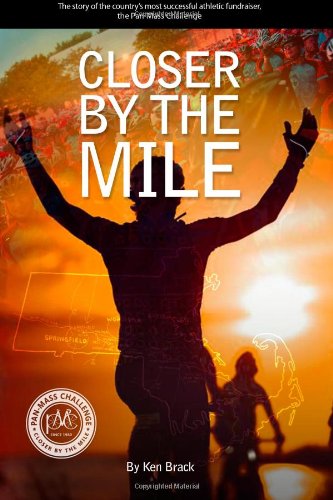
So someone finally wrote a book about the Pan-Mass Challenge.

If you are one of my friends who care about (or are just curious about) the event, you might be interested in picking it up. It’s short—just 150 pages—with a handful of greyscale photos. It’s inexpensive too—just $9 at Amazon!—and the author is giving 75 percent of the profits back to the PMC.

Front cover

The writing is first-person and informal. While that makes it readable, the author rambles around each chapter, covering diverse topics with no real focal point, yielding a book that also has no coherent theme other than the experience.

But to be fair, the PMC—the event—is all about that experience. The entire weekend is intensely emotionally charged, and that’s something that is nearly impossible to convey in words. This is astutely summarized in a quote from one teen rider, “When you explain it to a friend they sort of know what it is, but until they’re there, they don’t really know.”

Sure, there’s the obligatory nod to the event’s long history, including how the idea came to the founder during a ride in Boston’s Arnold Arboretum, how he ran the event for fifteen years from his father’s dining room, how everyone reacted to the first rider fatality, finally getting permission to use the campus of the Massachusetts Maritime Academy as an overnight stop, and the event’s phenomenal growth.

And there’s plenty of interesting factoids. On PMC weekend, riders will pedal a collective three-quarters of a million miles. 70 percent of riders return to the event each year, and scores of PMC kids rides serve as a farm club for the main event, iculcating future generations into a culture of philanthropy and caring about others.

Combine all the other single-event athletic fundraisers in the nation, then multiply that by 3.5—that’s what the PMC raises every year. Having passed 100 percent of rider-raised money through to the charity, the PMC constitutes 60 percent of the Jimmy Fund’s revenue and—at 20 percent of the Dana-Farber Cancer Institute’s entire budget—is DFCI’s largest single source of funding.

All this enables Dana-Farber to conduct over 700 clinical trials and 350,000 outpatient visits per year. But more importantly, the PMC gives Dana-Farber the power and security to do the impossible. The PMC has directly underwritten research that led to treatments and cures for rare pediatric cancers that threaten the lives of a thousand kids per year, a hundred kids per year, even just 32 kids per year.

The book tells the stories of a number of these kids, including the PMC’s poster boy: Jack O’Riordan, who at one year of age was cured of Wilms Tumor, which only six children had at that time. And how, after cheering on PMC riders for 14 years, he finally was old enough to do the ride himself (despite a broken leg).

The book also includes stories from the more than a hundred Dana-Farber staffmembers who ride, and gives a pointedly realistic assessment of Lance Armstrong’s single visit to the event in 2011, shortly before his confession as a doper and resignation from his own cancer-related charity.

Many of the people in the book provide quotes that further illustrate the attitude and atmosphere the event creates.

“There are widows and there are orphans, but no word exists for a parent who loses a child.” -One 17-year rider’s fundaising email

“At first when I get the call my heart goes out for the family; it’s so hard. But then my heart soars because they’ve found the right place, the right team.” -A pediatric oncologist who rides

“To the world you may be just one person, but to one person you just may be the world.” -One of hundreds of signs lining the route

“You’re never done, you’re never done with the event.” -A 25-year volunteer

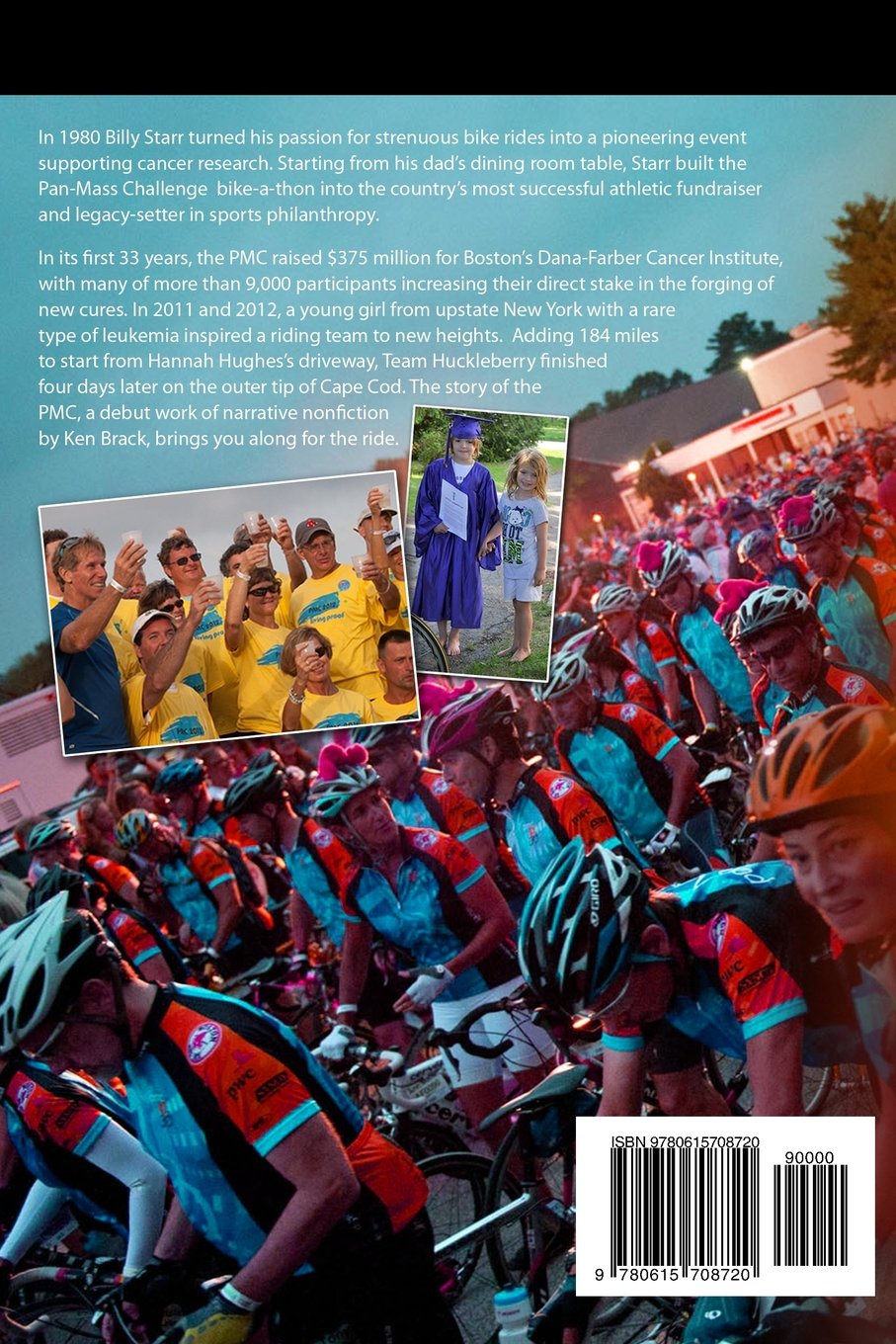
For me as a 13-year rider, the book left me with mixed feelings. I so want to be able to share with others what the PMC experience is like. Although the book relates a handful of very emotional narratives, it’s simply impossible to capture all the amazing and heart-wrenching and grace-laden stories in an event that spans hundreds of miles with 5,500 participants, 3,000 volunteers, countless roadside spectators, and a quarter million sponsors over 33 years.

Back cover

One of the difficult things to capture about the PMC is the emotional impact. All weekend long, you’re primed, because you never know when you’ll see something that instantly moves you to tears, whether it be to the heights of inspiration or the depths of despair. Will it be the kid holding an “I’m alive thanks to you!” sign? Riding next to a Red Sox or Patriots player? Or exchanging greetings with an 80 year-old rider, or an amputee riding with only one leg?

Will it be hearing the story of someone who has raised a quarter million dollars, or a rider with a loved one’s photo or dozens of ribbons with names pinned to their jersey? The tandem bike with an empty seat, representing a lost loved one?

Will it be the sincerity and passion with which hundreds of people lining the route thank you for riding? Or watching the tens of thousands of people—riders, volunteers, sponsors, supporters, patients and their families, doctors, and nurses—who have come together to make a real, meaningful difference in each others’ lives this often impersonal and uncaring world?

As a longtime writer myself, I don’t envy anyone who tries to capture and communicate the PMC experience, in whatever medium. So I won’t criticize the author for falling short of 100 percent success. But I’m very glad he did it, and I think it’s well worth the $9 for anyone who has ever felt attachment to this singular and irreproduceable event.

And, of course, if you have yet to sponsor my upcoming 13th PMC ride, now’s the time!

The following is a letter from the President of the Dana-Farber Cancer Institute to the PMC organization.

I have chosen to share it with you and my sponsors to give you a better idea exactly how the money we raise is spent, and how vitally important it is to their lifesaving mission. And, of course, so you too can receive the thanks you deserve for your support of my ride.


Dear Fellow PMC Members:

First, thank you from the bottom of my heart. Thank you on behalf of so many who work so hard to conquer cancer, and even more people who count on us to do just that, and on behalf of everyone at Dana-Farber and all of the people who depend on us. You, individually and collectively, have been absolutely phenomenal. The financial support that you have provided has enabled groundbreaking research that has saved lives and will ensure that we will be able to save more lives in the future. Of equal importance, is the extraordinary spirit and positivity that you bring to your effort. This is enormously uplifting, motivating, and sustaining to all of us who work on the frontline of trying to conquer cancer.  You are right there with us, and that is enormously heartening. I thought it would be a good time to update you about what is going on in the world of cancer research and what your incredible support is doing to allow cancer research to move forward at Dana-Farber despite one of the worst external environments in the history of medical research.

Among the most important things unrestricted funds supports is our ability to recruit and retain the world's most incredible faculty of cancer care givers and researchers. You have met many of them; Nadler, Demetri, Winer, Partridge and more. Nearly all of them are here because we were able to use the unrestricted support that you provided to invest in their recruitment and to support their early work, work at the cutting edge, before it was a "sure enough bet" to be funded by the National Institutes of Health or other agencies. Indeed, these faculty members have become so important and prominent that they are the target of enormously attractive recruitment packages from many other institutes. Because of the PMC's record breaking support last year, I was able to use these funds to support retention programs that kept them here to continue their work. PMC support helps convince them that we can commit the resources they need to make the maximum impact on cancer outcomes on now and in the future at Dana-Farber.

PMC funds support work for ground-breaking, out of the box projects by our investigators in their own research programs; other funds allowed us to invest in key equipment such as state of the art sequencing and imaging facilities. One of the world's first small imager Cyclotrons, a multimillion dollar piece of equipment needed for the imaging capabilities at the frontiers in research, is being used on more mouse models in cancer. It was partly funded by the PMC. To get the remaining funding, we were able to leverage your support to obtain matching funds from the Commonwealth of Massachusetts. We now have the finest animal imaging facility in the country used to study mouse models of cancer, and we will make it available to collaborators within Harvard, and outside to the biotech and pharmaceutical world.

This past Friday, I had the honor of presenting the Osler Young Investigator Award to Dr. Kimberly Stegmaier, one of our rising faculty stars who was supported in her early work by the funds that you raised. She is now a world class developer of novel agents for the treatment of childhood leukemias and neuroblastoma using innovative genomic technologies that we used PMC funds to support. PMC funds allowed us to purchase equipment and collaborative services both at Dana-Farber and the Broad Institute. This has sustained a unique collaboration between two world-class institutions in the conquest of cancer.

This past spring, Drs. Ken Anderson and Paul Richardson and their collaborators from the Medical School and the pharmaceutical industry received the highly prestigious Warren Alpert Award from Harvard for their work in developing novel therapies at record speed. These have been the driving advances resulting in the tripling of survival time for patients with multiple myeloma. A significant amount of the funds that made this work possible came from PMC teams that have ridden in support of Drs. Anderson and Richardson. Perhaps even more importantly, some of the very earliest work of this group, working before its value was apparent, was supported by unrestricted funds that were generated by the PMC.

These are just a few of many examples that provide tangible proof that you are allowing us to forge ahead in very difficult times. In virtually every one of our disease centers and our departments, there are young investigators whose careers were launched by funds raised by the PMC. In every one of our cores and centers, equipment, expert scientists, computational capabilities, expensive supplies and expert personnel are there because we are able to support them with PMC funds. Every one of our clinics and clinical trials are supported by your funds.

You truly are marching with us on the front lines in the war to conquer cancer. It seems almost impossible to do even more than you are doing. However, if ever there was a time for even more effort and generosity, it is now. The federal government allowed "sequestration" to happen, this has resulted in a cataclysmic cut in the NIH budget. Cancer research is disproportionately affected. In addition, Massachusetts and federal healthcare and payment reform are reducing clinical reimbursements.  And, in this time of highly constrained resources, competition from many other worthy causes for traditional forms of philanthropy is more intense than ever.  It is only through the PMC that we can hope to remain aggressive and optimistic about making a difference in the lives of patients with cancer and saving even more lives in the future. Thank you as always for the incredible work that you do on our behalf.

Sincerely,

Edward J. Benz, Jr., M.D.

I recently read this article which cites a study by the Women’s Philanthropy Institute at Indiana University that reported finding a significant gender bias in philanthropic giving.

Actually, the article’s tone was a little more strident than that, loudly proclaiming that “Women are the conduit for change on the planet,” and backing that claim up with further observations that “Women across nearly every income level gave significantly more to charity than men, nearly twice as much in some cases,” and “Women gave more often than men and […] they also give more in total dollars.”

Now although I care about sexism, I’m also sensitive to reverse sexism, and this article raised my hackles from the start. Even if there is a statistically significant difference in philanthropy by gender, what is the value of reporting it in this manner, other than to reinforce tired stereotypes of women as nurturers and men as competitive and selfish? Gee, that’s progressive!

Of course, my indignation wouldn’t have justified a blog post were the issues of gender and philanthropy not personal, exacerbated by my predilection for numerical analysis. So…

As you well know, I’ve spent the last ten years fundraising for the Dana-Farber Cancer Institute, and off the top of my head I hadn’t noticed any gender bias (one way or the other) in the donations I’ve received.

But that got my curiosity up, so I went and ran the numbers. While I can’t speak for national trends, here’s my real-world results.

chart

First, I looked at the gender breakdown of the people who have sponsored my Pan-Mass Challenge ride since 2001, throwing out four donations that explicitly came from couples. I came up with 105 women and 134 men.

Contrary to the study’s findings, I have 30 percent more male sponsors than female. Huh. Interesting.

chart

Second, I looked not just at people, but at the total number of donations they made. Although I had fewer female sponsors, perhaps they actually donated more frequently.

No, that wasn’t the case either. I have received a total of 226 donations from women, and 339 from men.

Again bucking the study’s findings, the men who sponsor me have given 50 percent more donations than the women. Wow! I hadn’t noticed that.

chart

My third measurement was designed to account for any possible gender bias in the makeup of my donor list. After all, I am a guy, and I might have a proportionally larger number of guy friends, right?

So I divided the number of donations by the number of people making them, which told me the average number of donations made per person. If that article was right, surely the average lady would donate more frequently than the average man.

No. As a group, the women who have sponsored me have done so an average of 2.15 times, while the guys have averaged 2.53 donations per person.

That did close the gap a bit, but the men have still made 20 percent more donations per person than the women.

Nothing I’ve described so far validates the article’s claims. In fact (and to my surprise), it’s actually the opposite; if we go by number of donations, the men have been 20 to 50 percent more forthcoming in support of my PMC ride than the ladies.

Surely that can’t be right, tho. Let’s look further…

So far I’ve only focused on how many donations people made. Remember that the article also claimed that women give significantly more (dollar-wise) to charity than men, sometimes twice as much. Okay, let’s start looking at my numbers in terms of dollars and (perhaps) sense.

chart

Chart number four shows how much money I have received from each group. Note that I have explicitly excluded all funds received from anyone’s employer matching gift programs; this is purely individual donations.

Again, the boys have the edge, contributing nearly $32,000, while the women account for only $16,000.

Yes, those numbers are correct. While the study claims that women often donate twice as much to charity as men, over the past decade they’ve only given half as much as the men gave to my Pan-Mass Challenge ride.

In this case, the article’s assessment that “women are the conduit for change on the planet” must be reversed, because my male friends have given twice as much as women in the effort to stop cancer.

chart

Again, since there are more men in my sample than women, we have to correct for that. This chart shows what happens when we look at those numbers on a per capita basis.

As you can see, each woman who has sponsored me has given, on average, $155. That’s not per donation; that’s each person’s sum total of all their donations since 2001. At the same time, each man has given, on average, $237.

So extrapolating all that out, over ten years the average male sponsor has given me $80 more than the average female sponsor. It’s not twice as much as his female counterpart gave, but it’s still over 50 percent more.

chart

Finally, let’s forget the ten-year tally and boil it down to one final number. Just how big is the average donation? Girls versus boys!

Sorry, girls. The trend still holds true.

The average donation I receive from a woman is $72.25, while the average donation from a man… $93.65.

On average, every donation I get from a man is 20 dollars more than what I would get from a woman. In the final tally, men have given me 30 percent larger donations than women.

Of course, those are just averages, and there are tons of people of both genders who give much more or much less. The point isn’t to make anyone feel self-conscious about how much they give. I’m not challenging anyone or any group of people to increase their giving. I’m just describing how things have gone down, because I was curious and maybe you are, too.

I’d actually also be interested to hear what others’ fundraising stats are like. More is always better when it comes to data!

To summarize all that: the analysis of my Pan-Mass Challenge fundraising shows that I have 30 percent more male sponsors. As a group they have made 50 percent more donations, and they average 20 percent more donations per person than women. Men have given twice as much total money as women, 50 percent more money per person, and their average donation size is 30 percent larger than those given by women. It’s a surprising result, made doubly so by how consistently the results reinforce one another.

All this is starkly contradicts the conclusions in the news article I first mentioned.

Even if it doesn’t jibe with my firsthand experience, it’s still possible that the study behind that article was done with scientific rigor and its claims are valid.

On the other hand, the news article was written by a woman reporter, quoting the woman director of a woman’s philanthropy institute that, together with a women’s advocacy organization (Fenton), conducted a gender-based study whose conclusion (unsurprisingly) made women look better than men and depicted women as “the conduit of change on the planet”. Doesn’t sound like a recipe for objectivity to me.

That degree of built-in gender bias in the underlying study’s genesis, sponsorship, execution, conclusions, and reporting really bring its validity and its conclusions into question.

But who knows? Maybe women do give more money to charity more often than men. But it won’t be proven by this study conducted by the Women’s Philanthropy Institute.

Those of you who have sponsored me on previous Pan-Mass Challenge charity rides have my profound thanks once again.

On the other hand, if you have not sponsored my ride, this year’s 2010 Pan-Mass Challenge would be the perfect time to start. Why? Read on…

This year, you can both sponsor my ride and not spend a lot of money doing it, because I really need your help. This year I’m trying to get 100 people to sponsor me, so even a $5 donation will help me reach my goal. If you can afford a five dollar donation, please consider it, because it will really help me out.

As you probably know, the PMC is a two-day, 200-mile bike ride across Massachusetts that raises money for life-saving cancer research and treatment via the Jimmy Fund and the Dana-Farber Cancer Institute. Over 5000 people ride, over 3000 people volunteer, and a quarter million people sponsor riders each year, and 100 percent of every dollar goes directly to the Jimmy Fund, which has earned 9 consecutive 4-star ratings from Charity Navigator.

Since I began riding the PMC in 2001, outpatient visits and infusions at Dana-Farber have more than doubled, and the number of clinical trials available to their patients have increased by 80 percent. Thanks to the help of people who sponsor riders, the PMC provided the single largest donation in Dana-Farber’s 7-year, “Mission Possible” campaign, enabling them to reach their billion-dollar fundraising goal a year early. Construction is well under way on Dana-Farber’s new, 14-story Yawkey Center for Cancer Care, which will open next year. These are all the direct results of the quarter billion dollars raised by PMC riders.

On top of that, 2010 marks a big milestone for me: this will be my tenth Pan-Mass Challenge. I hope you’ll help me celebrate a decade of cycling -- and raising over $60,000 for cancer research—by sponsoring me this year.

Finally, in order to put the “challenge” back into the Pan-Mass Challenge, this year I’m going to do a true “pan-Massachusetts” ride for the first time. While the PMC covers 200 miles over two days, it only goes two-thirds of the way across the state. So in order to ride all the way across Massachusetts, I’ll be biking an extra hundred miles through the Berkshire hills on the day before the PMC kicks off, making it an arduous three-day, 300-mile expedition.

You can see me talk a little more about these goals in the video that follows at the end of this post.

I hope those are enough reasons for you to consider putting five bucks in my hat.

Remember, with my 100-sponsor goal in mind, even a tiny donation will make a meaningful contribution to my goal. Please make a donation to the Jimmy Fund at this web page:
 
       http://ornoth.PMCrider.com/

And if you want to read about this year’s training or look through my writeups, photos, and videos from previous years, those can all be found via http://www.ornoth.com/bicycling/

Please help out. And thanks!

Those of you who have sponsored me on previous Pan-Mass Challenge charity rides have my profound thanks once again.

On the other hand, if you have not sponsored my ride, but have the means, this would be the perfect time to start. With the economy forcing many former sponsors to tighten their budgets, it would really, really help if I could get a few new sponsors to make up for some of this year’s shortfall.

On August 1st, I will line up for my ninth Pan-Mass Challenge. However, I’m doing something a little different this time. Instead of sending you yet another long email with the same familiar talking points, this year I’ve put together a video that will hopefully communicate how important the PMC is. Here it is:

Last year the PMC donated a total of $35 million to the Jimmy Fund, and I raised a record $12,000. In this, the Pan-Mass Challenge’s 30th year, the sour economy has forced me to reduce my goal to simply surpassing the $6,700 Heavy Hitter level. If I raise that much, I will also exceed $50,000 in lifetime fundraising, which is an achievement I’ll take great pride in.

Regardless of whether the economy is good or bad, hundreds of thousands of Americans continue to die of cancer each year. I hope you will support my fight against cancer by making a donation to the Jimmy Fund at this Web page:

http://ornoth.pmcrider.com/

And if you’d like to look through my writeups, photos, and videos from previous years, or keep updated on this year’s training, those can all be found on Orny’s Cycling Page.

Thanks for reading, and I hope to hear from you soon!

With summer here, it’s once again time for my annual posting to ask you to sponsor my Pan-Mass Challenge ride.

Apologies to those of you who have seen this already. Bear with me; I’m afraid there’s quite a bit of overlap in many of my communities.

And since most of you here have already heard plenty about the PMC in previous years, I’ll limit myself to the highlights.

Ornoth's 2007 PMC

You already know that the 200-mile, 2-day ride raises money for life-saving cancer research and treatment via the Jimmy Fund and Boston’s Dana-Farber Cancer Institute, and that the PMC is the Jimmy Fund’s largest single contributor, generating half of their annual revenue and enabling many kinds of research that wouldn’t otherwise be possible.

The PMC is also the most effective athletic fundraiser in the world. Most fundraisers devote as much as 30% of contributions to the administrative cost of running their event. In contrast, the PMC is a model of efficiency, running a bike ride that spans two days, seven different routes, sixteen water stops, and supports over five thousand riders passing through forty-six towns—in addition to running twenty-two smaller kids’ rides—without taking a single penny of the funds raised by our riders.

Last year, I was able to play a bigger part in that awesome achievement than ever before. Thanks to many of your help, I raised over $10,000 for cancer research, treatment, and prevention, and I have now raised over $37,000 during my eight years as a PMC rider. This year’s minimum is $4,000, and my goal is to once again surpass the Heavy Hitter level, which is $6,700.

Last year I rode in honor of my friends Ken and Christine. Ken was diagnosed with Stage IV Hodgkin’s Lymphoma in early 2005, and spent that summer enduring an intense chemotherapy regimen. In 2006, shortly after his first anniversary post-treatment, Ken’s cancer had fully returned, and he spent the winter of 2006-2007 in another six months of chemo.

At the time of last year’s ride, Ken had made it through that treatment regimen, and he and Christine were looking forward to a planned wedding in May of 2008.

But Ken’s cancer returned just before Christmas, and he went through his third series of chemotherapy this past January. Afterward, Ken’s doctors told him that there was little they could do to achieve a permanent cure short of a bone marrow stem cell transplant.

A month or so ago, just before the stem cell transplant, a PET scan showed that Ken has new tumors in his spine, spleen, and armpit. He immediately began his first radiation treatment, which will be followed by a fourth round of chemo, and possibly the removal of his spleen.

All this occurred just days before the original date of Ken and Christine’s wedding, which they had to put off for another year.

Because they’ve had such a difficult time of it, this year I am once again riding in Ken’s honor.

Cancer is both pernicious and pervasive. One in three Americans will contract cancer during our lifetimes, and one in four deaths is attributable to cancer. It is imperative that we devote the manpower and money necessary to better understand, treat, and prevent this deadly family of diseases.

Each year, I make a concrete contribution in the fight against cancer. It gives me an incredible sense of accomplishment, satisfaction, and hope. It’s a feeling I hope you’ll share if you choose to sponsor my ride by making a donation to the Jimmy Fund at this Web page:

http://ornoth.pmcrider.com/

As I did last year, this year I am also offering a special bonus for anyone who contributes $200 or more. This year’s gift is a Pan-Mass Challenge logo refrigerator magnet, such as can be seen here:

http://ornoth.com/pmc_magnet.jpg

And if you’d like to look through my writeups, photos, and videos from previous years, or keep updated on this year’s training, those can all be found at:

http://www.ornoth.com/bicycling/

Thanks for reading, and I hope to hear from you soon!

Views from the Vendome

With only eleven days until this year’s Pan-Mass Challenge ride, you can expect to start hearing a lot of PMC news.

This year’s fundraising letter will appear here in the next day or two, but don’t stress about the ride date, as I can continue fundraising for another two months.

However, the thing I wanted to mention in this post is that I was the cover story on the summer edition of “Views from the Vendome”, my condo’s newsletter.

Better still is that it came out last Tuesday, which coincided with a going-away party for one of our longtime concierges, Bob. Everyone I saw seemed to have already read the article and were all very enthusiastic. I’m hopeful that it’ll bring in a few contributions from the Vendome crowd, who haven’t been a big source of donations in the past.

If you’d like to see the article, click through to the PDF version of “Views from the Vendome”.

PMC Time!

Jun. 24th, 2007 11:07 am

As just about all of you know, in August I’ll join 4800 other riders and bike 200 miles in two days during my seventh Pan-Mass Challenge, which supports cancer research, treatment, and prevention through the Dana-Farber Cancer Institute’s Jimmy Fund.

I’m asking each of you to consider sponsoring my ride this year.

The PMC is the largest athletic fundraiser in the nation, having given $26 million to the Jimmy Fund last year. In an industry where most charity events aspire to raise $1 million, last year the PMC’s donation to the Jimmy Fund grew by $3 million. To give you an idea what that means, the PMC represents fifty percent of the Jimmy Fund’s annual income. And the PMC donates an unsurpassed 99 percent of the money raised by riders, which is unmatched by any other fundraisers.

In my seven years, I’ve personally raised $26,000, and hope to raise over $6,300 this year. Thanks to my sponsors, last year I raised a record $6,260 for the Jimmy Fund. That not only beat the minimum fundraising level of $3,300; it not only smashed my previous record of $3,865; but it also qualified me for the $6,000+ “Heavy Hitter” status, an achievement that I didn’t believe I could ever make. I was incredibly proud to see my name listed—for the first time—in the PMC’s 2006 Yearbook. My thanks go to those of you who have made that achievement possible.

Last year I rode in honor of my good friend Nicole, who was going through five months of chemotherapy to treat ovarian cancer, after the painful loss of both ovaries. I’m happy to report she’s still cancer-free, and delighted to have her hair and eyebrows back. In the past year she has traveled to India three times for work, and has more travel planned this summer and fall. I saw her recently, and was delighted to hear that she’d just celebrated the one-year anniversary of the end of her chemo treatments.

However, cancer can reappear at any time, as I learned last fall. On November 5th I was just getting ready to leave for the PMC’s 2006 check presentation ceremony when I got a message from my friend Christine: two months after they celebrated the one year anniversary of the end of her fiance’s chemo treatment, his cancer had recurred.

That—and everything else they have been through—is why I’m riding in his honor this year.

Ken and Christine had known each other via the Internet for three years in 2005, when he was first diagnosed with advanced stage Hodgkins lymphoma. He and Christine met in person and became romantically involved over the summer of 2005, while he was undergoing six months of chemotherapy. He successfully wooed her, and proposed that December. Things looked good, and they moved into an apartment together in Virginia last July, where they celebrated the anniversary of the end of his treatment.

But a late October followup PET scan showed that Ken’s cancer had unexpectedly come right back to Stage IV. He immediately began another six-month regimen of chemotherapy, which has been extremely difficult on both of them. His treatment ended just a few weeks ago, and he should be back to his former strength again soon. And hopefully he and Christine will be able to celebrate another end of his treatment anniversary when they are married in Chicago next May.

Ken and Nicole’s stories show both how much we have learned about cancer recently, and yet how much more we need to do to overcome this persistent disease. Both those lessons are also clearly depicted in a recently-published book called “The Cancer Treatment Revolution: How Smart Drugs and Other New Therapies are Renewing Our Hope and Changing the Face of Medicine”.

The book was written by Dr. David Nathan, former president of the Dana-Farber Cancer Institute, the research hospital that is the beneficiary of the Pan-Mass Challenge. In his book, Dr. Nathan describes the amazing progress made against all forms of cancer during his fifty years in oncological research, and the equally amazing and heartening prospects for the future. It’s an amazing way to discover the work that has been done at the very facility that your PMC donations support. Read more about the book in my journal entry here: http://ornoth.livejournal.com/109013.html

In order to share some of the book’s perspective on cancer with my supporters, this year I will purchase and send a free copy of “The Cancer Treatment Revolution” to every person who makes a contribution of $200 or more (before employer match) in support of my ride this year. It’s my way of both offering my thanks and sharing the real progress that your donations have made and/or will make possible.

The battle against cancer has become one of the most important causes of our lifetimes. In March, DFCI announced “Mission Possible: the Dana-Farber Campaign to Conquer Cancer”, with an audacious $1 billion fundraising goal by 2010. Read about it and—the PMC’s role in it— here: http://www.pmc.org/ems_client/html/pdf/BillionCampaign.pdf

And on a more personal level, last November I came across a familiar name on the Internet: one of my best friends from grammar and high school, whom I’d lost contact with. After surviving testicular cancer, had also become a charity rider, raising money and doing activism for the Lance Armstrong Foundation. Small world…

The focus on eradicating cancer is very heartening, but research and prevention are still hobbled by lack of funding. In April, Lance Armstrong wrote an article that appeared in Newsweek, protesting when Congress cut the National Cancer Institute’s funding for the first time in thirty years, which galvanized his “Unite” campaign. See the article here: http://www.msnbc.msn.com/id/17888477/site/newsweek/

That’s why events like the PMC and individual donors like you are so very important. In many ways it’s your and my contributions that will make the real difference in the battle against cancer.

In August I will participate in my seventh PMC ride. and I hope you’ll help me raise more money in 2007 for cancer research, treatment, and prevention than I ever have before. Although the ride’s August 4-5, I can take donations until the end of September. And if your employer has a matching gift program, please make use of it, because that will double any contribution you make at no cost to you. And if you donate $200, I’ll send your book out right away.

Thank you again for allowing me to play an active part in what I believe is the most important cause of our time.

Here are the important links:

Make a contribution by credit card:
https://www.pmc.org/egifts/giftinfo.asp?eGiftID=OL0003

My cycling page, with writeups of my previous Pan-Mass rides: http://users.rcn.com/ornoth/bicycling/

My PMC profile page and this year’s fundraising total: http://www.pmc.org/mypmc/profiles.asp?Section=story&eGiftID=OL0003

The Pan-Mass Challenge: http://www.pmc.org/
The Dana-Farber Cancer Institute: http://www.dfci.harvard.edu/
The Jimmy Fund: http://www.jimmyfund.org/

Hey, folks. It’s once again time for me to check in with you and ask you to sponsor my sixth Pan-Mass Challenge ride in support of cancer research, treatment, and prevention at the Dana-Farber Cancer Institute.

Most of you know that I train year-round for the PMC, which is the most important event of my year. The PMC is by far the biggest athletic fundraiser in the nation, and generates half of the Jimmy Fund’s annual revenue. On top of that, there are a couple things that are different this year, and I’d like to share them with you.

1. Last year, the PMC donated 99% of the money raised by riders.

Athletic fundraisers usually donate as little as 60-70% of their contributions to the charity they’re supposed to support. The PMC is required by its charter to donate at least 91%. Two years ago, the PMC astounded everyone with a 97% pass-through rate, and last year increased that to an unsurpassed 99%, which we are justifiably proud of. So you can rest assured that your donations are going straight to the charity, not to the people who run the ride.

2. This year, I hope to exceed $20,000 lifetime fundraising.

I’ve never raised $4,000 in one year, but that’s my current goal, so I can reach the $20,000 plateau in this, my sixth year as a rider. I really need your help to get there. And if your employer has a matching gift program, please take advantage of it. You can double your contribution at no cost to you other than filling out a simple form!

3. This year, it’s personal.

For the past five years, I’ve been lucky: no one I knew was undergoing treatment for cancer. This year is different. This year I’m riding for my good friend and former co-worker [livejournal.com profile] rubyred660, who has had to face this disease again and again over the past five years.

Her mother fought a brain tumor for seven years before succumbing just a week before [livejournal.com profile] rubyred660’s wedding day. A year or two later, she and her father both received precancerous diagnoses that required removal of their colons. After another couple years, she lost one ovary during the removal of a football-sized benign cyst. Unfortunately, it recurred a month later, and her remaining ovary was removed. As another kick in the teeth, the doctors discovered some ovarian cancer cells, which meant five months of preventative chemotherapy, which she has just completed. After subjecting her body to all that chemo, [livejournal.com profile] rubyred660’s prognosis is good and she’s doing well, but after all that trauma, she’s also learned to be cautious when thinking about the future.

Imagine if you had gone through all that in the past five years. No one -- certainly no 28 year-old—should have to endure such an unbelievable amount of pain, fear, and loss. So this year, I’m riding to honor her, and the tremendous spirit she’s shown in fighting such a terrible disease.

I’m once again asking you to help me do that. I hope you are in a position where you’re able to financially support this incredibly important cause this year. It means a huge amount to me, and to the researchers and doctors at the Dana-Farber.

My page on the PMC site is at:
http://www.pmc.org/mypmc/profiles.asp?Section=story&eGiftID=OL0003

and you can go directly to the online donation form here:
https://www.pmc.org/egifts/MakeADonation.asp?eGiftID=OL0003

and you can always check out my cycling journal, [livejournal.com profile] ornoth_cycling, here:
http://ornoth_cycling.livejournal.com/

As most of you know, each year I participate in the Pan-Massachusetts Challenge, a 192-mile bike ride to raise money for cancer research, treatment, and prevention via the Dana-Farber Cancer Institute’s Jimmy Fund.

I’d really appreciate if you would consider sponsoring my ride this year. I can’t think of a more important cause than cancer research, treatment, and prevention, and the support I’ve gotten from several of you guys over the years has meant a lot to me.

I’m proud to say that the PMC is the largest athletic fundraiser in the nation. Last year, we raised a record $20 million for the Dana-Farber Cancer Institute’s Jimmy Fund, and an amazing 97 cents out of every dollar raised went directly to the charity. New research and treatment methodologies developed at Dana-Farber are constantly in the news, and the Pan-Mass Challenge ride constitutes half of the Jimmy Fund’s annual income.

I’m very proud to help make their work possible, and I want to thank you so much for the support several of you have given me as a rider. In the past four years, I’ve raised over $12,000 for cancer research, and with your help that number will increase to over $15,000 this year.

Whether you’ve sponsored me before or not, I hope to count you among my team this year. If you’d like to contribute, or simply read about past rides or my training, here are the important links:

Make a contribution by credit card:
https://www.pmc.org/egifts/giftinfo.asp?eGiftID=OL0003

My cycling home page, with writeups of my previous Pan-Mass rides, etc:
http://users.rcn.com/ornoth/bicycling/

My PMC profile page and this year’s fundraising to date:
http://www.pmc.org/mypmc/profiles.asp?Section=story&eGiftID=OL0003

Thanks so much. Be well, all!

Just got back from the Scooper Bowl, a seven dollar all-you-can-eat ice cream fundraiser for charity.

I was there approximately an hour and a quarter, and ingested no less than 20 cups of ice cream, an average of one cup every three minutes and forty-five seconds.

Those break down into four HP Hood Comeback Caramel, three each of Häagen-Dazs Cookies ’N Cream and Raspberry Sorbet, two Häagen-Dazs Light Dulce de Leche, and one each of Häagen-Dazs Mint Chip, Brighams/Élan Black Raspberry and Bordeux Cherry Chip, Edy’s Grand Orange Sherbet, HP Hood Green Monster Mint, Kemps Lovin’ Caramel Swirl, Garelick Farms Dinosaur Crunch and Vanilla…

…and one immense case of Bloaty-Ohs!

The charity which puts on the Scooper Bowl is the Jimmy Fund (the Dana-Farber Cancer Institute), which incidentally is also the beneficiary of the Pan-Mass Challenge, my annual charity bicycle ride from Sturbridge to Provincetown. I am late in starting my fundraising, but a notice will be posted here shortly. However, if you want to get a jump on the competition, aim your browser at my PMC Profile page.

Do you enjoy the cold weather and snow for the holidays?
Well, I’m a high summer sort of person, really. Autumn really depresses me, because it heralds the end of the world and eight months of cold, barren, deadness. On the other hand, winter biking can be a lot of fun; it’s a good challenge, there are fewer people out, it’s more peaceful, and everyone thinks you’re insane. As for the holidays, I think I’ve already said enough about that in my recent friends-only tirade.
 
What is your ideal holiday celebration? How, where, with whom would you celebrate to make things perfect?
But no, you had to keep poking, didn’t you? Okay, then. I celebrate the solar holidays, not the secular or Xist ones. My ideal celebration, therefore, is somewhere off amidst the power and beauty of nature, far away from man. Recently I have tended to frequent a few specific spots, including Castle Island, which is a tiny outcropping in the middle of Boston Harbor, or the Arnold Arboretum’s Conifer Path, or atop Great Blue Hill.
 
Do you do have any holiday traditions?
See above.
 
Do you do anything to help the needy?
Sometimes, if a close friend has a catastrophic need, I help if I can afford to, but in general the charity that I support is the Dana-Farber Cancer Institute, through my annual Pan-Mass Challenge rides.
 
What one gift would you like...
Well, a new job is the number one goal right now. But if we’re limiting ourselves to traditional petty western materialism, two things I’ve wanted for some time are the Ciclosport 434 cyclocomputer and cadence kit, which includes altimeter and inclinometer functions; and the Garmin Etrex Vista handheld GPS, which is like my original Etrex but also includes base maps and an altimeter, as well as a number of other new functions. But the easiest thing for people to get me would be a gift certificate to www.performancebike.com, www.coloradocyclist.com, or www.nashbar.com.

Frequent topics