On May 2 I got to see the Dalai Lama. Hosted at Gillette Stadium by
the Tibetan Association of Boston, tickets were not difficult to come by,
since we ordered them early. Our contingent consisted of four people
from CIMC (Mark, Shea, Erin, and I) and three friends (Annie, Andrea,
Nancy).
I got up at 5:30am on a Saturday in order to catch a bus over to Central
Square to meet up. The weather was light rain, with more precip
predicted before it cleared up late in the day, so I rigged for wet
weather. However, by the time we met up at 7:30am, the rain had stopped,
at least for the moment.
The drive down to Foxboro was uneventful until we got off the highway
and joined a large line of cars headed to the stadium, following mobile
signs indicating “Dalai Lama ------>”.
We parked and joined a long line waiting to get in; and the line was
growing longer at a rate almost as fast as a person could walk! Soon
enough, we got through security and onto the concourse, where a bunch of
Tibetan-themed vendors were set up. One of the vendors spoke to us about
how the Dalai Lama didn’t want to use the throne the Boston Tibetans had
fabricated for him, preferring a simple chair.
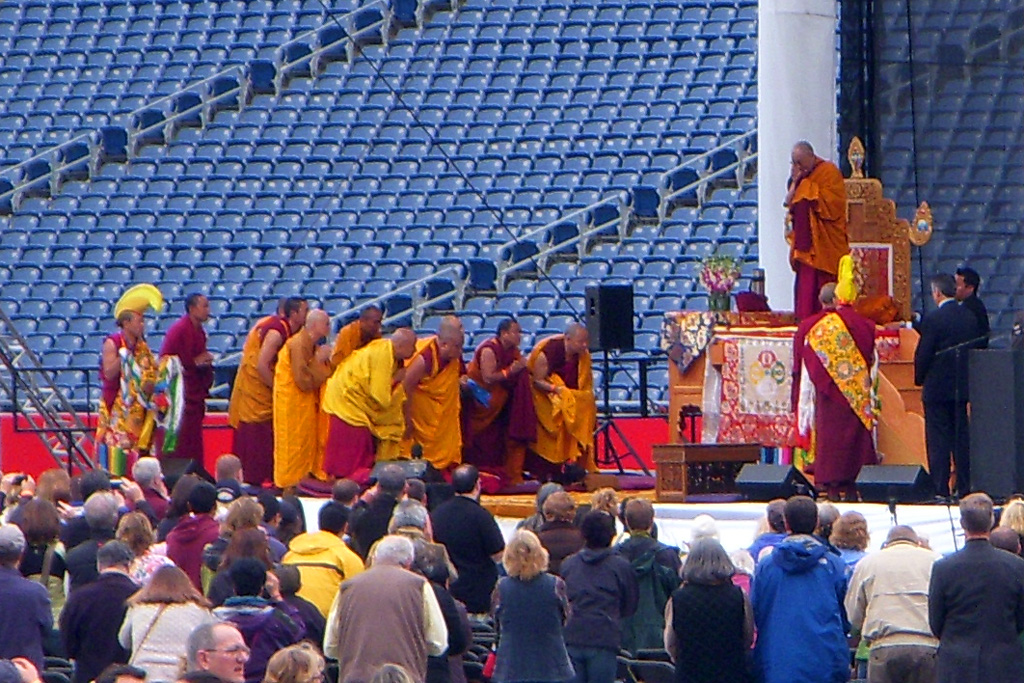
But there the throne was, set up on a stage at the fifty yard line on
one side of the field. VIPs were seated in a small section on the field
itself, while most guests were seated in the stands opposite the stage.
Our seats were in two groups, at opposite ends of the field, but within
the first three rows.
We were running a bit late, so we missed a couple of the preliminary
bits, but almost as soon as we were seated a huge entourage of
dignitaries and security thugs passed through an ornately-decorated
gateway onto the field, including His Holiness, who climbed up to the
summit of the throne and offered anjali to the crowd.
After a few more preliminaries, including a speech by Congressman Bill
Delahunt, His Holiness began a two-hour teaching on the foundations of
Buddhism, including the Four Noble Truths, non-self, and dependent
origination. For me, most of it was familiar, but there were several
bits worth noting.
He asserted that while mankind has made a lot of progress caring for our
bodies, we’ve spent very little effort in caring for the
health of our minds. He talked a lot about the Buddhist concept of
non-self, and equated that to the Xist concept of submission to God.
He also asserted that anything that arises solely as a result of
existing causes and conditions must itself be empty.
I found it refreshing and inspiring to be in the presence of a major
religious leader who could talk confidently about the Big Bang,
Darwinian evolution, and religious pluralism without any
sense of contradiction. However, I couldn’t help but feel that he was,
like so many others, unable to successfully communicate the value of
Buddhist practice to the average American. It also was kind of ironic to
see his image shown up on the stadium Jumbotron, surrounded by
tacky advertisements for coffee, automobiles, and credit cards.
His much-lauded sense of humor was demonstrated when he used his monk’s
robes to cover his head to protect himself from the raw morning breeze,
then bullied his fellow monks on stage to do the same. Later, he laughed
when using his gall bladder removal as an example, showing that
everything is impermanent and subject to change.
One bit that tickled me was his use of the term “Definite Goodness” as a
synonym for enlightenment, liberation, or Nirvana. He used it repeatedly
to refer to a very specific concept, so apparently “Definite Goodness”
is something I should be aiming for!
The morning ended with a voluntary Bodhicitta ceremony,
which includes the Refuges in the
Buddha, dharma, and sangha, plus the Bodhisattva vow
to work for the enlightenment of all beings. This was to take the form
of chanting three verses that appeared on the stadium Jumbotron.
Unfortunately, the phrases cycled much faster than anyone could read
them, and what should have been one of the most inspirationally moving
parts of the day devolved into chaos thanks to the ineptitude of
Gillette Stadium’s staff.
The lunch break was two hours long, and rather than
fighting 15,000 people for stadium food, I spent that time
studying the crowd. It was an odd mix of lifelong Buddhist
monks, lay practitioners, Tibetan exiles of all ages, local luminaries,
secular progressives interested in the battle for Tibetan freedom from
China, and Joe the Plumbers who just wanted to say they’d seen
this famous Lama guy everyone’s talking about. We even saw one
punk kid wearing a tee shirt that said, in blackletter: Meditate and Destroy. Huh.
Since the Dalai Lama draws such a diverse crowd, it must be incredibly
difficult for him to formulate a speech that doesn’t bore or go
over the heads of 40 percent of his audience.
An hour later, I went a grabbed a tiny lunch: two french fries and a
bottled water for nine bucks. While waiting in line, I was amused by the
anachronism of a robed monk walking around with his McDonald’s bag and
drink.
By 2pm, the morning’s rain clouds had burned off, providing an
auspiciously sunny day. The Dalai Lama returned for another two-hour
talk. The ornate Tibetan throne had been retired and replaced with a
simple chair, no doubt as a compromise between His Holiness and the
local Tibetans. With the sun in his face, he wowed the crowd by putting
on a bright red New England Patriots cap, which he wore for the rest of
the day. He also used an umbrella as a sun shade for a time, and bullied
his translator into taking off his suit jacket.
In the morning session, while talking in detail about the Buddhist
tenets, he’d relied on his translator about half the time, but the
afternoon session was almost entirely in English, since it was less
technical and directed at a more general audience.
The afternoon centered around the idea that there is a set of common
inner values underlying all religions: refrain from bad, and do good if
you can. He also asserted that this must also be at the core of any
secular set of ethical values. That allowed him to skilfully promote
inner values equally well, whether the recipient of his message was
Buddhist, Christian, agnostic, or atheist, without deriding any one of
those paths toward those universal moral truths.
He also addressed the alienation of modern society by reminding us that
man is by definition a social animal, and the importance of
warmheartedness in cultivating connections and relationships with one
another. One practice to undertake in order to promote this sense is to
perceive the people around you as friends and comrades, rather than the
more common daily assumption that you are surrounded by enemies.
After taking a few prepared questions, the day ended on the strange note
of an accounting of the event’s attendance, revenue, costs, and profit,
which will be used to establish a Tibetan Heritage Center in Boston.
That completed, the retinue filed off the field, but not before a final
wave goodbye from the 74 year old man, still wearing his Patriots cap.
Our crew regrouped in the parking lot to debrief. I discovered I had a
mild sunburn on my newly-shaven skull. We then drove back to Cambridge,
where some folks split off and the rest of us made our way over to
Amber’s for movie night (Enlightenment Guaranteed), but that’s another
story.
Overall, I’d say it was a very interesting day. While both a foreign
head of state and the leader of one part of a major world religion, the
Dalai Lama is also an eloquent speaker, a Buddhist scholar and monk, a
refugee and leader of a people without a home, and a very humble person.
It was enjoyable seeing each of those in him, and doubly so given his
limited time left with us. His teachings were meaningful and of
potentially great value to all the different types of people who
attended. It was quite a day, and one I’m certain I will always
treasure.
![[personal profile]](https://www.dreamwidth.org/img/silk/identity/user.png)