Although it didn’t start out that way, I guess this qualifies as a “memorabilia” post, given that it deals with stuff I’ve kept for the past 33 years…

Everyone has their own way of relating to significant purchases like a car, computer, television, camera, or stereo. Some people love buying new stuff when it’s on sale. Others pride themselves on getting a bargain by buying used. My M.O. has always been to buy the absolute best I can find, mostly irrespective of cost, then making it last as long as humanly possible… often long after newer, better things have made it obsolete. I take pride in having top-quality stuff and keeping it forever, and because of that I often form an emotional attachment to the objects I’ve acquired.

I can’t say that my first stereo was one of those things. It wasn’t very noteworthy, but it provided a lot of pleasure during my high school and college days.

But as I graduated college, got married, and moved into the workforce, digital audio arrived in the form of compact discs, and in 1992 my cheap high-school era stereo was decidedly worn out and in need of replacement. And my first job after college provided the necessary cash to splurge on something nice.

As fortune would have it, my then-spouse was working at a local electronics specialty store called Leiser and could get top-quality stereo components at cost. We wound up buying a hand-picked ensemble, spending around $1,500 on equipment that would have retailed for around $3,200 (which translates to about $7,000 in 2024 dollars).

I really loved that system, and was always proud to show it off. I’ll say more about that in a bit, but first let’s follow its history.

The majority of that system stayed with me following our divorce and my half-dozen subsequent moves, although I used it less and less over time, and the remaining components spent the last decade-plus stored away in their boxes…

Until recently. While noodling around YouTube I stumbled onto a tiny product that is essentially nothing more than a Bluetooth audio receiver with stereo outputs that could be hooked up directly to the auxiliary input of a traditional preamp. Such a device would allow Inna & I to stream any audio from our computers or smartphones directly through my audiophile rig. That was enough to spur me to finally dig up my beloved 33 year-old components and set them up for our enjoyment in 2025.

Of course, a couple of the old pieces are gone. The CD player that we received as a group wedding present from several university friends eventually self-destructed, and there wasn’t any point in keeping the old cassette tape player from my high school stereo. And I’d tossed my huge trunk-sized Infinity 7 Kappa speakers when the cones had dry rotted. I’d also discarded my old speaker cable and patch cords, but those were easy to replace.

But the most important three core pieces of my system were still there – my preamp, equalizer, and power amp – which needed little more than a thorough dusting. Lemme do a little show-and-tell about those, because I still hold a lot of affection for these three components.

Let’s start with my graphic equalizer. An EQ is useful to boost or cut specific frequency ranges in an audio signal. Got speakers that sound tinny? Use the sliders to boost bass and midtones. Don’t want to wake the baby on the other side of the house? You might quiet the bass a little while leaving everything else normal. Got a room where one speaker has to be placed in a back corner? Boost the left channel or reduce the right.

My 12-channel Denon DE70 graphic equalizer is a quality and useful piece of equipment. It’s always provided great service, and I find its lit bank of 24 faders visually appealing. It’s a bit unique in that the faders for the left and right channels are interleaved as paired green and yellow LEDS, rather than the more common setup that uses two physically separate banks of sliders. And there’s my little Bluetooth receiver perched at top left:

Denon DE70 graphic equalizer

Next, the crown jewel: my power amplifier. A power amp has just one job: take a microwatt “line level” audio signal and boost it to the tens or hundreds of Watts necessary to drive one’s chosen loudspeakers. It’s the final device in the audio processing sequence, connecting to and controlling the output from your speakers.

My power amp was manufactured by Carver, which comes with a bit of backstory.

Bob Carver was a legendary audiophile engineer, especially known for his innovative and impressively powerful amplifiers. I was first introduced to his work in high school, when my friend Paul showed me his brother’s stereo, which included Carver’s M400 old-school vacuum tube power amp, a radical-looking 7-inch square black cube that could pump out 200 Watts per channel: a ridiculous amount of power for a home system at that time. It made quite an impression on me!

The Carver TFM-4.0 power amp that I bought in 1992 is one of Carver’s followup models, offering a ludicrous 375 Watts per channel. It’s a great amp by a great engineer, but because Carver only produced this model for one year, it’s a rare and collectable component even within Carver’s exclusive lineup. Like the M400 that Paul showed me back in 1981, its only display is six sets of LEDs to show the power level of the signal it’s sending to the speakers; and in all the years I’ve owned it, no matter how high I pumped up the volume, I’ve never been able to light any but the first, lowest power level LEDs. The thing is a 23-pound workhorse!

Carver TFM-4.0 power amp

That just leaves my preamplifier, which is like the central conductor of a stereo system, orchestrating inputs from various sources (e.g. CD player, radio tuner, turntable, tape deck, microphone, and now even Bluetooth devices), sending a normalized signal out to the EQ and back, and then downstream to the power amp and speakers.

Like my EQ, my preamp is a decent piece of equipment. Being a CT-17 preamp/tuner made by Carver, it matches my power amp, but doesn’t have anywhere near the same cachet as his power amps. But the built-in radio receiver is a convenient combination.

Carver CT-17 preamp/tuner

Which brings me to the final, missing piece of the puzzle, the thing that kept me from setting up my stereo over the past decade-plus: the lack of speakers.

A good stereo is worthless without good speakers, and for a long time I wasn’t able to justify spending a lot of money on a set that would do justice to my other components. But I finally found a set of bookshelf speakers with positive reviews, that wasn’t too exorbitant, and which – if I bought them refurbished – would fit neatly within the credit card rewards bucks I was about to liquidate.

So let me introduce you to my one brand-new component: a set of Polk Audio R200 bookshelf loudspeakers. While I haven’t had them long enough to form a strong opinion of them (or bond with them), they seem to be doing a good job so far. They’re noteworthy in having a very flat response, which means considerably less tweaking of the frequency curve on the equalizer than I’m used to. I only wish I could move them a little farther from the wall, to better distribute the bass.

Polk Audio Reserve R200 speakerPolk Audio Reserve R200 speaker

Although this didn’t start out as one of my official “memorabilia” posts, overall I’m delighted to have my old components back in service again. Despite being 33 years old, they still deliver great sound quality, and it’s really nice having a Bluetooth connection to stream music at will from any of Inna’s and my laptops and phones. I’m really glad I lugged this equipment around with me for all these years!

I was probably 15 or 16 years old when computers first started appearing at the consumer level.

In the late 1970s, these were mostly for playing games. I played Pong (1972) and Asteroids (1979) on the first arcade consoles; Air-Sea Battle (1977) at Sears on the Atari VCS; Carriers at War (1984) on the Apple ][, and Crush, Crumble and Chomp! (1981) on the TRS-80.

My first experience using a computer for anything other than games was the University of Maine mainframe in 1982, long before the invention of the Web (1989) or even the TCP/IP protocol (1983) that heralded the creation of the Internet.

This was a time when card punches and readers were still being actively used. Students preferred to do homework on paper-fed teletype terminals like the DECwriter II rather than video display monitors, because they would still have a printed record of their assignment if the mainframe crashed and lost their work. It would be years before the first IBM PC model would appear on campus.

It’s a fair question to ask: with no games and no Internet, what did we actually do on the university computer?

Herein lies an interesting tale. You see, before TCP/IP, IBM had created its own networking protocol called RSCS, and in 1981 – a year before I arrived at UMaine – RSCS was used to connect computers at UMaine, Yale, CUNY, and a handful of other colleges in an academic network known as BITNET. BITNET allowed users at different sites to send programs and data files to one another, exchange email, and send interactive messages, and it would eventually grow to over 3,000 universities across much of the developed world.

In 1982, the idea of being able to send an instant message to someone across campus – or even across the country! – was incredibly compelling.

But RSCS messages weren’t all that. An incoming message would interrupt whatever you were doing, whether that was running a program, archiving files to magnetic tape, or composing a term paper. Each message was separate; there was no concept of an ongoing conversation, and there was no way to include anyone other than the sender and one recipient.

TeleVideo 925 terminal

TeleVideo 925 terminal

That all changed in 1983, when one of our university’s computer center staffmembers took an example program from a magazine and ran it on his mainframe account: WGH@MAINE. The program was what we called a chat machine; users across BITNET could sign in and send messages to it, and the program would echo those messages to all the other signed-in users. It was the ultimate ancestor of later services like Chat@PSUVM1, Relay@Bitnic, IRC, and Discord.

And its use spread like wildfire among the undergrads. If you were a smart kid who wasn’t into partying, then hanging out on a chat machine was how you spent your time. I devoted endless hours with a cadre of other geeks in the mainframe’s “user area”, idly hanging out on these early chat machines, conversing by text message with an increasingly familiar set of students from random sites across the world. I joined several other Mainers in making the trip down to New York City to attend the world’s first ChatCon meetup in 1984.

These days, I still retain a deep sense of nostalgia for those early days, and keep a few of the memories alive in odd, eccentric ways. Not only does my laptop’s “Terminal” window open in the classic green-on-black of a monochrome mainframe terminal, with the standard CMS “Ready;” prompt, but it also paints the default character-graphic VM/370 login panel. I wish one of my friends still had a copy of the old CAPS/UMaine login panel: an outline of the state of Maine, done in asterisk characters!

My Terminal window also uses the same idiosyncratic font-face as the huge old IBM 3278 terminals of the day. That’s kind of an indulgence, because I never used one… The only 3278s were kept inside the mainframe machine room; lowly student users like me only had access to TeleVideo 925 or 955 terminals… And no one has bothered to port those terminals’ fonts to modern Truetype or Postscript files!

One of the attributes of those mainframe terminals that I recall most fondly were their industrial-strength keyboards. They were of the same vintage as IBM’s “Big Iron” mainframes, long before “planned obsolescence” was a thing. Those keyboards were built to easily withstand a decade of student use, or a direct thermonuclear explosion, whichever came first.

Those old 4½ pound mainframe keyboards were so different from the flimsy, commodity rubber membrane actuated keyboards you get today, or the 1.4 pound Apple Magic Keyboard with its little scissor switches and a mere 1.15mm of key travel. And frankly I really missed the typing experience of a solid, durable keyboard with mechanical switches.

So now I have to admit… This whole nostalgia dump was really just a lead-up to this: I recently bought my first mechanical keyboard.

Now the first thing I’m gonna do is warn you: if you get intimidated by too many choices, selecting a mechanical keyboard is a complete morass! You’re absolutely inundated with choice, beginning with what size keyboard you want, and what keyboard layout. Then there’s tons of different keycaps to choose from, coming not just in different colors, but with different heights and profiles. Next there’s hundreds of different types of switches, with different travel, activation, and sound profiles. Mechanical keyboards are – unexpectedly – one of those incredibly detailed, technical areas that enthusiasts love to submerse themselves into, for reasons known only to the cognoscenti.

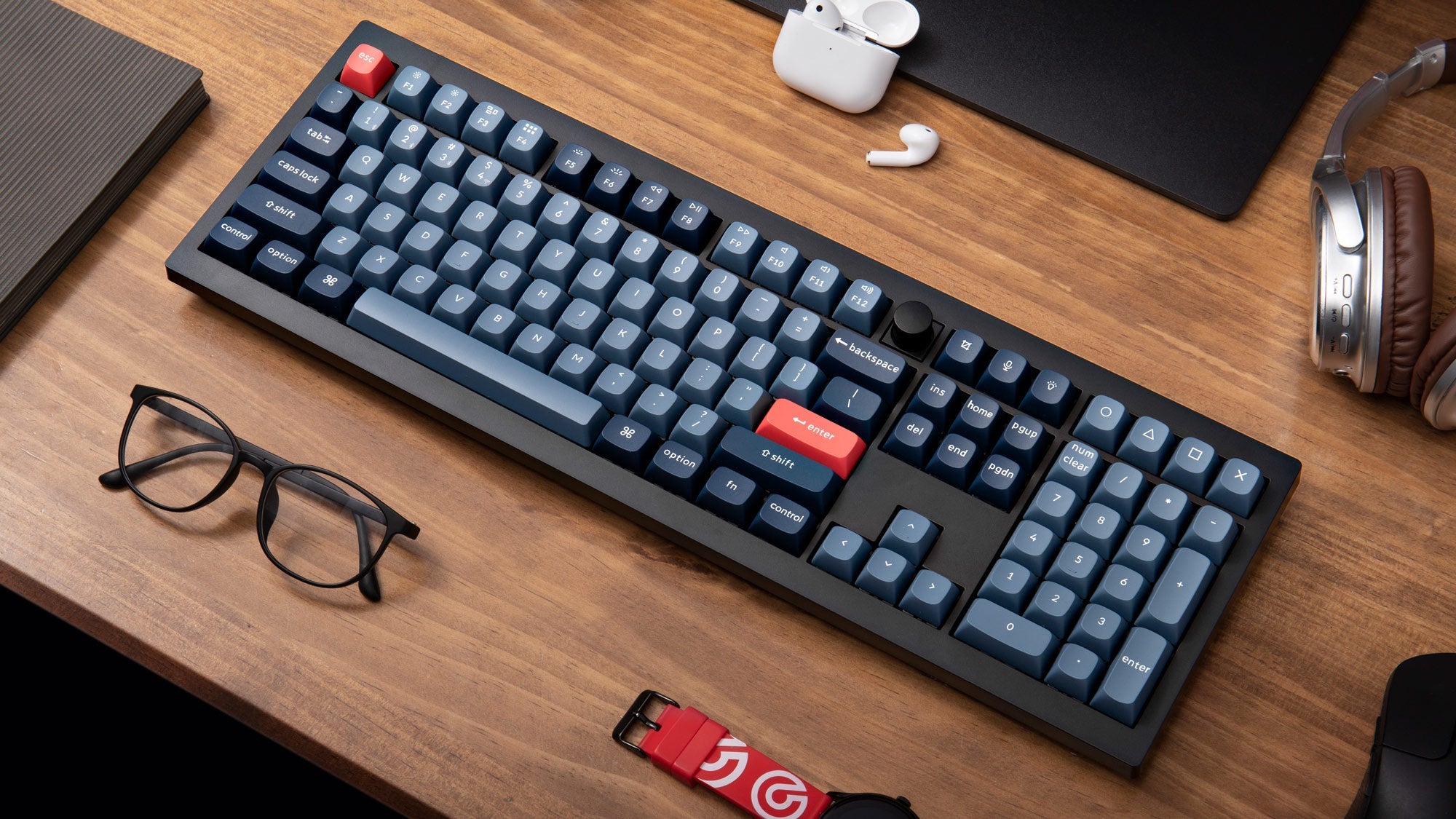
Keychron V6 Max keyboard

Saving you all the drama, I chose a Keychron V6 Max. I wanted something really traditional: a full-sized keyboard with dedicated function keys, arrow keys, and a number keypad, similar to the original IBM Enhanced PC keyboard, which is probably the most famous keyboard in history. The V6 Max is also wireless, which I prefer, given that I often type with the keyboard on my lap. And it’s sturdy, weighing in at 4.47 pounds, only half an ounce lighter than my beloved TeleVideo 925!

I kept the stock keycaps, which are a nice two-toned blue, with reddish ESC and ENTER keys. The keyboard has modes for both Mac and Windows, as well as dedicated keycaps for both OS’ idiosyncratic command keys.

Not knowing much about switches, I ordered two sets: the Gateron Jupiter Brown and Gateron Jupiter Banana, but I quickly opted to run the latter, which have a more satisfying sound, which will hopefully not perturb my housemate.

Other features… The keyboard is customizable with industry-standard QMK or VIA software. It also has a handy dedicated volume/mute knob on the top row just to the right of the F12 key. Like many modern keyboards, it comes with (often maligned) programmable LED backlighting, which I’ve set to simply flash blue underneath each key as it is activated. I also bought a nice clear plastic keyboard cover to put over it when not in use.

Having had it for six weeks, I have to say that it’s been a pure delight, and I find myself looking for reasons to sit down at the keyboard and bang away on it. In fact, I enjoy typing on it so much that I’ve been thinking about setting up a Discord text chat for a gathering of BITNET friends to revisit those old days when we used to spend hours upon hours typing to one another across the ether (hence the reminiscing about chat machines, above). And fair warning: another way I’ll satisfy my rejuvenated enthusiasm for typing is to produce more longwinded blogposts like this one!

I’ve only had two minor niggles. I had one bad switch – which happened to be on my ‘s’ key – that would register a double-strike about half the time. However, that was easily remedied by swapping the switch out. The other niggle is one I’ve had in the past with several other keyboards: the little rubber feet on the ends of the keyboard’s prop-up legs always seem to come loose for me, requiring an end-user application of superglue to stay put.

So after all that, the bottom line of this post was just to spend time gushing about having finally bought myself a quality keyboard. I’ve been dealing with garbage chiclet keyboards ever since I left college back in the late 1980s, and – given the amount of time I still spend sitting at the computer! – I was way overdue in treating myself to a higher quality input device.

And I’ll type, type, type till my baby takes my key-board away…
(no apologies to Brian Wilson)

Say you were a young college student taking a programming class, and your aging computer science professor’s first assignment was for each student to write a program to print out their name and telephone number.

Struble's Assembler Language Programming

That wouldn’t be the least bit sus, now would it?

Apparently, back in 1984 it wasn’t! Lemme tell you a story…

I was recently bedridden with both a back injury and my first case of Covid. And having already purged many of my old books, I really had to stretch (metaphorically, of course) to find something to entertain myself with.

One book that followed me through my migrations – from Maine to (five different locations in) Massachusetts, then Pittsburgh, and finally Texas – was a college textbook that was highly cherished by most of the CS majors I knew back then: George Struble’s “Assembler Language Programming for the IBM System/370 Family”.

Yes, I was so bored that I started re-reading a 40 year old textbook on one of the driest topics in all of computer science, for a computer that no longer exists!

Chapter 1 is a snoozer (not unlike the rest of the book). It’s all about how mainframe computers used combinations of ones and zeroes to encode numbers and characters. Like any textbook, the end of Chapter 1 had a dozen exercises for the student to solve, to promote active learning and demonstrate a practical understanding of what’s been taught.

Here’s the text of Problem 1.3: (emphasis mine)

Each byte of storage in the IBM System/370 contains eight bits of information and one parity bit. The parity bit is redundant; it is used only to guarantee that information bits are not lost. The parity bit is set to 1 or 0 so as to make the sum of 1’s represented in the nine bits an odd number. For example, the character / is represented in eight bits (in EBCDIC) by 01100001. The parity bit to go with this character will be 0, because there are three 1’s among the information-carrying bits. The character Q is represented by 11011000, and the parity bit is set to 1, so there will be five 1-bits among the nine. These representations with parity bit (we call this “odd parity”) are also used in magnetic tape and disk storage associated with the IBM System/370. Using the character representation table of Appendix A, code your name and telephone number in eight-bit EBCDIC representations, and add the correct parity bit to each character.

That’s right: on just the third exercise in the entire book, Struble is asking the student to provide their personal contact info, presumably to their instructor. I can only imagine the repercussions if a professor presented this exercise to his or her class today.

To be fair, when Struble’s book came out (in 1969, then revised in 1974 and again in 1984) such an assignment simply wouldn’t have set off the red flags it does today. The author and his editors probably felt safe in the assumption that women wouldn’t be taking hard-core mainframe assembler classes. And for the odd exception, what harm could possibly come from a young coed revealing her phone number to an upstanding member of the academic community?

What harm, indeed.

I’m not one to condemn past generations for not living up to more modern social norms, but still… Today that exercise just screams of inappropriateness and invasion of privacy. For me, reading that was a head-scratching moment of astonishment from an unexpected source, a true blast from my past.

Just a quick note to observe the 25th anniversary of both the Space Shuttle Challenger disaster and my professional career.

The Challenger disaster is one of the few news events where I recall exactly where I was. At twenty minutes before noon on January 28 1986, I was at work.

Although I hadn’t finished my undergrad at UMaine, I had just begun working as a software engineer for the university’s parking, police, and fire departments, which were all housed in one old farmhouse on the edge of campus.

My Televideo 925 mainframe terminal was located just outside the police chief’s office, and when the news broke about the shuttle’s disintegration one minute into its flight, the chief called everyone into his office to watch the event on the television that he usually used for videotapes or presentations.

Three months earlier, in October of 1985, I had been fired from a job slinging sandwiches at 7-Eleven because I had actually read the manual on how to operate the cash registers. My buddy Mike Dow was doing database work for the parking department and brought me in to assist, since he and I had already done some volunteer work together on CSNEWS, one of the internet’s earliest information services. But the Public Safety gig was my very first paid programming job.

For that reason, the Challenger disaster is inextricably linked with the beginning of my professional programming career. A career which has now officially spanned twenty-five years.

It’s been quite a ride, but I won’t indulge in reminiscing about all the good and bad times along the way. I’ll simply say that I’ve learned a lot, developed valuable skills, had a lot of satisfying successes, made so many great friends, and had a ton of fun. It’s enough to make an unemployed guy want to go back to work!

But today isn’t about all those things. It’s really more about just taking a minute to say: Wow, twenty-five years!

While the date is approximate, this is essentially the 20th anniversary of my founding of FSFnet, the electronic magazine which evolved into DargonZine. It’s by far the longest-running electronic magazine on the Internet, and its mission—to help aspiring amateur writers improve their craft—has been my real “life’s work”.

What follows is an email that I sent to our writers’ discussion list in observance of this event. I thought it appropriate both to archive it here as well as to share it with anyone who is interested, as it is without question one of the most significant events of this year for me.

With that said, here’s the message…

Going to college in northern Maine isn’t very pleasant, especially in the dead of winter. The sun has fully set by 4pm in the afternoon. The average daily temperature is 18, made worse by the wind that sweeps the bare, exposed hilltop university bare of anything but ice. The nearest town is twenty miles away; the nearest city, over 235.

Perhaps that’s why the students and computer center staff at the University of Maine were at the forefront of the nascent BITNET network, back in 1984. Desperate for any contact with the rest of the world, UMaine saw the development of the first Internet chat machine, the second automated network information service, the first registry of network users, and a half dozen of the Internet’s first electronic magazines. Perforce, we became the leading edge of the burgeoning international computer network; there wasn’t much else to do, after all…

I recall well the day that I had the idea for a BITNET-based fantasy magazine. It was between Christmas and New Years, during that lull between semesters when there’s no one on campus. Even the hardcore hackers I hung out with had stayed home due to an immense blizzard. The only people around were myself and one of the computer operators, a friend and fellow writer who came out of the glassed-in machine room to chat.

About six years earlier, I had been responsible for putting out an collection of poetry, art, and fiction for the New England Tolkien Society, a premium annual to complement our cheap monthly newsletter. I wondered whether an electronic magazine focused on fantasy and science fiction could garner enough submissions to survive. My friend Murph, the computer operator, was enthusiastically supportive, and even promised a story or two. So within a day or two I distributed what I called “FSFnet Volume Zero, Number Zero”, a bare, baldfaced plea for submissions, which went out to 100 people in our BITNET user registry, the Bitnauts List, who had listed fantasy or science fiction as an interest.

The response was very encouraging. Submissions started coming in from a handful of interested parties, and one interested reader designed a much better masthead than the one I’d used initially. After an early dip down to about three dozen subscribers, readership steadily grew into the hundreds. At the end of our first year, I brought our many separate writers together for the first time and proposed a radical concept: a collaborative milieu that would permit us to write related stories, sharing characters and places and events.

My motivations and expectations when I founded FSFnet were really twofold. First, I wanted to write. Second, I wanted to find other writers who were interested in talking about writing.

FSFnet and DargonZine achieved and far exceeded those goals. Looking back at it, my goal of merely talking to other writers seems a bit unambitious. In the interim, DargonZine has become a dynamic family, featuring both lifelong friendships while warmly welcoming new members. Even today, after the advent of bulletin boards, the World Wide Web, cellular telephones, and all manner of pervasive computer- and network-based technology the social aspect of the project remains one of the most powerful, vital aspects of our mission.

But there have been so many surprises along the way. Over time, the quality of our writing and our critiques have consistently improved. I’m proud to look both backward and forward and feel a great sense of pride in some of the tremendous works that I’ve had the honor of publishing. We’ve helped a lot of writers, and in return they’ve shared with us some truly wonderful works of fiction.

Of course, quality is often matched with quantity, and I don’t need to tell you about the volumes of writing we’ve printed. I never in my wildest dreams imagined that I would ever look back and count four hundred stories. Anyone who has tried to go back and read all our back issues knows firsthand that we’ve printed enough material to fill about two dozen paperback books.

And then, of course, there’s longevity. If you’d told me in 1984 that I’d still be putting this beast out when I turned 41, twenty years later… Well, that would have been quite a surprise.

Another thing that has surprised me along the way is how much people have sincerely cared about the magazine, as reflected in their comments, their demonstrations of emotion, and the effort they’ve put into making it work. The devotion and faith that our writers have had for the project has probably been the most humbling thing in the project to me, because it’s really touching that people believe so strongly in something that I had a part in creating and continue to guide.

And the final surprise for me has been that DargonZine has become, to some degree, as what I’d call a “leadership engine”. The project long ago became much more work that one person could administer. For many years, our writers’ devotion has prompted them to accept responsibility for small projects that further enhance the project’s purpose. As they execute those projects, they learn how to express their visions of the future, build consensus behind their initiative, get and keep the ball rolling, and bring it to fruition. Whether it’s running a Summit or updating our maps or character descriptions or whatever, it’s been rewarding for me to give our writers a place to test their leadership skills: practice using skills which might aid them in their careers and interactions in other organizations.

There has, of course, been a great deal of change in the past twenty years. Back in 1984, the Internet didn’t even exist! Even the networks that would eventually combine to create the “network of networks”— ARPAnet, Usenet/UUCP, BITNET, Decnet, and others—were little more than a dozen sites each. Email existed, but no World Wide Web. No electronic images existed in any fashion; text was the only interface, and email was the only way to communicate with another computer user. No compact discs, no cell phones, no laptops, no PDAs, no MP3 players, no ATMs, no GPS, no digital cameras, not even color computer screens. We still had computer card punches and readers at UMaine, and most students preferred to work on paper-based DecWriter terminals because they didn’t trust monochrome CRTs. Today’s technology environment is as different from 1984 as the Wright brothers’ flyer is from the Stealth Bomber.

On the other hand, some things just don’t change at all. In many ways, DargonZine’s challenges remain the same as they were on day one: having an adequate number of writers and enough submissions to fill a regular publishing schedule. And then as now, readers are really more of a side-effect than a priority.

And, just as that December day was back in 1984, today is actually a unique and pivotal moment in our history. In a matter of weeks, we will finally break the longest spell we’ve ever gone without an issue, and we’ll do so by publishing the first of many Black Idol stories, which is itself one of the most important events in our long history. We are desperate for new writers, and hopefully the publicity that the Black Idol generates will bring in a new wave of writers who will become the project’s backbone for the future. Our Web site desperately needs an overhaul. We need to bring in new readers to replace those we’ve lost over the past years. Both the arc and Dafydd’s epiphany have gotten us thinking about how to collaborate more closely and more effectively. After failing to get our new writers involved, as evinced by the number of people who are getting dropped in the current participation review, we are completely reassessing the value and tactics of our mentoring program. After years of just coasting along, happy with the status quo, we are currently both in great peril, and on the verge of tremendous changes, and it’s definitely an interesting time to be part of the project.

For more than a decade we’ve owned the right to call ourselves “the longest-running electronic magazine on the Internet”. But every single day we increase that longevity record. The fact that we’ve been around a decade longer than virtually any other online publication further underscores how very special what we do really is.

Since day one, I’ve known where to lay the credit for the magazine’s success. Here are some quotes from FSFnet 0-0, that initial mailing wherein I defined what FSFnet would be. I think they were absolutely prescient, because an unimagineable twenty years later, these statements are just as true as they were that wintry evening back in 1984:

FSFNETs success depends on reader contributions and efforts.

Please, FSFNET can only work if people are willing to contribute to it.

The more people who read it, the more people will submit quality work, >the better FSFNET will become.

This is your fanzine, more than it is mine. It is up to you to keep it >going. I have merely brought you together. Now it is your turn.

Some of you have been here virtually since day one. Dafydd (my erstwhile editor, most prolific writer, and overall curmudgeon), Jon (my conscience and good friend), and Jim (my last surviving co-founder and recurrent agitator). There’s simply no way that I can say enough to thank you for how much you’ve helped the magazine survive and thrive. People have long looked up to you as the soul of the project, and I do, too.

Some of you—Rena, Pam, Victor, and others—came on board in a wave a few years ago, and you have all pulled a lot of weight. You joined the project and thought of yourselves as newbies, but you very quickly were asked to become project leaders, and you’ve done an excellent job, rejuvenating the project when it was at a point much like today, when we needed new ideas and energy to replace the departure of several outgoing veterans. I thank you all, because you’ve taken on so much. The project survived and came out of that stagnant period stronger than ever, and the zine is what it is today because of your hard work.

Our newest crop of published writers includes Liam and Dave, and I couldn’t be happier with you guys. You, too, have provided an infusion of energy when the project really needed it, and you have also stepped forward to become leaders, like the generation before you. I hope that you stay with us for the long haul, because we really need active new writers with a passion for improving the way the magazine works, and I really see you as agents for positive change. You’re the people with the insight to ensure that we set up policies and procedures that enable us to effectively integrate and inspire the new writers who will be showing up in the coming months, and that’s the most important job anyone can do right now.

And the new folks who haven’t been printed yet. You haven’t been part of all this history, but I really hope that you will help create DargonZine’s future, because DZ’s success is very much more in your hands than it is our veterans. There’s always turnover in the project, even amongst the Old Ones, and we’re always looking for people with the vision to help us improve the project, and the enthusiasm to make it happen. I really hope you make the effort to be active in the group, because you are really what the project’s all about, and you’ll have to step up and help lead us soon enough.

For each of you, I want to thank you for what you’ve done for the project, whether you’ve been here twenty years, twenty months, or twenty weeks. As I said twenty years ago, all I’ve done is give you a forum; DargonZine’s success—and it has been a phenomenal success, achieving far more than I ever anticipated—has been entirely because you cared about it, believed in it, and worked for it.

As I have said countless times, DargonZine isn’t my creation. Sure, I had a couple good ideas a long time ago, and I send out the emails and crack the whip to keep everyone moving, but ultimately DargonZine could survive very easily without me. On the other hand, there would be absolutely nothing were it not for dedicated writers like you.

Together, we have created something amazing, something that has lasted longer than anything of its kind. We have learned a ton from one another and helped amazing number of writers, and we’ve created a very tight-knit community. I’m honored to be one of the people within this circle, and I thank you for everything you’ve done to make it what it is today, and to create the future that I see before us.

So please join me in raising a glass to twenty years of collaboration and camaraderie. Then get back to your story or your critique queue, so we can get started on our future!

Frequent topics