… or “nihonjin ni henshin”: inexpertly translated as “turning Japanese”. This is the story behind my attempt to learn the native tongue of the rising sun.

Obviously, the first question is “Why?” and it’s not that easy to answer.

Turning Japanese cover image

I’ve had some relationship to Japanese culture as far back as high school. I practiced kyūdō – Japanese meditative archery — for several years and hope to resume again. I’ve also dabbled with taiko: Japanese drumming. There’s a slight Buddhist connection, tho Zen is rather distant from my own meditative lineage. Despite approaching 60, I still watch anime (usually subtitled). Even something as mundane as the virtual cycling app I train with, which recently released a Tokyo-themed expansion, provides lots of signage for a Japanese language student to decipher.

Another big reason why I am attempting this now is because physical limitations reduced the amount of indoor cycling I could do over the winter. So with more time on my hands, I could attack one of the most time-consuming things on my long-term to-do list.

As an aside, the other big pastime I undertook over the winter was improving my investing by doing a lot of reading about how to interpret corporate financial reports: balance sheets, income statements, and cash flow statements.

Other than just killing hours over the winter, learning Japanese provides a great intellectual challenge. I’ve always loved – and been reasonably good at – picking up foreign languages (French, German, Russian) and alphabets (runic, Cyrillic, plus calligraphy). Although to be honest I think I might have opened Pandora’s box in tackling a language made so difficult by formal and non-formal modes, slang, regional dialects, and of course three different alphabets, including kanji. Still, it’s a great way for an older guy to stretch his neurons. And if I really enjoy it, I can always look into formally testing myself by taking the standardized five-level JLPT language exam(s).

The next question is how I’m attacking it.

So far my primary tool has been the (Pittsburgh-based) Duolingo phone app. Theoretically they’ve taught me about 1,200 words, which is terrific, but it does have some shortcomings. My active vocabulary is trailing my passive vocabulary, and I find I rely too much on the hiragana pronunciation hints rather than learning the kanji characters in words. Part of the problem is just how the app is set up, and part of it is because the gamification elements set up incentives that aren’t always in the best interest of the student.

I’ve also made use of YouTube, where it’s easy to find tons of language instruction. Although I don’t feel especially loyal to any one channel, the one I’ve relied on most is Japanese Ammo with Misa.

And no Japanese student can avoid the elephant on the bookshelf: the Genki textbooks. I’ve downloaded electronic copies of their third editions, but haven’t used them much yet. If I find them useful, I’ll spring for the print copies.

There are other resources that I am not using yet, including local language programs, online tutoring like Italki, and local Japanese language learner meetups.

I seem to have a fair number of friends who have learned Japanese, including one guy whose former wife was a Japanese native. But I’m sad that my high school friend Mark died before I took this up. He moved to Japan after college, where he married a Japanese woman and taught English for thirty years. I’m sure he would have been amused and happy to support me and host a visiting traveler.

I’ve already alluded to how it’s gone. I’ve been putting in ten to fifteen hours a week, and I’m enjoying it and making steady progress. Although like any language, the complexity ramps up substantially as you start tapping into more complex (and realistic) grammatical structures. And learning a few thousand pictographic kanji characters is a bear.

But it’s been fun, and hopefully I’ll become competent enough to actually interact with other Japanese speakers in person sometime in the future.

I lost one of my high school buddies recently.

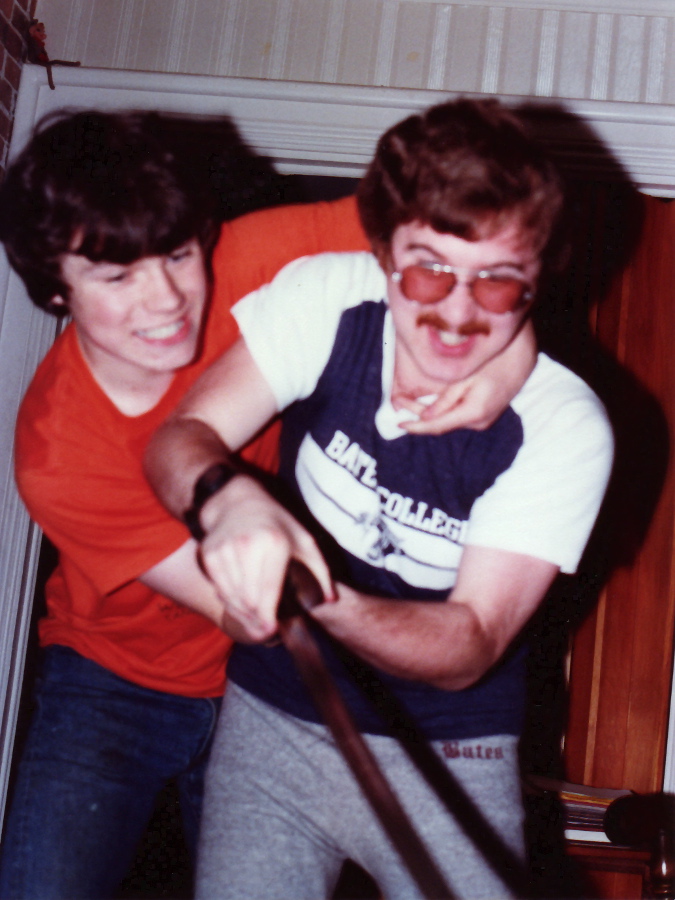
I met Mark through some organized wargaming activity back in the day, and a half dozen of us quickly formed an inseparable pack that lasted for years, with perhaps another dozen occasional co-conspirators.

He was quick-witted, charismatic, and a mischievous instigator of the highest order, probably partially in response to what seemed like a difficult family situation. But whatever the psychological underpinnings, Mark made every day an opportunity for outrageous adventure, which was irresistible to us as a pack of bored adolescent guys.

While I can only relate a small number of our many adventures, here—to amuse my captain—are some of the memories I have of my time with Mark.

Swashbuckling Heroes

Swashbuckling Heroes

Bring in that Floating Fat Man!

Bring in that Floating Fat Man!

Perpendicular Brothers

Perpendicular Brothers

Summers spent on Water Street in Hallowell, caretaking his grandfather’s antiques shop. Then closing up shop for clandestine and nominally illegal group swimming trips to the local granite quarry.

Days at the local videogame arcade, particularly seeing his “MGE” initials filling the leader board of the Star Trek videogame. “Congratulations… High score!”

Numerous expeditions to some of the most memorable movies of that time: that perpetual source of quotes Star Trek: The Wrath of Khan; the iconic animated feature film Heavy Metal; the laughable ridiculousness of Krull and Beastmaster; and the ill-conceived and too-bad-to-be-funny waste of film called Caligula.

Of course, the hundreds of hours spent gaming. His persuasiveness at Diplomacy. The Fletcher Pratt naval miniatures engagements. Call of Cthulhu roleplaying sessions. Hands full of dice medieval miniatures. The planetary exploration and economics microgame Trailblazer, with its inhuman bookkeeping requirements, leading us to the long-remembered planet christened Fuck You All. And dozens of others.

Even spare-time sessions of “the dictionary game”, where we’d laugh until we pissed ourselves over definitions like “Kenny Kinnikinnick, inventor of Gnip Gnop” or my culturally sheltered inability to correctly pronounce “gifelte fish”.

Dozens and dozens of basement poker games, with stakes ranging from quarters to new wargames, computer disk drives, and upward of $300 in cash. And, of course, Mark’s introduction of his (and subsequently our) two favorite poker variants: Hurt Me and The Bates Motel.

He wasn’t above petty larceny, one night convincing us to steal the US flag from its pole in front of a Maine state office building, using the specious justification that it was a federal offense for them to fly it after sundown without proper illumination.

And then the coup de grace. We showed up early for an evening session at the local game store. While several of us kept Hal, the proprietor, engaged in conversation, Mark retrieved from a nearby top shelf the box containing the materials for a huge plastic model of the starship Enterprise, opened it up, loaded all the contents into his briefcase, closed the box, and returned it to its former location, where it remained unexamined for a year or more. Hence the righteous name of the operation, which will never be forgotten: Free Enterprise. It was really difficult keeping a straight face through the ensuing game session!

Mark left for college 30 miles away, but that didn’t preclude group shenanigans, thanks to careening, edge-of-control rides to Lewiston in Mark’s “Little Red Chevette”. There, he would found the Bates College Imperialists club and propagandize over his college radio show. He’d even open his own game store, which was the scene of my first date with my first girlfriend (appropriately, since we’d met one another at a gaming convention).

After college, I moved to Boston and didn’t have much contact with anyone in my old high school circle. Mark was one of the few of us who escaped Maine, but he might have overreached, moving to Japan to teach English, establishing his own language school, getting married, and bringing up a child. He pretty much fulfilled his vow never to return to the US again.

Although he was an infrequent correspondent, I did receive occasional emails from him. To my complete surprise, when I told him I was doing a bike ride to raise funds for the Dana-Farber Cancer Institute, he became one of my most loyal and generous supporters. He is one of only nine people who sponsored me in each of the 14 years I rode, and my sixth highest sponsor in terms of dollars given.

Less than four months ago, I was back in Maine and visited a few of our old buddies for the first time in decades, including Mark’s younger brother Josh. It was interesting seeing how much each of us had changed, and sharing treasured memories of our ridiculous high school antics. They also shared news about the rest of the guys who weren’t around; as you would imagine, Mark’s name came up quite often.

So it was a huge shock to hear from his brother a couple weeks ago that Mark had unexpectedly passed away from a heart attack.

As with my mother’s passing earlier this year, I’m really not sure how to articulate my feelings. Whatever you thought of him, Mark had enough personality for ten men. He was arguably the central figure in our circle, and one of the most important and memorable faces from our adolescence.

I will miss him greatly, and all of the outrageous adventures he launched us on.

This year’s birthday wasn’t the greatest piece of work I’ve ever experienced. Woke up with a sore throat that presaged the cold I’d deal with for the following weeks. Made the usual pilgrimage to Foxwoods (where I lost for the first time in three years) and visit to Purgatory Chasm, which was cold and grey but pleasant enough, then a big grocery run, since I had free time and a rental car. Got myself Thai takeout from Montien, which was nice, but it outta be, at $21 for an app and one entree. Then watched some anime on Hulu. Woo-hoo.

The following morning I was in full-on head cold, and off at 8am for the first day of my annual “Sandwich Retreat” at CIMC. The “sandwich” means 12-hour meditation sessions on both Saturday and Sunday of two consecutive weekends, with 3-hour evening sessions on the five weekdays “sandwiched” in-between.

Sudafed FTW, baby. That’s the only way I got through those nine days of head cold hell. I was a coughing, drooling, snotting, sneezing, gagging, nose-blowing, mouth-breathing ball of unhappy. Highly recommended way to spend a long meditation retreat.

In the middle of the week I somehow managed to convince myself that it’d be a good idea if I biked 20 miles out to the Pan-Mass Challenge office to pick up the sneakers that were this year’s premium for people who reached the $6,300 Heavy Hitter fundraising level. The next day (Thursday) I had such a massive relapse of sinus pressure and headache that I skipped that evening’s retreat session, which was actually okay, since there were no group discussions that night, only sittings.

This was my fourth Sandwich Retreat, but it was the first time I stayed at CIMC the whole time. In previous years, I spent periods of walking meditation roaming the streets near the center, whereas this year I stayed indoors and stuck with the formal walking practice. I also spent this year’s 90-minute lunch breaks napping in CIMC’s lower meditation hall, rather than going out and sitting on the steps of Cambridge City Hall.

In fact, the only time I went outside I just sat on a bench in the yard, captivated by the bizarre moire patterns made by passing cars’ hubcaps, viewed through the gaps in CIMC’s slatted wooden fence.

And unlike prior years, when I’d pick up food from outside, this year I actually stayed and ate the vegetarian meals CIMC provided. Depressingly, all four lunches were some form of vegetarian stew, but they were paired with brown rice and bread, which I was able to fill up on. And please, people: raw green beans aren’t tasty or elegant; for chrissake cook those suckers!

The biggest challenge I had was with my “yogi job”. This year I was again assigned to end of day cleanup. It’s a two-person job, and my good buddy Mark signed up to be my parter. Except on the first day, he didn’t show up for it. And the second day, he left early. Then he didn’t even show up for the second Saturday and Sunday. I was kind of stunned that he’d stiff me like that, but some of it was misunderstandings that were later clarified, and thankfully other yogis stepped up and helped me out.

One of the things that makes the Sandwich Retreat unique is the “homework” we are given: something to practice with throughout our regular weekdays, which we can then share with others during the evening sessions. This year we were asked to notice when we were feeling resistance to life as it is, note what conditions caused it, what emotions and mind states it manifested as, and how it evolved and changed once we noticed it.

What almost no one (including me) realized was that this was the exact same homework as last year’s Sandwich Retreat! Ironically, I think a lot of what I observed during the week this year was nearly the same as things I’d observed last year!

Being unemployed and living alone, I wasn’t interacting with a lot of other people, which limited the number of opportunities I had for resistance to come up. The ones I did notice were subtle and ephemeral, like the briefest irritation when I had to wait for a line of cars to pass before I could walk across the street. Such irritations arose and disappeared so fast that I couldn’t really examine them. In the end, I decided that the source of my irritation was some kind of unmet expectation, followed by an immediate reset of my expectations. “Oh! There’s a line of cars. I guess I have to wait.” As soon as I adjusted my expectations, the resistance passed and I was much more patient with the situations.

Naturally, my cold provided me with an opportunity to practice with resistance. On Monday, when I described how acknowledging my irritation lessened its power over me, Larry commented that stopping those problematic mental proliferations actually leaves more energy for the body to fight off infection (or other maladies). Sadly, that didn’t help me during Thursday’s relapse, when mindfulness of my irritation did absolutely nothing to alleviate my physical symptoms and the misery that came with them.

During our sitting meditation periods, I spent most of my time doing karuna practice: the compassion work that I began last month and plan to continue for a full year, similar to the metta practice I did last year. I feel like it is both more meaningful to me and a more productive practice than metta, so I’m really enjoying it so far.

As if exploring resistance and developing compassion weren’t enough to work with, I spent my two teacher interviews grilling Narayan and Michael about my felt sense of anatta (non-self), free will, and the nature of the observer.

I think a lot of it revolves around whether the act of observing life as it plays out is something undertaken by some independent entity within, or whether it’s just another thought process. Because that determines who is in control.

Basically, if everything (including my feelings, thoughts, and actions) is purely conditioned, then I don’t see myself as having the western idea of free will. And that, in turn, causes the Buddhist concept of “non-self” to make more sense to me. If there’s no free will, there’s no independent actor making choices, and if there’s no independent actor making choices, how can there be such a thing as free will?

That was my basic thought process, and I wanted to run it by our guiding teachers to see if they thought it was (a) a useful line of inquiry, and (b) a reasonable understanding of the Buddhist view of reality. However, as is typical in these situations, their responses left me with many more questions than answers.

I first talked with Narayan, who said it was a meaningful line of inquiry, because it relates directly to Wise View: the first and foundational element of the Noble Eightfold Path. She also agreed that all thoughts and feelings are conditioned, but disagreed with the idea that the observer is just another thought.

She asserted that there is something within us that allows us to influence our actions, to alter the conditions that are the input to our decisionmaking process, but she described it in terms of a process, an action, a “mystery”, and a way of “be-ing”. She even described it as our innate “Buddha nature”, that seed of the unconditioned within us all.

She also didn’t think that “free will” was necessarily the best way of thinking about it, since there’s no way of definitively knowing whether we have free will or whether it’s just an illusion. Thus, the question of the degree to which we are able to make free and conscious choices is similar to the questions the Buddha described as “not useful” in the Cula-Malunkya Sutta.

Narayan acknowledged that there was a seeming contradiction in the idea that all thought, feeling, and actions are conditioned, while man still has the freedom to influence his thought patterns, make decisions, and take independent action. After the interview, I felt that contradiction was something I would have to sit with and examine at length.

I also felt it might be useful to spend some time trying out the idea that everything is conditioned and there is no such thing as free will, just to see how it differs from our default and predominant world view that we are independent actors.

After that, I really wanted to talk to Michael about it, since Narayan seemed to have directly contradicted something I’d heard from him, that the observer really was just another (conditioned) thought process. So a week later, I talked to him.

Rather than answer my question directly, Michael came back with an alternate question. For him, it isn’t the question that’s important, but what is driving the question. Why does the question need to be answered? Does it tell us something about the person asking the question? As a parting shot, Michael suggested that universal questions like this can tell us a lot about the individual’s relationship with the unknown. It wasn’t what I wanted to hear, but it was definitely more food for thought.

So when the time came for the final day’s feedback session, I talked a little bit about the scattered nature of examining three things at once: the karuna/compassion practice I was doing during the sitting periods; the homework, which concerned itself with resistance and aversion; and my teacher interviews, where I grilled them about non-self, the nature of awareness, and my relationship to it. I didn’t even mention our homework from the Long-Term Yogi group, which has to deal with interpersonal connection and Wise Speech. Still, I felt like I made progress on all those fronts.

Despite being sick, I wasn’t as mentally fatigued this year as in previous years, when I was absolutely exhausted. Part of that is attributable to being unemployed, but I also made a conscious effort to be more relaxed in my practice during the sittings, which I’m sure helped. The only day I felt truly wrung out was the final day, which was okay with me.

Last year at this time, I reported back from my first Buddhist retreat, CIMC’s “Sandwich Retreat”, so called because it has all-day sessions on two consecutive weekends, and three-hour sessions every weekday evening in between. If you care, last year’s length summary can be found here.

It’s now been a week since this year’s Sandwich Retreat, and it was just as rewarding—and exhausting—as last year’s.

Like last year, I intentionally set my expectations low. I anticipated that we would sit a lot and walk a lot, and I wasn’t disappointed. I knew I was right on the money when I arrived on Saturday morning and read the following agenda for the day:

sit
walk
sit
walk
sit
lunch
sit
walk
sit
walk
sit
tea
sit
talk
walk
sit

At a high level, the retreat is all about bringing the practice into your regular life. As such, there’s a weeklong exercise that you are asked to bring into your daily activities during the work week. This year’s homework was to exercise full-body awareness.

The first couple days, I thought I did pretty well. I went back to first principles, which state that one can only know something through the six sense stores. However, most of the senses provide little insight into the body. Taste and sound are pretty worthless, and thinking more so. You can smell other people, but it’s hard to smell yourself. Sight is okay, but again there’s no major revelations to be had by gazing at your navel.

So my first understanding was that we primarily know the body through feeling. This was confirmed at that evening’s debrief, when everyone who talked about their experiences throughout the day started their description with “I felt…”

What are some of the things I observed? Well, you can feel things on the surface of your body, but there’s much more going on internally. There’s also a difference between what someone might be feeling (pain, discomfort, pleasure) and what might be apparent to an observer (calm).

Feeling can also be really subtle. Somehow, this sense tells you when you need to blink your eyes, when a sneeze is coming, when you need to crack a joint, when your belly is full, or when a pimple is forming. The blind read braille using their fingers, a feat of bodily sensation that has always amazed me.

But perhaps the most interesting feeling I observed was the innate human sense of balance. Walking is often described as a perpetual fall, and even standing still requires constant adjustments based on this innate sense. I spent one whole walking period standing on one foot, observing how rapidly my body adjusted to my sense of balance in order to keep me balanced and upright. And I had the opportunity to observe myself and several of my fellow meditators as our heads bobbed, on the verge of falling asleep. Even though our conscious minds were already asleep, the sense of balance caused us to start every time the body started to droop and tip. It’s amazing that such a sophisticated sense can operate even though the operator is unconscious!

The other thing I noticed is that it’s really difficult for me to observe the sensations of the whole body at once. Most of one’s other senses take in a small field: there’s only a limited number of things you can taste, smell, hear, or think at one time. But the sense organ for feeling is the entire body, and while it’s easy to observe discrete parts (my knee hurts, my nose itches), it’s very difficult for me to attend to the entire body’s sensations simultaneously, as a single sensation.

So all that—and a lot more that I’ll spare you—was what I learned from my first two days’ exercise in whole-body awareness. Then came Tuesday night’s debrief with Larry, one of CIMC’s three teachers. Almost the first thing out of Larry’s mouth was that we weren’t doing whole-body awareness practice in order to gain insights into the body, but as a way of using the body to ground our attention in the present moment, as opposed to endlessly drifting off to fears and plans about the future or reverie about the past. Doh!

So midweek I had to make a big correction, paying less attention to the body for itself, and focusing instead on using the body as a reminder to be present with what is. Unfortunately, at first I didn’t find whole-body awareness made me any more present than I was before. While it was good when I was doing something physical like walking or perhaps cycling, I found it less useful when sitting or conversing.

Wednesday I had my teacher interview with Michael. I told him about how I’d started out being too analytical about the full-body awareness, and how I was struggling with the body as too big a field to deal with at one time.

I also told him about my two other current practices, which are also both analytic. The first is just observing the vedenas, the feeling tones of pleasant/unpleasant/neutral that come up in response to every stimulus. I’ve gradually come to believe that the feeling tones aren’t absolute, but conditioned and somewhat arbitrary, such as a country-dweller finding a police siren jarring, when a city-dweller might not even notice it.

My other practice is to try to notice every volitional movement I make—even down to where my eyes track—and examine the motive and the quality of the intention behind that movement. And on the cushion, where you’re not doing any real volitional movement, you can examine the movements of your mind, and the motives behind them.

After hearing all that, Michael concluded that I was too much in my head and needed to be more grounded in the simple act of observing the present moment. What he suggested was to simply periodically check in and consciously relax the eyes and the muscles of the face. I expanded that to include my shoulders, which I’ve known for years carry a lot of tension, as well. For years I’ve futilely tried to consciously relax my shoulders while I’m cycling, where the tension induces a lot of neck pain.

For the remainder of the week, in trying that practice on, I found it made a huge difference. From the shoulders up is a convenient subset of the body to work with, and for me it feels like the base of where my thoughts and my feelings reside. As such, relaxing the face seems to produce a general relaxation, improving my mood, receptivity, and empathy, all attributes I’ve wanted to cultivate for some time. It reminds me somewhat of cognitive-behavioral therapy, where you model the way you want to be, even if you don’t feel it, and then it gradually starts to feel real to you; similarly, relaxing the face and shoulders might help me become truly more relaxed and receptive overall.

During the interview, I also inquired about having more of an ongoing relationship. I’m at a point where I’ve exhausted reading and dharma talks as learning tools. In a sense, I know everything I need to know about the dharma. The next step is to bring more of it into my daily life, and that’s where someone who knows my particulars can help. Knowing this, and knowing that opportunities to talk with the teachers are very rare, I arranged with Michael to have periodic check-ins every 6-8 weeks. This had been a major goal when I signed up for the retreat.

I picked Michael for a few reasons. I’ve felt some rapport and also some dissonance with each of the three teachers, so no one of them resonated more than the others. Larry and Narayan are more popular, but that also means they have less time and longer lead times for interviews. As a former intellectual, Larry might be useful in helping me overcome my analytic side, but it might be just as good to go with someone completely different. After a particularly good dharma talk a month or so ago, I finally decided I’d at least start out with Michael.

So those were the big themes of the retreat. Now let me go into a few of the smaller items, just so that they get recorded for later reference.

This year my weekend “yogi job” was end-of-day cleanup, which was great. That meant that unlike most retreatants I had our whole lunchtime break as free time, which I usually used to go sit in the sun at the Cambridge City Hall. On the long 9- and 12-hour weekend days, it was nice having that long break in the middle. I used one of those to hit the hardware store and pick up silicone sealant for my shower, which apparently has started leaking into the downstairs.

And, by luck of the draw, I shared this year’s yogi job with Shea, one of my dharma friends who only recently returned to the group. So that was a real pleasure.

In Larry’s first-day introduction, he used the “No matter where you go, there you are” line. I wonder if he knows he’s quoting Buckaroo Banzai

As an object of meditation, you can choose the breath, the body, sound… or the smell of the onions cooking downstairs!

I generally haven’t got a lot of suffering in my life, but what I do have manifests itself as either irritation or planning. That seems to imply that I desire predictability and control more than anything else.

Ethics and religion really aren’t anything more than a radical acceptance of responsibility for one’s actions.

Don’t eat jawbreaker candy during a sitting.

While outside doing walking meditation in the neighborhood around the center, I met two cats. One was a calico doing a great imitation of a flower in a window box. The other was a very friendly longhaired tiger cat. For future reference, they were both on Cleveland Street.

Retreatants have one teacher interview on each weekend, and one during the week. Ideally, you’re supposed to get to talk to each of the three teachers, but this year Maddie stepped in to help due to the large number of retreatants. I got her, making this the second year in a row that I haven’t had any interview with Narayan.

There’s this Buddhist concept that the body is vague, permeable, that its borders are fluid and ill-defined. I generally disagree with this, but then one might ask whether dental work is part of you body. Or glasses? Clothing? A pacemaker?

Tuesday’s sitting was interesting, because it was election day, and everyone was on pins and needles anticipating the results. I wasn’t very nervous, because I didn’t expect any meaningful results before we broke at 9pm. But when they let us go, Michael noted that “Someone won Pennsylvania”, which caused everyone to cheer.

I missed Friday’s session because I was sick as a dog with nausea and a headache. I slept right through from about midnight to 5pm on Friday.

The food continues on last year’s pace of being edible exactly one time in four. I know, most of you would love the wholesome vegetarian fare cooked with love and all that rot, but I don’t. Fungus is fungus, no matter how you chop it. The one exception was the ominous-sounding “celery stew over rice”, which was surprisingly savory.

My interview with Larry could be summed up as “relationships are hard, and the form of practice is irrelevant—it’s all about how it impacts your life”. Then he got up and gave me a big hug. Larry?

I remain unclear about where the line is between practice and seeing practice as a self-improvement project.

Sunday morning, as we began our ninth straight day of sitting, I passed a note to my buddy Mark that read, “What’re we gonna do today, Brain?”. He was amused. The appropriate response is, of course, “The same thing we do every day: sit and walk, walk and sit…”

People often report that they have a hard time at the beginning of a retreat, but that when it ends, they felt that they were just getting on a roll. I have the exact opposite experience. I can fall into meditation pretty easily and stick with it for a couple days before I start getting restless. But by day nine of nothing but sitting and walking, I’m at the far limit of mental fatigue and I’m ready for a wholehearted binge of lying, cheating, stealing, drinking, having sex, murdering, eating meat, and lots and lots of sleeping!

The Sandwich Retreat is the only lengthy retreat that CIMC offers, and in my experience it’s the only place at CIMC where I got the sense of sangha, or community. It’s kinda hard creating community when you only get together once a week and spend those three hours together with your eyes closed and not speaking!

This year, that sense of sangha even more pronounced, as I fostered relationships with a number of people. Of course, I enjoyed the company of my dharma friend Mark, and it’s awesome to have Shea back, as well. I also met Dylan, who is a new resident at CIMC, and John, an MIT prof who is trying to get a group of guys together to go cycling, of all things. And it was good to see old friends like Tim and Amy and Whispering Deer, as well.

So despite nine days of sleep deprivation and mental fatigue, I think this year’s Sandwich Retreat was a success. I met my expectation of sitting and walking, achieved my goal of initiating an ongoing relationship with a teacher, cultivated more of a sense of sangha with new and old dharma friends, and of course learned more about myself and the world around me in the process.

Back in high school, I hung out with an interesting crowd. Among our pursuits was wargaming, and we’d occasionally go over to the local game store in the evening for a session of Diplomacy or maybe some Napoleonic or medieval miniatures.

The local gaming store was run by Hal, an aging veteran who’d been partially deafened in the war. Hal was the nicest guy you can imagine, although he’d talk your ear off, and we kids enjoyed giving him a verbal jab every now and again.

Like many such businesses in my home town, the building was a residence turned into a business. Most of the first floor had been converted into a retail bookstore, while the kitchen and upper floors were still living space.

So one evening we arrived with a plan. A number of us showed up a bit earlier than expected, while Hal and his wife Alice were still finishing their supper in the kitchen. The standard procedure was to mill about the store for a bit while all the players arrived.

Now, in addition to games, Hal also sold books, plastic models, topo maps, and the like. Among his wares was a very large plastic model of the (original) Starship Enterprise. The box alone was probably two feet by three feet, and it was displayed prominently above one of the racks.

So, while Hal and Alice were eating, a couple of us peered into the kitchen and engaged Hal in light conversation. Meanwhile, around the corner, our friend Mark proceeded to open up the Enterprise box and transfer all its contents into a soft-sided briefcase he invariably carried.

I don’t know how long the Enterprise box sat on that shelf, empty, but I know it was many months. Nor do I know the circumstances under which the switch was revealed, although I envision some 13 year old boy coming up to Hal with the intent of buying the model, asking for its contents.

All I know is that we got away with a pretty amusing childhood prank, and for the rest of my life I’ll always smile whenever I hear anyone talking about the benefits of “free enterprise”.

Frequent topics