![[personal profile]](https://www.dreamwidth.org/img/silk/identity/user.png)
Zen in the Art of Archery
Feb. 24th, 2014 04:58 pmAs I step away from some of my older hobbies, it looks like kyūdō—the Japanese martial art of archery—might be a new activity that arises to take their place.
People who know me will realize that when I commit to an interest, I dive into it with a unique intensity and dedication. Looking back, I’ve had numerous interests which I pursued for years and sometimes decades, such as Tolkien fandom and fiction writing during my youth, or cycling and meditation as an adult.
But every five or ten years, I step back and reevaluate my hobbies and how they fit into my life. Often I can tell when a chapter of my life is about to end because I feel that my interests aren’t helping me grow in the direction I want to go in. It’s at those times that I’ll suddenly walk away from things I’ve been devoted to for years, such as when I left my writers’ group after running it for more than a decade. At the same time, I feel myself looking for what new interests might come along to replace the old.
In the past year or two, I’ve set the groundwork for dropping two time-consuming hobbies. I’ve already publicized that after fourteen seasons, 2014 will be my last year riding in the Pan-Massachusetts Challenge, which will free up a lot of time I’d otherwise spend fundraising. In addition, I will soon stop tracking my money using the Where’s George website, after a ten-year run. These were great activities, but it’s finally time to move on.
Knowing that this would free up time and energy, I started kicking around ideas for what I might enjoy doing next: something I could get involved with that would also appeal to the very different person I have become.
And the first thing that seems to have arisen is kyūdō.
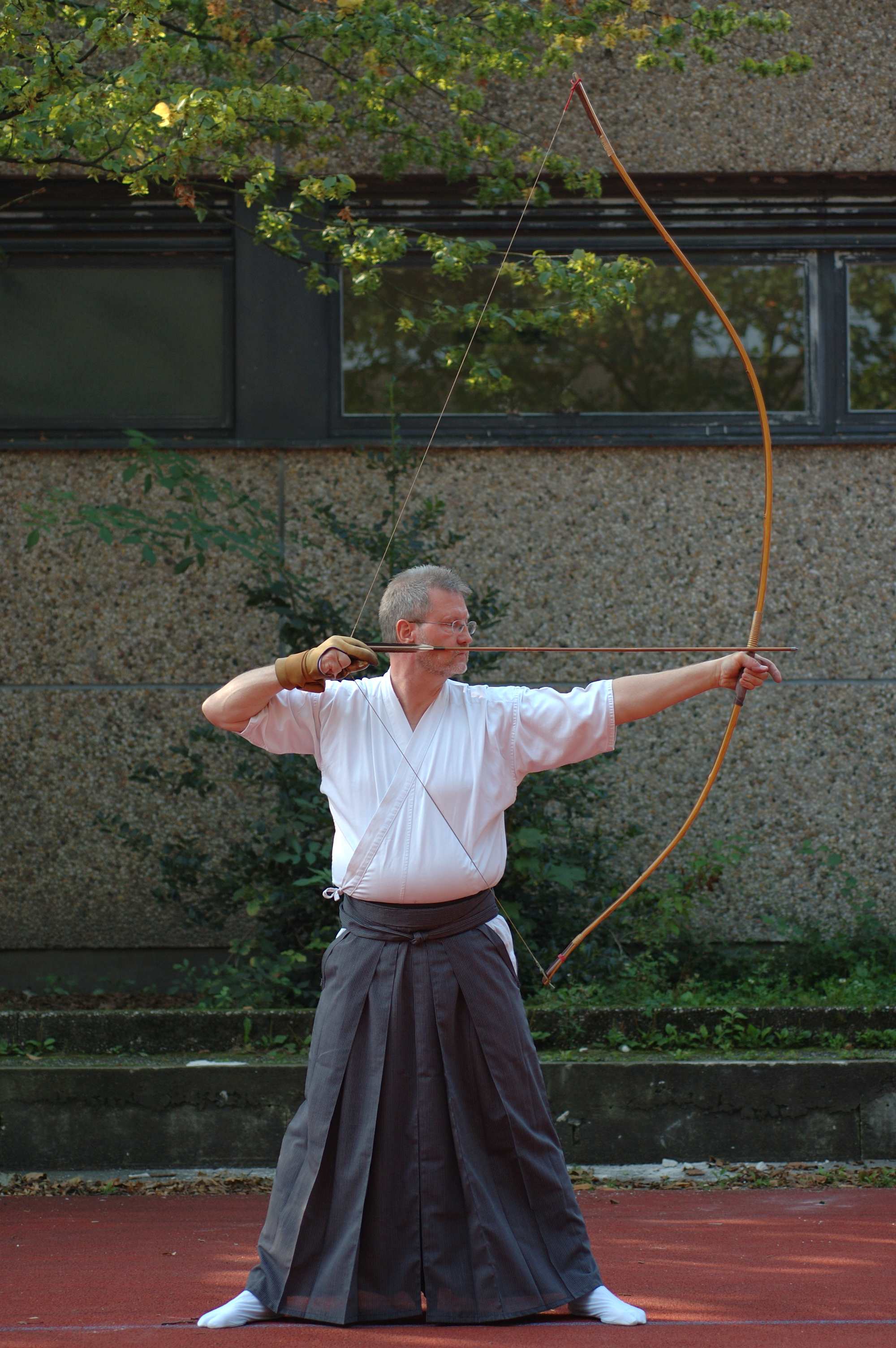
Kyūdō is a meditative martial art devoted to the traditional Japanese form of archery. It’s surprising that kyūdō is not widely known in the US, because it is extremely popular in Japan, where archery and its equipment are viewed as highly sacred. Kyūdō has been refined and distilled into a highly reflective, meditative practice, as reflected in the first western book on Japanese archery. Eugen Herrigel’s 1948 “Zen in the Art of Archery” was wildly popular and was the first book to use the now-popular moniker “Zen and the art of…”
So why have I been drawn to kyūdō? It’s hard to explain, but it boils down to six attributes that appeal to me: it’s social, meditative, physical, elegant, familiar, and Japanese.
Although the focus of the form of kyūdō is internal, participation and instruction are offered in the context of a small, friendly martial arts dojo of mixed ages and genders. This is imperative to me, since social life and connection is revealing itself as the primary project of my fifth decade of life.
I probably don’t need to belabor how kyūdō’s meditative focus complements my longstanding contemplative practice. As a form of meditation that involves a fair amount of movement, Kyūdō seems to nicely fit in the gap between rather sedate walking meditation and full-bore regular life.
For years, I’ve been looking for some technique for integrating physical exertion and meditation, which initially led me toward an exploration of yoga. However, being in a room filled with women in tight skinsuits—all rolling around on the floor in provocative positions—wasn’t especially conducive to internal exploration. Kyūdō allows and incorporates a focus on the body without the detrimental distractions.
However, like the asanas in yoga or the forms in tai chi, kyūdō is strictly choreographed. And when control of the human body and its motions is combined with the natural geometry of the bow, bowstring, and arrow, kyūdō epitomizes elegance and grace: attributes that I strive to embody.
And archery has always appealed to me. Even as a child, archery was my favorite activity at summer camp, and over the years I became pretty skilled at it. And in my medieval recreationist days I bought and used a very powerful English longbow, as well.
And for whatever reason, I seem to be in a phase where Japanese stuff is interesting, so it fits into that, as well.
So as you can see, kyūdō actually complements my interests quite nicely.
Practices are both convenient and a bit of a stretch. During the winter, they use an indoor aikido dojo in Union Square, which isn’t easily reached by mass transit, but is manageable. And in the summer they’re out in Lincoln, which would be really difficult, except that’s just one town over from where I would be training during a regular weekend bike ride, so I’ll probably combine the two.
I first started looking at their website around Thanksgiving, and saw that they were running a new student “first shot” training at MIT in January. However, it filled up before I could sign up.
So two weeks ago I showed up at the dojo just to observe. Fortunately, another new guy was there, and apparently we comprised enough interest for them to schedule another first shot training the following week. So I returned for a second visit and received instruction on most of the form from Joyce and Randy, with the expectation that I’d get to perform my first shots the next time.
This past weekend, I returned for part two of the training. Although the other new guy wasn’t around, I received additional instruction from Joyce, and then Don covered some more details before encouraging me to step up and take my first shot.
To put that into perspective, in Japan new students often take weeks, months, or sometimes years drilling the techniques before they’re allowed to shoot. Due to Americans’ typical impatience, our school has disposed of that, but it’s still a big milestone.
So I felt some anxiety as I stepped up and went through the movements and fired two arrows. When we move outside, we’ll fire at targets 28 meters away, but indoors we shoot at cardboard bales from a distance of about ten feet. I managed to remember most of the steps, but forgot to flip my right arm back upon my first release; I corrected it for the second.
What was interesting to me was how intensely the body experienced it. When I stepped away, my heart was racing and I was breathing heavily. I think much of that is due to the selfconsciousness of taking my first shot under the sensei’s gaze, combined with the physical stress of drawing the bow and the loud thunk of the arrow striking the target.
Of course, I haven’t mastered anything as yet. It’s frustrating but entirely predictable that some of the things I do wrong are common both to kyūdō and cycling, such as tensing and hunching my shoulders. And I also need to pay better attention to keeping my body facing perpendicular to the target, rather than turning toward it.
But it was successful! I’d followed the forms and properly fired and lodged my arrows into the target. So at least I’ve got the basics down.
Over time, I hope to embody some of the elegance that you can see in some of the YouTube videos or Vimeo videos about kyūdō. And if I stick with it, perhaps someday you’ll even get to see a photo of me in a hakama!
- anxiety,
- archery,
- body,
- cycling,
- gracefulness,
- hobbies,
- kyudo,
- meditation,
- pan-mass,
- pmc,
- social,
- wheres george,
- yoga


