I wrote this two years ago, but never posted it, due to the high emotions surrounding the Presidential election. Now, with John McCain dead and Lord Trump’s midterm popularity contest upon us, I think it’s a fair time to share.


For virtually my entire life, the political world has been divided between Republicans and Democrats.
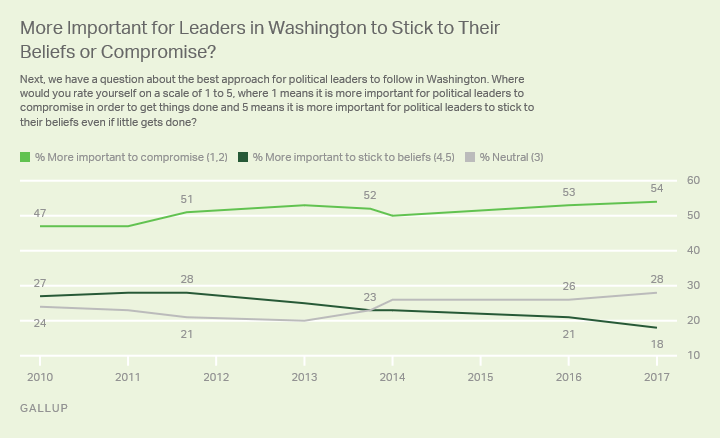
Americans favor compromise

Americans favor compromise

The Republicans see themselves as the champions of small government, low taxes, strong defense, and individual initiative. Their opponents are quick to point out the shortcomings of Republican policies, which include corporate rapacity, military adventurism, blind nationalism, and selfishness and greed that run counter to the common good.

The Democrats espouse high-minded ideals like fairness, compassion, equality, inclusivity, and a social safety net. However, their government handout programs are expensive, and their idealism can get in the way of real-world pragmatism.

Republicans accuse Democrats of diluting the Christian values of America, while the Democrats point out the hypocrisy of vocally Christian Republicans whose behavior is anything but charitable.

All this posturing obscures the values that we as Americans have in common: freedom, fairness, individualism, a strong economy, and an overall greatness that lends us a justifiable position of world leadership.

This year has brought to light fundamental challenges for the American two-party system. The Republican party has fractured into moderate and radical factions with no viable leadership and no apparent path to reconciliation. The Democratic party faces a similar split between centrists and socialists, although the two factions appear to be able to play together, at least for now.

This is all symptomatic of the fact that the two-party system no longer serves the best interest of Americans. For the first time in decades, the American people have abandoned traditional political parties and the mediocre candidates they typically nominate. The mainstream Republican candidates were all weak and easily toppled by an outspoken, brash, demagogue who gleefully spews the most un-American and shameful vitriol. While the Democrats could only offer us another untrustworthy business-as-usual chameleon.

Meanwhile, the Republican Congress is doing its damnedest to avoid its Constitutional duty to ratify a new Supreme Court justice. The radical faction is the tail that is wagging the Republican party, leaving the Republicans I know in a quandary. There is no longer any space in the Republican party for intelligent people who are fiscally conservative (low taxes and small government) but socially liberal (reproductive rights, LGBT rights, equality, immigration reform). Meanwhile, Democrats don’t exactly welcome members who are fiscally conservative. Where are those voters—and there are plenty of them—supposed to go?

Lost amidst all this shortsighted partisan tantrum-throwing is the old-fashioned notion of hearing one another out and finding mutually-acceptable legislative solutions. Political theory suggests that the majority party honor and address the concerns of the minority party, to produce a stronger piece of legislation that earns bilateral support.

In the past, this has worked well. Democratic social programs can only succeed with assertive watchdoggery. Corporate profit-seeking enhances our standard of living only if its excesses are regulated for the benefit of all. A huge military must be tempered with strong diplomacy and compassionate leadership.

Everyone acts as if the winner gets to mandate how the country is run, but it has always been—and always will be—a political process of communication, negotiation, and compromise. The wisest political solutions only come about when civil people with diverse views work together, which our current political parties have forgotten.

It amazes me that I need to point this out to my fellow Americans, but even radical views don’t need to lead to radical conflict. This is America, for chrissake! Our whole 240-year experiment in democracy is built upon a foundation of political tolerance and respect.

A high-minded but political realist named Lincoln, when asked why he didn’t call Confederate rebels his irreconcilable enemies, once replied, “Do I not destroy my enemies when I make them my friends?”

Sweet '16

Jan. 4th, 2017 05:34 pm

I suppose an end-of-year update is in order, since I haven’t posted to my main blog since last August.

It’s ironic that my last post covered Inna’s and my summertime trip to Maine, visiting my mother as well as my brother, who had made his annual trip from his west coast home on Vancouver Island.

Ironic because for more than three months now I’ve been back in Maine, caretaking my mother, who has repeatedly bounced back and forth between hospital and nursing home. After several weeks managing it alone, my brother joined me here, so we’re both dealing with another unwanted Maine winter. The only person missing from making this a full repeat of our summer visit is Inna, whom I’ve barely seen at all since last September.

Hibernal Augusta

So no Inna, no biking, no Begemot, no job hunt, no Thanksgiving, no Christmas. In their place there’s nothing but snow, ice, and freezing cold, amidst long, dark months spent inhabiting Maine’s fine medical institutions.

It’s hard to look forward more than a day or so. Mom’s health is a perpetual roller-coaster ride; meanwhile, there’s the added stressors of managing her finances, trying to dispose of her accumulated belongings, finding a nursing home placement for her in Pittsburgh, and figuring out how to transport her there. And lo! here comes tax season, when I get to file taxes for two!

To make this vacation extra fun, over the holidays I contracted a really nasty influenza. While that gave me recourse to avoid holiday familial obligations, it cost a solid two weeks of weakness, nausea, coughing, and other unpleasant symptoms that I’m just coming out of.

And I have to admit a very deep-seated depression regarding the election and the prognosis for American democracy. For whatever misguided reasons, the people have ceded control to a selfish, petulant, xenophobic, entitled, compulsive liar who seems intent on systematically dismantling everything America once stood for: quaint, 19th century concepts like truth, ethics, democracy, justice, rule of law, fairness, rationality, integrity, respect, and compassion. It’s astonishing and demoralizing to anyone who still believes in those averred American values.

Welcome 2017

Meanwhile, the people—from whom all power emanates—stay willfully and myopically focused on things that don’t really matter. It was painful to see so many people wishing “Good riddance to 2016”. If the loss of Prince and Princess Leia (sic) upset you that much, then I have some sobering news for you: 2017 and the complete trainwreck of a “post-ethics” Drumpf Presidency is gonna make your hated 2016 feel like a goddamn Carnival cruise.

So, yeah. Happy new year.

A quick post about my most recent read: David Byrne’s “Bicycle Diaries”. Yes, that David Byrne. It’s really more about his observations based on various cities he visited than it is about cycling, so it’s not surprising that the two bits I want to share from it have absolutely nothing to do with the bike.

Bicycle Diaries

In his section on Berlin, he talks about the Stasi, the East German secret police:

The combination of psychological and Orwellian horror is hellish and weirdly seductive. The agency was known for turning citizens against their neighbors by subtle pressure, implied threats, or economic incentives. It seems it’s something that many national security agencies do from time to time. (“If you see something, say something.”) Turning the citizenry into rats makes the entire populace scared and docile, and after a while no one knows who’s informing on whom.

The quoted phrase rings loudly in any Bostonian’s ears, because the MBTA transit police have been drumming those exact words (authored by the Department of Homeland Security) into our heads for more than eight years, encouraging us (as described here) to be on the lookout for anyone carrying a backpack, holding an aerosol can, or “acting in a rehearsed manner”.

Orwell’s rep as a visionary becomes that much more impressive when you realize that he was only off by 17 years.

The other interesting bit was a quote from Enrique Peñalosa, former mayor of Bogotá, which goes like this:

In developing-world cities, the majority of people don’t have cars, so I will say, when you construct a good sidewalk, you are constructing democracy. A sidewalk is a symbol of equality… If democracy is to prevail, public good must prevail over private interests.

His perspective in that last sentence is profoundly interesting for those of us in 21th Century America, torn as we are between the American dream of freedom to acquire and amass unlimited wealth and the protests of the Occupy movement, which make it abundantly clear that the American dream is inaccessible to most, and has resulted in an unsustainable concentration of wealth and power in the hands of a small elite minority.

Just some thoughts, sadly having nothing to do with cycling whatsoever.

Chart 1
Chart 2
Chart 3

I almost never take quizzes, and even less frequently post the results, but in this case I find the way the results are presented interesting.

The quiz is the OkCupid Politics Quiz. It quantifies people’s political beliefs along two axes that represent how much government should restrict people’s economic and social behavior. Those two axes are clearly shown in Chart 1, which the other two charts are based upon.

Being liberal and progressive (and more so since I started reexamining my personal philosophy some years ago), I pretty much knew where I was likely to fall: government should work to ensure social freedoms, but carefully limit economic freedoms in the service of a guaranteed minimum standard of living and equal opportunities for all. That’s reflected by the marker representing me in Chart 1. As always, click for bigness.

Chart 2 is the same chart, but it roughly overlays famous politicians based on where they fall on the same axes. I’m snuggled nicely in the Clinton/Obama camp, which again is no surprise.

The one that really got my attention was Chart 3, which maps out all the major political movements against those axes, including not just Democrat and Republican, but Socialism, Libertarianism, Anarchism, Totalitarianism, and so forth. That’s the interesting nugget for me: seeing the way these political groups relate to one another and differentiate themselves.

Having grown up in a household dominated by a very conservative and very political father, I’m curious what his results would have been. I could see him fitting in anywhere in the arc from Libertarian through Capitalist and Republican.

Frequent topics