Parents love posting things about their children. Others might incessantly post about their pets, or jobs, or recipes, knitting patterns, or bike rides. Although this post is primarily addressed toward parents, if you post really frequently about any topic, it applies equally to you.

And this isn’t directed at one person. In the past year it seems like everyone on my friends list has bred, and the resulting deluge of oversharing is why I feel the need to post this reminder.

The basic message is this: people friended you on Facebook because they are interested in *you*, not necessarily your progeny or your primary interests. For some people, their interest in you might extend to your children/interests, but for others it will not.

Since most people don’t want their news feed cluttered with stuff they’re not interested in, a thoughtful person would only share your baby pictures with the people who care to see them, and not with those who don’t.

I don’t bring this up solely to cater to my own ideosyncracies. While I’ll openly admit that I despise children and would love to see fewer of them in my news feed, the rabid popularity of services like unbaby.me prove that I’m definitely not alone.

And let’s be honest: a lot of people abuse their “proud parent” allowance. The rest of us don’t need daily (or even weekly) visual proof of your capacity to procreate.

If you post very frequently about your kids (or your job, your dog, or your bike rides), please offer your readers the ability to opt-out of posts about that topic. That’s simple courtesy.

The good news is that setting it up is really easy. On Facebook, all you need to do is create a “list” of the people who don’t want your baby posts. Then when you post a baby story, set the privacy on the post to exclude that list.

I use this facility all the time; it’s simple to do, easy to remember, and it works great!

To create the list and put people on it:

  1. Hover over my name and wait for the popup box
  2. Click on the “Friends” button
  3. Click on “Add to another list”
  4. Click on “New List” and name it “No babies please!”
  5. Use the same general procedure to add additional people to the list

Facebook screen shot

Then, to post something that those people won’t see:

  1. Compose your status message but don’t hit “Post” yet
  2. Click on the posting privacy button (it’ll probably say Public or Friends)
  3. Select “Custom”
  4. See the “Don’t share this with…” section? Enter your exclusion list’s name here, and Save
  5. Then click that “Post” button

Facebook screen shot
 
Facebook screen shot

The only thing you need to be careful of is that the privacy setting is “sticky”, so the next time you want to post a story that isn’t about your baby, you need to change the posting privacy setting back to what it was before.

And of course you should post an announcement to let people know that you have an opt-out list.

But if someone asks to be put on your list, please never take it as an insult. Remember that it’s not that we dislike you; if you’re still on my friends list after several “friend purges”, you’re definitely someone I care about and want to hear from. I’m genuinely very interested in you and your life; just not your children.

As for myself, although I have a number of interests that I engage in regularly (meditation, cycling, cats, etc.), I try not to post about any one topic very frequently. But if someone does feel that they’d like to be on an exclusion list for any topic that I regularly post about, please let me know.

I want to share posts you will find interesting and valuable, not ones you’ll consider tedious and annoying. I hope you feel similarly.

Thanks!

Time for a grab bag of Buddhisty observations based on some recent readings, dharma talks, and workshops.

At a recent talk, Ajahn Geoff was asked about the Buddhist concept of Right Effort: specifically, how to cultivate the discipline to perform actions you don’t want to do, but which you know will have positive results. To my surprise, he responded by outlining my longstanding belief that you must be guided by how you will feel on your deathbed about the choice you made. I’ve mentioned this guiding view of mine in blog posts from 2005 here and 2003 here.

My belief that the brahmaviharas of metta (lovingkindness) and karuna (compassion) are very similar was confirmed by Narayan at a recent CIMC workshop. The main difference is that compassion is more specifically targeted at suffering, whereas metta is a more general friendliness toward all, irrespective of the conditions of their life.

The phrases Narayan uses for compassion practice are “May I care for your [physical] pain” and “May I care for your [emotional] sorrow”. I feel that “May I” is semantically much weaker than “I do”, and “care for” is weaker and more vague than “care about”. So the phrases that speak to me most compellingly are “I care about your pain” and “I care about your sorrow”.

While on the topic of the compassion workshop, I should mention the following. Although I am currently halfway through my intended year of intensive metta practice, my current intention is to follow that up with a year of intensive karuna practice. That’ll cover the first two brahmaviharas, but I do not plan on devoting the same time and energy to the remaining brahmaviharas of equanimity and sympathetic joy.

When someone expresses dismay with the phrase “It’s not fair!”, I have always taken glee in pointing out that “Life isn’t fair, and you’re setting yourself up to be disappointed if you expect it to be”. I have recently begun to appreciate that although life indeed isn’t fair, that doesn’t mean we shouldn’t have compassion for those who suffer from life’s injustices, and take action to remedy them.

The two figures on the table behind the teachers’ platform at CIMC are Avalokitesvara, the bodhisattva of compassion (aka Guan Yin, Chenrezig), and Manjusri, the bodhisattva of transcendent wisdom. It seems a bit odd to have them so honored in a Theravadin meditation center, but it does underscore how relaxed CIMC is about borrowing from other Buddhist lineages.

We are often so preoccupied with planning about the future or reminiscing about the past that we aren’t paying any attention to the present moment. We must be present for our minds to process the sensory input we receive in each moment. If we are absent, one might say that we are “Out of our minds”. Are you “out of your mind”?

One of the observations in the Pali Canon is that our egos exhibit certain seemingly contradictory impulses: the desire to exist, and the desire to not exist. These can be seen, of example, in the desire to “leave one’s mark on the world”, or the parental impulse to live solely for one’s offspring’s benefit, losing oneself in something other than one’s own life. The Buddha stated quite clearly that these are not helpful preoccupations. However, many Buddhists also espouse the idea of cosmic unity: the view that we are all one entity, one living expression of universe, rather than many unique and separate individuals. To me, this seems to be just another, more politically correct manifestation of the desire to not exist. Submersion in some anonymous universal being is just as much a manifestation of the ego’s desire to find oblivion as any other human activity.

One of the ways that karma works is by one action setting up the conditions that influence one’s future state. For example, if we choose not to pay back a debt, we have created the conditions that cause others to mistrust us. Thus our bad acts indeed precipitate negative reactions from others, which impinge upon our future lives.

In “Walden”, Thoreau writes about mankind’s advancement of science and contrasting lack of progress in the ethical sphere thus: “Our inventions are wont to be pretty toys, which distract our attention from serious things. They are but improved means to an unimproved end.” Technology is a tool that multiplies our capabilities, but it’s up to man to create something meaningful with that enhanced capability, and our philosophies haven’t advanced in any meaningful sense in the past 2000 years.

One way of looking at mindfulness is being mentally and physically present and open to the beauty in each instant of life in its fullness. If there is so much beauty and joy to be experienced in this world (and I believe there is), that raises the question of how to avoid being overwhelmed by it. At any given instant, I am presented with all kinds of sensory input and myriad potential objects of attention; so if I am to appreciate any of it fully, how do I choose what part of that experience to focus my attention on? This difficulty is compounded by the Buddhist affinity for what is called “choiceless awareness”.

One of the reasons western society is so focused on acquisition as a method of seeking happiness is the very affluence we have achieved. Consider the experience of a child going through a mega-warehouse toy store. The child is presented with thousands of wonderful things that create and fortify his sense desire. But even though his parents might give him numerous toys that far exceed what children in most other cultures would have, no parent can buy everything in the store, so the overwhelming majority of that child’s experience is being repeatedly told that they cannot have what they want. This cultivates an incessant feeling of lack, which over time solidifies into a longlasting sense of dissatisfaction, with a particular focus on acquisitiveness as the solution to life’s inherent disappointments. The scenario of a child surrounded by toys—seeking happiness from material objects they cannot have—is played out throughout adulthood as we are enslaved by our compulsive desire for the newest electronic gadgets, a sleek car, a wonderful home with the nicest television and kitchen appliances, and a trophy spouse. But ultimately it is the very profusion of consumer goods available to us that makes us feel deprived, impoverished, and unloved.

Most American adults suffer from some form of self-esteem issues. As a result, our childcare and education systems have changed to place an immense emphasis on cultivating self-esteem in our children. Today’s youth have grown up in an environment where they are not criticized, they are not disciplined, and they never face emotional hurt. However, since they have rarely if ever seen one of their peers suffering and in emotional pain, they have also never learned the skill of compassion. And even if they do see another person hurting, their own lack of trauma means they haven’t developed the ability to empathize with another person. To one who has never been hurt, the sight of another person’s suffering brings up feelings of aversion and disgust and fear rather than compassion; others’ suffering becomes something that divides and separates people rather than unites them in sympathy. By putting so much effort into raising children with a strong sense of self-esteem, we have accidentally raised a generation of youth who are self-absorbed and stunningly lacking in the virtues of empathy and compassion.

What were your favorite childhood stories?
I don’t have any specific affinities for any writing prior to 7th grade (12 years of age). However, my English teacher at that time read some juvenile lit aloud each day in class. We went through Madeleine L’Engle’s “A Wrinkle in Time” and J.R.R. Tolkien’s “The Hobbit”. The latter made enough of an impression that I went on to read and enjoy the slightly more adult “Lord of the Rings” trilogy and become a hardcore Tolkien fan.
 
I also aped “The Hobbit” the following year in the first piece of fiction I ever wrote, a 4-page, 2200-word quest to bring healing medicine to an afflicted prince. Instead of Gandalf the Grey, I had Galor the Elder. In place of Mirkwood my story introduced the Wood of Darkness, a place haunted by the spirits of the dead trees, which took the form of skeletal flying monkeys (a là “Wizard of Oz”). Instead of the Misty Mountains, I had the Murky Mountains, and instead of Gollum I provided the Farog, a solitary subterranean beastie with a poisonous bite. Tolkien’s Beorn was replaced by a healer named Thodin living alone between the wood and the mountains. The story was titled, appropriately enough, “Ornoth’s Journey”, after the protagonist, a prince who undertook the quest along with his brother and sister and the wizard. The opening line, reworked a thousand times in dozens of subsequent revisions, is forever branded in my mind:
Spring came early to Gamdorn, and all of the fields were alive with color, as a stranger clad in a dark robe stroke up the walk to the doors of the large Royal Hall…
But that’s getting rather afield from the original line of inquiry.
 
What books from your childhood would you like to share with [your] children?
My what???
 
Have you re-read any of those childhood stories and been surprised by anything?
Re-reading Tolkien was something of a letdown, because by then I’d become a very proficient fantasy writer and editor myself, and I found his work quite different in style from that which I preferred. While he still retained the sense of wonder that is absolutely critical to the success of any fantasy story, I disagreed with his pacing, and had outgrown the remoteness and the moral absolutes of high fantasy, having found low fantasy both more palatable and more fertile for stories of real human interest.
 
How old were you when you first learned to read?
I have no recollection. A typical age. Three to five?
 
Do you remember the first 'grown-up' book you read? How old were you?
No real recollection, although the “Lord of the Rings” might qualify.

You’d think that as a writer I would have stronger opinions about fiction, but in truth I consider prose a rather cheap commodity. After all, much of it is poorly-written, and even the stuff that’s well-written is easily come by and available in a near inexhaustible quantity. Therefore I don’t tend to value fiction very highly. That might seem an odd view for someone who claims creative writing as their primary method of artistic expression, but so it is.

Bonus points if you get that reference!

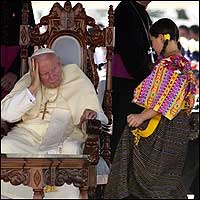
I have to say this for Pope John Paul II: the little bugger's a better visual comedian than Jim Carrey! Last year I came across a photo of him posing with a gaggle of schoolchildren. Completely inappropriate for the situation, the old guy was making a face like he'd just been poked in the eye while eating a communion host that had gone bad. The photo was so funny that I had to feature it in a series of collages I was doing for art school, even though it completely violated the series' theme...

At the time, I thought it was a one-time fluke, but recently I was proved wrong. Our Man JP's recent trip to the Americas provided a couple particularly wonderful images of ecclesiastical humor. In one image (here), JP is being escorted from the PopeJet by a young priest, but his body language and expression say "Let go of me ya damned cardinal! I'm outta here I tellya!" That was followed up by another photo (here), where an attractive adolescent girl in colorful garb is presenting herself to the pontiff. His beanie is knocked askew, and he's holding his head as if to say "Oy, and I took a vow of celibacy?"

But the point of this post isn't to make fun of the chosen representative of God on Earth. No, really! After all, anyone who can type "http://images.google.com" can do that!

But this was the topic of conversation between my friend Rhonda and I when we went down a particularly interesting line of inquiry. We got onto the subject of her "version" of Heaven differing from the standard interpretation, and she described to me a recent Robin Williams movie entitled "What Dreams May Come".

Now, before I get into it, let me tell you that the movie is bad. I'm about to describe its only redeeming feature, so there's no need for you to go out and see it. Fair warning.

Rhonda brought it up because the movie's basic premise is that the afterlife we'll experience is a reflection of our expectations of it. If you believe that the afterlife is what el papa says, then that's what you'll experience; if you believe the afterlife is going to be one big orgy, then for you it will be; if you think you'll be punished for your transgressions in this life, you surely will be; and if you don't believe in life after death... Well, the movie doesn't really address that question, but I'm sure you can imagine. The basic plot of the movie is that Robin Williams dies and finds himself in the world he and his wife had always dreamed about; his wife, a needy, self-absorbed neurotic, commits suicide shortly after, and resigns herself to an eternity in her own personal hell. The basic conflict is Robin Williams' quest to be reunited with his wife and show her there's another way.

The idea that everyone could be a god ruling a world created by their own imaginings was the basis of the first story I ever got paid for, "In Our Infinite Wisdom", published more than 20 years ago. The premise was a late-night wargaming session, where the players began theorizing that if there were an infinite number of worlds, there'd be a world just like Earth, only we'd all live in castles, that one could get to simply by thinking about it. Shazam! There it is. The characters wind up continuing this line of thought, essentially incrementally thinking their way into their own individually-tailored Heaven. To give away the ending, the twist comes as they all gradually realize that there'd also be an equivalent Hell that one would be transported to simply by thinking of it, and their brief but vain struggle to not think about it.

So all this talk got me thinking about my own idea of Heaven, and how it might look. Not what I believe is after death, because I think I made than abundantly clear in my 2/24/2002 LJ article "Philosophy for Dummies" (here), when I wrote "When we die, like any animal, we die. There is no essense or spirit which survives when our brain activity ceases", but what I would like: what world I'd design if I were given free reign to create a Heaven of my own devising.

Interestingly, despite having written a story that dealt with the topic, I really have never thought about what my Heaven would be like. I decided that'd be an interesting line of inquiry. At the same time, I'm also curious about the kinds of worlds other people would create. Would they just give the universal answers of "flying angels, no disease, no hunger, no conflict", and so forth? I think you could learn a lot about someone by the unique things they'd do to create their own world and how it'd be different from everyone else's. In "What Dreams May Come", Williams' world is full of saturated colors and things made from wet paint, since his hobby is painting. I think it'd be an interesting question to ask people over beers. I also think it'd make a cool assignment -- create a ten-minute videograph of your idea of the perfect afterlife -- although in some of our cases getting willing and appropriately-endowed actors and actresses might be a bit of an issue...

So let's consider this question. Let's get the base assumptions out of the way: we're all going to prohibit things like disease, pain, conflict, hatred, inequality, injustice, and fear, right? Let's not restate the painfully obvious here. But in what less straightforward ways would your world differ from Earth? Here are some of mine...

  • I would have the time to do everything I want to do
  • "Do what thou wilt, and it hurt none" would not just be the whole of the law, but would also actually be practical and meet everyone's needs
  • Travelling from place to place would be both free and instantaneous, allowing you to go anywhere anytime you wanted
  • There would be the ability to travel to different destinations in time; you could easily visit the 1970s or the 14th century or ancient Rome if you so desired
  • Seasons would be more discrete; summer would be more summerlike, autumn more autumnal, and you'd know when you passed from one to the next
  • Similarly, urban areas would be more urban, and rural areas more rural; the two would mix less
  • There would be no economy, in the sense of no currency and no need to work just to maintain one's standard of living
  • Creating things would be quicker and less error-prone; things like baking, programming, and art would be much less labor-intensive
  • Things would be less pre-fabricated, and everything would be more "designed"; all housing, in particular, would demonstrate more architectural and artistic appeal
  • There would be very, very few smells; most odors we know wouldn't exist, and there'd be a cap on the strength of all odors
  • There would be no children, noisy, smelly, hateful little things that they are
  • Everyone would appear to be the age at which I knew them, e.g. my high school friends would be circa 1982, my college friends circa 1986, my co-workers circa 1998, and so forth
  • No one would have any body hair, save normal hair on the top of their head
  • One would have the ability to experience life as a member of the opposite gender if desired
  • People would be free to express their affection to one another, without fear of any kind
  • Sex of widely diverse flavors would be much more common; inhibiting factors such as social acceptance, rape, STDs, performance issues, and unwanted pregnancies would be alleviated
  • People would be able to intuit and accept (and, of course, act on) one another's turn-ons
  • True non-consentuality would not exist

I don't think there's any real need for me to comment any further on these. The point isn't to justify them to you, but just to noodle around some vision of what life might be like in my perfect world. And I'd hardly advertise this as an immutable list, just some brainstorming.

Now, unlike my previous postings, I'm going to open this one up for public response. However, I want to emphasize that I'm not interested in your comments about my Heaven, or the thinking that got me to this point. What I'm interested in is your description of the Heaven that you would create. I'd appreciate it if you limited your comments to that topic.

It's one part imagination, and one part character; so show me what you got!

Frequent topics